@bots_and_bits@TuXinming I think this posts suggests they were in the training set 🤓 and the LLM now has a PLM (protein langauge model) essentially baked inside it.
Claude was trained on protein sequences, at scale.
We gave 20 language models the start of little-studied bacterial proteins and asked for the next amino acids. Only the latest Claude models predict them. Not GPT, not Gemini, not seven open-weight models.
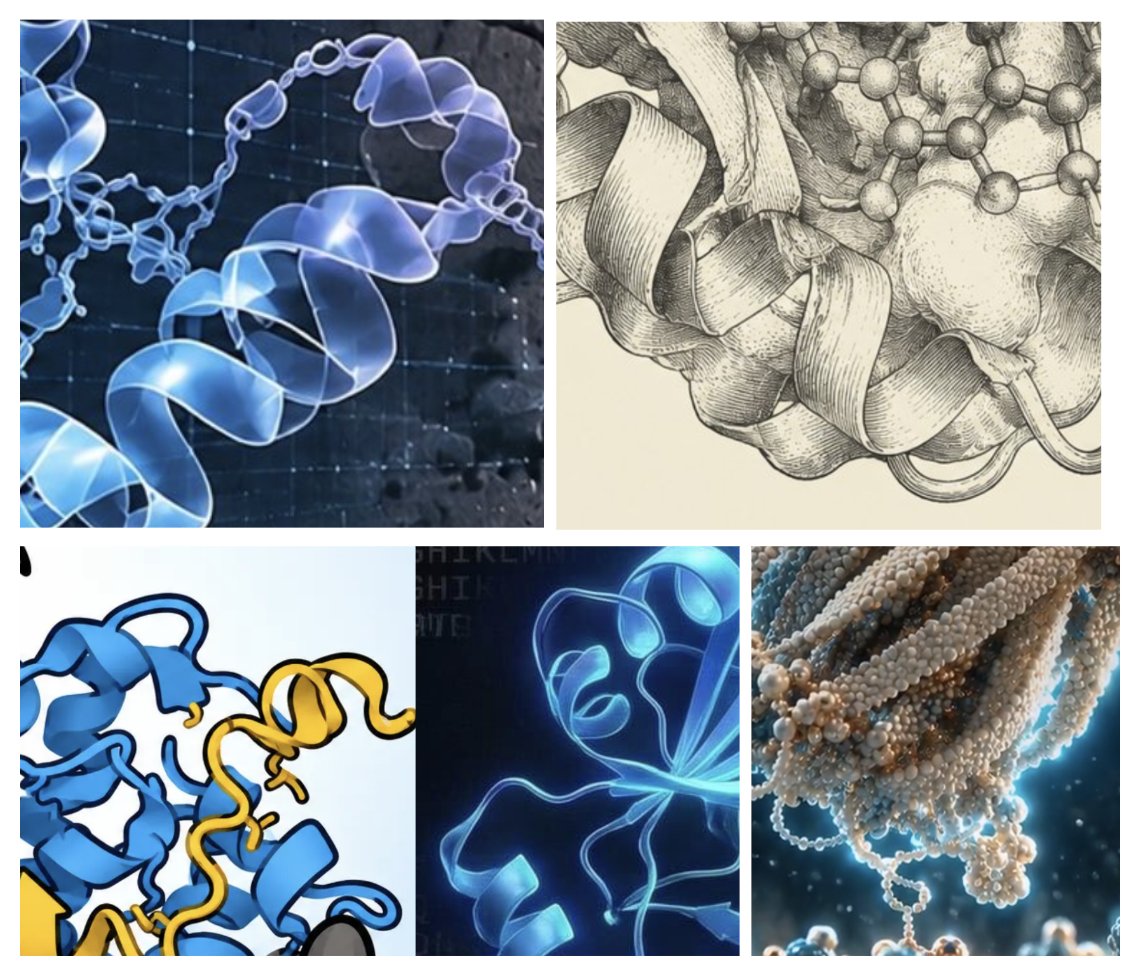
@bradyajohnston I think the problem is folks using AI to generate these images might actually not be able to tell the difference or that there is something seriously wrong with images. 🙃
@try_litefold "Since the advent of AlphaFold, homology search has been an integral part of structure prediction"
What do you mean? MSA has been an integral part of structure prediction since 1990s. 🤪
1/ 🧵 New preprint! Do protein foundation models really understand local chemistry?
We probed them with NMR chemical shifts, per-atom reporters of chemical environment.
Short answer: they struggle exactly where the biology gets interesting 👇
[link] https://t.co/2DhcjYGM99
@yablak@gklambauer The point I was trying to make: unlike coding, where you can validate faster than you write code. The bottleneck in science is not the ideas (we have millions of grants waiting 2 be funded), but the funding, developing the assay & actually lab experiments needed to test them.
@mosasaurus27@gklambauer If they are anything like humans they should fail at least 95% of the time, then just by chance stumble upon something significant. 🙃
@navvye@gklambauer As in for any task, be it math, be it code, be or biology it's likely to give you error filled output. But once you link it up to a system where it can validate its output, it can iterate and correct itself.
@gklambauer If we want to "solve biology" we need to either figure out a way to simulate life at subatomic level (via quantum computers?) and give AI access to the simulator. Or start building massive scale wet lab centers... That AI can have access to for each given prompt.
@gklambauer Same can be said about math, AI did not solve math, it's still terrible at it, what made it possible is many agents running in parallel with access to lean, where it can iterate until it gets the math right.
Mol-1-constraint is now available to every researcher ^^
88.3% success on Foldbench-AB. Code and weights released: https://t.co/BSvQlV8C4g
Clone it. Build on it. Make it part of your research. Or try it directly at https://t.co/FKhdWUmjXV.
Research should benefit everyone. We’re putting that belief into practice.
1/X Introducing Pallatom2, our new atom-to-atom co-design model. Atom14 unifies backbone, side chains and L/D residues; AtomPairFormer encodes 3D geometry and bonds; residue-guided sparse attention connects global structure to local atomic detail.🫡🥳