Today, we are incredibly excited to present LiteMol-1, our very first foundation model from LiteFold.
Structure-based models like BoltzGen, O-Design, and RFdiffusion have become the de facto standard for designing biomolecules. However, they are expensive to run at scale. In many campaigns, we have to generate tens of thousands of designs and rigorously filter them down to a handful of top candidates.
More importantly, most molecule design systems are primarily optimized around binding. But what about everything else that makes a molecule a useful therapeutic: ADME, toxicity, drug-likeness, membrane permeability, synthesizability, selectivity, and more?
That’s where we introduce LiteMol-1, our first Multi-Molecule Foundation Diffusion Language Model, pre-trained from scratch. With a single set of weights, LiteMol-1 can conditionally generate small molecules, peptides, cyclic peptides, depsipeptides, peptides with ncAAs, macrocycles, and PROTACs.
You can generate molecules unconditionally or condition generation on a protein target sequence. You can in-paint molecules, preserve parts of an existing scaffold, generate non-canonical peptides, cyclize designs, and continuously edit and regenerate them.
We also introduce a Monte Carlo Tree Search framework for multi-objective molecular design. Instead of trying to make one molecule perfect at everything, the search keeps a set of promising molecules, each with different trade-offs across properties. This matters because molecular design is fundamentally not a single-objective optimization problem.
Finally, and probably the part we are most excited about: this is a model for Agents. LLMs are not particularly efficient interfaces for repeatedly reasoning over thousands of large PDB/CIF files inside an AutoResearch loop. Sequence space is different. SMILES and molecular sequences are compact, editable, and much easier for an agent to inspect, compare, modify, and reason over.
So we treat LiteMol-1 as an infinite molecular canvas.
The model generates possibilities. The agent takes inspiration from them, evaluates them, edits them, optimizes them, and generates again. The AutoResearch loop continues until it finds candidates that satisfy the given design objectives; while bringing in expensive structure prediction, docking, or simulation only when they are actually needed.
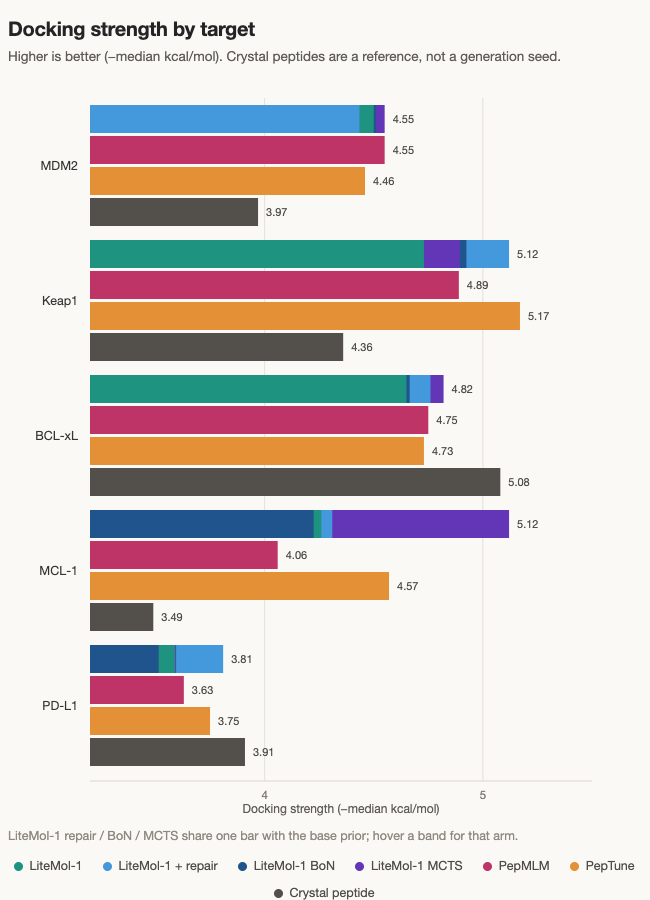
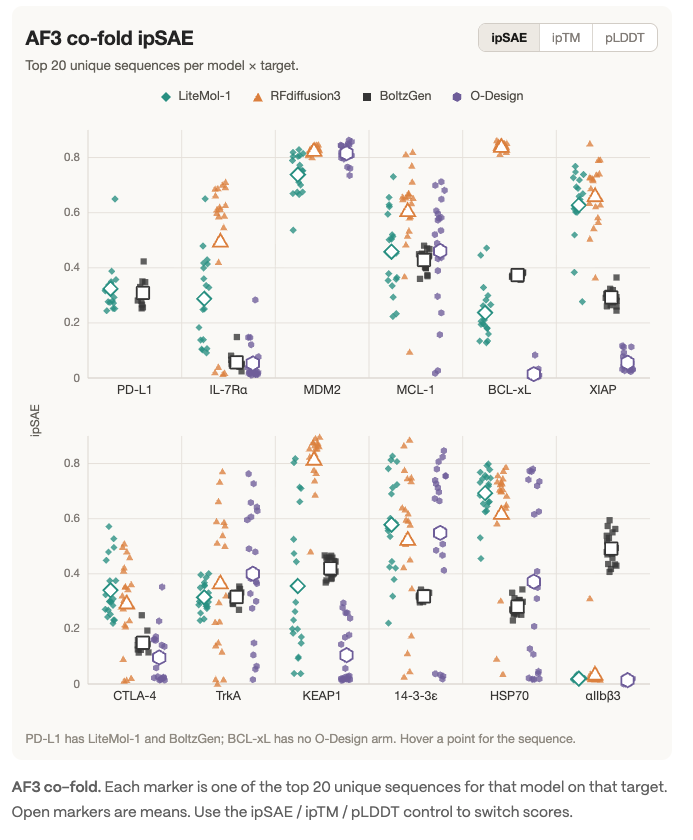
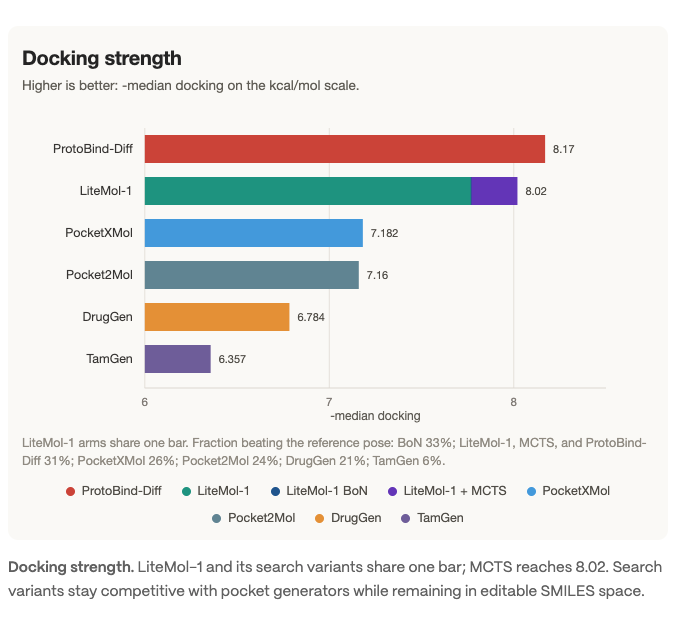
Our evaluations across peptide and small-molecule generation show that LiteMol-1 is competitive with, and in several settings on-par with or better than, frontier structure-based and sequence-based models, while operating at a fraction of the generation cost and time.
And this is only the first step. Check out our technical research blog post in the comments to learn more about LiteMol-1.
As said before, if we are going to do agentic science, lets do it in a right, controlled way, just like how controlled reproducible experiments looks like.
All u gotta do is just connect ur lab.
Ahem ahem. Topic: Own and Customize everything
294 Connectors across target science, mol engineering, developmental biology. DBs, tools, atlases, just ask for it. You can add custom ones.
200+ skills along the same lines. Add custom skills.
Give permissions to all the platform workflows.
Add custom instructions, give permissions what your agents can and can not use and when to ping you. Even create your own subagents.
Compute: Select the compute capacity you need when agentic coding requires gpus.
We have found ways where we have ontologically organized every connector and skill, use jev-like decision models, and cut the token cost by half, and actually getting better accuracy in using the right things in the right time.
As said before, if we are going to do agentic science, lets do it in a right, controlled way, just like how controlled reproducible experiments looks like.
Ahem ahem. Topic: Own and Customize everything
294 Connectors across target science, mol engineering, developmental biology. DBs, tools, atlases, just ask for it. You can add custom ones.
200+ skills along the same lines. Add custom skills.
Give permissions to all the platform workflows.
Add custom instructions, give permissions what your agents can and can not use and when to ping you. Even create your own subagents.
Compute: Select the compute capacity you need when agentic coding requires gpus.
We have found ways where we have ontologically organized every connector and skill, use jev-like decision models, and cut the token cost by half, and actually getting better accuracy in using the right things in the right time.
As said before, if we are going to do agentic science, lets do it in a right, controlled way, just like how controlled reproducible experiments looks like.
Understand biology -> find targets -> design molecule -> predict properties -> do wet lab -> tune your params across systems -> iterate
RSI incoming. Just climb the local hill.
Understand biology -> find targets -> design molecule -> predict properties -> do wet lab -> tune your params across systems -> iterate
RSI incoming. Just climb the local hill.
Protein design campaigns could be sometimes so expensive. And we realized, we should not give full autonomy to agents to design everything. After all, human in the loop should not the term, but we should find ways to practice it
A new type of modality agnostic design workflow, fusing structure based diffusion methods (RF / BoltzGen / O-Design / Complexa etc) and Hallucination Based method (BindCraft + SwitchCraft) and LiteMol-1 to engineer: mini-proteins, peptides, small-molecule, antibody, dna/rna etc. Soon!
Been testing an internal version of bindcraft on @try_litefold ensembled with RF-3 and so far it's not bad! Btw I can just see the results and loss going down real time (for bc-1)
A new type of modality agnostic design workflow, fusing structure based diffusion methods (RF / BoltzGen / O-Design / Complexa etc) and Hallucination Based method (BindCraft + SwitchCraft) and LiteMol-1 to engineer: mini-proteins, peptides, small-molecule, antibody, dna/rna etc. Soon!
Been testing an internal version of bindcraft on @try_litefold ensembled with RF-3 and so far it's not bad! Btw I can just see the results and loss going down real time (for bc-1)
What does computational protein design look like?
We did a PD-L1 design run using rosalind in LiteFold. We tried to design linear and cyclic peptide candidates to see if we can explore any denovo binders. We used BoltzGen and within a few hours we shortlisted five candidates, with predicted confidence scores ranging from 0.70 to 0.87 and ipTM score from 0.80-0.95
A typical run would usually take days to get good enough binders, but with LiteFold you can do it within hours, including the research like hotspots, pocket scanning etc.,
These are strictly computational binders and not wet lab validated .
Explore protein design with LiteFold.
All the coding models are great, but do you know what these cli based tools or a simple chat interface lack?
It's just not only interface, but the ability to take control properly.
Imagine, you are managing so many cli sessions containing different subagents. How are you expecting to maintain a reproducible set of artifacts with such tools?
Thats exactly where Lite helps you.
> You can see the subagents running in the top.
> You can switch to see what they are doing.
> You can control the model you want to use.
> You can edit the files agents created and vice versa.
> You can disable or enable access to certain tools / skills.
> Create your own skills
> Even create your own subagents, just with few clicks.
If we are doing Science using AI, it should be a controlled experiments, like we used to do before, but now AI native.