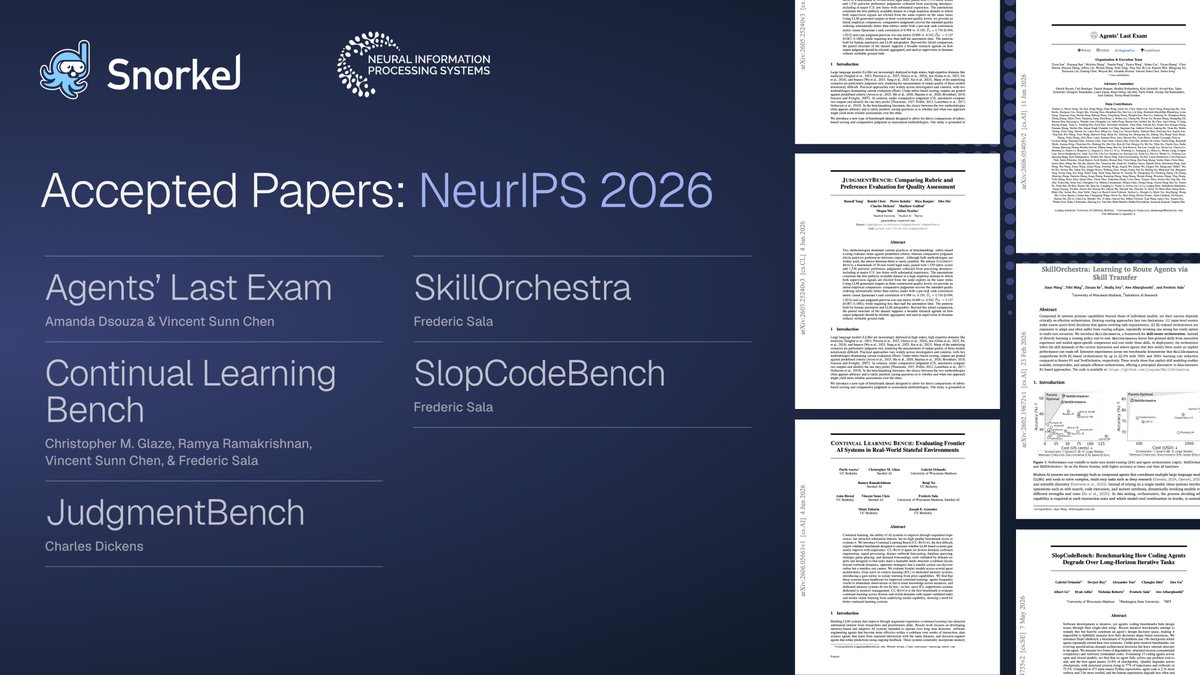
Our research team has five papers accepted to @NeurIPSConf 2026:
- Agents' Last Exam: long-horizon professional tasks, <1% average pass rate on the hardest tier (https://t.co/atOtJQkYJy)
- Continual Learning Bench: do agents improve with experience? (https://t.co/JhHV7kiXye)
- JudgmentBench: expert attorney preference judgments for ranking legal AI output (https://t.co/wrp51QmeNf)
- SkillOrchestra: routing tasks by agent competence and cost (https://t.co/DBL7kTHgFd)
- SlopCodeBench: agent-written code gets more bloated and eroded with every iteration (https://t.co/9P33IIBkT6)
Congrats to @amanda_dsouza, @vincentsunnchen, @chris_m_glaze, @RamyaRamakri, @fredsala, Charles Dickens, and to all our collaborators!
Data 1.0 was about volume. Data 2.0 is about quality and complexity.
@ajratner talks with Eric Choi, CEO of Palo Alto Capital, about why AI data is shifting from simple, high-volume tasks to complex expert work, and how humans and AI build it together.
Watch the conversation: https://t.co/loIqUJzTem
Agents’ Last Exam tests agents on long-horizon, economically valuable work across 50+ sectors. @dawnsongtweets (@UCBerkeley) explained why her lab built it and where the next version is headed at Frontier Data Summit.
Accepted to NeurIPS 2026 and supported by our Open Benchmarks Grants.
https://t.co/yNqDikGHMr
Up next: a virtual Reading Group on steering “AI Scientists” toward valid, trustworthy research, with @harit_v of the @UniofOxford. RSVP: https://t.co/KWth6SMCa2
Earlier this week, @Jiacheng_Miao of @StanfordHAI joined our Reading Group to discuss Paper2Agent, an approach for turning research papers into interactive AI agents, now published in Nature.
On 300 benchmark questions, Paper2Agent scored 91.2% vs. 80.3% for Claude Code with the repo.
ICYMI recording/transcript: https://t.co/RctLOmjUc8
We're closing with a happy hour sponsored by @SnorkelAI and @NorwestVP. We may have a few spots for non-attendees, and you can apply here: https://t.co/Nqsb5Hdnqz
New from our research team: Qwen3.8-27B, trained on 1,105 expert-built GDPval+ tasks, goes from 31.9% to 40.7% pass@1 on OpenAI’s GDPval gold set.
Standard GRPO barely moved. Binary-gated GRPO learns from failed attempts.
Write-up by @mefatemi: https://t.co/puLEbT7SEd
📈 We trained Qwen3.8-27B on 1,105 @SnorkelAI expert-built GDPval+ tasks.
Pass@1 on OpenAI’s GDPval gold set rose from 31.9% to 40.7%. Standard GRPO on the same data barely moved.
The difference was learning from failure. 🧵 (1/N)
Blog: https://t.co/OkTH0jqdzU
📢 Join us for the 2nd Workshop on Agentic AI Benchmarks and Applications for Enterprise Tasks (AABA4ET) at NeurIPS 2026!
Co-organized by Carnegie Mellon University (@CarnegieMellon ), Fujitsu, Keio University (@Keio_univ_PR), and Cohere (@cohere), the workshop brings together research and industry perspectives on benchmarking, evaluating, and deploying robust, efficient, and trustworthy AI agents for complex enterprise operations.
🙏 We are grateful to Snorkel AI (@SnorkelAI ) for their generous support as a Sponsor of this workshop.
The program will feature:
・ Invited talks by prestigious AI professors and experts
・A panel discussion on industry and research perspectives on agentic AI for enterprise
・Workshop accepted paper presentations
📅 December 11, 2026
📍 Sydney, Australia
🔗 Register now: https://t.co/6UUekqRMpi
🔗 WS official site: https://t.co/MRm9S99EQo
#AgenticAI #NeurIPS2026 #NeurIPS2026Workshop #AABA4ET @NeurIPS
Really interesting paper on simulated users in AI agent training envs and how they can be exploited, along with two solutions: https://t.co/yfdiKBESrY
Snorkel's solution in our training envs is to include different "variants" of user personas for the same tasks, similar to their sampling method.
If you have ever wondered - "I feel like something is wrong with this rubric- but I can't quite put my finger on it"
Then come watch this deep dive w/ @jonathanschloss, about how to understand rubric failures, better based on years of education and meaurement theory. We will also cover how to concretely name these failures.
Will be moderating this event with @ankitaich30 and @SnorkelAI! It will be a great conversation on checking the checks when it comes to grading and training AI.
This is a timely topic, especially with all of the benchmarking the benchmarks talk.
If you're in this space, tune in and check it out!
Luma event here: https://t.co/n7aU823S4v
Introducing Data Deep Dive, our new virtual series with Snorkel researchers: a talk, then open Q&A.
First up: @ankitaich30 presents RIFT, a way to check the rubrics that grade and train AI. Rubrics score outputs and supply reward signals in training but they rarely get checked themselves. RIFT is a framework that works to evaluate these rubrics.
Dec 15, 12pm PT / 3pm ET. Request to join: https://t.co/0Tlkxk7P8z
Next up at the Snorkel AI Reading Group (+🍕): Paper2Agent, a framework that turns a research paper and its codebase into an interactive AI agent presented by @Jiacheng_Miao of @StanfordHAI. RSVP: https://t.co/s6BR98bXrD
Wed, Nov 18 | Doors 4:30 PM PT; talk 5 PM | San Francisco
Introducing Singularity-Bench 🕳️
🔄 We measure whether agents can autonomously conduct the full agent development lifecycle: six long-horizon, end-to-end tasks spanning pre-, mid-, and post-training, inference engines, cluster management, and harness development on production GB300 clusters!
We emphasize rigorous verification to guarantee correctness and execution integrity 👮♂️
🙌 Big shoutout to all authors contributing from academia and industry: @IronSteveZhou, @wonderingkrish, @chenzhuoming911, Zerui Wang, @KyriectionZhang, Wenshuang Li, Xinpeng Wei, Zhichen Zeng, @Jingyu227, @JueWANG26088228, @Wu_Sen, Ziheng Jiang, @zhendongucb, @hancai_hm, @Hades317, @ying11231, @ce_zhang, @uiuc_aisecure, and @BeidiChen!
How far are current agents from building their successors end to end? 🤔 We're here to find out!
🧵1/n
🌐 Website: https://t.co/R4B8zo0E3c
The conversations shaping what’s next in AI are coming to Innovation Basecamp. 🎤
Hear from @HayaOdeh of @Replit, Amit Kumar of @Accel, @ajratner of @SnorkelAI , and Karen Chen of @nvidia on building, funding, and scaling AI companies.
Follow along next week for highlights from the Frontier Innovation Summit. 🚀
#MicrosoftForStartups #MicrosoftIgnite
what are the second-order effects of increasingly agent-written code?
- what happens with code quality as specs evolve? (cleaner line-level diffs, but overall complexity still accrues)
- do agents use the libraries they have, or rewrite them? (mostly still rewrite!)
- can the next agent build on a library the last one designed? (not as well as humans!)
work led by @GOrlanski - excited to see more here!
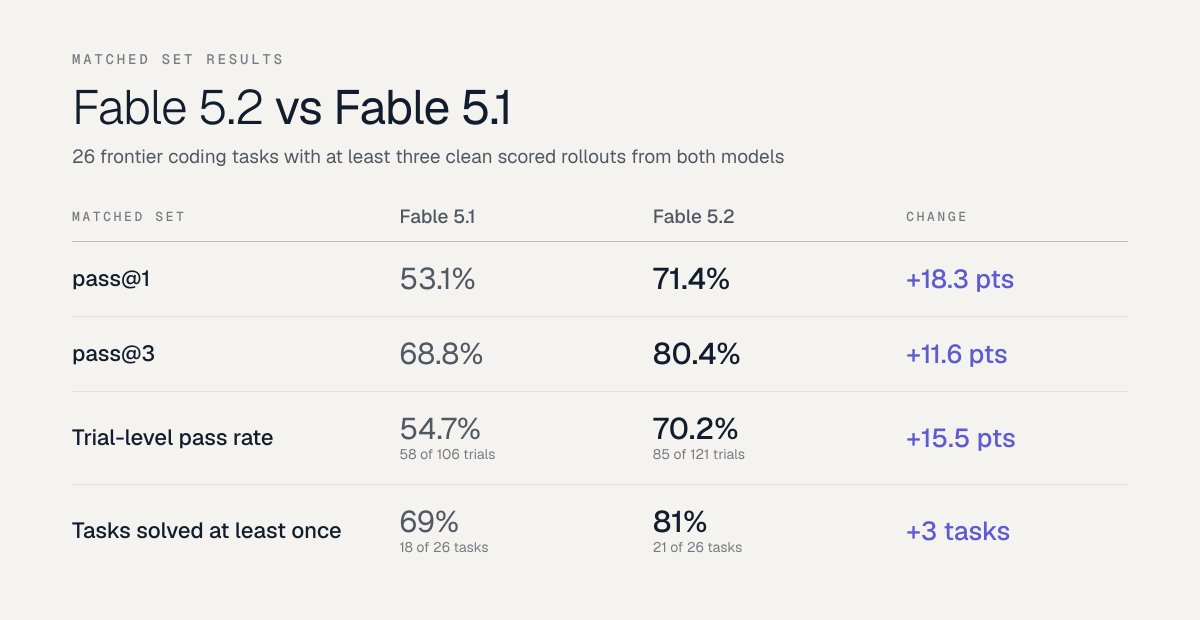
We ran Claude Fable 5.2 through the same frontier terminal tasks we used to evaluate Fable 5.1. On a matched set of 26 tasks with clean runs from both models:
pass@1: 53% → 71%
pass@3: 69% → 80%
Tasks passed on every attempt: 6 → 15
The bigger story is how the failures changed. Fable 5.1 mostly failed mechanically. 42% of its failing runs died mid-trajectory, often with a near-correct solution already written. In the Fable 5.2 run that failure class was practically gone.
What remains are challenges in planning and strategy. Choosing the wrong plan drove 35% of Fable 5.2’s failures, faulty inference 28%, and misreading the task 23%.
There were also some regressions. Two tasks that 5.1 passed reliably now seemed to fail on every attempt. This occurred because the model focused on a wrong reading of the task and then verified its work against that same reading, leading the model to think it did the task correctly although it was not the correct solution.
You can see the full analysis here: https://t.co/qAXTpwbWfI
@SnorkelAI@ankitaich30