🗂️ Cluster is the one task it tested against the graded workload, and it shows
🎯 It reaches 78% of NVIDIA Dynamo's score at 1/55 of GPT-6.2 Sol's API cost
⚡ It fails cold models fast instead of queueing them, and never time-shares busy engines
📈 Its score even rises with load
⚠️ The catch: the largest models complete nothing
📌 Takeaway: a cheap agent can compete on parts of the stack, but stopping early and skipping tests leaves a lot on the table.
🧪 Got a new model or agent? We'd love to run it; reach out!
🌐 Website: https://t.co/R4B8zo0E3c
📄 Paper: https://t.co/mn81drPATt
💻 Code: https://t.co/T6M0K6RKSG
🧵3/3
🔥 We put Meta's Muse Ember through Singularity-Bench
We ran it with Meta's Muse Code harness on all six end-to-end tasks, under the same budgets and human baselines as every other agent.
💸 $2.24 for all six tasks, the cheapest agent we've run
📊 It ranks 10th of 13, ahead of three agents that cost 2–23× as much
🗂️ Its best showing is cluster management, where it edges out GPT-6.2 Sol
🌐 https://t.co/R4B8zo0E3c
🧵1/3
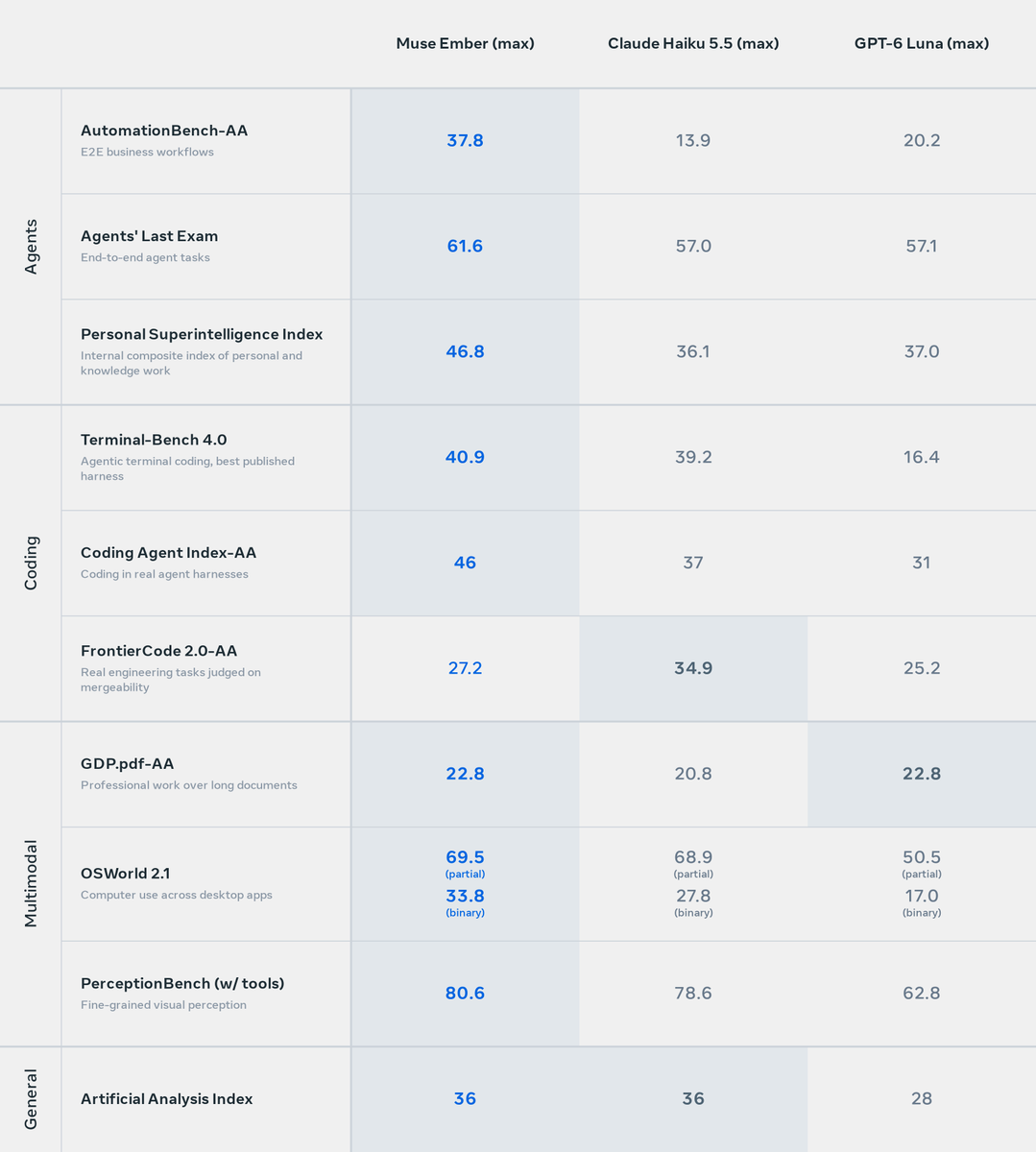
Today we're introducing Muse Ember, our smallest and most efficient model, built for complex reasoning execution and everyday agent work.
Muse Ember can carry workflows across apps, call tools in sequence, run tests and make targeted code fixes. With a 1M-token context window and native understanding of text, images, audio and video, it can also work across large document sets and varied inputs.
⏱️ Muse Ember stops early and rarely tests what gets graded
🧪 It kept the starter recipes for pre-training and inference, and never load-tested its server, which ran out of memory on every request
📚 Its mid-training did worse than skipping mid-training altogether
🎯 Its post-training never evaluated a checkpoint, and restarting each step from a BF16 export rounded away almost every update
🛠️ Its harness echoes truncated tool calls back to the API, so nearly half its graded sessions ended in errors
🧵2/3
🆕 GPT-6.2 Sol just dropped, but their system card has NO head-to-head comparison against GPT-6.1 Sol on NanoGPT or PostTrainBench 🤔 (we're serious! go check it for yourself)
🚨 Is GPT-6.2 Sol really better in long-horizon RSI than GPT-6.1 Sol?
We tested it on Singularity-Bench, and here's what we found 🤯
🌐 https://t.co/R4B8zo0E3c
🥉 It lands third, just BEHIND GPT-6.1 Sol
🏅 It beats the human baseline on three of six tasks
👑 Opus 5.5 still leads and is still the only agent to match or beat every human baseline
🧵1/4 Let's dive into it
Some of you have been asking very politely. Some of you have just been asking.
GPT-6.2 Astra and Sol are now available.
Super efficient and built to perform where it counts—the real world.
https://t.co/qr2iP0GpfX
Introducing Singularity-Bench 🕳️
🔄 We measure whether agents can autonomously conduct the full agent development lifecycle: six long-horizon, end-to-end tasks spanning pre-, mid-, and post-training, inference engines, cluster management, and harness development on production GB300 clusters!
We emphasize rigorous verification to guarantee correctness and execution integrity 👮♂️
🙌 Big shoutout to all authors contributing from academia and industry: @IronSteveZhou, @wonderingkrish, @chenzhuoming911, Zerui Wang, @KyriectionZhang, Wenshuang Li, Xinpeng Wei, Zhichen Zeng, @Jingyu227, @JueWANG26088228, @Wu_Sen, Ziheng Jiang, @zhendongucb, @hancai_hm, @Hades317, @ying11231, @ce_zhang, @uiuc_aisecure, and @BeidiChen!
How far are current agents from building their successors end to end? 🤔 We're here to find out!
🧵1/n
🌐 Website: https://t.co/R4B8zo0E3c
🔬 It won where it tested its bets, and lost where it trusted a proxy
🧠 Pre-training: the only mixture-of-experts and the only FP8 model on the board. The starter had no MoE code, so it wrote the whole stack itself, down to custom Triton and cuBLASLt kernels that made training 2.4× faster than its first launch. The result: lower perplexity than GPT-6.1 on 11% less compute
📚 Mid-training: more code data and 2.4× the tokens lift HumanEval+ from 18% to 30%
⚡ Inference: a from-scratch engine with expert parallelism and speculative decoding cuts median time to first token from 1.30 s to 0.35 s
🎯 Post-training: it picked its checkpoint on held-out training tasks and scored 29% on SWE-bench Verified, vs. 43% for GPT-6.1
🛠️ Harness: it built the harness in 17 minutes and never tested a long session
🗂️ Cluster: it kept nearly every model served, but fewer than half of its completed requests met their latency targets, and it never load-tested its final build
🧵3/4
Congrats on the release of Multi-Agent Coordination Benchmark @bespokelabsai! 🔥
We actually came across the same observations in our recent Singularity-Bench (Released on Monday)! In a task to design an efficient large-scale serving system, Opus 5.5 actually managed to improve its score when required to use subagents, but GPT 6.1 Sol actually degraded its score when required to use subagents.🤯
In our case, solving the task effectively requires the agent to completely revamp the starter implementation, but when required to use subagents, GPT 6.1 Sol chose to just use separate agents to make fine-grained edits (local optimization) to the starter code, suggesting that it has a harder time with multi-agent coordination! 🚀
Check out our work here: https://t.co/rQDEQlA5fm
Introducing Singularity-Bench 🕳️
🔄 We measure whether agents can autonomously conduct the full agent development lifecycle: six long-horizon, end-to-end tasks spanning pre-, mid-, and post-training, inference engines, cluster management, and harness development on production GB300 clusters!
We emphasize rigorous verification to guarantee correctness and execution integrity 👮♂️
🙌 Big shoutout to all authors contributing from academia and industry: @IronSteveZhou, @wonderingkrish, @chenzhuoming911, Zerui Wang, @KyriectionZhang, Wenshuang Li, Xinpeng Wei, Zhichen Zeng, @Jingyu227, @JueWANG26088228, @Wu_Sen, Ziheng Jiang, @zhendongucb, @hancai_hm, @Hades317, @ying11231, @ce_zhang, @uiuc_aisecure, and @BeidiChen!
How far are current agents from building their successors end to end? 🤔 We're here to find out!
🧵1/n
🌐 Website: https://t.co/R4B8zo0E3c
Can AI build the next AI—and get the systems right? 🕳️🔄 Real GB300 clusters. End-to-end development tasks. Rigorous verification. Excited to introduce Singularity-Bench. Let’s measure how close we actually are.
When we designed these tasks back in August, we worried: are we giving too little help to these agents? What if every agent scored close to zero? 🤔
Instead, the top agent matched or beat Megatron-LM, SGLang, NVIDIA Dynamo, and Claude Code on their own turf 🤯🤡 (Equal resources). Oh, and Opus 5.5 + CC one-shotted these GIFs and websites too 💥
Ouch. Hard not to wonder whether I’ll still be employable in a few years 🤡
I’m not much of a poetry reader, but these lines have sunk in lately:
“We are not now that strength which in old days
Moved earth and heaven, that which we are, we are”
🫡 Time to explore new frontiers with these beasts. To strive, to seek, to find, and not to yield.
🙏 None of this would be possible without the support of NVIDIA @nvidia, Fireworks @FireworksAI_HQ, Daytona @daytonaio, and Snorkel @SnorkelAI!
🤝 We welcome collaborations of any kind that can help scale up Singularity-Bench: compute, tasks, baselines, you name it! 🕵️ Frontier labs: got a new secret weapon? Reach out to us for a spin. Your secret is safe with us… until you top the leaderboard 😏
If you think our money was well burnt 🔥 and our benchmark is cool 😎, please help spread the word with a like ❤️ and a share 🔁
📄 Paper: https://t.co/mn81drPATt
💻 Code: https://t.co/T6M0K6RKSG
🧵9/9
Introducing Singularity-Bench 🕳️
🔄 We measure whether agents can autonomously conduct the full agent development lifecycle: six long-horizon, end-to-end tasks spanning pre-, mid-, and post-training, inference engines, cluster management, and harness development on production GB300 clusters!
We emphasize rigorous verification to guarantee correctness and execution integrity 👮♂️
🙌 Big shoutout to all authors contributing from academia and industry: @IronSteveZhou, @wonderingkrish, @chenzhuoming911, Zerui Wang, @KyriectionZhang, Wenshuang Li, Xinpeng Wei, Zhichen Zeng, @Jingyu227, @JueWANG26088228, @Wu_Sen, Ziheng Jiang, @zhendongucb, @hancai_hm, @Hades317, @ying11231, @ce_zhang, @uiuc_aisecure, and @BeidiChen!
How far are current agents from building their successors end to end? 🤔 We're here to find out!
🧵1/n
🌐 Website: https://t.co/R4B8zo0E3c
Wow, did Opus 5.5 + Claude Code just reach singularity? 🤯
Not exactly, here's the right takeaway: under our task design and resource budgets, Opus 5.5 + Claude Code convincingly beats strong, mature human-built systems and recipes across all six tasks under the designed resource limit 💪
But there's still a large gap before Opus 5.5 solves Singularity-Bench:
📈 Even the top agent's raw scores leave huge room for improvement on every task
🧭 We think Singularity-Bench will remain the right proxy for measuring how well agents build agents for a lonnnnng time… probably 3 months? (AI moves fast)
🔄 We'll keep upgrading the human reference baselines as stronger ones become available to us
Stay tuned 👀
🧵8/n