Co-Founder & CEO @SkildAI, Faculty @CarnegieMellon.
PhD @UCBerkeley; BTech @IITKanpur
I study topics in AI (robotics, machine learning & computer vision).
Steph believed in @SkildAI from day one. One of the things I value most about working with her is how well she understands the details and how often she brings a perspective we haven’t considered. As a founder, having someone who cares enough to challenge your thinking and help you see your blind spots means a lot. We’ve been lucky to have her in our corner.
Excited to see you build your own firm, @stephzhan! Here’s to many more years of partnership. Godspeed.
I’m starting a new early-stage AI fund, doing what I love: partnering with founders from company formation on bold bets, long before consensus.
The fund’s LPs will include Sequoia, Jeff Dean, Sachin Katti, Philip Wong (my Stanford professor and Chief Scientist adviser to TSMC), and others whose work has shaped our industry and how I think about AI’s future.
I’ll remain a partner at Sequoia and keep serving on my boards on Sequoia’s behalf.
Sequoia has been my home for the past 11 years. I joined as the youngest investor the firm had ever hired. I grew up here. Through years of intense debate and shared work, I found lifelong mentors and friends who took me under their wing and taught me this craft. They taught me to aim high and take big swings. I’ll carry that into what I build: outsized ambition, relentless truth-seeking and curiosity, and a refusal to become complacent.
Working alongside founders has made me want to build something of my own: a firm shaped from day one around the convictions I’ve developed over the past decade.
Life has taught me not to take time for granted. This is how I want to spend mine.
Why now
We’re seeing a new way of building companies in today’s AI era. Research and products often advance together. A breakthrough can open a market or accelerate a business far faster than expected. Some companies require extraordinary capital and compute early on. Others reach meaningful scale with remarkably small teams. The rules for how big these businesses can get, and how fast, are being rewritten.
But early on, the technology is unproven, the resources required enormous, and the vision seemingly implausible.
This is what I love most: seeing the potential right from the beginning, and helping founders realize their full scale of ambition.
More than ever, it starts with an extreme willingness to believe early, with bold, independent conviction in a founder’s technical insight before any product or market validation. Then, it means helping founders take the biggest swings, giving the rare, long-term patience to see those bets through uncertainty, ambiguity, and turbulence, and serving as a level head when the stakes are highest.
I learned this kind of partnership at Sequoia. It’s the foundation of the firm I’m building.
Believing before consensus
My fascination with AI’s potential took root at Stanford in the early-to-mid 2010s, studying computer science and working in Andrew Ng’s lab. The friendships I formed connected me to a community whose people and ideas would help shape modern AI and build some of our generation’s defining companies. What stayed with me was the gap between what those people saw was possible and what the wider world could imagine.
I’m drawn to founders pursuing ambitions that sound impossible today.
I start with a simple question: “What if everything goes right?”
Then we work backward together to make it happen.
In 2023, Deepak and Abhinav set out to build a general-purpose robot brain at @SkildAI, before physical AI was a consensus bet. Their sim-to-real breakthroughs gave me conviction where earlier robotics approaches had fallen short. But the data flywheel required deployment at scale. We made commercialization as urgent as research and brought in strategic partners like NVIDIA and SoftBank to support the ambition. Three years in, Skild is advancing the frontier of physical AI with nine figures in annualized revenue.
In 2024, Ioannis and Misha founded @reflection_ai with an insight into scaling reinforcement learning. As that grew into the ambition to build a Western frontier lab for open models, the hard question was how a startup competes with labs spending tens of billions. An introduction to NVIDIA and many compute calls and recruiting events later, the team has built Beam, now one of the leading US open models.
In 2025, Anna and Azalia, the co-creators of AlphaChip, founded @RicursiveAI to design models and hardware together. From day one, we made early customers and ecosystem partners a priority. Today, they are showing order-of-magnitude improvements on real workloads, working with some of the industry’s most consequential players, and reaching a defining inflection point.
The ambition keeps growing as these companies scale.
@linear has always had a kind of magic to it. Now it’s the system a new generation of AI companies builds on, for teams and agents alike.
@tavus saw early that we’d one day talk to AI the way we talk to each other. Today, it’s building the human computing interface for a world of AI colleagues.
@Mach_Industries began as hydrogen experiments in an MIT dorm room. It has since become one of the most exciting next-generation defense companies.
Making the ambition possible
Being a first believer is only the beginning. Compute falls through. A deep-pocketed incumbent makes your mission its top priority. A breakthrough changes the opportunity and the capital required overnight.
These are stomach-churning moments, and early belief carries a responsibility to help make the bet work.
This is the partnership I love: turning the full ambition into concrete steps. Raising capital, securing compute and strategic partners, recruiting exceptional people, and winning the first customers together. Thinking several moves ahead while solving what’s in front of us. And as breakthroughs open new possibilities, helping founders dream even bigger.
Thank you
To the founders I’ve worked with: thank you for trusting me and Sequoia to be your first partner and first believer. It’s been the joy of a lifetime, and I can’t wait to keep building together.
Thank you to Alfred and Pat for your leadership of Sequoia and your support of my next chapter. To Roelof, for bringing me into Sequoia and believing in me from the beginning. Alfred and Roelof, you have been mentors in investing and in life. So much of what I know, and the investor I’ve become, comes from your guidance and generosity over the years. To Bill, for the close partnership and wealth of knowledge, always wrapped in humility. To Shaun, for showing me how to think deeply and imaginatively. To Michael Moritz, for inspiring 22-year-old me to dream big. To Doug, for teaching me to keep things simple. To Bogie and Jess, for bringing joy to the everyday and perspective on what matters. And to all my Sequoia teammates, for the friendship, camaraderie, and lessons I’ll carry with me.
To my family, especially my husband and my brother, who have each started companies of their own: thank you for giving me the courage to take this leap.
Let’s get to work!
If you're signed up for Encord's Long Horizon Physical AI Summit, I'll see you this morning (the 20th) at Fort Mason!
Thanks to Encord for putting this event together -- Many great speakers today and tomorrow (the 21st) as well:
https://t.co/yypPpoTrqr
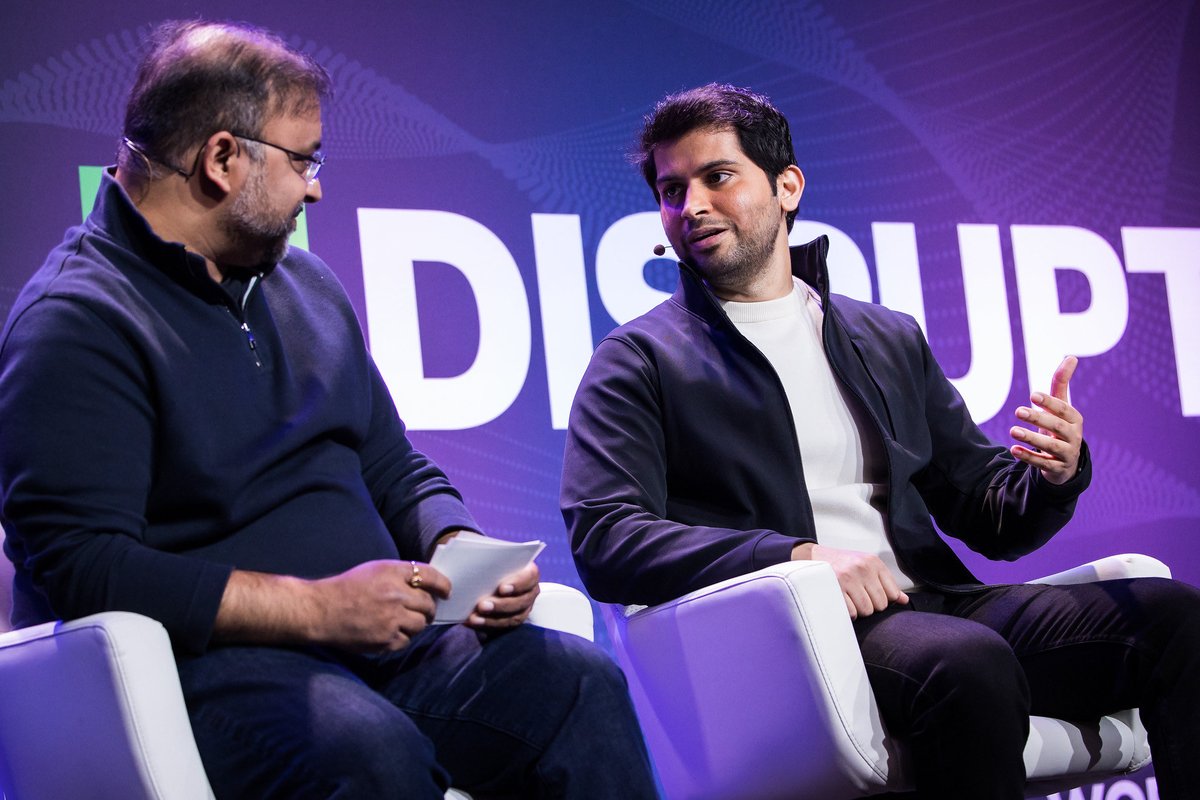
Enjoyed hosting @deepakpathak , Co-founder & CEO of our portfolio company @SkildAI, at @TechCrunch Disrupt yesterday.
One of my favorite moments was Deepak reflecting on what he’s had to unlearn as a founder. He once believed you could build a general-purpose robotics platform and leave deployment to others. The reality is far messier. Deployment is an integral part of the research loop, not something you can outsource while the technology is still maturing.
Equally telling was his observation that customers care most about how quickly a robot can be deployed and deliver value. That makes in-context learning a critical piece of scaling general-purpose robotics.
Skild recently crossed $100M in ARR, and they’re just getting started.
#PhysicalAI #Robotics
Thanks, @Nasdaq, for celebrating @SkildAI's revenue milestone.
Skild robots handle logistics, assemble GPUs, package food, and much more. Demos and free POCs are easy; getting someone to pay for it is hard!
Most AI for media solutions focus on the application layer, @trydrama_io is trained from scratch to solve for tiniest details from ground up.
With their second model release, NeuralGarage has become one of the frontier AI companies out of India.
Great results -- congrats, Subho and Mandar!
Introducing our new AI model @trydrama_io to kill reshoots and make acting editable!
Control what part of a performance to preserve and what part to change using a simple intensity slider.
We just nailed 3 industries(thread):
Deepak Pathak @deepakpathak (Co-founder & CEO, Skild AI) joins the Humanoid Hub Conference as a keynote speaker.
One general-purpose brain, many robot bodies. He'll be unpacking how @SkildAI is getting there.
Oct 15-16, SF
We’re excited to partner with @NVIDIA on the Agent Safety Platform and bring it into real-world robot deployments at @SkildAI.
OpenShell enables our agentic layer to securely orchestrate the Skild Brain across diverse robots in factories and warehouses.
Today, with over 100 industry partners, we introduced the NVIDIA Open Agent Safety Platform, bringing together OpenShell and Sentry.
Artificial intelligence is extraordinary technology that will advance discovery, productivity, security, health, and prosperity for generations to come.
But its full promise can only be realized when people have confidence that AI is being built to be safe and deployed with wisdom and responsibility.
This is bigger than a single product. It's the beginning of an open ecosystem to build the trust layer for safe agent systems.
Together, we are building the foundation of the AI economy.
Trust and innovation are not in conflict. Safety is how trust is earned. We must build not only the most capable AI, but the most trusted AI, so that this extraordinary technology can realize its enormous promise for the world. https://t.co/ugYWQ1MyRi
The only AGI on Earth emerged after billions of years of "physical self-play". Robots won't be any different.
This method scales, and we will scale it.
@pannag_ Thanks @pannag_ !! Table tennis work was awesome and is one of the main inspirations for our work. I remember seeing it in early days during 2019 visit when you guys were just getting started on it. We discussed it in length at our CMU lab earlier.
@0fir0z Sorry I misread your earlier comment as DOOM instead of DOM.
Yeah you are right and it makes sense for navigational reasoning in partially observable scenes, as in your example!
But for manipulation dexterity, visual reasoning has to be closely tied to motor outputs.
There's something interesting about ripping the "thinking" layer off an LLM and having it "emit one token at a time," then update state. Naively seems like a better way to use an LLM to interact with the physical world.For coding tasks, you can make a lot of changes to the environment, e.g., write a whole file—before "executing." But physics requires constant state updates as you interact.
Jev is a great fit for discrete games, which are natively classification tasks. But it's still seem to be missing key ingredients that would let it work for robotics, where the problem is continuous control. You could imagine doing RL with a Jev-like VLM to complete tasks with a robot in an env... But then you're essentially back to a regular VLA?
Local Laya moggs Jev at @grok 4.7-built Tetris 🧩
An open-weights System One model called Laya, beat cloud-based Jev at playing Tetris by making decisions 11 times faster, running locally on a 16GB MacBook Air!
Run AI models locally -> https://t.co/RbcCOIgVkj
Robots are on the path to RSI.
At Skild, we have deployed them for bringing up real datacenters, automating factories, and building critical infrastructure!
AlphaGo, but for humanoid soccer.
Skild AI brings self-play to humanoids. Their flagship robotics foundation model, S1, can now be post-trained with no human demonstrations by competing against itself in simulation.
The testbed is soccer, which demands balance, agility, ball control, reactivity, and strategy. Given a single objective (score goals), S1 played 140+ years in NVIDIA Isaac Sim and went from falling over to dribbling past defenders, shielding, tackling, shooting, and getting back up.
None of these behaviors were hand-rewarded; they emerged because they helped it score. Its opponents (past versions of itself) improved alongside it, creating an automatic curriculum. With 4 agents, passing and coordination started to emerge.
Skild says the approach extends to social navigation, collaborative manipulation, and any multi-agent task with a simulator and an objective.