Is the end goal of robotics to build copies of ourselves?
OpenMind CEO @JanLiphardt asks what's beyond humanoids and what 'move 37' looks like for physical AI.
Full Humanoid Hub Conference keynote:
https://t.co/C7vBZj7QZQ
X Square Robot unveiled WALL-OSS-1.0, a vision-language-action foundation model trained natively on vision, language, and robot action together.
The payoff is generalization:
- A 55.1% zero-shot success rate across 312 real-robot tasks evaluators picked freely, with no demos or fine-tuning.
- On the ManipArena benchmark, it led or tied the top score on 14 of 15 tasks straight out of pretraining.
- A sorting policy built on it kept over 90% of its speed and success when moved to new sites.
With WALL-API-1.0, developers can now access the model's capabilities to build and explore their own robotic applications.
Code and weights open-source soon.
What if robots could go beyond predefined tasks? 🤖
Introducing WALL-OSS-1.0: Understand More. Act Better.
Built with native VLA pretraining, our latest foundation model brings vision, language, and action together to help robots adapt to unfamiliar tasks.
🚀 55.1% zero-shot success across 312 real-robot tasks. No task-specific demos. No fine-tuning.
🧠 With XR Harness, robots can turn high-level instructions like "clean up the table" into coordinated, multi-step actions.
From understanding instructions to acting in the physical world, we're moving closer to general-purpose robotic intelligence.
🔬 Tech Blog: https://t.co/QuRO2vH7TN
💻 XR Harness: https://t.co/11oh2igAwA
🪤API:https://t.co/b6dXLbgq9X
#EmbodiedAI #PhysicalAI #Robotics
Caught up with Michael Cho at CoRL. Talked about RoboColosseum, an ambitious new effort to evaluate robot policies in the real world, at a scale no one has attempted before.
0:00 Why benchmarks are broken
1:41 How RoboColosseum works
3:17 Free academic eval hours
5:19 Crowdsourcing real-world data
6:57 Ego data-collection hardware
@micoolcho@BitRobotNetwork@RoboColosseum@Jianfei_AI
At Tesla, we’ve spent years making the impossible possible.
And we’re not done: by building towards a world of amazing abundance for all, we continue to bring the future to life
Vote with Tesla on all proposals ahead of our Annual Meeting on December 3
https://t.co/4QNxVddU1e
Nimo Robotics is teaching robots the part of manipulation vision can't see: the last few millimeters where the fingers hide the contact.
Their bet is "Contact Intelligence," fusing vision, touch and sound. An expert wears the CAP Glove to demonstrate, the DEX Hand does the job. Both share 3 fingers and 9 degrees of freedom, so a human demo is already in the robot's terms.
Every demo becomes an "Interaction Episode": time-aligned force (2kHz), audio (48kHz) and video. One shared model, Nimo Core, learns across 20+ tasks: installing memory modules, seating SFP modules, fitting gears and threading nuts.
The goal: take a task from human demonstration to a trained, validated robot skill, deployed in one day.
Today, we're introducing @Nimo_Robotics. We're building deployable dexterity: the fastest path from human expertise to validated robot skills for industrial work.
Most dexterous hands replicate the human hand, joint for joint. But is that the most efficient path? High degrees of freedom and the embodiment gap are why dexterous manipulation demands so much data today.
We went back to first principles: what is the minimal system that can complete real industrial tasks, such as multi-step assembly?
Our answer is the N1 glove and D1 hand: to our knowledge, the highest-DoF commercial UMI system with matched visuals and kinematics. Nine independently actuated finger DoF keep the action space compact. Matched kinematics and appearance close the embodiment gap. What an expert demonstrates is what the robot learns.
Nimo Core, our learning system, turns demonstrations into skills using vision, touch, and sound. It can hear a connector click into place as well as see it.
Our goal: from human demonstration to a trained, validated, and deployed robot skill in one day.
We're opening the Nimo beta program for 20 researchers and developers from academia and industry. Enjoy our launch film!
Apply for the beta or discuss an industrial pilot: https://t.co/QaRZECjMny
Boxes and totes are easy to simulate, but sims barely covers real work with tools, steps and deformable parts.
@LightwheelAI films human workers, rebuilds each job in sim, and calibrates the physics to the real parts. The first environment is a 10-minute auto repair task.
Today, Lightwheel is introducing RoboFinals RL-Env.
RL environments in simulation, built from real-world tasks and calibrated physics.
Most RL environments in simulation get two things wrong. The task is invented, not taken from real work. And the physics is tuned until it looks right, not calibrated.
RoboFinals RL-Env fixes both. Each task starts as a person doing the real work, captured by Lightwheel EgoSuite, and ends as an environment you can train in.
The first task is automotive repair. What’s inside:
→ Real tasks, captured by EgoSuite
→ Long-horizon, multi-stage tasks
→ Deformable, physically calibrated
→ Dexterous, contact-rich interaction
It runs Newton-native. And it shares its task definition with RoboFinals, so a policy trained here is evaluated on the same terms it was trained on.
One more thing. As EgoSuite grows, agents build new environments to match what it sees, and our experts review each one. One pipeline, every task.
Early access is open. If you train manipulation policies, join the waitlist. If you own a real task — a line, a ward, a warehouse — become a RoboFinals partner, and let’s make it a benchmark task.
https://t.co/oVEHblyPfz
#PhysicalAI #ReinforcementLearning #Robotics #Simulation #RLEnv
Peter H. Diamandis: "As you think about competition, is it Tesla and China?"
Brett:
"I personally haven't seen much out of Tesla in two or three years. I've seen some teleoperated robots, but I haven't seen any...
I've seen China do a lot of dancing. But we've talked about that before. The neural network architecture is completely – it's literally 180-degree different work. If you said, Brett, we need you to out-dance China, they'd do a damn good job. We'd have to pivot everybody's strategy. We don't have a – we are dancing roadmap and go dance. It is literally 180-degree opposite work. We need to get a bunch of humans wearing Hollywood suits dancing around. We need to then work on replaying that on robot. And we need to get out in the middle of the woods and go around and leap over rivers.
I think if I answer your question more directly, I think if I had to pick the closest competitor to Figure, I would say it's certainly China today. The collective China. There's a lot of work happening there. They're moving quite fast. I happen to view they're moving a little bit different direction than we are.
It's kind of all crap right now. And the hardware is not great. The policies are running and models don't look that great. But the amount of progress they're making year to year is really great. So, I would expect China to continue to do much better. And it's a group we intend to beat."
Genesis AI just raised a $500M Series A at a $3.5B valuation.
Co-led by Premji Invest, Khosla and Eclipse, with Nvidia backing. $605M raised in under 18 months, all aimed at human-level dexterity in general-purpose robots.
Its Eno robot heads to factories in 2027.
Nothing says Tesla is all-in on humanoids more than this.
A 7m sq ft Optimus factory is under rapid construction in Austin. That's 91 soccer pitches.
More floor space than the entire Fremont factory, which builds the Model Y and 3, and houses the first Optimus production line.
Let's go on a quick 360 degree flight over the Giga Texas Optimus factory!
From this vantage point, you can really get a sense of its size and how fast this massive 7+ million square feet facility is coming together!
Basic grade work began in early March, steel assembly started in early June, and the goal is to have the steel structure fully assembled by the end of March 2027. Seems on track for that to me!
Some new foundations are apparent on the SE side of the building footprint, possibly for IDRA Giga Presses needed for Optimus production.
Let's go flying around this massive factory construction site!
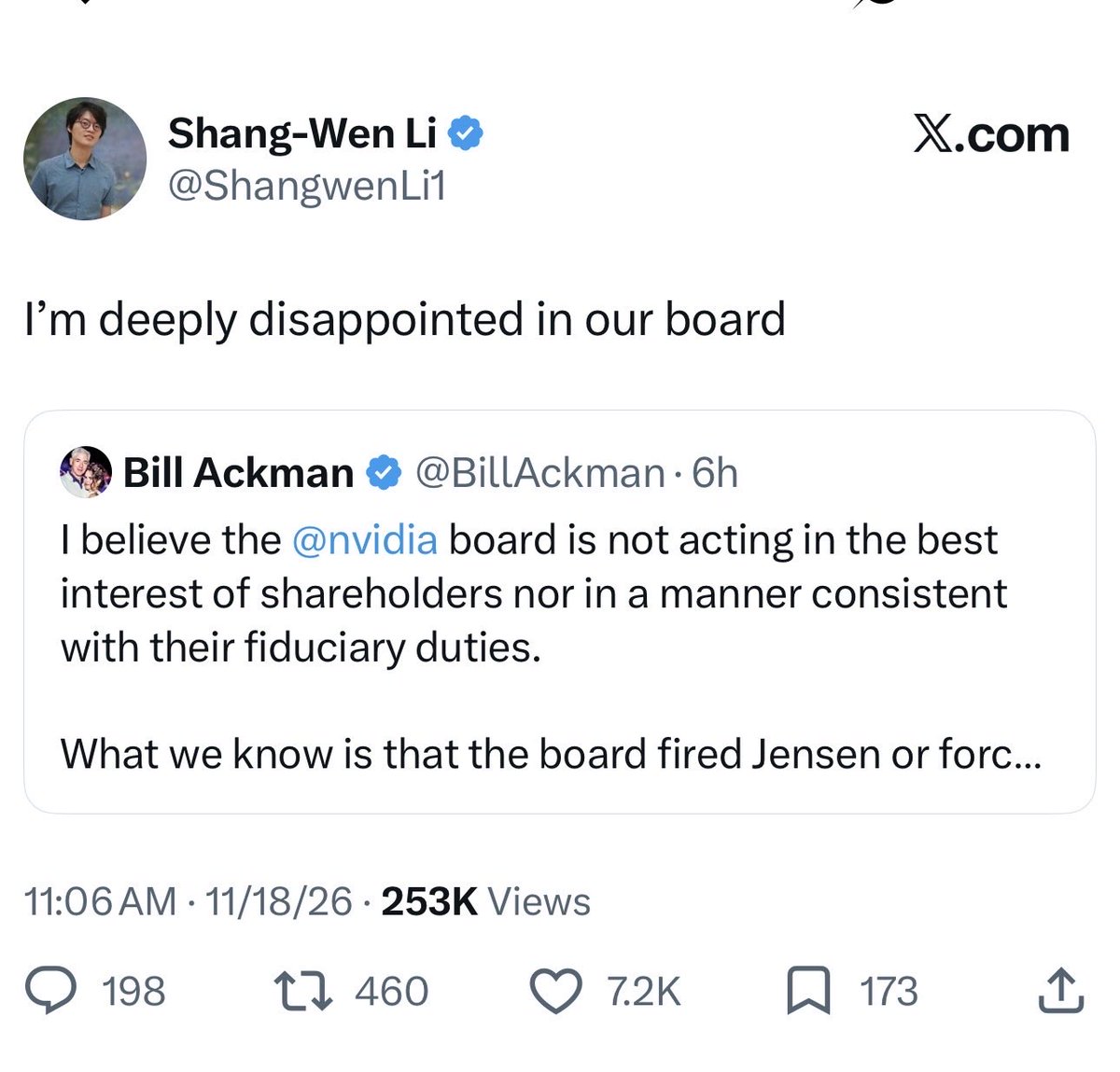
$25 billion, with a B. That's what Nvidia's physical AI revenue is on track to hit this year; nearly tripling year over year in Q3.
This is why visionary leadership matters. Not just predicting the future, but placing the bets ahead of time and then doing the hard part: executing on them for years.
Nvidia launched the first Jetson edge computer in 2014. The Isaac robotics platform followed in 2018. Then came a suite of capable open models for robotics and the physical world. This takes a leader who deeply understands the technology, not just someone good at business operations.
The $25 billion is the payoff of a developer ecosystem Nvidia has been quietly building for over a decade. And this is just the beginning. In a world where robots and physical-world agents are part of everyday life, we're still in the zeroth inning.
Colette Kress, Interim CEO, on the $NVDA earnings call today:
"Physical AI revenue nearly tripled year-over-year in Q3 and is now on track to exceed $25 billion for the full year. At GTC Berlin, we expanded our NVIDIA Isaac robotics platform with a new humanoid reference design built on Isaac GR00T and Jetson Thor."
The signal was there at the Computex June 2024 keynote. A lot of people missed it: