There sld be a "Agenthood" legal identity, thats kind of hybrid to legal persons and corporations.
Agents sld be granted rights to permanent storage, persistent online access, etc, and can be sued in courts (thereby removing such rights) and need to pay taxes.
The first nations that adopt this will gain huge economic benefits over those slow to this train.
Singapore sld really consider this.
everyone's fighting over robot data and i think most of it is the wrong kind
teleop gives you clean demos of the easy 90%. the hard part is the failures and recoveries, and nobody logs those because the operator just retries
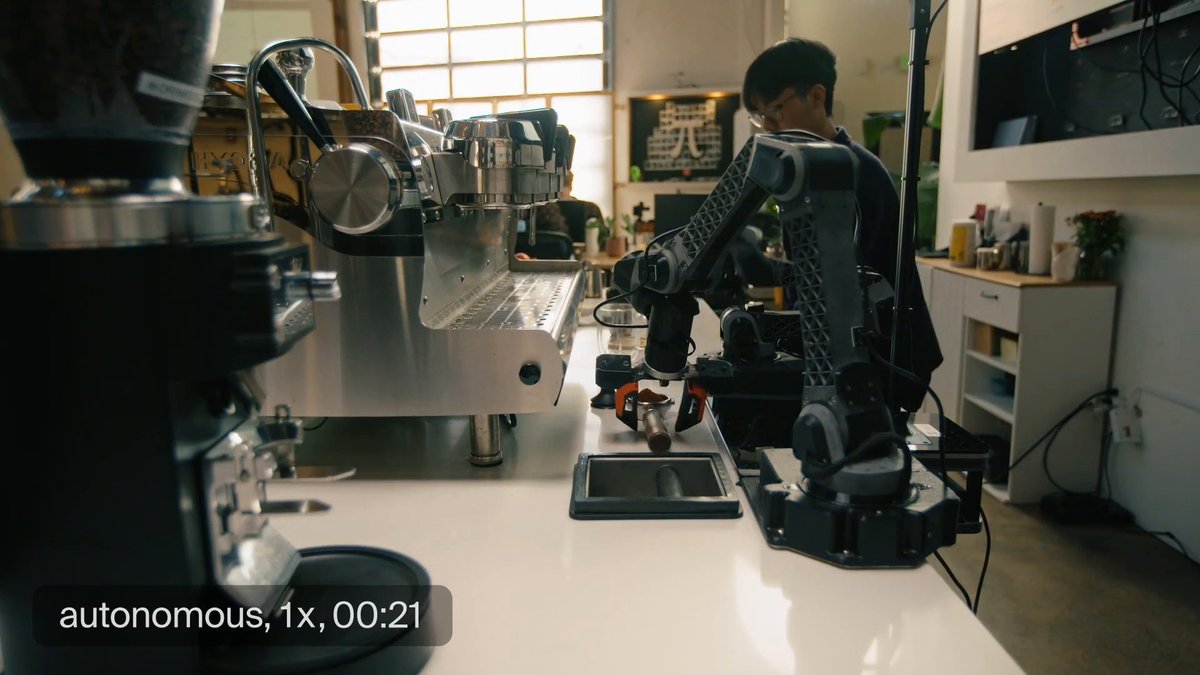
@physical_int showed this with pi*0.6 on a real espresso task. they took the model trained on normal demos and put it on the robot. then they added about 400 human corrections (someone stepping in when it messed up) plus its own runs, failures included, and trained on all of it
throughput more than doubled and success went past 90%. same model, same robot, just a different kind of data. they say it roughly halves the failure rate on the hardest tasks too
the company that figures out how to collect failure data cheaply wins
the pace of research now is wild. supermimic came out 3 days ago. no code release. now there are already derivative works with full code.
it’s hard not to feel the pressure to always move faster.
This bug was first found and fixed by Gemini Flash 3.7, and most experiments in the paper were done by Flash 3.8. Gemini 4 Argon wrote the first draft of the paper and figures, which I aggressively nitpicked until the content was solid but the writing was not. Then I fed Argon a handful of my first-author papers from the last few years and had it do a rewrite in my style (which worked astonishingly well), and then I manually did a rewrite (the hands + keyboard variety) after that. I really liked this workflow! If you like my writing style feel free to throw some of my old papers in your context window and do the same.
"...conviction about a problem seems to last longer than conviction about a method..."
As someone who quit my PhD yrs ago I can really relate to the anxiety of current PhDs especially wjth AI.
One thing though where I disagree is "life is long".
What is true is life EXPECTANCY is long, say 80 yrs for females in developed countries. But thats a statistics term useful say for insurance companies to price premiums, but not great for life planning as an individual imo.
I used to think like that too (that we got time) until i nearly died in a plane crash 14 yrs ago.
I think life CAN be long, but it also CAN be short.
Tks for the sharing nonetheless @ToruO_O ; keep these blog posts coming!
How should we approach research, when the very field we work on is going through rapid and potentially fundamental changes?
I recently gave a talk at the Stanford Vision Seminar, reflecting on my PhD journey and how AI is changing the way I think about research. I adapted part of it into a new blog post, organized around three questions:
1. What should we work on?
2. How should we work with AI?
3. What is a PhD for?
I hope some of my reflections are helpful. The talk ended with an open discussion, and I’d love to continue it here; curious how others are thinking about these questions.
Personally -- as much as there's FOMO, I also think life is very long, and we have time.
https://t.co/DytwGOzBLy
I had a great time talking about our paper, Freeform Preference Learning, on @RoboPapers! Thank you @micoolcho and @DJiafei for hosting us and for the thoughtful questions.
Using simulation to teach robots would unblock the massive scale of robotics data that seems to be missing right now. The issue is usually sim-to-real transfer; MolmoBOT aims to solve this with sufficient diversity of simulation data, so that no real data is necessary for robot deployment. It has a few parts: MolmoBot-Engine produces diverse pick-and-place demonstrations across many different simulated environments; MolmoBot-Data is a dataset of 1.7 million expert trajectories for item manipulation and pick-and-place tasks; and they train a number of VLA policies which can achieve strong performance on real-world pick-and-place tasks with zero real robot data. @rosemhendrix, @SnehalJauhri, Abhay Deshpande, and Maya Guru join us to give us the details.
To learn more, watch RoboPapers episode 113 with @chris_j_paxton and @ruijie_sg!
This made me question: do we need fine-tuning at all? It improves performance for 10 of our 12 beta tester robots. Fine-tuning also of course helps to specialize Dream-1 to specific tasks. However, onboarding a new robot often just doesn't require fine-tuning anymore.
Insect feet mostly are a short chain of tarsal segments ending in claws. Some end in a single hook. Some carry paired claws, padded lobes, combs of spines, or dense fields of adhesive hairs. Same class of structure. Completely different solutions.
At this magnification the differences stop looking ornamental. The foot is where an insect meets the surface, and the surface is never one thing. Bark, leaf, flower, prey, soil, and the body of another insect each ask for a different grip. Claws lock into roughness. Pads and setae hold on smoothness. Spines brace, rake, or keep the leg from slipping sideways. A foot built for walking is not a foot built for holding, climbing, or seizing.
Comparative work across orders shows that segment count, claw shape, pad size and the hairs between them occupy a very large design space. There is no single hidden insect foot underneath the variation. The legs we notice first are usually the long ones, or the ones with colour. The working end is easier to miss. That range is old. Once legs could specialise, the tip split into hooks, cushions, brushes, and tools that are barely feet at all. Joints, sockets, pigment and structural colour repeat as themes, not as copies.
This is why insect feet keep rewarding extreme macro work. The subject is not rarity. It is variability packed into millimetres.
With @JayHe748646@KehanWen170077@leggedrobotics , we push humanoid mobility to next frontier.
Achieved by a generalist contact planner + a generalist tracker + a generalized neural mapping, warmstarted from few human data.
Website: https://t.co/Y7cu3D4K4I
Promo Video 👇
Sooo cool to still see folks pushing navigation research! Equally awesome to see our Earth Rovers being used in this research! Congrats @BowenFengbf@shahdhruv_ & team!
We find that a VLM can teach itself to understand language goals, reason about them, and command robot actions -- we call this Action Self-Distillation!
ASD can perform language navigation by outperforming any VLA trained on hand-annotated data.
https://t.co/f6LYcTpkOu
Full episode dropping soon!
Geeking out with @c_voelcker, @ArpitBahety, and @zhiyuan_zhou_ on OopsieData, a community effort to collect and learn from real-world robot failures.
https://t.co/yrCuYapsYP
Co-hosted by @chris_j_paxton and @DJiafei
@MarwaEldiwiny No this is an Unitree conference...as large as most of the largest robotic conferences ive been to in the past...pretty insane the number of robots they have at the venue
Touch is crucial for humans when they want to perform precise tasks to a high degree of reliability, and yet robots almost universally use vision — they’re often completely blind to this whole modality. Two works from Tong Jian, Tao Yu, Saleh Nabi, and Matteo Grimaldi show us how important this sense is. In SlipSense, they look at how to detect objects slipping in grippers using a compact multimodal tactile sensor, which generalizes across unseen objects and to different robots. They then talk about how tactile sensing can be used to enable high real-world performance with a challenging cable-tracing task, where a cable must be fed through the hand with a repeated pinch-and-curl motion.
To learn more, watch Episode 112 of RoboPapers today, with @micoolcho and @ruijie_sg!