Full episode dropping soon!
Geeking out with @YiHerngOng0812 on “Representation and Architecture for Robot Foundation Models,” featuring Devol Robots’ Interaction World Model and Devol-ONE.
https://t.co/nGPAat1Iq8
Co-hosted by @chris_j_paxton@ruijie_sg
Full episode dropping soon!
Geeking out with @YiHerngOng0812 on “Representation and Architecture for Robot Foundation Models,” featuring Devol Robots’ Interaction World Model and Devol-ONE.
https://t.co/nGPAat1aAA
Co-hosted by @chris_j_paxton@ruijie_sg
Imitation learning has enabled amazing robot capabilities, empowered in part by diffusion or flow-matching policies. These generative models outperform direct action prediction, but come at a cost: they are often slower and harder to train. The performance gap is usually explained by better support of multimodality, but @yuchen010807 and @maojiayuan say this is wrong: that instead, the advantage generative policies have over pure regression is better explained by state-depended variation and by heavier-than-usual Gaussian “tails.”
They propose HT-Policy, which learns an input-dependent residual scale and uses it to reduce the effect of these long-tail data example resulting in reduced influence of these long-tail examples on training, allowing you to train regression models that are competitive with flow matching.
To learn more, watch Episode #117 of RoboPapers, with @chris_j_paxton and @ruijie_sg!
Full episode dropping soon!
Geeking out with @yuchen010807 and @maojiayuan on Residual Modeling Closes the Regression and Generative Policy Gap in Robot Learning
https://t.co/b9dCaK3Tnu
Co-hosted by @chris_j_paxton@ruijie_sg
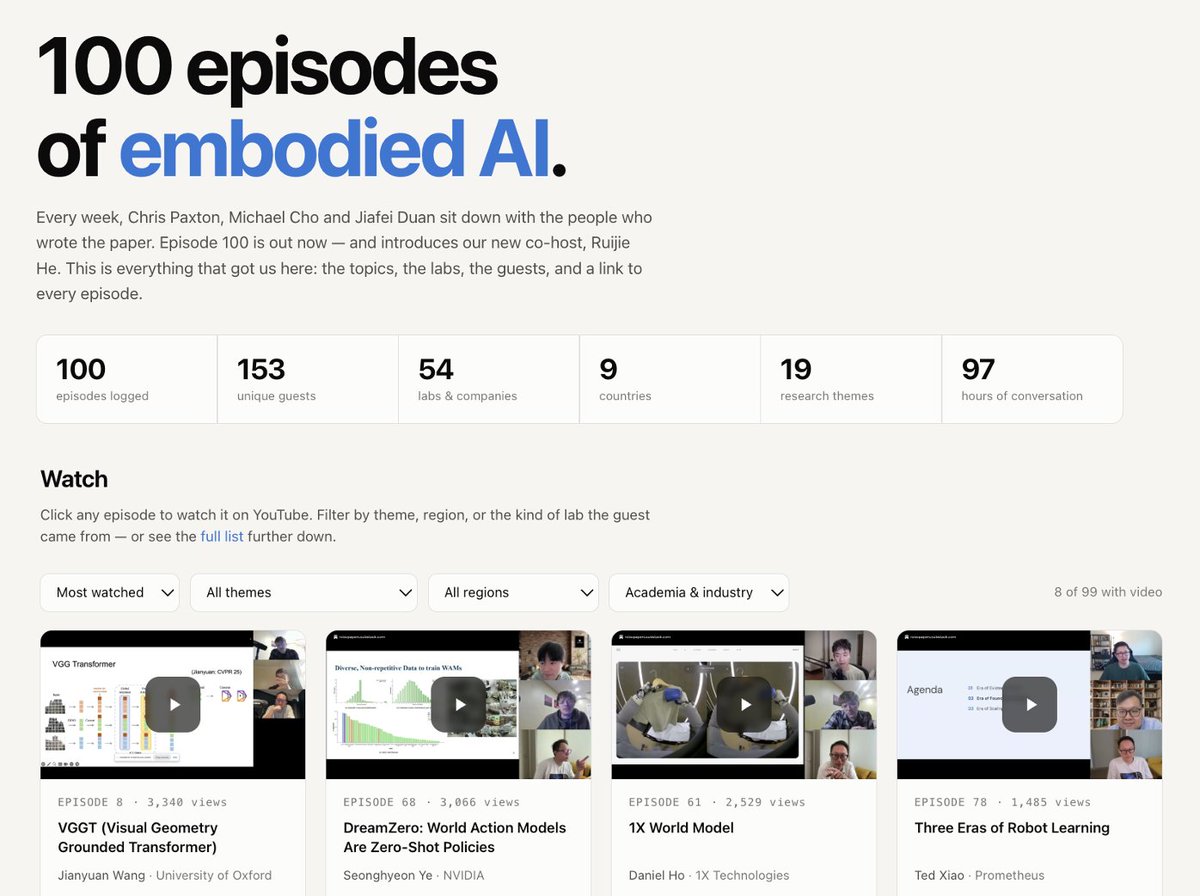
Over the past 20 months, @RoboPapers has become the go-to place to keep up with the latest robotics research.
At @corl_conf, we're hosting a mixer to thank authors of papers that have been on the show. If that's you, sign up here: https://t.co/mWO903Nlpm
Thread ↓
Full episode dropping soon!
Geeking out with @yuchen010807 and @maojiayuan on Residual Modeling Closes the Regression and Generative Policy Gap in Robot Learning
https://t.co/b9dCaK3Tnu
Co-hosted by @chris_j_paxton@ruijie_sg
Coding agents powered by large language models are increasingly able to complete complex, long-horizon goals, but this capability is still largely relegated to computer tasks. Bringing agents to real-world robotics is much harder.
Enter SimEX, by @JiahengHu1, @SteveTod1998, and team. It is a simulation-based auto-research framework, wherein agents can develop skills which can be used to control real robots, developing a robust toolbox of skills which can then be used for real-world tasks like towel folding and plate manipulation.
To learn more, watch Episode 116 of RoboPapers with @micoolcho and @DJiafei!
Delta Intelligence’s Δ₀ is a humanoid full-body foundation model, which can perform long-horizon, whole body loco-manipulation. They show a single, generalist policy which can control a 69-DoF humanoid to perform everyday tasks at nearly human speed — using whole-body human data for large-scale pretraining.
@jeasinema and @siyuanhuang95 tell us more about how they achieved this, and about the importance of jointly designing policy and controller. Delta uses a delta action space, for example, which makes it easy to provide human interventions without interrupting the whole body controller: a human operator can correct the robot seemlessly while it works.
They show a wide range of impressive humanoid loco manipulation tasks using their generalist model.
Learn more on Episode 115 of RoboPapers, with @micoolcho and @chris_j_paxton!
Full episode dropping soon!
Geeking out with @JiahengHu1 and @SteveTod1998 on “SimEX: Simulation-Integrated Robotics AutoResearch.”
https://t.co/SiUXjTNk6Z
Co-hosted by @micoolcho and @DJiafei
Over the past 20 months, @RoboPapers has become the go-to place to keep up with the latest robotics research.
At @corl_conf, we're hosting a mixer to thank authors of papers that have been on the show. If that's you, sign up here: https://t.co/mWO903Nlpm
Thread ↓
Full episode dropping soon!
Geeking out with @JiahengHu1 and @SteveTod1998 on “SimEX: Simulation-Integrated Robotics AutoResearch.”
https://t.co/SiUXjTNRWx
Co-hosted by @micoolcho and @DJiafei
Our co-hosts @micoolcho@Djiafei@ruijie_sg are teaming up @huggingface to launch @RoboColosseum - a large-scale in-the-wild robotics benchmark
Roll-out data will be open-sourced, along with 10,000 hrs free eval service for academia labs.
Full episode dropping soon!
Geeking out with @jeasinema and @siyuanhuang95 on Delta-0 (Δ₀): A New Chapter in Humanoid Intelligence.
https://t.co/buiIeX6Kqt
Co-hosted by @micoolcho and @chris_j_paxton
Full episode dropping soon!
Geeking out with @jeasinema and @siyuanhuang95 on Delta-0 (Δ₀): A New Chapter in Humanoid Intelligence.
https://t.co/buiIeX6Kqt
Co-hosted by @micoolcho and @chris_j_paxton
Robotics has a data problem, but not the one you’re thinking of: almost all robotics data is of successful instances of robot behaviors. But many of the most exciting research areas for robotics today, including world models and reward model learning, require failures: interesting examples of manipulation trajectories that did not succeed.
@c_voelcker, @ArpitBahety, and @zhiyuan_zhou_ join us to talk about their data collection effort and their upcoming workshop on “oopsie data”: all these valuable failures that are currently being thrown out. Their goal is to collect the first large community-driven open-source dataset of failure examples.
Watch Episode 114 of RoboPapers, with @chris_j_paxton and @DJiafei, to learn more!
Using simulation to teach robots would unblock the massive scale of robotics data that seems to be missing right now. The issue is usually sim-to-real transfer; MolmoBOT aims to solve this with sufficient diversity of simulation data, so that no real data is necessary for robot deployment. It has a few parts: MolmoBot-Engine produces diverse pick-and-place demonstrations across many different simulated environments; MolmoBot-Data is a dataset of 1.7 million expert trajectories for item manipulation and pick-and-place tasks; and they train a number of VLA policies which can achieve strong performance on real-world pick-and-place tasks with zero real robot data. @rosemhendrix, @SnehalJauhri, Abhay Deshpande, and Maya Guru join us to give us the details.
To learn more, watch RoboPapers episode 113 with @chris_j_paxton and @ruijie_sg!
Touch is crucial for humans when they want to perform precise tasks to a high degree of reliability, and yet robots almost universally use vision — they’re often completely blind to this whole modality. Two works from Tong Jian, Tao Yu, Saleh Nabi, and Matteo Grimaldi show us how important this sense is. In SlipSense, they look at how to detect objects slipping in grippers using a compact multimodal tactile sensor, which generalizes across unseen objects and to different robots. They then talk about how tactile sensing can be used to enable high real-world performance with a challenging cable-tracing task, where a cable must be fed through the hand with a repeated pinch-and-curl motion.
To learn more, watch Episode 112 of RoboPapers today, with @micoolcho and @ruijie_sg!
Full episode dropping soon!
Geeking out with @c_voelcker, @ArpitBahety, and @zhiyuan_zhou_ on OopsieData, a community effort to collect and learn from real-world robot failures.
https://t.co/yrCuYapsYP
Co-hosted by @chris_j_paxton and @DJiafei