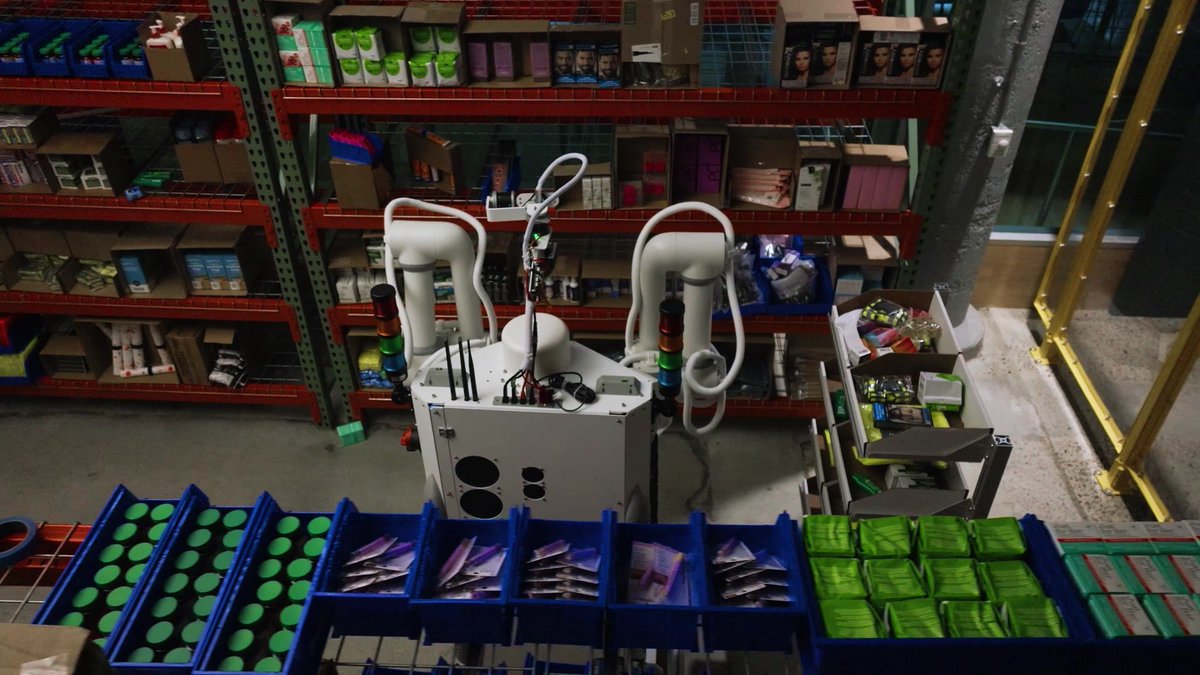
Introducing TRACE: deployment-time compute scaling for robot learning.
From a few Tutor demos, frontier LLM agents rebuild a robot's task in sim and train reliable, human-speed policies. Performance becomes a function of compute.
TI-0.1 is our first model trained with TRACE.
How do we build a billion useful robots?
Tutor Intelligence @tutorintel announced a $75M funding round yesterday. Isembard @IsembardGroup has opened 16 factories in just a year.
Their founders, @joshgruenstein and @alexfitzgerald, sat down for our latest founder chat on building robot intelligence in the real world and scaling the industrial base around it.
They discuss franchising factories, why McDonald’s might be the greatest manufacturing business ever built, differences between the U.S. and China, and how AI is already changing what’s possible on the factory floor.
More below on the work underway to make a more abundant world a reality.
00:00 Preview
01:55 Meet Josh and Alex
02:05 Building robot intelligence in the real world
04:25 Franchising factories and the McDonald’s playbook
08:13 China’s manufacturing model vs. a distributed industrial base
10:09 How much of the robotics stack should you own?
12:12 A robot’s first day: birthday cake and a hairnet
14:43 Robot labor as a utility
16:45 What reindustrialization means for prosperity and security
18:12 Finding exceptional people and building roles around them
20:10 Raising the floor: what robotics can do for people today
21:13 What will it take to build a billion robots?
25:11 Vibe coding, factory software, and operational bottlenecks
27:21 Isembard’s ambitions beyond components
29:10 If you could build any product in history…
Tutor CEO @joshgruenstein live on MTS 11:30-11:55AM PT, unpacking what it takes to deploy intelligent robots now, on the heels of the company's $75M Series B with a16z.
Tutor Intelligence co-founder and CEO Josh Gruenstein is putting AI robots to work in American factories and warehouses, taking on the back-breaking jobs they can't hire for.
Tutor builds its robots in Massachusetts and charges by the hour, with no upfront cost. When the AI gets stuck, a human "tutor" takes over and teaches it the task, creating training data along the way.
Josh joins a16z's Martin Casado and Raghu Raghuram to discuss how Tutor goes from a first sales call to a working robot in about three months, why so many robot startups died building for a single customer, why anyone will be able to start a business in the physical world, and a whole lot more.
0:50 Deploy robots, then build the data
2:50 Why smart robots aren't enough
4:38 The ultimate systems problem
6:45 Why robot companies go vertical
9:07 How remote humans tutor robots
11:00 Will robots outgrow their tutors?
14:54 How AI labs sped up robotics
16:57 Meet Cassie and Sonny
20:55 What factory work actually looks like
23:18 A robot for $16 an hour
25:51 When robots become coworkers
29:04 Why robot startups keep dying
31:21 When 1% cheaper flips a market
34:52 Robots cost more to run than to buy
38:18 China's automation bet may backfire
42:02 Real-world RL on a 100-robot fleet
YouTube: https://t.co/TEVdluuuhT
@joshgruenstein@tutorintel@martin_casado@RaghuRaghuram
We raised a $75M Series B to deploy intelligent robots now, led by @a16z, with participation from @usv and @neo.
@tutorintel robots work real jobs across the United States, directed by human “tutors” and the foundation models we’ve trained on the work done. This round accelerates frontier model training, robot manufacturing, and deployment into industry.
We’re in almost 4x as many sites as a year ago; nearly a third of this year’s deployments went to existing customers coming back for more; and we’re on track to have more than 1,000 robots under contract by the end of 2027.
Our mission is to proliferate robotics for the common good. If you want to make robots reliably do things others think are impossible, for people who’ve never had access to this technology, join us.
The R&D team at @tutorintel is lightning fast.
But what's more impressive is how quickly Tutor actually deploys their robots into the field.
No demos. Just real work in the real world.
Mobility + dexterity is the unlock to functional robots. @tutorintel's new Sonny robot has both and is soon to be deployed in warehouses and 3PLs around the country. Watching this company sprint is awesome.
Humans have remarkable perception, dexterity, and the ability to tackle an enormous diversity of tasks in the physical world. How do we build an embodiment with those capabilities but optimized for the warehouse, that is sufficiently robust, safe, and cost-effective to deploy at scale across the physical economy?
We're also sharing the newest generation of Cassie, a general warehouse and factory worker for bulk tasks. Customers from family-owned manufacturers to Fortune 50 distributors trust Cassie in their critical operations.
Cassie is picking the first day of most deployments, with ~40 day median timing from signed paperwork to robots in production.
I'm excited to share Tutor's next generation of robots, pushing the frontier of robot capabilities in real customer deployment.
Meet Sonny, a human-inspired mobile robot running our Ti-series VLA built for the real world.
Excited to share @tutorintel's Data Factory 1, a 100 robot semi-humanoid research farm and the largest robot data factory in the United States.
Our first embodiment “Cassie” is deployed at industrial scale across the supply chain. We built DF1 to bootstrap fleet-scale learning for our "Sonny" industrial semi-humanoid embodiment, powered by our first end-to-end robot foundation model Ti0.