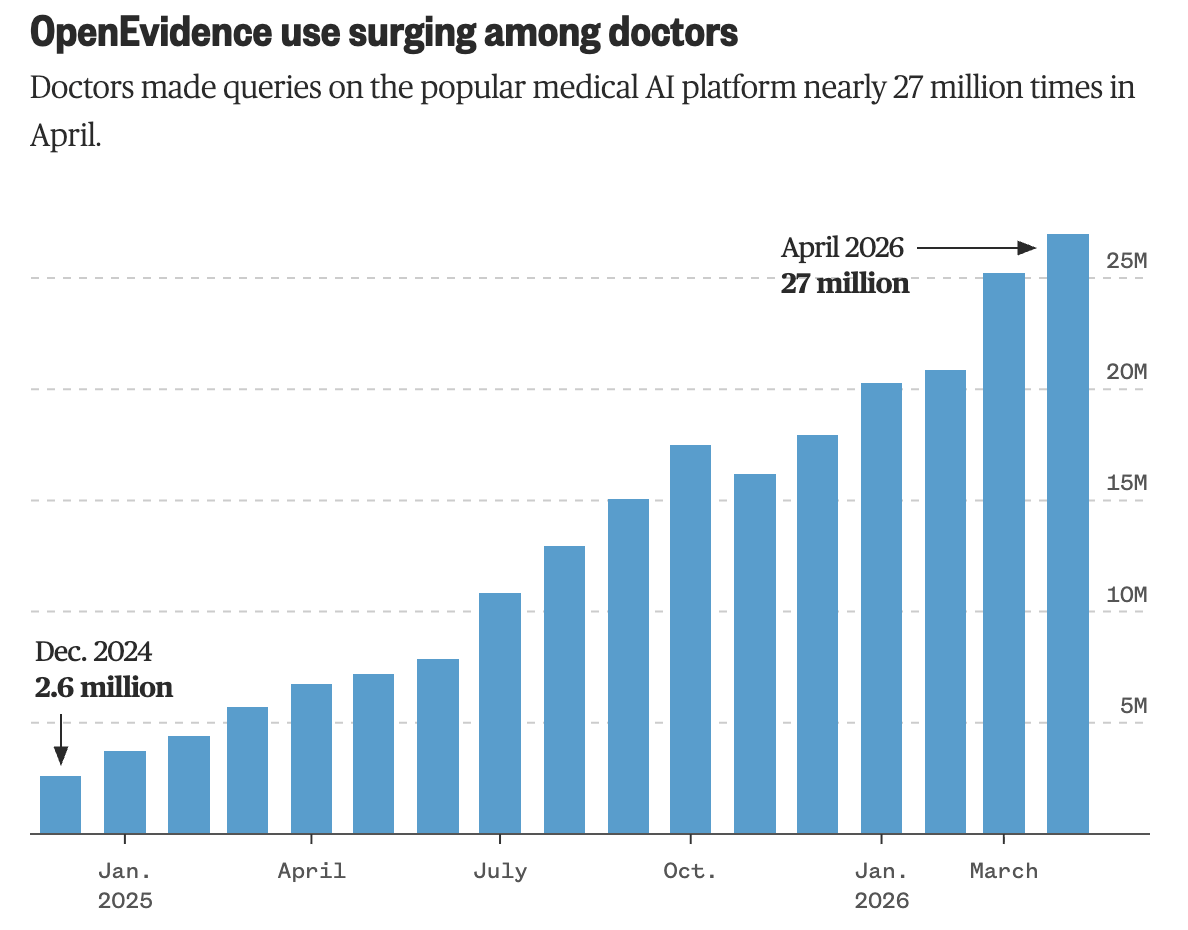
OpenEvidence is the most popular AI for doctors in the United States. Founded with the mission to organize and expand the world's collective medical knowledge.
“We did the hardest thing in the history of American health care. We got the majority of American doctors to all voluntarily adopt a single technology platform.”
NBC News on how that happened, what U.S. physicians actually do with OpenEvidence, and how partnerships with NEJM, JAMA, NCCN, and Wiley make it possible.
Dr. Travis Zack from @OpenEvidence delivers his talk on "Synthesizing Medical Literature: The New Era of AI-Driven Evidence" at our Virtual Healthcare in the Mainstream Symposium & Research Forum.
Join @NEJM_AI for a free virtual event to explore how AI is reshaping guideline development and clinical decision-making. Hear from leading experts as they discuss how to harness the strengths of large language models while preserving clinician autonomy, minimizing bias, and ensuring that evidence—not algorithms alone—continues to guide patient care. View the speaker lineup and save your seat: https://t.co/3yyTTSjdzk
How are clinicians using AI in patient care?
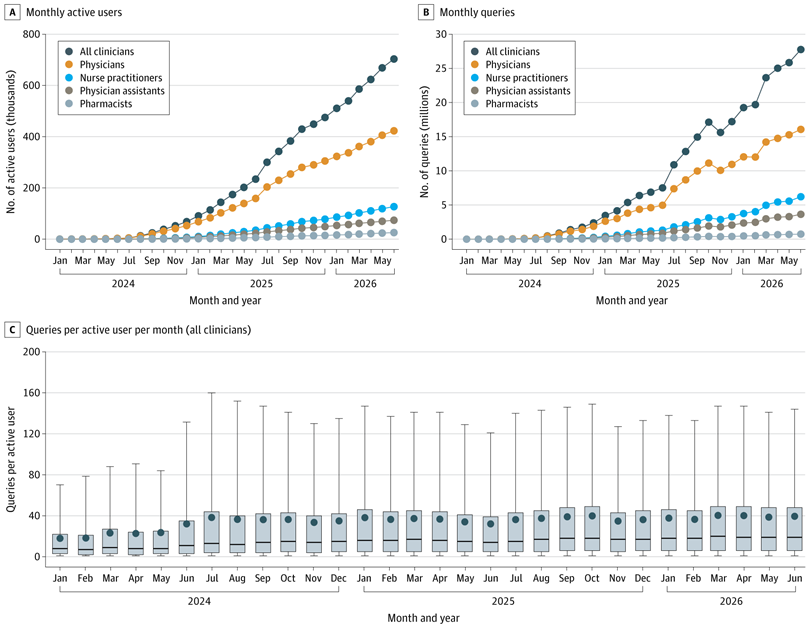
A new @MassGenBrigham study in @JAMA_current analyzed 271 million queries to OpenEvidence to find out.
Read more: https://t.co/MT5s51Gcad
DOI: https://t.co/NfpuNHkSQ5
"It's a tool to make doctors more effective and efficient doctors, and it relies on superintelligence at the core of it in order to do that sort of integrative task."
@NIHDirector_Jay discusses how AI tools like OpenEvidence can help doctors connect the latest medical research to patient symptoms and treatment options.
In this edition of STAT Health Tech: A new paper in JAMA offers a glimpse into clinicians's use of OpenEvidence, and a look at Isomorphic Labs. https://t.co/hF0Ppkv4xm
"A growing share of knowledge access is shifting from recall to retrieval." Clinical judgment stays with the doctor.
From a Harvard-led JAMA study, co-authored with OpenEvidence researchers.
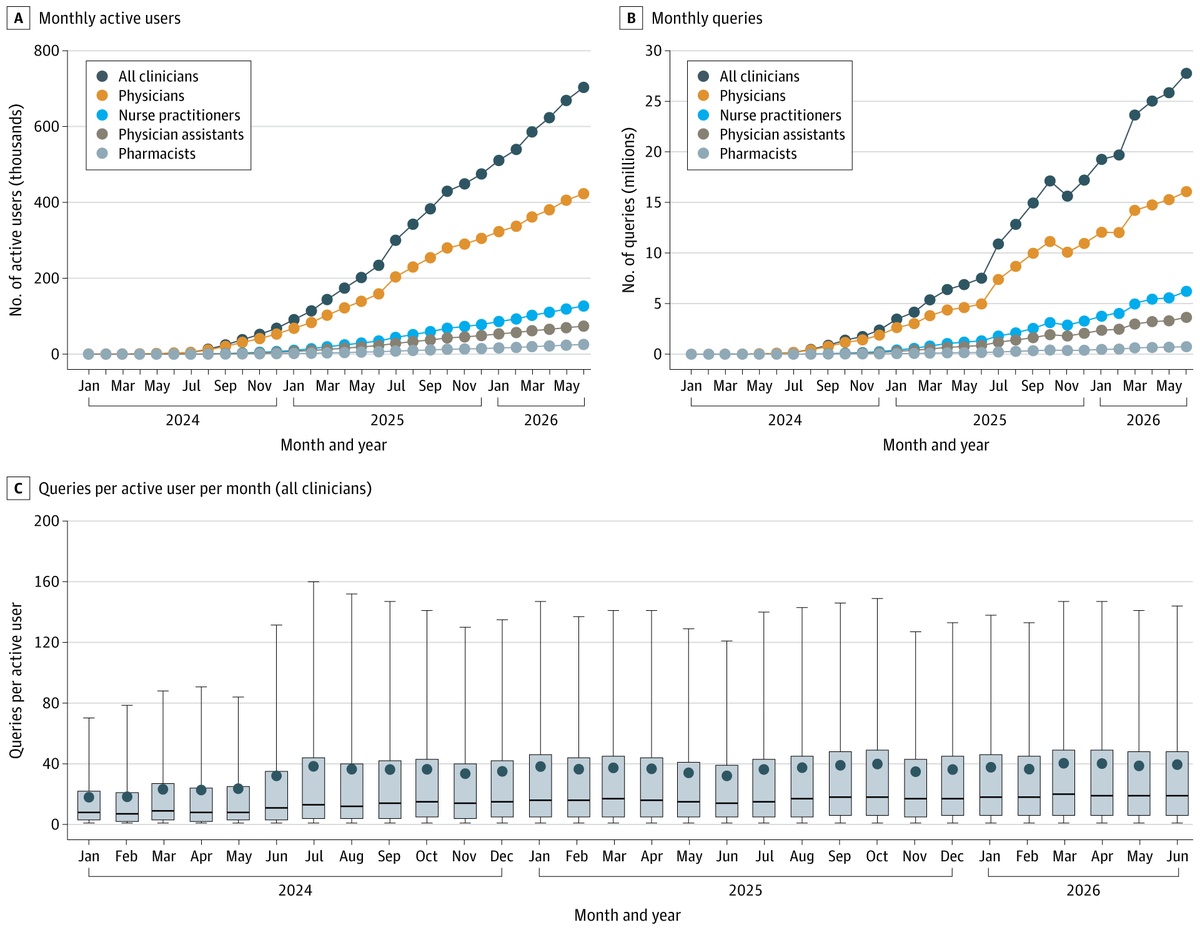
OpenEvidence, as a physician-facing LLM, is being used by more healthcare professionals month by month. Now, a study analyzes how almost a million US clinicians use it while submitting 271 million AI-enabled clinical queries!
"Early-career physicians (use ratio, 2.54) and those in oncology and hematology (2.00), internal medicine (1.88), and family medicine (1.80) submitted a higher-than-average share of queries; treatment and management accounted for 33.1% of physician queries and diagnosis for 13.9%."
I really liked their concluding remark:
"For much of modern medicine, clinicians have been expected to internalize a body of knowledge through training and maintain it through continuing education. Study findings suggest a growing share of knowledge access is shifting from recall to retrieval."
We cannot expect physicians to know everything, but we can expect them to know where to find the information they need.
The study: https://t.co/gUhb3TnDWZ
Are you using @OpenEvidence?
In @JAMA_current, Patel, @AnupamBJena et al show rapidly rising use with 271M queries from >950K clinicians spanning info treatment, management, diagnosis, & more.
Our Editor's note discusses what AI platforms mean for education & clinical care
https://t.co/VAKjDTJgaQ
@francisdeng@IAmSamFin@jbrafel@LiuMichaelMD@AnupamBJena Radiology came in at about a quarter of its workforce share in the JAMA paper, and this is probably why. The question comes up while you're dictating, and switching tabs breaks the read. Differential first, or follow-up recs for incidentals?
Clinicians bring OpenEvidence the question that matters most once a diagnosis is made: what to do next for this patient.
New in @JAMA_current, from researchers at Harvard Medical School and OpenEvidence, including our CMO @TravisZack2: treatment and management questions outnumbered diagnosis questions more than two to one.
That should change how clinical AI gets tested. Most evaluations still grade diagnosis with board-style vignettes that have one right answer. Real treatment questions rarely do. They depend on this patient's kidneys and on the trial that changed practice last spring. That is the test we want to be held to.
Physicians also reached well beyond their own fields. ER doctors asked about topics outside emergency medicine 88% of the time. Medicine is wider than any one specialty, and good clinicians check before they act.
Among US #clinicians, use of an #AI-enabled clinical information platform increased substantially over 2.5 years, with sustained use across #physician and nonphysician groups.
Queries most often focused on #treatment and #management rather than #diagnosis, indicating that these tools are being used primarily to support #clinical decision-making at the point of care.
https://t.co/067RQEpCl4
I’ve long felt that @OpenEvidence query data is the medical equivalent of the Google street view cameras, providing a first-hand look at how clinicians navigate the terrain of clinical knowledge, both knowns and unknowns.
IMO there is so much utility in using these data to discover trends in our practice, holes in our guidelines, emerging clinical needs, opportunities for impact.
But obviously, any mining of these data has to be approached with great care, for patient safety and clinician trust. This paper is a first measured step in publishing trends from OE data (other than implicitly through work with, eg society guidelines). It focuses on basic trends in who is using the platform and for what purpose. Excited to see it out. So much fun working with @TravisZack2 and our colleagues from Harvard on this.
Other efforts are in the works and I hope there is much more to come in the genre of @OpenEvidence -> new evidence.
Thrilled to partner with @OpenEvidence 🩺
Quite simply the finest AI tool available to surgeons. We use it every single day in the hospital—and now, to craft innovative surgical education content.
Big things coming as we integrate OE knowledge into our platform, and vice versa. Stay tuned! 🚀
LinkedIn's Top Startups list is built entirely from its own hiring data, so it measures one thing well: where people want to work. This year, OpenEvidence is #6 in the U.S.
We're physicians and engineers working to organize and expand the world's collective medical knowledge, so no doctor has to practice without the best available evidence.
If that's the work you want to do, we're hiring. https://t.co/6v3tjPoDGq
Good people & an absolutely incredible product ➡️ the recipe for success 🚀
Thanks @AmbarMehta for all you do! We are thrilled to integrate @OpenEvidence into the content we develop @BehindTheKnife.
It happened. We got Behind the Knife.
@BehindTheKnife's surgical education library will feed into OpenEvidence answers, and OpenEvidence will be built into their ABSITE and oral board prep.
@AmbarMehta, a vascular surgeon who leads surgery initiatives at OpenEvidence, puts it this way: the toughest surgical decisions live between the lines of the evidence.