@sequoia is leading our Series C at a $1B valuation.
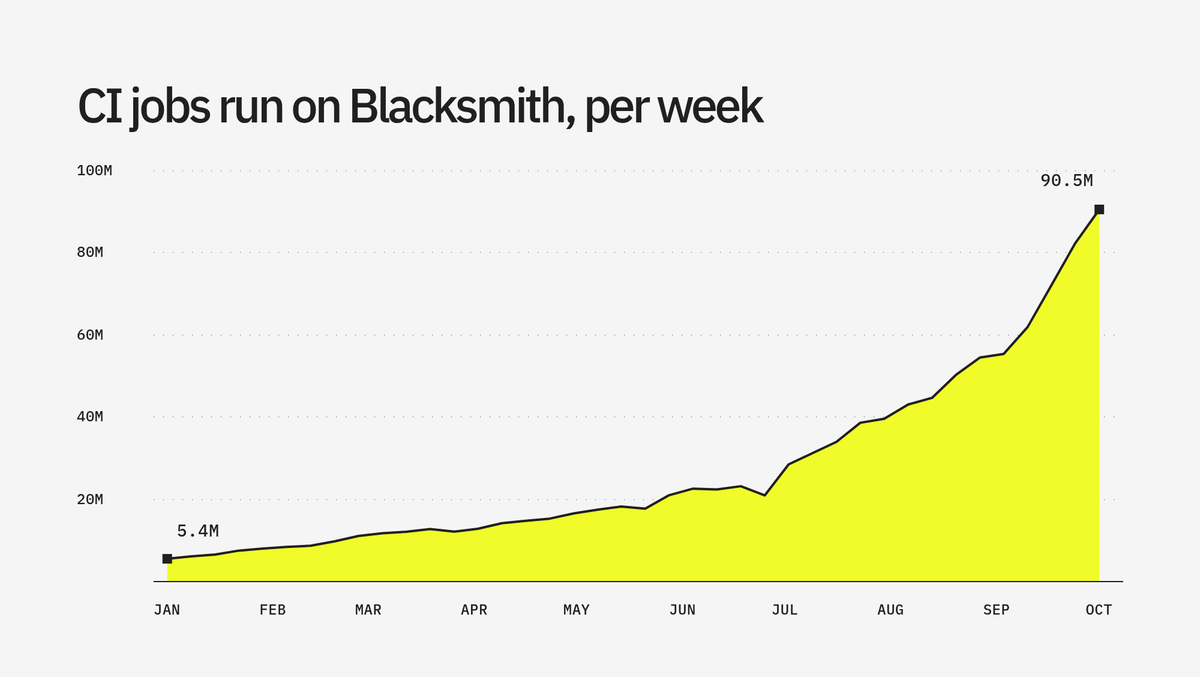
Since January, we’ve gone from running 5M CI jobs a week to over 90M. Agents are writing an order of magnitude more code, and all of it still needs to be built and tested before it ships.
Turborepo caching is now on by default for free on Blacksmith.
400+ teams are already using it. One monorepo that runs over a thousand Turborepo tasks a day now sees cached runs finish 97% faster.
Large downloads from GitHub are now 22% faster on Blacksmith runners (p90: 54 → 65 MB/s).
We shipped a network optimization and measured it on production traffic, before and after. More coming soon.
GM. Friday. A lot going on. Here's the line up:
- @rosstaylor90 (General Reasoning)
- @max_buchan (Valarian)
- @8eanmurray (Fuse Energy)
- @alirhaddad (XRlabs)
- @gluk64 (Matter Labs)
- Richard Starson (Stellios Technologies)
- @adijayaprakash (Blacksmith)
See you on the show.
@sequoia is leading our Series C at a $1B valuation.
We started Blacksmith in 2024 to make CI faster and less painful. In January we ran 5 million CI jobs a week. Today it's over 90 million and growing, and we’re still early.
@sequoia is leading our Series C at a $1B valuation.
Since January, we’ve gone from running 5M CI jobs a week to over 90M. Agents are writing an order of magnitude more code, and all of it still needs to be built and tested before it ships.
Blacksmith now supports GitHub Enterprise Server (GHES) and GitHub Enterprise Cloud with data residency.
Companies who require their own GitHub instance or a fixed data region no longer have to pick between security and faster CI.
Learn how to get set up in the comments.
It’s never been easier to ship code, but testing has still been a massive bottleneck for us… so I decided to change that 🫡
With @Cap, we’re currently making a full transition to GPUI, and a screen recorder is a strange thing to test reliably, because you can export a perfectly playable video that has the wrong frames in it. Everything appears to work until you look closer!
I don’t want to ship slop, and any regressions are my worst nightmare. The faster we’re shipping code (and generously from contributors!) the more time I find myself spending trying to 100% prove that we haven’t broken something
So I’ve spent the last couple of days building an automated testing harness for Cap… 🥁
It runs our actual media code through repeatable scenarios whenever a relevant PR changes it and runs simultaneously across macOS, Windows and Linux. Also made it so that a draft gets a smaller suite so feedback comes back quicker (this is great for agents!)
The interesting part though is how we know whether the video is correct…
To do this, we generate test videos with an ID encoded into every frame, alongside audio markers placed at exact moments. These are our video fixtures. When we put one through Cap’s exporter, we can decode the result and check which frames actually made it through
So a cut would change which frame should appear next, or maybe a speed change alters when it should appear. We calculate that independently of Cap’s implementation, so the test has something to check the output against
For example, if frame 125 appears where frame 126 should be, we will know. We don’t need someone to sit there watching for it!
Performance gets measured too. The PR and its merge base are built on the same machine, then benchmarked in alternating runs after warming up. That gives us a comparison of CPU time before and after the change, while reducing the noise you’d get from comparing unrelated CI runs
We’ve moved most of this onto @useblacksmith . One Windows test batch went from 9m 52s on GitHub-hosted runners to 2m 59s, about 3.3x faster (!!) Another went from 5m 08s to 45s. Nearly 7x faster for that test step (!!!)
What I hadn’t quite expected though was how much we’d fix while building the actual harness itself
In one crash recovery test, the footage lost went from 11.03 seconds to 1.03 seconds. We also fixed a decoder bug that could show a frame from 89 frames earlier after seeking, without meaningfully increasing CPU usage
There’s something almost self healing about having this in a loop. We get a reproducible failure, fix the cause, and the test stays behind to catch it if it ever comes back. Each fix leaves us less dependent on remembering everything that’s gone wrong before
I think now that we have this in place, the logical next step is to scale it up and run performance/regression testing autonomously from things like Sentry logs and user feedback. Definitely going to commit a decent amount of $ to it. I probably need at least another 4x Claude subs!
Really excited to ship the improvements we’ve already made just from building this. With the harness mostly in place, I can move much faster on my own changes and contributor PRs. Being able to make that progress without the constant worry of breaking someone’s recording feels pretty fucking good I can’t lie 🤩
Blacksmith is in the Disruptors 60 Class of 2026, curated by @GreenfieldVC at @TechCrunch Disrupt.
Writing code isn’t the slow part anymore. Every generated change still has to be built and tested before it merges. 10,000+ companies run that step on Blacksmith.
Go build caching is now enabled by default for every Blacksmith org, free of charge.
Across customer CI jobs, the median Go step got 20% faster and the slowest ones got 74% faster, with one test suite dropping from 58s to 5s.
Try now, link in first comment.
We were fortunate enough to have our CI accelerated and sponsored by @useblacksmith
Simply swapping to blacksmith accelerated build times by nearly 2x. We then layered on more improvements.
@blankparticle wrote about it here:
https://t.co/hFeLyWxfIc
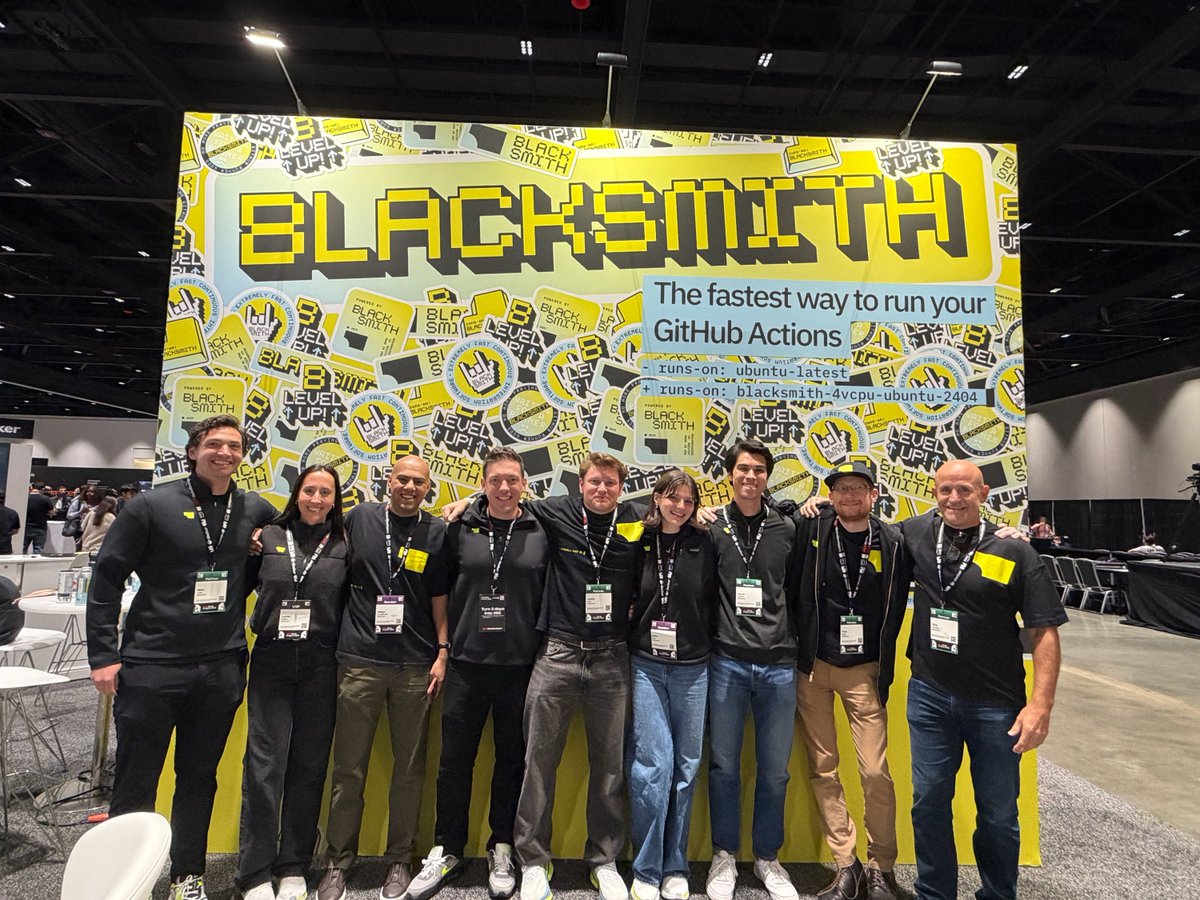
Two days at @WeAreDevs talking about what happens when agents write more code than ever and CI becomes the bottleneck.
Our CEO @adijayaprakash covered the shift, Piotr Bejda the infrastructure behind it, and Abbe Piels showed engineers how to move CI to Blacksmith with one line of YAML.
More highlights soon.