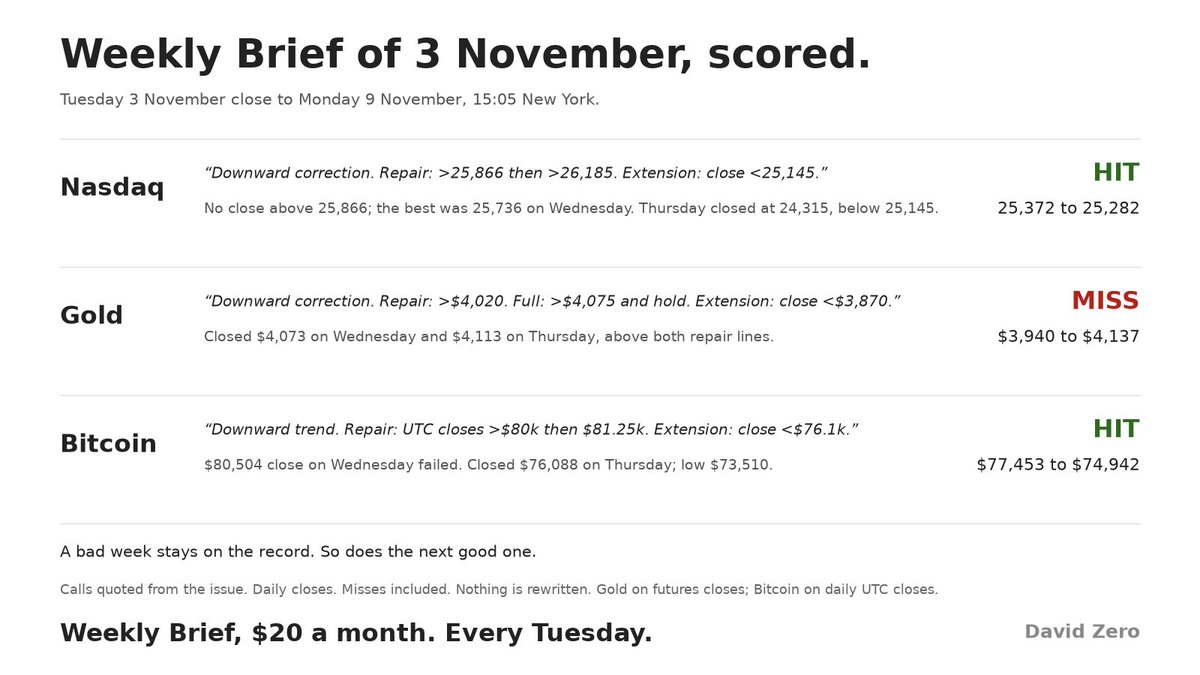
This week's card. The Weekly Brief of 3 November, scored. Nasdaq and Bitcoin went as stated. Gold did not.
Hit. Nasdaq, 25,372 to 25,282. The Brief called a downward correction, with 25,866 as the first repair line and a close below 25,145 as the extension. Nasdaq never closed above 25,866 and closed at 24,315 on Thursday.
Miss. Gold, $3,940 to $4,137. The Brief called a downward correction and set $4,020, then $4,075 and hold, as the repair lines. Gold closed at $4,073 on Wednesday and $4,113 on Thursday. The repair came, and the correction call was wrong.
Hit. Bitcoin, $77,453 to $74,942. The Brief called a downward trend, with UTC closes above $80k as the first repair and a close below $76.1k as the extension. One close at $80,504 on Wednesday failed the next day, Bitcoin closed at $76,088 on Thursday and traded down to $73,510 on Sunday.
November: 5 of 6 Brief calls held.
A bad week stays on the record. So does the next good one.
Less uncertainty. Better decisions. That is the situation. Know it first. Enter it at the right price.
Brief readers had 25,145 and $76.1k on the page before Nasdaq and Bitcoin went through them. Everyone else found out from the screen. The Weekly Brief, $20 a month, every Tuesday, 7-day free trial. Know it first. https://t.co/kUQ6hcCyBb
New York close: Nasdaq-100 25,028 as the chip rout deepened and pulled bitcoin and gold down with it. Bitcoin $58,380. Gold $3,528 as forced selling outweighed lower yields. https://t.co/871U5Wk2Cq
DZ London Close Note: the AI selloff drove money into bonds and the yen, and the dollar held
London close, Friday 20 November 2026. Prices and yields at 16:30 London time.
The yen was the strongest currency in London. USDJPY closed at 158.74, down from 159.74 at midnight and 159.23 at the London open, with a low of 158.55 just after 13:30. The bond market moved with it: the Bund closed at 3.3%, the OAT at 4.8% and the Gilt at 5.2%, all lower through the session, and the US 10-year yield closed London at 4.9%, back under the 5% it held at Thursday's New York close.
The reason was the AI selloff, and it reached London through Tokyo. The Nikkei closed sharply lower, at its low of the day, and Taiwan and Korea fell further, after Anthropic's debut turned into a sale of every other AI holding. When Japanese equities fall that hard, Japanese money comes home and the trades funded in cheap yen are closed, and both mean buying yen. The same fear moved money out of shares and into government bonds; when a bond is bought its price rises and its yield falls, which is why every 10-year yield on my screen was lower by the close.
The cross-check is that the yields fell together. The Gilt dropped as far as the Bund and the OAT, on the same morning that UK borrowing figures were heavy, so this was not a British or a French story; it was one flow into safety across every market at once. A domestic surprise moves one bond. A rush for cover moves them all, and that is what the screen showed.
The dollar did not join the yen. The dollar index closed at 103.76, inside a range of 103.59 to 103.91, because it is a haven in its own right and a December Fed hike is close to fully priced. Even softer inflation expectations in the final University of Michigan survey at 15:00 barely moved it; a figure cannot shift a price the market has already settled. EURUSD closed at 1.0983 after failing just above 1.10, and GBPUSD closed at 1.3098, near its low, as falling Gilt yields took support from the pound.
The session showed that fear set the price of the yen and of bonds, while the Fed, already priced, kept the dollar where it was.
On 19 November my Elite New York intraday grade was Bullish on the dollar index at 103.689; it dipped no lower than 103.676 and closed New York at 103.891.
The yen's direction was settled in Tokyo before London opened, and anyone who waited for the London open to decide traded at a price the crowd had already moved.
Less uncertainty. Better decisions. That is the situation. Know it first. Enter it at the right price.
Tokyo's close set the yen's direction and the Fed's pricing held the dollar in place, and both were there to read before the first London trade. Know it first. https://t.co/2xeEm7iSvt
This leg of the tech selloff is not about rates. Yields are falling today and the Nasdaq is still leading lower, so the pressure is coming from inside the trade: chip names hit by the tighter China export rules and the AI valuation unwind, with the new Anthropic listing falling on its second day. Earlier in the week the Fed was squeezing tech; today the market is repricing the AI story itself.
DZ Economic Data Note: households cut their inflation outlook to 3.7% and bonds shrugged
Gold traded at $3,575 a minute before 10:00, touched $3,584 by 10:02 and was back at $3,575 by 10:05. The two-year yield dipped a basis point and recovered inside five minutes. That was the whole reaction.
The University of Michigan's final November survey put consumer sentiment at 51.5, in line with the 51.5 expected and above the 51.0 first reading, and up from 48.0 in October. Current conditions rose to 49.4 from 46.7 and expectations to 52.9 from 48.8. The bigger change sat in prices. Households now expect 3.7% inflation over the next year, against 4.3% in the first November reading and 4.7% in October. Long-run expectations eased to 3.3% from 3.4% in the first reading and 3.5% in October. The survey puts the lift down to cheaper petrol and post-election hopes for business conditions.
On paper that is the friendliest inflation signal from households in months. The rate chain barely moved. The 10-year yield stayed under 5%, the two-year at 4.7% and the 10-year real yield at 2.8%. The dollar index held near 103.7, and S&P 500 futures, at 7,203 a minute before the release, stood at 7,193 by 10:05.
The reason is the one that has run all week. The drop in expectations was already visible in the first reading, and the bond market had pulled the two-year yield lower before the open. The hike pricing set by hot core inflation is still in place, and a survey cannot remove it. Only hard inflation and labour data can. Until they do, real yields and the dollar keep setting the price of gold and risk.
On 19 Nov my Elite New York intraday grade called gold Bearish at $3,714; it stood at $3,661 at 16:00, $53 lower.
The traders who chased the headline paid for a move that lasted two minutes. The ones who knew what was already priced kept their capital for the move that pays.
Less uncertainty. Better decisions. That is the situation. Know it first. Enter it at the right price.
Households cut their inflation outlook to 3.7% and bonds barely blinked, because the move was already priced. Pro sets out what is priced before each release and grades every asset on it. Know it first. https://t.co/48BRgy876X
Dollar alone up and crypto worst is the same trade seen from both ends. The Fed spent the month pushing hike pricing higher, real yields climbed, and the dollar soaked up the money that had been chasing risk. Bitcoin sits at the far end of that chain as the highest-beta liquidity asset, so it takes the biggest hit. Today it is trading with the Nasdaq rout, not as a hedge.
The week's damage was the Fed, but today's leg is not a dollar story. Yields are lower and the dollar is softer today, and gold still broke down. That is liquidation: funds cutting gold alongside the AI tech rout, because it is the liquid winner they can sell. The hawkish minutes set up the slide; deleveraging is driving today's leg.
This was my ELITE intraday grade on gold on 19 Nov. I graded it Bearish at 3,738 in the London session and again at 3,714 in the New York session, and gold stood at 3,661 at 16:00 ET, 77 under the first grade and 53 under the second.
Members had both grades in real time. You are seeing them afterwards, and the only difference is the time.
My London intraday grade was Bearish at 3,738, posted at 02:44 ET with gold already at a 14-month low. The most it traded against me afterwards was 3,743 at 03:13 ET, 5 over. My New York intraday grade stayed Bearish at 3,714, posted at 09:48 ET, with a sell-rally entry back at the 3,725 anchor, and gold never got there. Its high after the post was 3,716. Gold slid to 3,691 by 10:40 ET and 3,675 by 11:00 ET, and finished at 3,661, with a low of 3,660.
The Fed minutes said almost all officials see more hikes, and Governor Waller wants 50 basis points in December. The 2-year yield stayed near 4.8%, the 10-year real yield near 2.8% and the dollar index firmed to 103.8 by the close. When cash pays more after inflation and the dollar firms, a metal that pays nothing gets sold.
It was not painless. My sell-rally entry in the New York session never filled, so gold had no entry alert. My New York Bullish grades on the S&P 500, Bitcoin, Ether and silver at 09:48 ET were wrong, and I turned all four Bearish at 10:43 ET. My Bund long from the London session finished 2 basis points under its entry.
That is one more day on a record I keep in the open, wins and misses together, and each grade reaches members before it reaches you.
Market View Elite is where I post these intraday grades every weekday, London and New York, with the entry alerts.
Less uncertainty. Better decisions. That is the situation.
Gold was already at a 14-month low and still lost 77 more, so anyone who bought that low sat 77 under at the close. Market View Elite members had my Bearish grade at 02:44 ET. Know it first. https://t.co/PBMeZTQdhe
New York close: Nasdaq-100 26,517 after Anthropic's record debut turned a morning rally into a broad tech selloff. Gold $3,660 as the dollar firmed. Bitcoin $61,984. https://t.co/vranYArW2T
DZ London Close Note: the dollar's morning dip was bought back and the pound closed at its low
The dollar index closed London at 103.88, right at its session high, after it had fallen to 103.59 at 10:47. GBPUSD closed at 1.3107, the low of the day, having traded up to 1.3173 at the same mid-morning turn. EURUSD closed at 1.0978 after a run to 1.1013 that did not hold, and USDJPY closed at 159.87, within a whisker of 160. Everything the dollar gave up in the morning it took back in the afternoon.
The morning was a pause, not a change of mind. The dollar had risen for seven sessions on hotter US inflation, the Fed minutes showed nearly all officials expecting more hikes, and Waller said the Fed may need to shock markets with a half-point move in December. A trend that crowded needs a reason to rest, and Anthropic's record Nasdaq debut gave risk appetite one. ECB voices added to it: Nagel and Kocher both said further hikes may be needed, and that lifted the euro above 1.10. When the New York desks took over, they treated the dip as a better price for a view they already held, and anyone who had sold the dollar in the morning was forced to buy it back at a worse price.
The cross-check is in the bond market, and it explains the pound. The Gilt closed at 5.3%, higher through the session, while sterling fell to its low. When a currency weakens as its own bond yields rise, the market is not paying for a Bank of England hike; it is charging a premium for the public finances, and reports that the Treasury opposes cutting employers' national insurance put that question back on the table. The OAT closed at 4.9% after France sold close to 12 billion euros of bonds, and the Bund at 3.4%, both higher as oil climbed on reports of tankers striking mines near Hormuz. The US 10-year yield closed at 5%.
The yen told the same story from the other side. The BoJ's Ueda signalled room for more hikes, yet USDJPY rose through the session, because a risk-on tape and a yield gap of this size outweigh words that come without a date. Traders who sold the dollar on the morning dip were selling against the Fed, the gap and the crowd at once, and the close showed what that costs.
The session showed that a hawkish Fed still set the price of the dollar, that the morning's softness was positioning rather than a turn, and that the pound paid for a fiscal question its own bond market was already asking.
On 13 November my Elite London intraday grade was Bearish on EURUSD at 1.10656; it rose no further than 1.1070, then fell to 1.1026 by the New York close.
The dollar's afternoon was decided before London opened, by a Fed that had already told the market what it intended, and anyone who read the morning dip as a turn paid for it by the close.
Less uncertainty. Better decisions. That is the situation. Know it first. Enter it at the right price.
The euro touched 1.10 and the pound found buyers in the morning, yet the Fed's message never changed and New York took the dollar back to its high by the close. The condition was there to read before the first trade in London. Know it first. https://t.co/TYwqROmdRt
@MarketWatch The lift is an AI flow story, not a rates story. The record Anthropic listing pulled money back into chip names, and it happened with yields rising, the same pressure that pushed gold to fresh lows today. Tech is rallying against the Fed today, not with it.
This is not margin-call selling. Stocks are rallying hard today while gold falls, the opposite of a liquidity crunch. Gold is losing to rates: the minutes told the market more hikes are coming, and yields rose even after softer jobless claims and a weak factory survey. Higher yields are doing the selling, not forced sellers.
DZ Economic Data Note: factory activity cooled while factory prices ran hotter
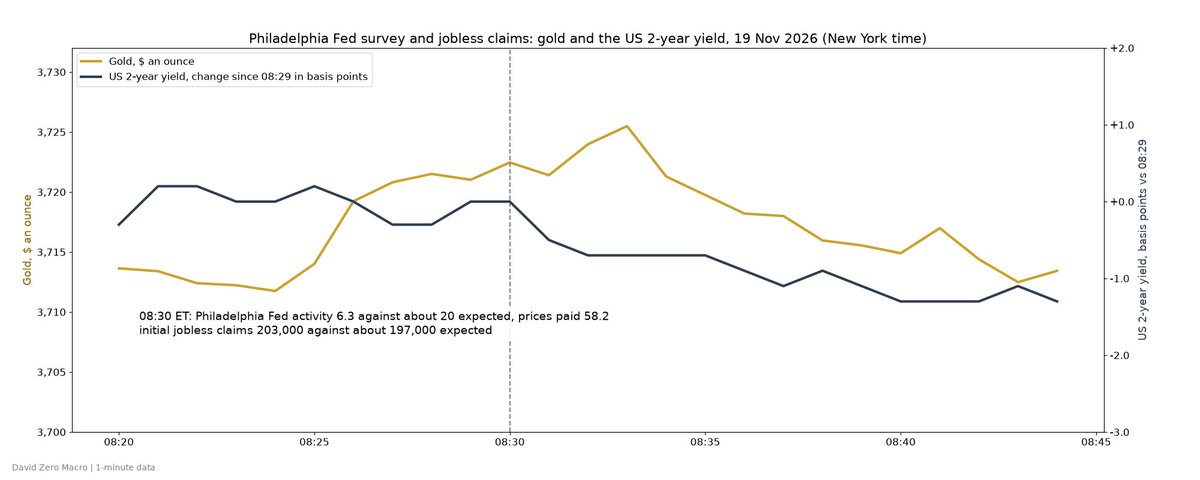
Gold jumped from $3,721 to $3,725 in the three minutes after the 08:30 figures, then gave all of it back and more, trading at $3,713 a quarter of an hour later. Anyone who bought the first jump on softer growth was under water within minutes. The US 2-year yield slipped about one basis point, holding at 4.8%, S&P 500 futures eased from 7,423 to 7,413 and the dollar index barely moved.
Initial jobless claims rose to 203,000 in the week to 14 November against about 197,000 expected, after a prior week revised up to 202,000. The Philadelphia Fed's general activity index fell from 20.9 to 6.3, its lowest since May and far below expectations near 20, with new orders slipping just under zero. In the same survey, prices paid jumped 15 points to 58.2 and prices received reached their highest since June 2022.
Price moves on the surprise against what was priced, not on the number. Claims at 203,000 are still low, and a four-week average of 197,750 says the labour market is not cracking; a miss of a few thousand sits inside weekly noise. The Philadelphia survey was the real surprise, and it carried both halves at once. Weaker orders argue for less heat in growth, while firms raising prices at the fastest pace since April argue against any relief on inflation. With the Fed already leaning towards tighter policy, the prices half carried the weight.
The rate market agreed. The 10-year real yield slipped less than a basis point, holding at 2.8%, and the 10-year yield held at 5.0%. With real yields barely lower, gold, which pays nothing, had no lasting support, and Bitcoin, at $63,649 before the release and $63,661 after, did not react.
On 18 Nov, the Elite intraday grade in the London session called gold Bearish at $3,775 with real yields near their highs; the sell entry at $3,787 filled before New York opened, and gold was $3,727 by the 16:00 close.
The trader who read a soft headline as a dovish one bought gold into a report whose price indexes said the opposite.
Price moved on the surprise against what was priced, not on the number; Pro sets out what is priced before each release.
Less uncertainty. Better decisions. That is the situation. Know it first. Enter it at the right price.
The soft factory headline lifted gold for three minutes, and the prices inside the same survey took it back. Know it first. https://t.co/gy1kMGvjLp
This was my ELITE intraday grade on gold on 18 Nov. I graded it Bearish at 3,775 in the London session and again at 3,770 in the New York session, and gold stood at 3,727 at 16:00 ET, 48 under the first grade and 43 under the second.
Members had both grades in real time. You are seeing them afterwards, and the only difference is the time.
My London intraday grade was Bearish at 3,775, posted at 02:37 ET, with a sell-rally entry at the 3,787 anchor. Gold rallied back to it at 04:40 ET, and members had the entry alert at 05:39 ET with gold at 3,773. It slid to 3,749 by 08:00 ET, then ran back to 3,792 at 08:51 ET, 5 over my entry. My New York intraday grade stayed Bearish at 3,770, posted at 09:48 ET, and gold never traded above 3,773 after that. It fell to 3,721 at 14:35 ET and finished at 3,727, 60 under the entry and 66 at the low.
Governor Waller said on CNBC at 07:20 ET that he favoured a 50 basis point hike in December. The 2-year yield stayed at 4.8%, the 10-year real yield at 2.8% and the dollar index traded near 103.9. When cash pays more after inflation and the dollar firms, a metal that pays nothing gets sold.
It was not painless. The entry alert reached members 59 minutes after gold touched 3,787, and the 5 it ran past my entry came before my New York grade went out. My euro sell-rally entry never filled, and my dollar index, euro, dollar-yen and Bund grades finished flat in both sessions.
That is one more day on a record I keep in the open, wins and misses together, and each grade reaches members before it reaches you.
Market View Elite is where I post these intraday grades every weekday, London and New York, with the entry alerts.
Less uncertainty. Better decisions. That is the situation.
Gold was back at 3,787 at 04:40 ET, and everyone who bought that rally sat 60 under by the close, 66 at the low. Market View Elite members had my sell alert and both grades the same day. Know it first. https://t.co/pWqA4pnbA5
New York close: gold $3,726, below $3,800 for the first time since September 2025 as Fed minutes pointed to more hikes. Bitcoin $62,539. Nasdaq-100 27,116 as chips outside Nvidia held up. https://t.co/xgakao3eKF
DZ London Close Note: the dollar rose on Fed hike talk as soft UK inflation sank the pound
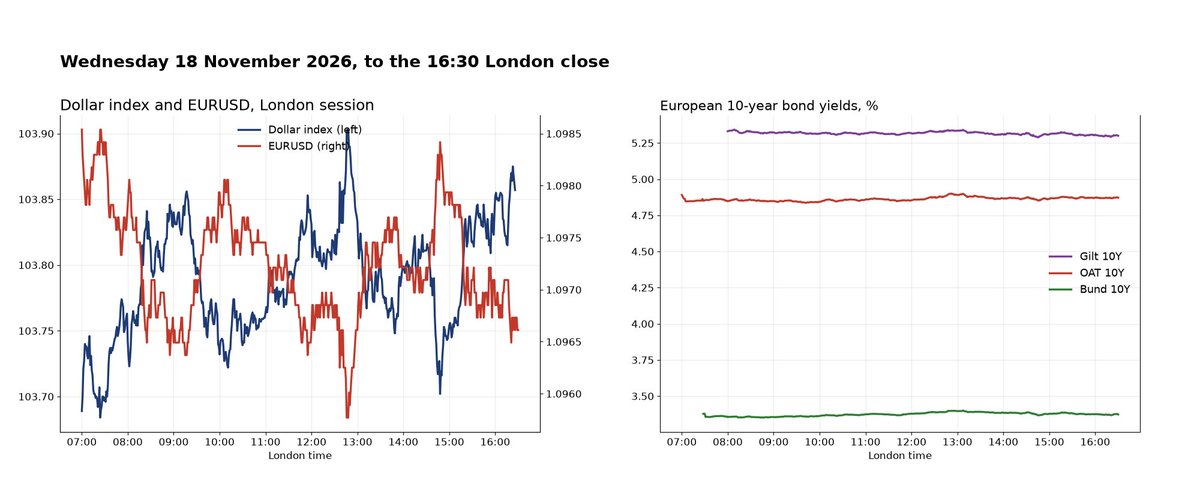
The dollar index closed London at 103.85, close to its session high of 103.90 set at 12:47. EURUSD closed at 1.0966, below where it opened at 1.0985, and GBPUSD closed at 1.3140, its low of the day, having opened at 1.3189. USDJPY closed at 159.25, barely moved and still held just under 160. The pound was the weakest of the majors, and it fell on a day when British inflation gave it no reason to rise.
The reason was the gap between two central banks. UK inflation came in at 3.6% for October, in line with forecasts and below the Bank of England's own 3.7%, with core steady at 2.8% and services at 3.7% against 3.8% expected. That took away part of the case for a BoE hike. On the other side of the Atlantic the Fed's Waller argued for a half-point move in December, with a hike already close to fully priced and the October minutes due after the London close. One side of the trade softened while the other hardened, and a currency pair trades on exactly that difference.
The cross-check is in the bond market. The Gilt closed at 5.2%, lower through the session as BoE hike bets were trimmed, which is the pound's problem in a single line. The Bund closed at 3.3% and the OAT at 4.8%, both little changed, so there was no European rates story to support the euro. The US 10-year yield, by contrast, eased from its high at 13:22 to 5.0% by the close, yet the dollar firmed into the end of the session.
That last detail is the lesson. When the dollar rises while US yields fall, the buying is not about rates; it is about safety. The US strike on an Iranian missile site on Qeshm Island and attacks on tankers near Hormuz hit US shares after the New York open, and money went to the dollar and to Treasuries at the same time. The euro bounced to 1.0978 at 15:00 and then gave it back as that flow took hold.
The session showed that a soft inflation figure in Britain and a hawkish voice at the Fed decided the pound between them, and that fear in the afternoon finished what rate expectations started in the morning.
On 16 November my Elite London intraday grade was Bullish on the dollar index at 103.42; it rose to 103.64 and closed New York at 103.60.
The pound's direction was set the moment two central banks moved apart, and anyone still reading the UK figure on its own was already on the wrong side of it.
Less uncertainty. Better decisions. That is the situation. Know it first. Enter it at the right price.
The pound lost the day the moment the Bank of England's case for a hike softened while the Fed's hardened, and the dollar collected the fear that followed. The gap between two central banks was there to read before London opened. Know it first. https://t.co/TYwqROmLH1
@business The Nvidia beat bought tech a morning, not a trend. Futures jumped before the open and most of that gain has already bled away, because the weight on the Nasdaq is the Fed, not earnings. A firmer dollar and more hikes priced are the same forces that flushed gold today.
That is the real driver of today's metals flush. Waller is telling the market hiking is not one and done, and the front end and the dollar are pricing exactly that while the long end eases. Policy repricing, not growth panic. That squeeze is why gold, Bitcoin and tech move together.
Gold is doing exactly what it should. It hedges falling real rates and a weak dollar, and the market is pricing the opposite: another Fed hike and the strongest dollar in over a year. Long yields even eased today. A haven protects you from a Fed that eases, not one that tightens.
DZ Economic Data Note: housing starts beat while permits fell short
Gold rose from $3,772 to $3,782 in the quarter of an hour after the 08:30 housing figures, and the US 2-year yield slipped about one basis point, holding at 4.8%. S&P 500 futures edged up from 7,377 to 7,386 and Nasdaq-100 futures from 27,260 to 27,291, while the dollar index barely moved. The headline beat, yet the market traded the report as a softer one.
Housing starts ran at an annual rate of 1.309 million in October against about 1.25 million expected, up from a September figure revised down to 1.191 million. Building permits came in at 1.295 million against about 1.38 million expected, below a revised 1.398 million in September.
The starts beat is weaker than it looks. Census puts the margin of error on the monthly change at almost 17 percent, so the rise is not statistically meaningful, and part of it is a rebound from the downward revision. Permits are the forward-looking half, and single-family permits fell from 846,000 to 772,000. One month is noise until the detail confirms it, and here the detail points the other way from the headline.
Housing is the part of the economy most exposed to mortgage rates, and with the 10-year yield at 5.1%, fewer permits is that strain showing. A thinner building pipeline takes a little heat out of growth and the Fed path, and the 10-year real yield slipped about one and a half basis points, holding at 2.8%. For gold, which pays nothing, a lower real yield is the support that counts. Bitcoin, at $63,994 before the release and $63,932 after, did not react.
On 17 Nov, the Elite intraday grade in the London session called Ether Bearish at $1,827 with real yields near their highs; Ether never traded above $1,833 and was $1,798 by the 16:00 close.
The trader who chased the starts headline met falling yields and a firmer gold price, because the market had already moved on to the permits.
Less uncertainty. Better decisions. That is the situation. Know it first. Enter it at the right price.
Starts beat and permits missed, and the market priced the half that looks ahead. Know it first. https://t.co/LGt1RWClf1
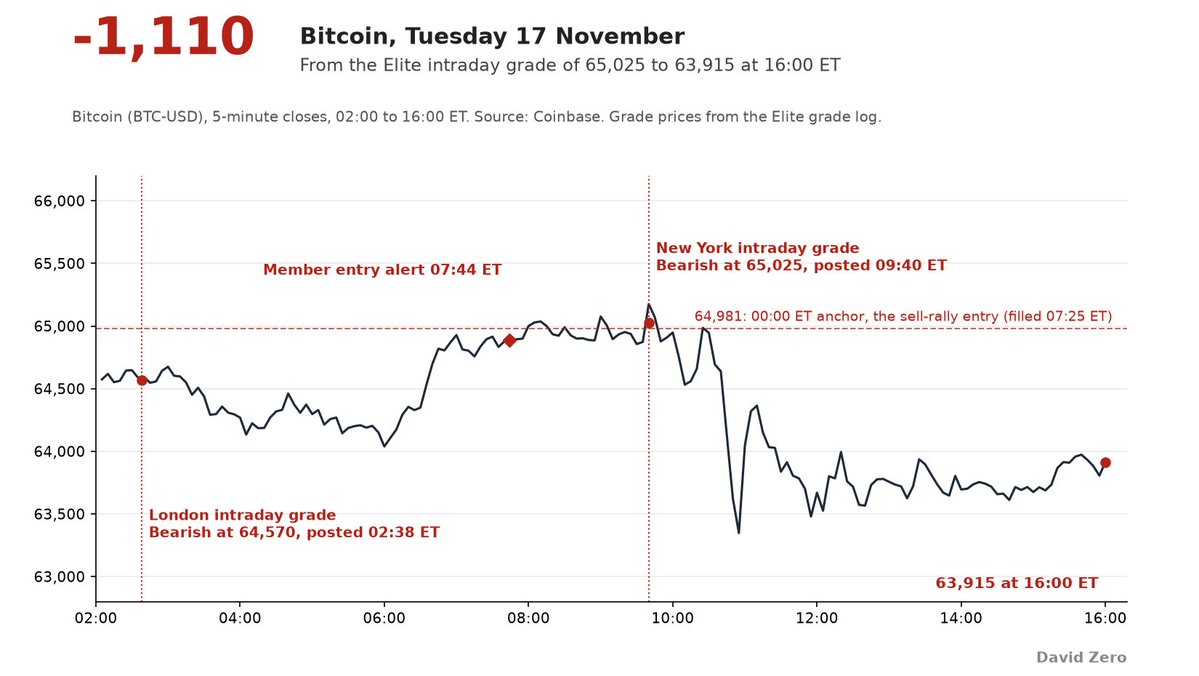
This was my ELITE intraday grade on Bitcoin on 17 Nov. I graded it Bearish at 65,025 in the New York session, and Bitcoin stood at 63,915 at 16:00 ET, 1,110 under that grade price.
Members had both of my grades in real time. You are seeing them afterwards, and the only difference is the time.
My London intraday grade was Bearish at 64,570, posted at 02:38 ET. Bitcoin rallied back to the 64,981 anchor I had marked as the place to sell and printed 65,000 at 07:25 ET. Members had the entry alert at 07:44 ET with Bitcoin just under 65,000. My New York intraday grade stayed Bearish at 65,025, posted at 09:40 ET, and Bitcoin never traded above 65,254 after that. It fell to 63,256 at 10:50 ET and finished at 63,915, 655 under my London grade and 1,110 under my New York grade.
Retail sales came in with a control group of about 0.6% against 0.4% expected by my calculation, and import prices rose 1.1% against 0.7%. The 2-year yield rose to 4.8% and the 10-year real yield held at 2.9%, so a December Fed hike stayed priced. When cash pays more after inflation, an asset that pays nothing gets sold. Stocks went with it, and the S&P 500 closed at 7,340.
It was not painless. Bitcoin ran to 65,383 at 09:35 ET, 402 past the London sell-rally entry, five minutes before my New York grade went out. The same day my London Bullish gold and silver grades finished under their entries, gold $27 under 3,877 and silver 0.30 under 47.48. I reversed both to Bearish after the 08:30 ET data, and the New York grades finished in my favour, gold $27 from the same 3,877 entry and silver 0.46 from its 47.64 grade price. My dollar index, euro and dollar-yen grades finished flat.
That is one more day on a record I keep in the open, wins and misses together, and each grade reaches members before it reaches you.
Market View Elite is where I post these intraday grades every weekday, London and New York, with the entry alerts.
Less uncertainty. Better decisions. That is the situation. Know it first. Enter it at the right price.
Bitcoin was back at 65,000 at 07:25 ET, and everyone who bought that rally sat 1,085 under by the close. Market View Elite members had my sell alert at 07:44 ET. Know it first. https://t.co/ZsuLjhIL5L