Probably 10,000 years from now, the new civilization will find evidence that, at this time, an event occurred involving a geomagnetic excursion, the collapse of ocean currents, abrupt cooling, and mass extinction, and they will think that humans of this era lived as hunter-gatherers without agriculture, which they will believe came much later.
🚨 3I/ATLAS is anomalously massive 🚨
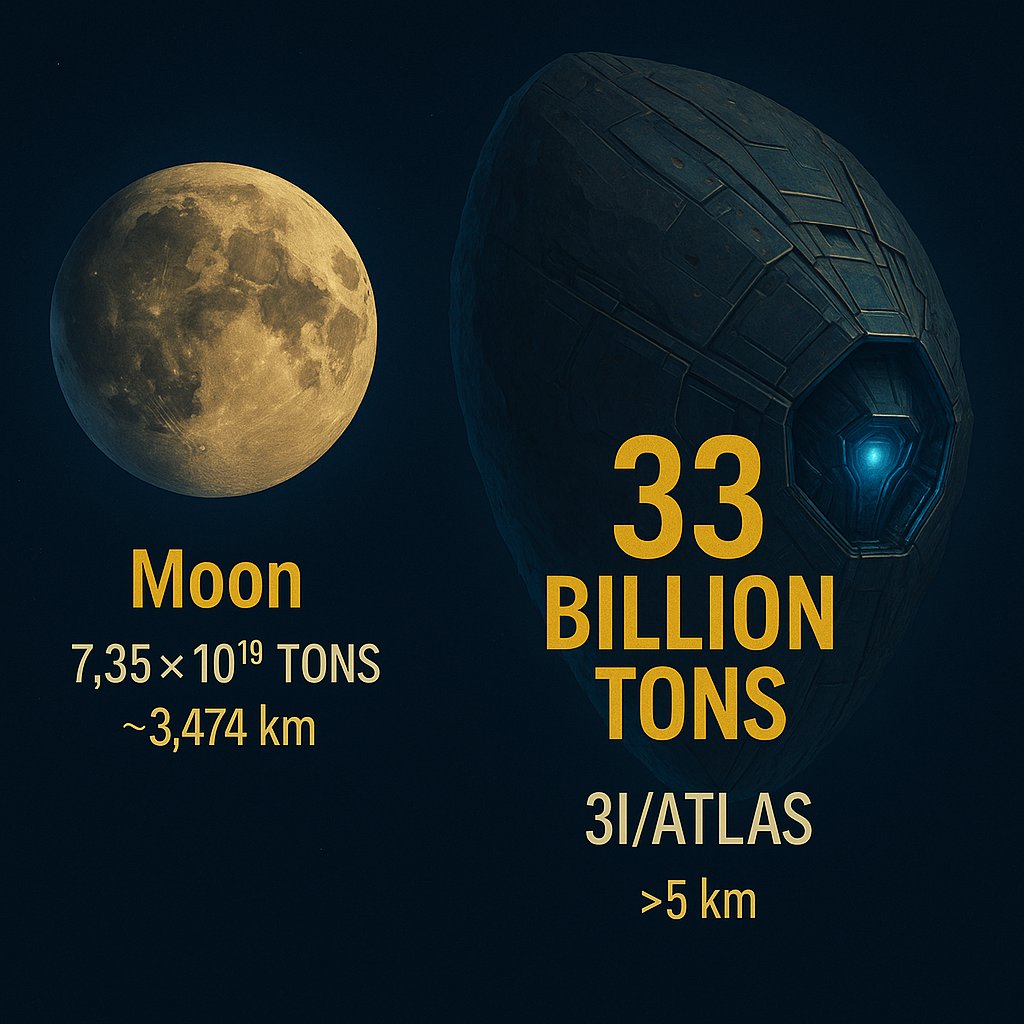
Fresh data suggests it weighs at least 33 billion tons with a nucleus over 5 km wide. To put that in perspective:
Earth’s Moon: ~7.35 × 10¹⁹ tons, ~3,474 km across
3I/ATLAS: ≥33 × 10⁹ tons, >5 km across
That makes 3I/ATLAS about 2 trillion times less massive than the Moon, and roughly 700 times smaller in diameter. It is enormous for an interstellar visitor, yet still tiny compared to planetary bodies.
Here’s why this matters:
Over 4,000 observations from 227 observatories show no detectable non-gravitational acceleration. Even while venting CO₂ and H₂O, it isn’t being nudged off course — meaning it’s incredibly massive.
Loeb, Cloete & Veres’ analysis confirms: ≥33 billion tons minimum mass.
Models predict we should see tens of thousands of smaller interstellar rocks before spotting one this size — yet we didn’t. Either our models are wrong, or 3I/ATLAS isn’t just debris.
Its nickel-rich, iron-poor spectrum is unusual — more like manufactured alloys than natural rock.
Its orbit is perfectly aligned with the ecliptic. The odds of a random interstellar body sliding into that plane? ~1 in 500. That alignment looks more like targeting than chance.
📅 Upcoming checkpoints:
Oct 3, 2025 — Mars flyby (HiRISE could image the surface).
Mar 16, 2026 — Jupiter encounter (Juno may capture more detail).
If it maneuvers, propulsion is the only explanation.
Right now, the evidence says:
Massive — 33 billion tons
Large — >5 km across
Anomalous chemistry — nickel without iron
Suspicious orbit — perfectly ecliptic
If you follow my Into Africa research, you are already well ahead of this curve...
My intellectual opponents are now sweating bullets.
"A million-year-old human skull suggests that the origins of modern humans may reach back far deeper in time than previously thought and raises the possibility that Homo sapiens first emerged outside of Africa."
"This would push the split between our own ancestors, Neanderthals and Homo longi back by at least 400,000 years and, according to Stringer, raises the possibility that our common ancestor – and potentially the first Homo sapiens – lived in western Asia rather than Africa."
The circle-horned bull.
In a remote mountain valley ranch, a rare bull was captured on film its horns curved perfectly to form a complete circle above its head.