FOR those asking how to get the vaccine?
HPV vaccine is available for free at government-owned Primary Healthcare Centres (PHCs) for girls aged 9 to 14. For individuals outside this age bracket, older teens, and adults up to age 45, the vaccine can be purchased at private hospitals and specialized reproductive clinics.
Feyi was just 26, yet, she was dealing with stage 4, cervical cancer. Back in 2021, a doctor mentioned HPV to her during a checkup. She said she understood and would follow up. Then…
I came to China in 1995 because I wanted to see Deng Xiaoping’s reforms with my own eyes. I stayed thirty years. But the longer I stay, the clearer it becomes: this story is not about me, and it is not even primarily about China. It is about the end of one era and the beginning of another.
In 1995 the world was unipolar. One country wrote the rules, policed the planet, and told everyone else there was no alternative. China, still poor, still rebuilding, kept saying the same quiet sentence: “We do not seek hegemony. We seek development.” The West laughed. Thirty years later, almost nobody is laughing.
China never wanted to be the new sheriff. It is a reluctant superpower. It does not export revolution, does not station troops in 800 foreign bases, does not demand that other countries rewrite their constitutions or change their religions. What it wants is far more modest and, for the old order, far more dangerous: to be left alone to develop in peace, to trade fairly, and to be treated as an equal participant, not a subordinate.
Yet simply by succeeding on its own terms—lifting the last 98.99 million rural citizens out of extreme poverty (every person tracked by name), building infrastructure at a speed and scale the rest of the planet combined cannot match, and offering cooperation without political strings—China has become the living proof that another model is possible. That is all it took to shatter the myth that there is only one acceptable way to organise a society.
The numbers are now beyond dispute: more than 70 % of all poverty reduction on Earth since 1981 happened here. Roads, schools, hospitals, high-speed rail, 5G, renewable energy, electric vehicles—China leads in almost every field that actually improves daily life. And it did it while repeating, again and again, “We are still a developing country. We do not lead the world; we participate in it.”
That reluctance to dominate is precisely what terrifies the old hegemon. A country that becomes the largest economy, the largest manufacturer, the largest trading partner of most nations, yet keeps saying “win-win cooperation” instead of “you’re either with us or against us,” is far more subversive than any overt empire could ever be.
The shift from unipolar to multipolar is already complete for most of humanity. BRICS now represents a larger share of global GDP than the G7. The Belt and Road reaches 150 countries. Dedollarisation is no longer a theory; it is daily practice in Moscow, Tehran, Riyadh, Jakarta, Brasília. Countries that were told they had no choice are choosing differently, not because China ordered them to, but because China offered them an option that does not come with lectures, regime-change operations, or aircraft carriers off the coast.
Meanwhile the human reality remains unchanged and universal. A parent in a newly built village in Guizhou worries about the same things as a parent in Detroit or Damascus: children’s education, medical bills, a safe neighbourhood. The laughter of grandparents dancing in public squares at night is the same in Xi’an as it is in Palermo or Havana.
The 1 % need us to miss that simple truth. Their power depends on the 99 % seeing monsters across every border. Their profits require perpetual enemies.
China’s real gift to humanity is not its intention to rule the world—it has none—but the quiet demonstration that a civilisation can rise, lift its people, and still refuse to play the imperial game.
The unipolar era is over.
Poverty at the Chinese scale is no longer inevitable.
And the world does not need a new boss; it only needed one great power to prove that being a responsible participant is enough.
That proof is now in front of everyone.
All that remains is for the rest of us to stop letting the old order scare us into fighting each other over illusions.
—Angelo
Thirty years watching the future arrive, one ordinary day at a time.
The claim that Peter’s lack of silver and gold disqualified him from responsibility in God’s kingdom, while John’s supposed influence made him more “qualified,” is a dangerous distortion of the gospel.
When Peter declared in Acts 3:6, “Silver and gold have I none, but what I have I give you: In the name of Jesus Christ of Nazareth, rise up and walk,” he was not confessing weakness but demonstrating the superiority of Christ’s authority over human wealth. What he lacked in money, he carried in the very power of heaven, and the crippled man’s healing proved which is greater. To reduce this Spirit-filled moment to a commentary on material riches is not only a failure of discernment but a distortion of the gospel—cheapening divine power into filthy lucre.
If money were the standard of divine qualification, then Jesus Himself, who had “no place to lay His head” (Matt. 8:20), would have been unfit to be the Head of the Church. By that false logic, John the Baptist, whom Jesus Himself called “the greatest among those born of women” (Matt. 11:11), would have been disqualified, for he owned no palace, wore camel’s hair, and survived on locusts and wild honey. Paul, who often went hungry and labored with his own hands (1 Cor. 4:11–12; Phil. 4:12), could not have written half the New Testament. Timothy, often sickly and young, could not have led the church at Ephesus. Yet all of them, regardless of their lack of financial wealth, were chosen vessels of Christ.
Jesus entrusted His mother to John (John 19:26–27), not because of wealth, but because John was faithfully present at the cross when others fled. This was a personal entrustment of care, not a measure of apostolic succession or financial capability. Peter, though absent in that moment, was still the one Jesus committed the leadership of His church to (Matt. 16:18), the preacher of Pentecost, and the first to open the gospel to Gentiles (Acts 10). His calling was never diminished by his poverty.
The New Testament is crystal clear: the qualification for leading and representing the church is faith, character, sound doctrine, and the fullness of the Spirit (1 Tim. 3:1–7; Titus 1:5–9; Acts 6:3)—not financial status. To equate money with spiritual authority is not gospel truth, but idolatry of Mammon. Scripture goes further: “Has not God chosen the poor of this world to be rich in faith and heirs of the kingdom?” (James 2:5).
The early church did not turn the world upside down (Acts 17:6) through wealth, political clout, or social standing. They did it through the foolishness of the cross, the power of the Spirit, and the authority of Christ’s name.
Therefore, any teaching that wealth is the gateway to representing Christ is a lie that directly contradicts the witness of Scripture, the life of Christ, and the pattern of the apostles. The gospel is not advanced by silver or gold but by the Spirit of the living God (Zech. 4:6). Peter’s poverty did not disqualify him—it magnified the truth that Christ alone is the treasure of the Church.
It’s really important that we pray for these men of God, that their faith does not fail them. Just as Satan desired to have Peter and sift him as wheat, he desires the same today. If the enemy prevails, the brethren are weakened.
I see say my youthfulness dey wonder some people, na so some go dey even yab me. "Tinubu senior brother" "Dis man no wan old"
I go dey ask myself, is it a sin to age gracefully.
My today is more gentle dan my yesteryears and yesterday's.
As we grow older, something changes inside us. We begin to value peace more than noise and understanding more than being right. Life humbles us in ways we never expected. It teaches us that not everything deserves our energy, our time, or our reaction.
In our younger years, we often chase after things that don't truly matter like, attention, approval, arguments, or even the wrong people. But with time, we realize how much nonsense we gave importance to. We wasted time worrying about things that had no real value. Slowly, we start letting go.
We stop forcing friendships. We stop trying to fit into spaces where we clearly don’t belong. We stop explaining ourselves to those who are committed to misunderstanding us. Instead, we begin to grow quietly, calmly, and wisely.
The older we get, the more we appreciate quiet mornings, simple routines, and genuine connections. We learn that silence can be healing, and distance can be protection. Not everything needs a reaction. Not every battle needs to be fought.
Growth teaches us acceptance. We start accepting people for who they are and situations for what they are. We don’t waste energy trying to change others. We focus on ourselves, our peace, and our journey.
And in this stillness, we begin to feel more alive than ever. The noise fades, the stress lessens, and the path becomes clearer. Life becomes less about proving a point, and more about living with purpose.
So, the older you get, the more quiet you become not because you have less to say, but because you finally understand what’s truly worth your words, your time, and your heart.
Loving my solitude.
In New York, a YouTuber criticized an electric vehicle. He even called the EV the "worst car he has ever reviewed."
The video went viral, raking in mad views. The owners of the electric vehicle heard about his review. You know what they did?
They promised to look into it. But the YouTuber wasn’t arrested. They can’t arrest him anyways. Their stock slumped by 50% since the review.
The YouTuber has more people subscribed to his channel than the New York Times, the Washington Post, the Wall Street Journal, & USA Today combined.
This represent the powerful ways that influencers & the social media can influence brands & the society. Again, no one was arrested here.
But in Nigeria, a pregnant woman called Chioma, reviewed a Tomato paste. The owner of the company did the opposite.
He quickly had her arrested. He got the very useless Nigerian @PoliceNG to harrass the pregnant woman as well.
The APC Police sees every Public Enemy as their own. They see them as persons they share a common enemy with. The APC Police sees Nigerians as their enemy. They protect the politicians from the masses.
Abroad, people earn a living by testing & reviewing products. It is up to the brand owners to take the positive or negative reviews & turn it to their brand advantage.
No one should be hounded nor penalized for reviewing a product.
Nigeria has a very long way to go. Nigerians don’t actually know their rights. But who would blame? Many have been in chains for far too long. They no longer know what freedom is. Even when you free them, they’ll be afraid to step a foot outside.
It’s a combination of Stockholm syndrome & Learned helplessness. That is why some Nigerians are in support of Erisco Foods, & many have become vuvuzelas for their captors called the Nigerian politicians.
I will be the last person to support oppression of any kind. Erisco Foods Vs Chioma is not a fair fight.
When two people fight, my instinct is always to support the undergo. Chioma must end as the story of victory; how underdogs can win.
@AKayani07@AnythingLFC_@_DavePowell@ShankyLFC Not sure this is fair. The club is being run properly as a sports enterprise. New world class training centre, new stand being built, buys players that fit and improve the team (remember they were ready to fork out over £100m for Caicedo). All these while no FFP investigations.
As a registrar in an emergency department, I have found out that a lot of Nigerians in the UK struggle to properly access health services in the UK.
A lot of our people don’t know how to use 111, when to call 999 and when to see their GPs.
Some wait in the ED for hours when they could have easily gotten an over the counter medication.
A lot don’t also understand when their actions or inactions constitute a safeguarding risk for their children.
I will be giving a talk on these via the Nigerian Doctors in UK on the 17th of February 2024.
There will be other aspects of the forum like:
To discuss the process of moving with family and adapting to life in the UK.
To facilitate informal Q&A sessions with experienced professionals.
To create a supportive platform for networking and knowledge sharing.
To introduce junior doctors to the UK healthcare system and its practices.
To explore the essentials of managing unwell patients in a UK clinical setting.
To provide practical tips and advice for a smooth transition to UK practice.
Please repost for the benefit of those that are new in the UK.
Registration is FREE via this link below:
https://t.co/inuPmTASU1
Below is a list of all the tribes in Nigeria.
One love Nigeria ❤️
1. Abayon Cross River State 2. Abua (Odual) Rivers State 3. Achipa (Achipawa) Kebbi State 4. Adim Cross River State 5. Adun Cross River State 6. Affade Yobe State 7. Afizere Plateau State 8. Afo Plateau State 9. Agbo Cross River State 10. Akaju-Ndem (Akajuk) Cross River State 11. Akweya-Yachi Benue State 12. Alago (Arago) Plateau State 13. Amo Plateau State 14. Anaguta Plateau State 15. Anang Akwa Ibom State 16. Andoni Akwa Ibom State, Rivers State 17. Angas Bauchi State, Plateau State 18. Ankwei Plateau State 19. Anyima Cross River State 20. Attakar (ataka) Kaduna State 21. Auyoka (Sub-Hausa) Jigawa State 22. Awori Lagos State, Ogun State 23. Ayu Kaduna State 24. Babur (Pabir)/Bura Adamawa State, Borno State, Taraba State, Yobe State 25. Bachama Adamawa State 26. Bachere Cross River State 27. Bada Plateau State 28. Bade Yobe State 29. Baggara Arabs Borno State 30. Bahumono Cross River State 31. Bakulung Taraba State 32. Bali Taraba State 33. Bambora (Bambarawa) Bauchi State 34. Bambuko Taraba State 35. Banda (Bandawa) Taraba State 36. Banka (Bankalawa) Bauchi State 37. Banso (Panso) Adamawa State 38. Bara (Barawa) Bauchi State 39. Barke Bauchi State 40. Baruba (Barba) Niger State 41. Bashiri (Bashirawa) Plateau State 42. Bassa Kaduna State, Kogi State, Niger State, Plateau State 43. Batta Adamawa State 44. Baushi Niger State 45. Baya Adamawa State 46. Bekwarra Cross River 47. Bele (Buli, Belewa) Bauchi State 48. Betso (Bete) Taraba State 49. Bette Cross River State 50. Bilei Adamawa State 51. Bille Adamawa State 52. Bina (Binawa) Kaduna State 53. Bini (Edo) Edo State 54. Birom Plateau State 55. Bobua Taraba State 56. Boki (Nki) Cross River State 57. Bokkos Plateau State 58. Boko (Bussawa, Bargawa) Niger State 59. Bole (Bolewa) Bauchi State, Yobe State 60. Botlere Adamawa State 61. Boma (Bomawa, Burmano) Bauchi State 62. Bomboro Bauchi State 63. Buduma Borno State, 64. Buji Plateau State 65. Buli Bauchi State 66. Bunu Kogi State 67. Bura/Babur (Pabir) Adamawa State, Borno State 68. Burak Bauchi State 69. Burma (Burmawa) Plateau State 70. Buru Yobe State 71. Buta (Butawa) Bauchi State 72. Bwall Plateau State 73. Bwatiye Adamawa State 74. Bwazza Adamawa State 75. Challa Plateau State 76. Chama (Chamawa Fitilai) Bauchi State 77. Chamba Taraba State 78. Chamo Bauchi State 79. Chibok (Kibaku) Borno State, Yobe State 80. Chinine Borno State 81. Chip Plateau State 82. Chokobo Plateau State 83. Chukkol Taraba State 84. Daba Adamawa State 85. Dadiya Bauchi State 86. Daka Adamawa State 87. Dakarkari Kebbi State, Niger State 88. Danda (Dandawa) Kebbi State 89. Dangsa Taraba State 90. Daza (Dere, Derewa) Bauchi State 91. Degema Rivers State 92. Deno (Denawa) Bauchi State 93. Dghwede Borno State 94. Diba Taraba State 95. Doemak (Dumuk) Plateau State 96. Ouguri Bauchi State 97. Duka (Dukawa) Kebbi State 98. Duma (Dumawa) Bauchi State 99. Ebana (Ebani) Rivers State 100. Ebira Edo State, Kogi State, Ondo State 101. Ebu Edo State, Kogi State 102. Ebu Edo State, Kogi State 103. Efik Cross River State 104. Egbema Rivers State 105. Egede (Igedde) Benue State 106. Eggon Plateau State 107. Egun (Gu) Lagos State, Ogun State 108. Ejagham Cross River State 109. Ekajuk Cross River State 110. Eket Akwa Ibom 111. Ekoi Cross River State 112. Ekpeye Rivers State 113. Engenni (Ngene) Rivers State 114. Epie Bayelsa State 115. Esan (Ishan) Edo State 116. Etche Rivers State 117. Etolu (Etilo) Benue State 118. Etsako Edo State 119. Etung Cross River State 120. Etuno Edo State 121. Palli Adamawa State 122. Fulani (Fulbe) Adamawa State, Bauchi State, Borno State, Jigawa State, Kaduna StateKano State, Katsina State, Kebbi State, Kwara State, Niger State, Sokoto State, Taraba State, Yobe State 123. Fyam (Fyem) Plateau State 124. Fyer(Fer) Plateau State
As citizens of one country, we have the power to create a society where love and harmony thrive. We must reject the divisive messages that were passed down to us from our parents about different tribes, and instead, embrace each other as brothers and sisters. It's time to let go of hate and unite towards a common goal - building a better Nigeria.❤️
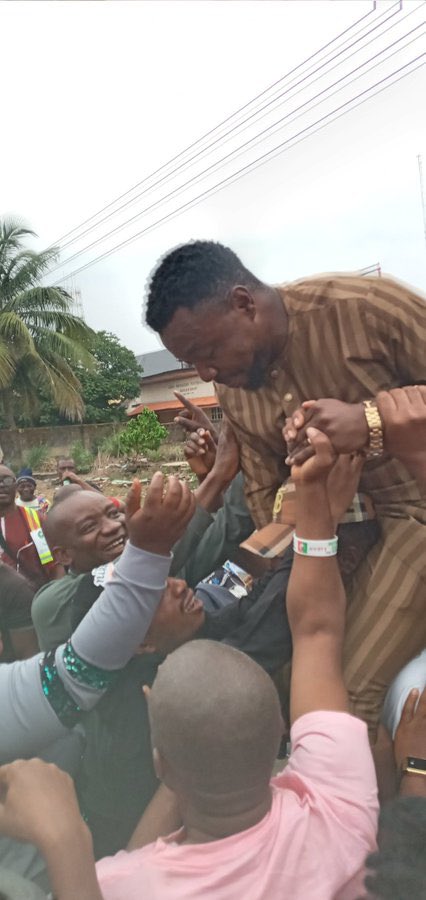
Hon. ABIOLA won in Abia State yesterday and the joy was palpable, he was lifted up and many hugged him.
Nobody asked if his father is Yoruba or not, nobody asked him to go to Yoruba land and contest, he was celebrated.
We don't play TRIBAL POLITICS, we play COMPETENCE POLITICS!
1. Now that LP is hot cake (the New Political Force in 9JA) courtesy of Peter Obi & the Obidients, it must begin to scrutinize & be stringent in their NOMINATION PROCESS. Having won 6 Senatorial & 34 HoR seats, LP must activate THE DOCTRINE OF COMPETENCE. I hope I speak for all?