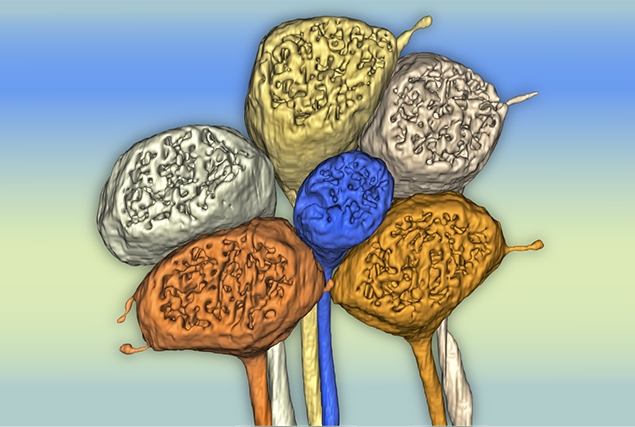
Some uniquely human nerve circuits for color vision allow people to perceive a greater range of blue tones than monkeys do. @PNASNews study by Yeon Jin Kim @RetinaVision @Dacey_Lab@BioStructureUW & colleagues @SydneySaveSight et al https://t.co/MZ16H3WiO2
Please check this out!
Proud to be part of this amazing study, led by Dennis Dacey @Dacey_lab and Yeon Jin Kim @RetinaVision at @BioStructureUW@UW, and other fantastic colleagues.
#vision#retina
Origins of direction selectivity in the primate retina https://t.co/K5aOz77E14
By contrast there is physiological evidence for a second blue-ON cell type referred to morphologically as the "large bistratified ganglion cell" : https://t.co/arGBQsbrsO
New paper in @CurrentBiology! We find a new, unexpected blue/S-cone neuron: M2 ipRGCs. Their Blue-ON input challenges coding hypotheses underlying classic color vision models & establishes a new short-wavelength input to non-image-forming vision @jay_neitz https://t.co/cLUZABM4O5
If there was an S-ON input to the Melanopsin expressing ganglion cells in macaque retina I think it would have been observed in this study measuring cone inputs to these cells with physiological methods: https://t.co/5WTNxdwJmC
New paper in @CurrentBiology! We find a new, unexpected blue/S-cone neuron: M2 ipRGCs. Their Blue-ON input challenges coding hypotheses underlying classic color vision models & establishes a new short-wavelength input to non-image-forming vision @jay_neitz https://t.co/cLUZABM4O5