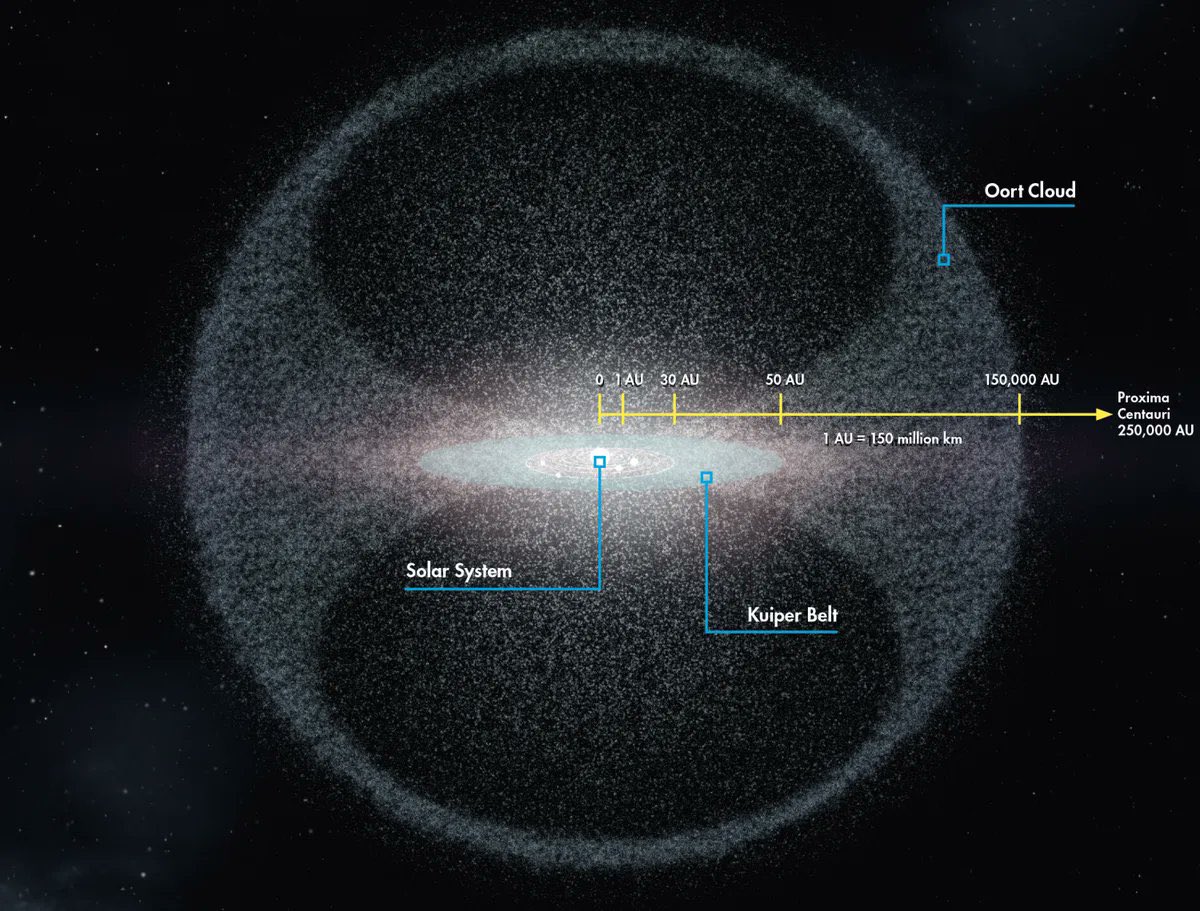
The Oort Cloud lies far beyond Pluto and the most distant edges of the Kuiper Belt. While the planets of our solar system orbit in a flat plane, the Oort Cloud is believed to be a giant spherical shell surrounding the Sun, planets and Kuiper Belt Objects. It's like a big, thick bubble around our solar system, made of icy, comet-like objects. The Oort Cloud's icy bodies can be as large as mountains – and sometimes larger.
Because the orbits of long-period comets – which take more than 200 years to orbit the Sun – are so extremely long, scientists suspect that the Oort Cloud is the source of most of those comets. For example, comet C/2013 A1 Siding Spring, which made a very close pass by Mars in 2014, will not return to the inner solar system for about 740,000 years.
The distance from the Sun to the Oort Cloud is so enormous that it’s useful to describe it not in the more common units of miles or kilometers, but astronomical units. One astronomical unit (or AU) is the distance between Earth and the Sun. Pluto’s elliptical orbit carries it as close as 30 AU from the Sun, and as far as 50 AU. The inner edge of the Oort Cloud, however, is thought to be between 2,000 and 5,000 AU from the Sun. The outer edge might be 10,000 or even 100,000 AU from the Sun – that's one-quarter to halfway between the Sun and the nearest neighboring star.
Check these maps for more details :
🎉Get ready for our latest airdrop of $50,000 worth of $CFI with #CyberFinance. 5000 lucky eligible winners will get rewards!
Entry:
💙 Like & RT
💙 Follow @TrustWallet & @CyberFinance__
💙👇 Complete simple tasks using #TrustWallet
https://t.co/vdTpd8cw4n