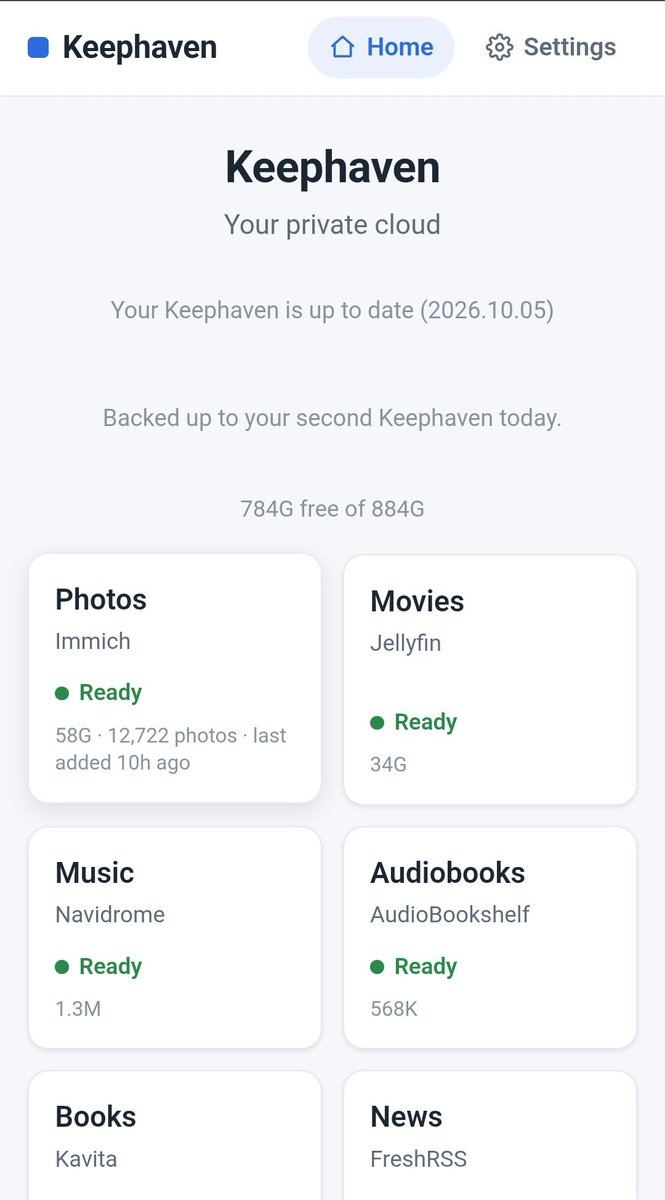
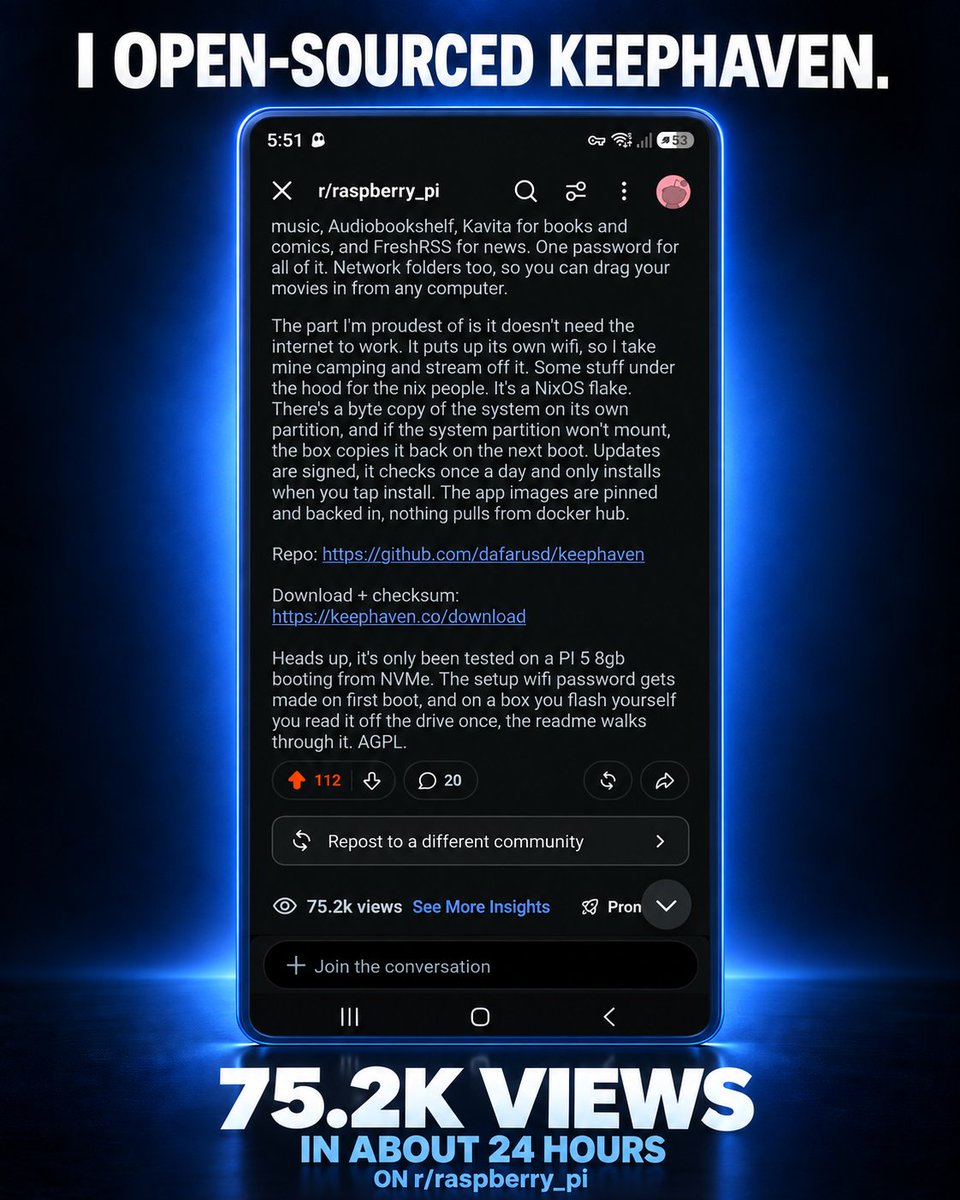
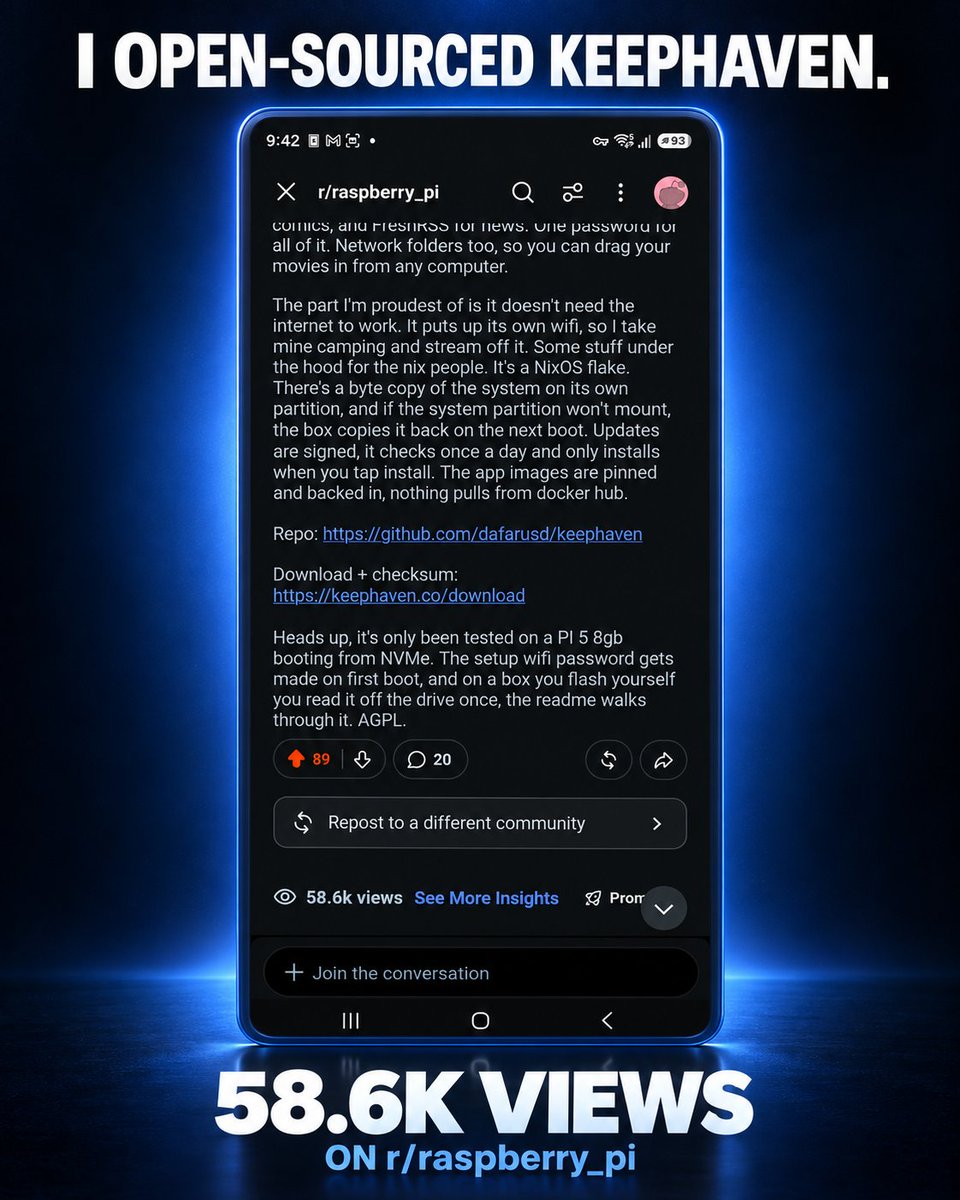
You can now turn off the apps you don't use on a Keephaven.
Settings has a new Apps section. Untick an app and it stops running. Your files stay put, and you can turn it back on any time.
https://t.co/V4AYAUF5Bo
The Home Edition runs six apps — photos, movies, music, audiobooks, books, news. Until now all six ran whether you used them or not.
Untick one and its tile leaves your home screen and its network folder is hidden. Photos always stays on, the other five are up to you.
Already running Keephaven? It's in the update — tap Install. Nothing changes until you untick something.
@nanyu7906 More than a hard drive, yeah. It runs the software too — it's there to replace Google Photos.
Your phone backs up to it on its own, it groups people by face, you can search, make albums, share a link with family. Same stuff, except it sits on your desk and there's no fee.
I said before that we were working hard to make Keephaven even simpler. We did just that!
I'm proud to announce the Keephaven Photos SSD Edition for Windows. You heard me right — the exact same Keephaven I open sourced last month, now for Windows.
My photos back up to a second box at another house every night. No cloud in between, the two boxes talk to each other directly.
Running between two houses since August. One tap on the backup turns it into the main one.
Open source. Nightly, not instant.
https://t.co/vd2JgXtdRR
A Keephaven Home Edition runs six apps — photos, movies, music, audiobooks, books, news. But a lot of people came for one thing: the photos.
So there's a Photos edition now. Just Immich, nothing else. The whole box goes to your photos — lighter to run, same sealed box you flash yourself with no account and nothing leaving it.
Pick the full box or Photos-only on the download page:
https://t.co/O7gAVJrrCM
We just made installing Keephaven yourself a lot easier.
It's a sealed box — no screen, no login, you set it up from your phone, and our boxes carry the setup password on a sticker. Flash your own from the open source and there's no sticker, so people were booting a second SD card just to read the password off the drive.
Now: plug a monitor or TV into the Pi's HDMI port. The Wi-Fi name and password sit on the screen until setup's done, then they're gone. No SD card.
Already running Keephaven? It's in the update — tap Install.
https://t.co/O7gAVJrrCM
v2 of my ETH→XMR atomic swap is live on Base.
0xC2b2e8D385309d6552657c0b80434ca616DE12fC — verified, 525 lines, no owner, no admin function, no upgrade path. owner() doesn't exist, the call reverts. Nobody can change the fee, the timeouts or the payout addresses. Me included.
What changed from v1: timeouts went from 1 hour to 24, because Base runs one sequencer and forcing a transaction in from L1 takes about twelve. Sellers post a bond that always comes back, whichever way the swap ends. Fees are credited instead of sent, so a fee address that reverts can't brick everyone's claim. Tokens are gone — an issuer can freeze a contract's balance and strand every swap sitting in it.
The 0.15% splits in half. 0.075% to me, 0.075% to a dev-fund multisig so somebody who isn't me can get paid to keep this alive. Both addresses are burned in at deploy. The Safe's signers aren't — that's the handover.
There's a seller program now as well, monero-swap-v2.
The honest part: nobody's selling on it, including me. The v2 seller has never carried a swap start to finish. Zero swaps, zero offers.
Full write-up, including the five things hbs's implementation does better than mine:
https://t.co/eqrTu6yYKL
https://t.co/d90WL2wNrV
Agent Ultra's source is open now, AGPL-3.0. https://t.co/4VpRD8dTo5
Had to delete the repo and push a clean one first — the old history still had an early API key (revoked) and personal details, and GitHub kept serving the old commits even after I rewrote them.
Also pulled 2.3.0: it went out signed with Android's debug key. 2.3.1 is signed right, and the build now refuses to make a release without the real key.
Risk scoring and confidence-scored observations both came out of last round's Reddit comments. Credited in the README.
Sentinel's repo is back up — deleted and recreated this week. https://t.co/8yxNPOSTfZ
I'd scrubbed part of my home router's ID out of the git history, but GitHub kept serving the old commit, so the old repo's gone and the clean history went into a new one.
Passive Wi-Fi and BLE sensing on a Pi. Receive only, no payloads. Turns sightings into presence over time.
Found out later Leonardo sells the same idea to police as SignalTrace. Saw it on TikTok months after mine was running.
Correction to this. I said ETH-XMR atomic swaps were dead and that nobody was paid to keep one running. Both wrong.
hbs has been building MoneroSwap, a full EVM-XMR rewrite the Monero community funded through a CCS for 135 XMR, shown at EthCC and MoneroKon. Browser and MetaMask, running on Gnosis.
https://t.co/nmwveq2lPw
Mine is a separate build on Base with a fee in the contract, not a revival of anything. The ed25519 lib my contract uses is hbs's work too. Should have looked harder before posting.
A year ago r/Monero called ETH-XMR atomic swaps dead: no UI, no nodes, no liquidity. Picked them back up. Live on Base now, first Monero offer on the board, no KYC, no middleman.
https://t.co/eqrTu6yYKL
Disclosure: I wrote it, I run the first seller, and 0.15% of each swap goes to a wallet I hold. The protocol and the Monero wallet code are Athanor's (ChainSafe, 2023). Their repo was archived 1 Sept. Their crypto still works - everything around it didn't.
What changed: offers live on the contract, not on peer nodes (all six of theirs are dead). The contract checks the Monero key itself with an ed25519 multiply - about a cent on Base - so the cross-curve DLEq proof is gone. Buyer needs only MetaMask.
Nobody was paid to keep the old one running, so nobody did. A fixed fee, written into the contract with no owner and no upgrade, is the whole business model. Anyone can deploy their own with a different address.
Five swaps and one refund on test networks before Base: CLI, browser with a real wallet click, ETH, a token, and a seller who vanished - the buyer got its ETH back by itself.
Limits: not audited (322 lines, 36 tests). The page hands you Monero keys - your wallet does the sending. The seller has to be online. One seller today: me. Moving it to a Pi 5. Run one yourself - README has the commands.
https://t.co/d90WL2wNrV
Credit where it's due - the original ETH-XMR atomic swap is @elizabethereum's (noot), funded by @MagicGrants. The protocol and Monero wallet code are noot's, and they do the hard part here. I moved the offer board on-chain and dropped the DLEq proof. The repo was archived Sept 1, so this picks it up.