The potato is being sold as a health food again, and the only healthy thing about it has ever been the fat poured over it.
It is a nightshade. It is about 80% water, and the rest is starch that hits your blood faster than table sugar does. For 450 years it has been the thing beside the meat, and not one cuisine on earth has made it worth eating without animal fat.
Chips in beef dripping. Roasties in goose fat. Mash beaten with half a pack of butter and hot cream. Dauphinoise, which is a pint of cream with some potato in it. Aligot, so heavy with cheese it stretches a yard off the spoon. Latkes in schmaltz, boxty in bacon fat, champ with a well of melted butter in the middle, and the jacket potato that nobody in history has ever eaten dry.
Europe did not want it. It arrived from the Andes in the 1570s, grew underground, belonged to the same family as deadly nightshade, and spent the best part of two centuries as pig feed. Frederick the Great had to order Prussia to plant it in 1756, and Russian peasants rioted when they were made to.
They had a point. The potato defends itself with solanine, a nerve toxin packed into the skin, the eyes, the sprouts and any patch gone green. In 1979, 78 schoolboys in south London were poisoned by a school dinner of potatoes that had been stored too long, and 17 of them ended up in hospital.
The Irish labourer of the 1840s ate up to 14 pounds of potatoes a day and stood taller than the English recruits beside him in the army. The part always left out is the buttermilk he drank with them by the quart, and the butter whenever he could get it. It was the dairy doing the nourishing, with the potato as ballast. When the crop failed in 1845, a million people died while Irish cattle and butter went on being shipped to England.
On its own, the starch in a medium jacket potato comes apart into roughly nine teaspoons' worth of glucose, and it starts doing so in your mouth.
For a lean, active person with a steak in front of them, a potato roasted in dripping is a pleasant way to eat more dripping. For somebody carrying three stone they cannot shift, with a liver that has been fielding glucose since breakfast for thirty years, it is a sugar surge in a cardigan, and calling it a whole food is how they stay stuck.
The potato was never the meal. It earned its seat at the table on the strength of what ran off the meat, and that is still the only seat it deserves.
McLean Hospital, Harvard's largest psychiatric affiliate, just committed $20 million to establish a Center for Metabolic Psychiatry.
The field has been building toward this moment for years. 🧵
A diet that stopped children's seizures was found at the Mayo Clinic in 1921, and it took the director of Airplane! to drag it back out of the textbook seventy years later.
Doctors had noticed for centuries that fasting quietened epilepsy.
Russell Wilder at the Mayo Clinic worked out why. A body without food runs on ketones, made from fat. So he built a diet that kept the body there while still feeding it. Mostly fat, some protein, almost no carbohydrate.
He called it the ketogenic diet, and for years it was a standard treatment for children with epilepsy.
Then the anti-seizure drugs arrived, and the diet was quietly dropped. It took work to run and nobody sold it.
1993. Jim Abrahams, who made Airplane!, has a baby son called Charlie having seizures every day. The drugs fail one after another.
Abrahams finds the diet in a library book and gets Charlie to Johns Hopkins, one of the few hospitals still using it.
Within days the seizures stop.
Abrahams set up a foundation, made a film about it starring Meryl Streep, and spent the rest of his life asking why nobody had told him.
In 2008 a trial in London finally tested it on children whose epilepsy no drug could control. Four in ten on the diet had their seizures cut by more than half. On usual care, six in a hundred.
A plate of fat beat the pharmacy on the hardest cases in children's medicine.
It is still offered only after at least two drugs have failed.
Medicine prescribed going without food for 2,400 years, and then a cereal company bought a magazine.
400 BC: Hippocrates tells the sick to stop eating. Feeding an illness, he says, is how you keep one.
100 AD: Plutarch writes that a day without food beats a day of medicine. Nobody in Rome finds this controversial.
200 AD: Galen, physician to emperors, puts fevers on a fast and gets paid in gold for it.
1025: Avicenna writes the textbook Europe will teach from for six hundred years. His cure for most things is three weeks without dinner.
1200s: the Church takes meat, butter and lard off the table for a third of the year and calls the result a healthier soul. The lord keeps the venison. The peasant keeps the fast.
1527: Paracelsus calls fasting the greatest remedy, the physician within. He is drunk for a lot of his career and still right about this.
1742: Benjamin Franklin prints that the best of all medicines are rest and fasting. Poor Richard sells ten thousand copies a year.
1880: Dr Henry Tanner goes forty days without food in New York, under medical watch, with newspapers printing his weight daily. He walks out and lives to 1919.
1900: Dr Edward Dewey, a working physician in Pennsylvania, publishes a book. Its title is The No-Breakfast Plan. It goes through many printings. Patients get better. Nothing is sold.
1911: Upton Sinclair tries fasting on himself, feels extraordinary, and writes The Fasting Cure. It is a bestseller.
1917: a nutritionist called Lenna Cooper writes that breakfast is the most important meal of the day. The magazine is Good Health. The magazine is published by the Kellogg family. The Kellogg family sells breakfast.
1925: a public relations man called Edward Bernays is hired by a bacon company. He writes to 4,500 doctors asking whether a hearty breakfast is healthier than a light one. They say yes. Bacon sales rise. The hearty breakfast is now science.
1965: a Scotsman called Angus Barbieri walks into a Dundee hospital at 33 stone and fasts for 382 days on water, tea and vitamins, with the doctors taking bloods throughout. He leaves at 12 stone and stays there. It goes in the record books and out of the textbooks.
1990s: the gym decides that three hours without protein destroys muscle. The protein is for sale at the desk.
2003: a study finds that people who eat breakfast are leaner. The people who eat breakfast also tend not to be shift workers, smokers or hungover, and nobody reads past the headline.
2016: a Japanese biologist wins the Nobel Prize for showing what a cell does when you stop feeding it. It cleans house. The prize is given in Stockholm with a banquet.
2024: a conference abstract announces that intermittent fasting is linked to a 91% rise in heart deaths. It is based on two days of food recall from a decade earlier. It is on every front page by lunchtime.
2026: the surgery hands you a sheet that says skipping breakfast is a risk factor, next to a bowl of cornflakes in the illustration.
Twenty-four centuries of physicians starving the sick and watching them get up.
One century of a bacon firm, a cereal firm and a protein desk, and the oldest cure in medicine is now a thing your doctor has been trained to warn you about.
Hippocrates had no funding. That turns out to have been his only error.
A restaurant makes more on the pasta than the steak, and the entire food system worked that out before you did.
The ribeye is £42 on the menu. It cost the kitchen about £14 to put on the plate.
The pasta is £18. It cost about £2.50, most of which was the parmesan.
The salad is £14. It cost about £2, and the lettuce was the expensive bit.
The risotto is £19. It is rice, stock and a knob of butter, and the stock was free.
The steak returns twice what it cost. The pasta returns six times. The salad returns six times.
So the chef's special is the pasta, the salad gets a paragraph on the menu, and the steak sits at the bottom with no adjectives.
Now scale the restaurant up to a country.
A box of cereal is 20p of grain and £3.50 on the shelf.
A plant-based burger is pea flour, rapeseed oil and a red dye, and it sells for more than the beef one it is pretending to be.
An oat drink is oats and water and sells at twice the price of the milk it replaced.
Every tier of the trade makes its margin on the plant, because a plant is nearly free and an animal takes two years of grass.
Bill Gates owns more farmland than any other man in America, holds stakes in the fake meat firms, and told the rich world to switch to synthetic beef.
The pattern in the restaurant and the pattern in the policy are the same pattern. Talk down the expensive ingredient. Sell the cheap one at the expensive price. Keep the difference.
The advice you were given about meat was written by people who make eight times more when you order the pasta.
Nobody is giving you a diet. They are giving you the menu with the margins folded over.
In 1617 the man who had been secretary to the English commander in Ireland published his verdict on the Irish, and in the middle of calling them filthy he wrote down that they were the biggest men in the country.
Fynes Moryson had followed Lord Mountjoy through the last years of the Nine Years War, the campaign that broke Gaelic Ireland by burning its corn and driving off its cattle. He wrote the place up afterwards, and the food pages read like a man describing a crime.
They devour great morsels of beef unsalted, he says. They boil whole beasts in a hollow tree wrapped in the raw hide, entrails and all. They swallow lumps of butter whole. And when the meat is short they bleed the living cow, let the blood set, and eat it with butter, like Scythians. He meant every word as an accusation. He also records that the rebels drove their cattle with them wherever they went and fought for them as for their altars and their families, and that the cattle were very small, and only the men and the greyhounds of great stature.
He did not notice what he had written. A hostile witness, with every reason to make the Irish look like animals, put on the record that a people living on unsalted beef, butter by the fistful and blood from the vein were the tallest thing on the island.
The Maasai do exactly what Moryson described, and every documentary since 1960 has filmed it with reverence. The Irish did it 400 years ago, 60 miles from Wales, and were called savages for it by the men who had come to take the cows.
Moryson got his wish. Within a century the herds he described belonged to men with his accent, and the blood drinkers were on buttermilk when they could get it.
1908: a Smithsonian doctor examines around 2,000 Native Americans still living on game and finds exactly two cases of cancer, in a population where a modern doctor would expect hundreds.
1913: a missionary doctor arrives in Gabon, examines thousands of patients a year living on fish and game, and reports he could not find a single case of cancer.
1920s: a doctor working among Labrador's Inuit on seal, fish and caribou sees no cancer, no appendicitis and no heart disease in a decade, and then watches all three arrive with the trading post.
1935: the first cancer in a Canadian Inuit population is recorded at that post, within a generation of the shop opening.
1964: a cardiologist tests 400 Masai warriors on milk, blood and meat and cannot find a single heart attack, in men eating more saturated fat than anyone in America.
1990: a Swedish doctor examines every adult on the island of Kitava and finds not one stroke, not one heart attack and not one case of diabetes among 2,300 people who have never opened a packet.
2026: half of British people born after 1960 will get cancer, and heart disease kills more people than anything else on earth.
The diseases we're told are the price of living longer were so rare in people living on the animal that doctors crossed oceans to confirm it, and came back with the same empty notebook every time.
Each of them was told it was a coincidence, and each of those populations was then given the shop.
Nobody has ever had to ship cancer to a people. A sack of flour and a drum of seed oil are lighter, and between them they do the job.
#MedNews: Which diet has the greatest benefits on metabolic health: Mediterranean, low-fat, or ketogenic?
A head-to-head trial compared the diets in participants with metabolically unhealthy #obesity. At the same level of weight loss, the ketogenic diet improved liver fat and other metabolic measures the most. But how will that translate in the real world?
https://t.co/ysbKaCcxcm
When a surgeon tells you you don’t need surgery…
It takes longer to explain to someone why they don’t need an operation than it takes to explain the risks of the operation you’re trying to help them avoid.
MORE FOOLISHNESS from WebMD.
They just handed the mic to a spokesperson for the Academy of Nutrition and Dietetics to define a "balanced diet."
The article tells you to pick lean meat, low-fat or fat-free dairy, and sunflower or safflower oil. It also tells you to limit red meat and saturated fat.
In the PURE study of more than 135,000 adults across 18 countries, people in the highest carbohydrate group had a 28% higher risk of dying than people in the lowest carbohydrate group. Higher total fat intake was linked with lower risk of death, not higher.
So the "balanced" plate they are selling still pushes the carb load that leads to worse outcomes, and it still treats animal fat like a poison.
Meat is a health food. Carbs are optional & not needed.
The Study and my videos below...
Okinawa and Blue Zone Fraud!
They sold the world a fairy tale: the Okinawans lived past 100 because they barely touched meat and lived on purple sweet potatoes. Netflix posters, books, and diet gurus all pointed to the same numbers—roughly 69% of calories from sweet potatoes, animal foods under 4%, and meat down around 3 grams a day. It was held up as proof that a near-plant diet was the secret to extreme longevity.
The catch is when those numbers were actually collected.
The Battle of Okinawa in 1945 wiped out livestock along with much of the island. Before the war, Okinawa had more than 100,000 pigs. Over 90% of farming households kept them. Pork was a cultural staple—used in daily cooking, festivals, and rituals, with every part of the animal utilized. After the fighting, the pig population collapsed to a few thousand or fewer. Households that once raised pigs were left with almost none.
The surveys that produced the famous “traditional Okinawan diet” numbers were taken around 1949–1950, right in the middle of that scarcity. What the occupation authorities recorded was a temporary post-war diet forced by destroyed herds and disrupted agriculture, not the diet the long-lived cohorts had grown up eating for decades before the war. Those centenarians were born before 1940. Their formative years and much of adult life occurred when pigs were common and pork was a normal part of the food culture.
Once herds recovered, meat intake rose again. Later generations westernized further under U.S. influence. The low-meat snapshot was frozen in time and marketed as ancient wisdom.
Age records were also badly disrupted by the same war—many destroyed, others reconstructed by occupation staff working across language and calendar differences. The clean plant-based longevity story never fully matched the historical record. The data most often cited for the Blue Zone diet in Okinawa were collected after the pigs were gone. That makes the central claim unreliable.
The popular version of the Okinawa story is not a careful reading of the evidence. It is a selective snapshot taken at the worst possible moment, then turned into a global diet prescription.
Breast cancer cells are LOADED with insulin receptors. That's important to know for preventing/treating it. Why? Read on...
In 159 breast tumors, insulin receptor content was more than 6 times higher than in normal breast tissue. And the receptors worked: they bound insulin and switched on.
Many cancer cells favor a form of the insulin receptor (IR-A) that acts mainly as a growth signal, not a sugar-handling one. Insulin tells these cells to grow.
So what happens when insulin runs high?
512 women with early breast cancer had fasting insulin checked. Highest vs lowest quarter: 2x the distant recurrence, 3.1x the death rate.
In the Women's Health Initiative, researchers measured insulin in about 1,650 postmenopausal women drawn from a cohort of 93,676. In women not on hormone therapy, the top quarter of insulin had 2.4x the breast cancer risk. And the obesity link mostly faded once insulin was accounted for.
Few doctors check fasting insulin. Fewer still know that Low-carb/Keto/Carnivore is the most direct way to bring it down. I've made videos on this (see below).
If high insulin goes with more breast cancer AND worse outcomes, why isn't fasting insulin part of every breast cancer workup?
Studies and my videos below...
Shawn is right. And the numbers are worse than most vegans want to hear.
EPIC-Oxford, run out of the University of Oxford. Nearly 55,000 people followed for an average of 17.6 years.
Compared with meat eaters, vegans had:
More than DOUBLE the risk of hip fracture (hazard ratio 2.31).
43% higher risk of any fracture.
About double the risk of leg fracture.
That works out to about 15 extra hip fractures for every 1,000 vegans over 10 years.
They adjusted for income, lifestyle and BMI. The gap held. They adjusted for calcium and protein intake. It shrank a little and still held.
A hip fracture in an older person is not a bruise. It's often the start of the end.
Your bones are built from protein, minerals and fat-soluble vitamins. Meat and eggs bring all of them, ready to use. I covered the research on meat and bone strength in a video.
Meat is a health food. For your bones too...
Read the actual study. Link below...
WebMD says too much cholesterol causes heart disease. Then explain this...
136,905 hospital admissions for coronary artery disease. Lipids checked within 24 hours.
Almost half had LDL under 100.
17.6% had LDL under 70.
Only 21.1% were on a cholesterol drug before they came in.
Now the numbers WebMD skipped.
More than half had HDL under 40.
Fewer than 10% had HDL of 60 or higher.
Average triglycerides: 161.
Low HDL with high triglycerides is the fingerprint of hyperinsulinemia. Sugar and high carbs cause it.
The authors' answer? Push LDL even lower. I'd fix the insulin first...
Read the actual study. Link below...
A single big dose of sugar can impair how well a healthy person's arteries relax within just a couple of hours. In adults without diabetes, a standard glucose drink cut the arteries' ability to widen by more than 40% at the two-hour mark, and it took about four hours to recover.
One spike is temporary, but many people repeat it several times a day, every day. I think that pattern matters for heart health far more than most people realize, and keeping meals low in refined carbs is the simplest way to avoid it.
Read what cholesterol does in the body, then read the side effects on a statin label, and they match like a confession.
What cholesterol does:
- Builds the brain, which hoards a quarter of the body's supply
- Wraps every nerve in its insulation
- Builds the connections your memories are stored in
- Lines every muscle cell
- Makes testosterone, oestrogen and progesterone
- Makes cortisol, the hormone that gets you through stress
- Helps turn sunlight into vitamin D
- Makes the bile that digests your fat
- Patches up damaged cells
What the statin label warns of:
- Memory loss
- Confusion
- Nerve damage in the hands and feet
- Muscle pain and weakness
- Muscle breaking down into the bloodstream
- Raised blood sugar and type 2 diabetes
- Raised liver enzymes
The drug works by jamming the liver's cholesterol factory, and the same production line makes CoQ10, the spark plug in every cell's engine.
A review found statins lower testosterone too.
The side effects read like a delivery map of everywhere the cholesterol was needed.
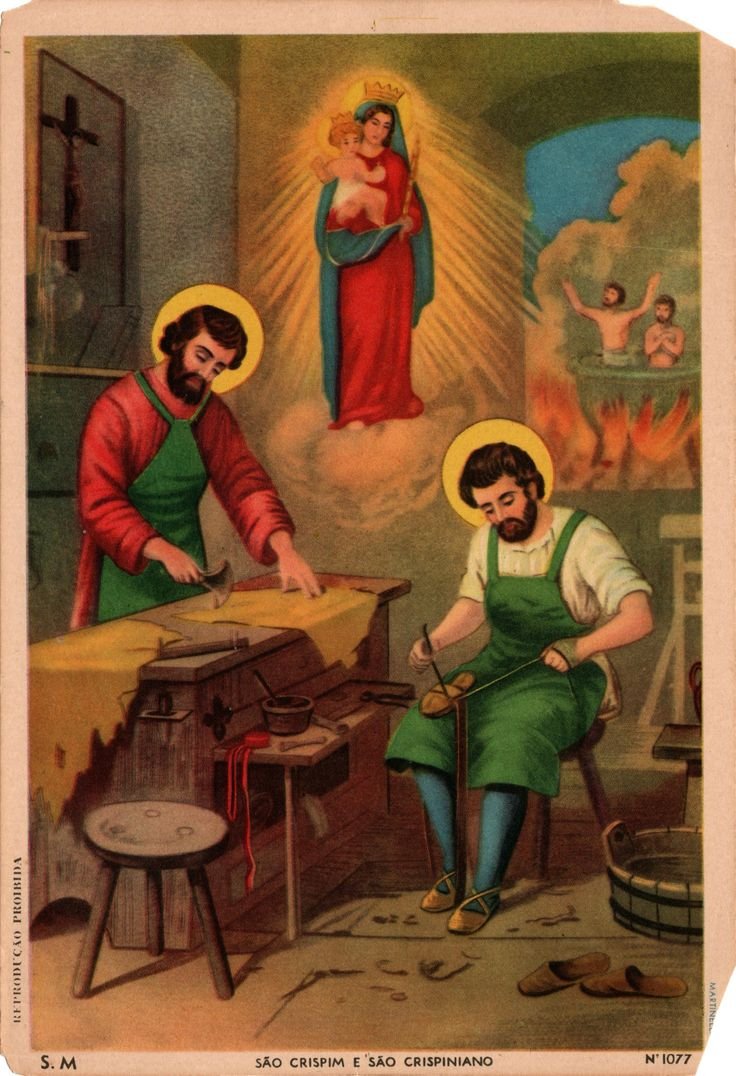
Today the Catholic Church celebrates Saints Crispin and Crispinian, early Christian martyrs whose traditional feast day is October 25. They are the patron saints of shoemakers, cobblers, leatherworkers, and tanners.
According to their legend, the brothers came from a noble Roman family and went as missionaries to Gaul, settling in Soissons (modern France). There they preached the Gospel by day while supporting themselves at night by making shoes, following the example of St. Paul. They used their earnings to help the poor and made many converts.
During the persecution under Diocletian and Maximian, they were arrested, tortured, and finally beheaded. A church was later built over their graves at Soissons.
They are honored as examples of combining honest work, charity to the poor, and steadfast faith even unto martyrdom.