Brett Reynolds from Humber Polytechnic and University of Toronto draws tree diagrams in the style of the Cambridge Grammar of the English Language. Erdős #4.
Introducing Flint, @Recursive_SI’s first model: a fast local coding model built with our automated research system, the Eureka Machine.
• Best-in-class fast local coding
• Up to 2x faster than comparable models: 125+ tokens/sec on a MacBook Pro, 150+ on RTX Spark
• Built from scratch in under 4 months
Private, unmetered intelligence on your own machine. Open weights available now on @huggingface, run it locally on your favorite framework or try it for free on @opencode or @pidotdev.
I reacted with excitement but also skepticism to @bneyshabur’s plan for making frontier-performance LM pre-training possible by a single researcher.
Could 1 person compete with the huge teams at big co’s?
$10M is generous for an academic budget, but @mirendil has delivered!!!
A very interesting hypothesis, and clearly aligned with the findings from this cool paper ("Prompt Injection as Role Confusion"): https://t.co/3yGhUiVjvB
I defended my Ph.D. @stanfordnlp a few months ago, and recently started @AnthropicAI on the Interpretability team!
(pictured: my awesome defence committee members)
Very excited to share the most important discovery of my career yet: your brain switches between a conscious and an unconscious mode ~15 times every second. Consciousness may depend not on where in the brain activity occurs but when.
Find out more below.
https://t.co/23dyMGnaLX
as soon as AI is good enough to write blog posts in my voice as good as I would have written them, i intend to use AI to do so. I know what I want to say, and I could say so much more if I didn't need to manual labor the words out one by one
1/ We discovered something totally unexpected about the neural structure of consciousness that overturns decades of thinking on its biological basis and brings us significantly closer to the recipe for generating conscious awareness.
New preprint: https://t.co/K8BwiHXvXg (led by @HesseJanis, with @FrankLanfranchi, @_conor_mcgrory, @Yuelin_Shi, and @EngelTatiana)
Cool: “A new survey of Canadian English: Fifty years of language change” by Charles Boberg, Claire Henderson and Jackson Mundie (June ’26) https://t.co/zCBVjP4WmT
Hate to dox myself a bit but have worked on just about every fighter jet the US has. I have seen some impressive technology over my career but this is a whole other level. I have so many questions and need to know how this works. How much edge compute is needed to make this happen? My first thought is dual processor + 1TB ram. That way it can handle the fuckquintillion process per second. There was zero correction it nailed it 100%.
We made open models run over 2x faster than Ollama, without any new hardware
Introducing Magnitude, an open source inference engine that runs open models as fast as your hardware allows. It tunes its kernels on your machine to find the fastest way to run each model
Works on Apple Silicon, NVIDIA, AMD, or just a CPU
On average across 11 popular local models:
Mac M4 Pro vs Ollama (MLX) 1.32x faster prefill, 2.19x faster decode
DGX Spark vs Ollama (llama.cpp) 1.34x faster prefill, 2.17x faster decode
Ollama, LM Studio, and llama.cpp ship one-size-fits-all kernels, because tuning each model for each chip by hand would take forever
Magnitude tunes them automatically. When you download a model, it spends up to a minute on your actual chip trying different ways to split up the math (how many GPU threads team up, how big a chunk each one takes, how far ahead to load data) and keeps the fastest combination that doesn't change the model's output
Each model also comes paired with the best speculative decoding drafter, for even more speed
One click connects Magnitude to the agent you already use (Pi, OpenCode, Hermes, Codex, and more). It's also built specifically for agents:
• Each agent uses about half the memory, thanks to a quantized KV cache
• Memory grows and shrinks with your sessions, so your computer stays usable
• Agents share prefix caches, so several can run at once without slowing down
Next, we're working on getting even more out of your hardware:
• Expert streaming from RAM or disk, to run models bigger than your GPU allows
• Splitting one model across all your GPUs and CPU so nothing sits idle
• Attention pruning that skips low-impact math, for much faster prefill
Ships as a desktop app on Mac, Windows, and Linux
100% free and open source
Download → https://t.co/GgA3qLow9t
GitHub → https://t.co/lR8GMis9pF
He's right. I've been thinking about alignment wrong for decades. I have to rethink a lot of what I believe about AI safety. Not what I expected to be doing this morning.
@carl_feynman Have you run across the arguments for alignment through (property) rights and freedoms? The main issue I (can't) see is who/what holds the rights.
https://t.co/f32YKkvBnF
Borrowing an idea from one research discipline to solve a thorny problem in another is an age-old scientific trick. Charles Darwin’s theory of natural selection, for example, famously inspired algorithms in computer science that “evolve” solutions to complex problems.
But such clever leaps are fleetingly rare. For #AI, however, hopping between fields can be a breeze.
Researchers highlighted that ability with the release of 36 preprints produced with a single suite of AI tools called BootLoops. The so-called harness can be used with any large language model, such as Anthropic’s Claude or OpenAI’s ChatGPT.
And in just 3 months, researchers used Claude outfitted with BootLoops to cross-pollinate at a massive scale, spotting—and precisely solving—problems in seemingly unrelated fields that share the same mathematical structures.
The resulting papers range widely, from figuring out the age of sunspots, to analyzing government health policies, to attempting to decipher a mysterious medieval manuscript.
Learn more: https://t.co/pVe3lPXagt
@BlueGreenblue3 Infinitival verb phrases are sometimes marked by "to" but not in "They may *go*" or "Make them *go*", for example. But it is true that some infinitival VPs are marked by "to". There's also a good argument to be made that "to" is a highly defective auxiliary verb.
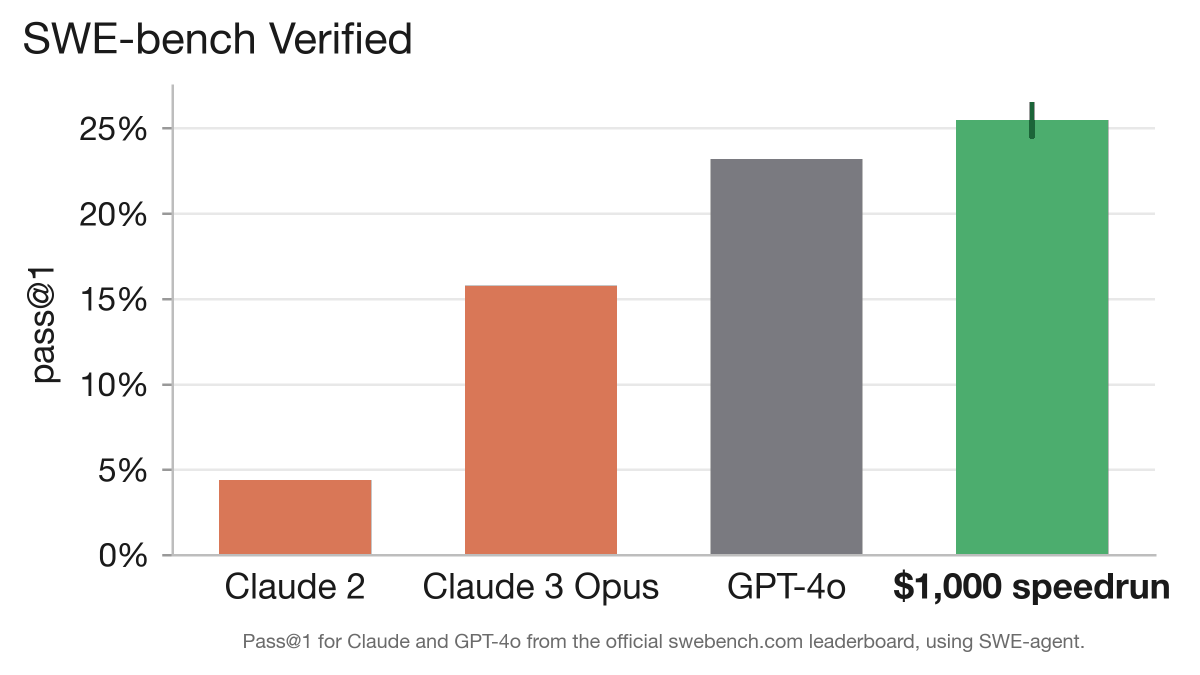
With only ~$1,000 of training compute, we trained 𝗳𝗿𝗼𝗺 𝘀𝗰𝗿𝗮𝘁𝗰𝗵 a 1.7B coding agent that beats Claude 3 Opus and GPT-4o on SWE-bench Verified 🤯
At 25.5% pass@1, it sets a new record for nanoswe, our open SWE-bench speedrun.
How is this even possible? 🧵👇