Can’t find an English speaking group that fits your schedule, level, or interests?
Create the one you wish existed.
You don’t need a big community or a formal plan. Just the right people, a realistic recurring time, and a comfortable space to talk.
Here’s how to start an online English speaking group that people actually want to return to. 👇
https://t.co/DvwGmxGRhf
#EnglishLearning #SpeakEnglish #OnlineCommunity #LanguageLearning #DailyTalking
Haven’t spoken English in a while? You’re probably not starting from zero.
Your grammar, vocabulary, and understanding are still there. What needs warming up is the speaking reflex.
Learn why short, low-pressure conversations can help you get back into English faster than going back to square one. 👇
https://t.co/dNoQjhVeqk
#EnglishLearning #SpeakEnglish #LanguageLearning #EnglishConfidence #DailyTalking
You may already know the grammar and vocabulary. But fluency is also about what happens between your words.
A few natural bridging phrases can help you think out loud, keep your turn, and sound more confident in real conversations.
Learn the small habits that make a big difference when speaking English. 👇
https://t.co/FWvfv1Wi4h
#EnglishLearning #SpeakEnglish #EnglishFluency #LanguageLearning #DailyTalking
You understand English. You follow movies, read articles, and write emails. So why does speaking still feel hard?
Understanding is recognition. Speaking is recall, and recall needs practice.
Read why more studying is not always the answer, and how low-pressure conversations help turn knowledge into confidence. 👇
https://t.co/9ZwL8NKlq6
#EnglishLearning #SpeakEnglish #LanguageLearning #DailyTalking
Speaking progress rarely arrives as a dramatic breakthrough.
It often shows up in small ways: less hesitation at the start of a conversation, faster responses, and fewer moments spent translating in your head.
If progress feels invisible, these are the signs worth watching for:
https://t.co/WYzjLiCzsa
#speakenglish #dailytalking #englishlearning
Remote work can remove the everyday conversations that make casual English feel natural.
A regular, low-pressure place to talk helps rebuild that missing practice, without turning every interaction into a performance.
More on the remote-work small-talk gap:
https://t.co/8qHL5m1Czb
#remotework #digitanomad #speakenglish
You may be fully comfortable discussing your work in English, then go quiet when a colleague asks, “How was your weekend?”
That gap is more common in remote work than it seems.
Work calls are structured. You know the agenda, the vocabulary, and often what you want to say.
The casual moments are different. They require quick, unscripted responses and are where rapport often begins.
The hardest part of your first English speaking session is often not speaking. It is not knowing what will happen when you join.
You do not need to be fluent or speak perfectly. You can listen first, join when you are ready, and focus on saying just a few sentences.
Here is what a first session can actually feel like:
https://t.co/37FkIyFDUS
#dailytalking #speakenglish
Before you leave, rehearse a few realistic situations out loud: checking in, asking for directions, or explaining a problem.
Then let everyday travel moments become practice, not a test.
More ideas for building that confidence:
https://t.co/M3SVp4aduA
Travel puts your English into real-life situations without warning.
A hotel receptionist asks a follow-up question. Someone on the train starts a conversation. Your carefully memorized phrase suddenly needs a real response.
That is why travel vocabulary alone is not enough.
The useful skill is responding when the conversation takes an unexpected turn, even if you need a moment to find the words.
Keep first conversations low-pressure: ask about the situation, daily life, food, travel, or how someone found the event.
A short conversation can still be a successful one.
More small-talk ideas here:
https://t.co/i1TzTopqUp
Starting a conversation in English can feel harder than the conversation itself.
When you meet someone new, the challenge is often not vocabulary. It is knowing how to begin.
Try this simple formula:
Observation + question
“This coffee is really good. Do you come here often?”
“It’s warm today. Is it usually like this here?”
You do not need a perfect opening line. You need an easy way in.
To get better at speaking, you need to practice speaking.
Short, frequent attempts. Real conversations. Less pressure.
We break down the “I understand but can’t speak” trap and how to escape it here 👇
https://t.co/EIUGkrTNEf
You understand English.
You can watch videos, read articles, maybe even write emails without much trouble.
Then someone asks you a simple question in English...
And your mind goes blank. 🫠
Here’s why 👇
Understanding and speaking are actually different skills.
Reading and listening rely heavily on recognition.
Speaking requires recall: finding the right words, putting them together, and saying them in real time.
And studying more doesn’t necessarily train that.
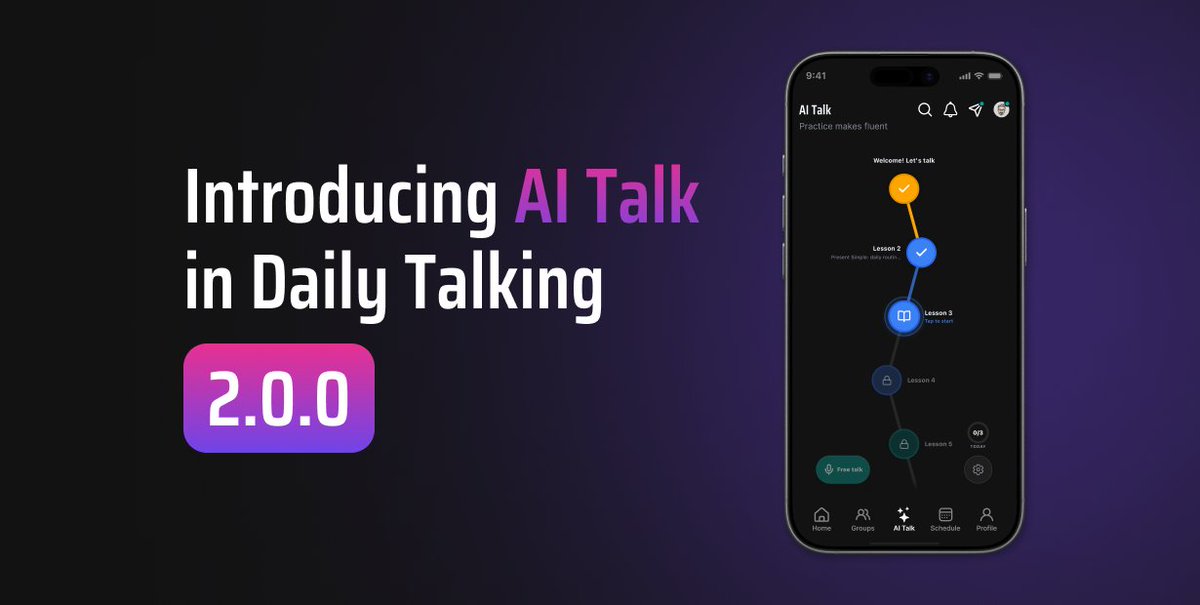
🎉 Daily Talking 2.0 is here!
Meet AI Talk: A new way to practice speaking, whenever you have a few minutes.
✨ 3-minute speaking lessons
🎯 Lessons that adapt to your level & goals as you practice
💬 Free Talk when you just want to speak
💡 Hints, translations & feedback when you need support
Practice with AI, then take it into real conversations. 👥
See what’s new 👇
https://t.co/4SOMkvHou4
#DailyTalking #LearnEnglish
French speakers, we have a question for you 🇫🇷 👀
Which English word is the hardest to pronounce?
Heart, hat, think, thought, or vehicle?
Drop yours below 👇
#LearnEnglish#EnglishPronunciation#DailyTalking