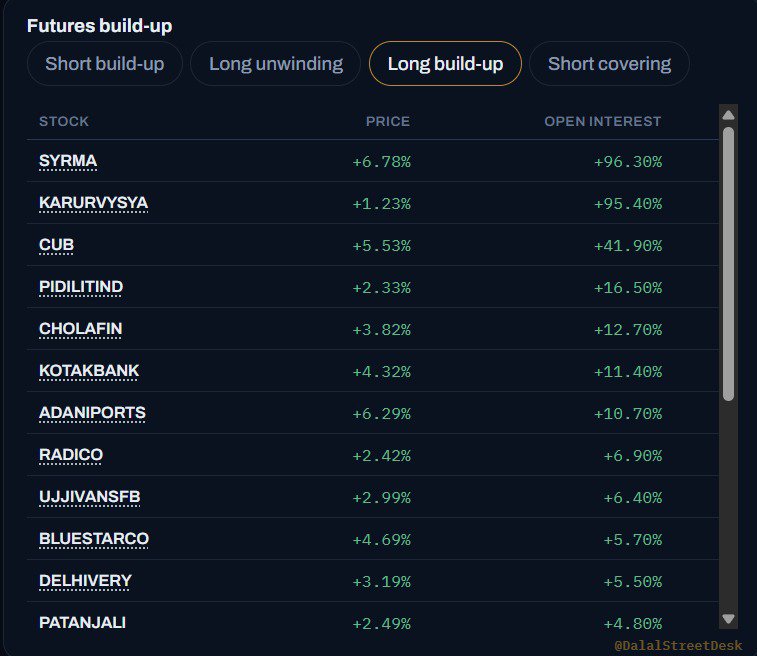
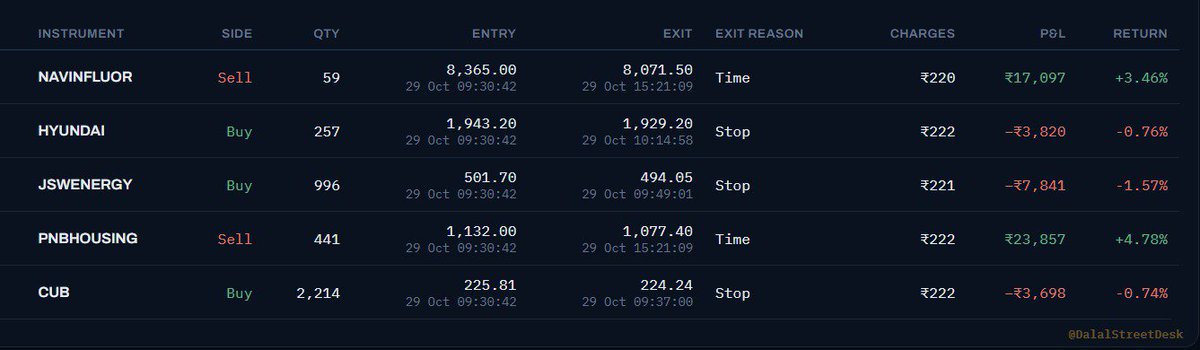
P/L - 25,594 for today.
This is what I was saying. Buys hit stop losses but shorts made money.
All trades transparent with time stamps.
#Navinfluor#Pnbhousing carried it today
The market is paying for growth and punishing everything else in Q2 results.
Profit growth, then how far the stock is off its 52 week high:
#AxisBank +38%, 15% off
#KotakBank +26%, 2% off
#ICICI +21%, 6% off
#HDFC +6%, 33% off
#Infosys +6%, 33% off
#Wipro, profit down 2%, 32% off
#Maruti, profit down 26%, 34% off
New 60 day lows have outnumbered new highs for 14 straight sessions among India's 1,000 most traded stocks.
On Oct 23, 439 of them hit a fresh 60 day low. Only one day since May 2025 was worse: March 23 this year, with 444.
Tuesday's close: 21 highs, 61 lows.
Today so far: 19 highs, 72 lows
Is this the washout, or is there more to come?
#Nifty #BankNifty
#NIFTY positioning at Tuesday's close:
Retail traders 81% long
FIIs 12% long, 88% short
FIIs have sold ₹48,688 Cr so far in October. DIIs bought ₹60,470 Cr and are the ones holding this market up.
Retail's long share is higher than on 87% of days in the last 2 years.
One side is going to be very wrong. Which one?
#NIFTY falling again is no wonder. I am not adding any size until this warning is off. Yesterday even though market was green, there were more New lows than new highs, never a good sign.
#Atherenergy reported its first quarterly profit today. ₹1.26 crore.
I opened the filing to see where it came from.
Other income was ₹62.7 crore. The half year cash flow statement shows what it is. From April to September, ₹82.4 crore of interest and about ₹19 crore of gains on mutual funds, out of ₹105.4 crore of other income. It's interest on cash, not money from sales.
That cash came from shareholders. This half Ather raised ₹1,300 crore in a QIP, ₹200 crore in a preferential issue and ₹250 crore upfront on warrants. Cash, deposits and liquid funds went from about ₹1,375 crore in March to about ₹3,020 crore in September.
Take the other income out and the quarter is a ₹61 crore loss.
The ₹74.2 crore EBITDA includes it too, because Ather's own definition counts other income. From sales alone, EBITDA was about ₹11.5 crore, a 0.8% margin.
That is still real progress. A year ago the same number was a 15% loss on revenue. Revenue grew 63% to ₹1,464 crore, volumes grew 42% to 93,211 units and pre orders more than doubled to 1.8 lakh.
Valuation
At ₹1,575 Ather is worth about ₹62,400 crore, 13x its trailing sales. TVS trades at about 3x, Bajaj Auto about 4x and Eicher about 8x.
Risks
The interest income shrinks as the cash goes into capacity. Capex was ₹520 crore in the half and the AURIC plant is still being built. Ather also carries ₹821 crore of borrowings. Market share slipped to 15.1% from 17.2% a year ago, with Hosur running at 98% of capacity at peak.
The milestone is the business breaking even on sales. The ₹1.26 crore profit is interest income.
@Ashish_A18@TejaswiPalam Most cooling companies already working on waterless cooling techniques, more than likely we will see it in 3-4 years. Should be fine till then.
@Ashish_A18@TejaswiPalam U don't need water now, most data centers are now on closed loop cooling systems. They keep recycling the same, water through the loop
Everyone is fighting for #Jioplatforms shares. Meanwhile #Reliance, which owns most of Jio, is down 24% this year and sitting near its 52 week low at ₹1,190.
Here's the math at Jio's IPO price of ₹1,119.
Jio is valued at ₹10.3 lakh crore. Reliance will own about 64.5% of it after the IPO, because the issue is all new shares and Reliance isn't selling any. That stake is worth about ₹6.6 lakh crore.
Reliance's whole market value is about ₹16.1 lakh crore. So Jio alone is about 41% of it.
That leaves about ₹9.5 lakh crore for everything else Reliance owns: oil to chemicals, Reliance Retail, new energy and media, before counting debt.
When a listed parent owns a listed child, the market usually values the parent's stake at a discount, because you can now buy the child directly. That's the holding company discount people keep talking about.
Jio's own numbers: FY26 revenue ₹1,46,885 crore and profit ₹30,049 crore. In Apr to Jun profit grew 9%, customers reached 533 million and ARPU was ₹215.6.
Where Jio lists on Wednesday will reset this math. If it lists 20% higher, Reliance's stake is worth about ₹8 lakh crore on paper.
This is the angle nobody is talking about #jioplatformsipo. Most of the demand came from institutions, whose portion was booked 70.6 times. Retail was only 2.7 times.
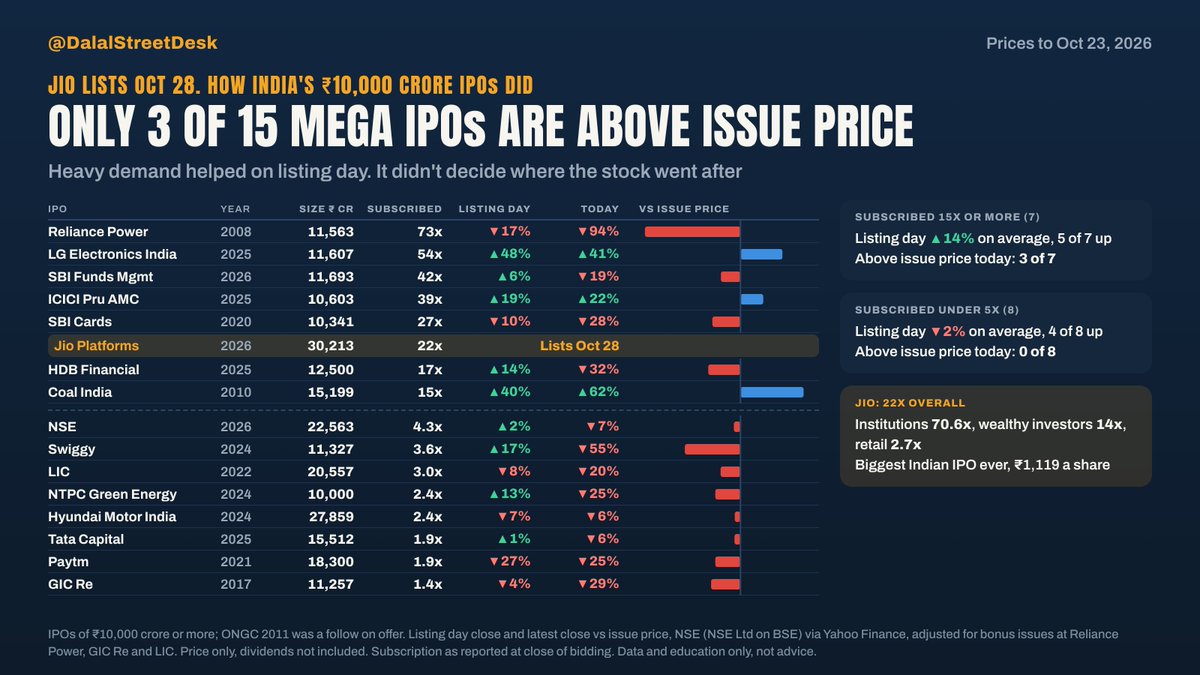
There have been 15 Indian IPOs of ₹10,000 crore or more before #jioplatformsipo
9 of the 15 closed their first day above the issue price, but only 3 are above it now: Coal India, LG Electronics and ICICI Pru AMC.
The 7 subscribed 15 times or more rose 14% on average that day. The 8 subscribed under 5 times fell 2% on average, and none of them is above its issue price today.
Reliance Power was subscribed 73 times and is now 94% below its issue price.
I went back through every #Nifty fall of 14% or more since 2000 and lined each one up with what earnings were doing.
The 4 longest took 2 to 4 years to get back to a new high: 2000 to 2001, 2008, 2010 to 2011 and 2015 to 2016. In 3 of them #Nifty's earnings per share actually shrank. EPS was down as much as 20% from a year earlier after the dotcom bust, 10% in 2009 and 6% in 2015.
The exception was 2010 to 2011. Earnings kept growing around 7%, but inflation and rate hikes pulled the PE from 26 down to 17.
When EPS kept growing, the falls were sharp but short. 2004 and 2006 both dropped 30% and made new highs in 11 and 6 months.
2020 broke the pattern the other way. EPS fell 21% but Nifty was back at a high in 10 months on the back of stimulus.
This year earnings slowed, but they aren't declining so far. Nifty's EPS growth was about 6% in January and fell to 1.5% by March as the October to December results came in. It never went negative.
It has picked up since. #Nifty 50 companies grew pre tax profit 5% in the January to March quarter and 9% in April to June. The 16 that have reported July to September are up 20%, about the same pace they managed in April to June. The drag has been concentrated: ONGC, Reliance, IndiGo and ITC took about ₹20,600 crore off pre tax profit in the June quarter.
So Nifty fell 16% from its January high while earnings slowed but kept growing, at around 4% now. That's the line to watch. In past falls, EPS turning negative is when the fall got longer.
@anujprajapati11 I think large caps fell harder. Those might where the biggest value is right now followed by midcaps. Smallcaps the least I think right now
Does the US midterm pattern work for #Nifty ? Not really.
The S&P 500 has been higher 12 months after every US midterm since 1950. Nifty, using NSE data back to 1994, was higher after only 5 of the last 8.
Before the vote Nifty usually dips. Between January and US election day it fell an average 18.8% from peak to bottom, and 7 of the 8 years saw a drop of 10% or more. 1998 was the worst at 33%.
After the vote it was all over the place. Up 62% after 1998, 67% after 2002 and 52% after 2006. Down 25% after 1994, 14% after 2010 and 3% after 2014. Up 14% after 2018 and 7% after 2022.
The biggest gains came after the deepest falls, but those years also rode the 1999 tech boom and the 2003 to 2007 bull run.
This year Nifty has fallen 15.6% from its January 2 record close to the October 8 low, while the S&P sits near its own record. The vote is November 3.
For Nifty, local earnings and foreign flows have mattered more than who wins in Washington.
Nifty sectors against their own history, PE as of Friday's close.
#NiftyPharma is the only sector trading above both its 10 year and 5 year median PE. 39.2 today vs 35.1 and 33.6.
#FMCG is at 29.5 against a 10 year median near 42. Realty 33.1 vs 49.1. IT 19.8 vs 25.1. All three sit roughly 20 to 30% below both medians.
Financial services is at 14.7 vs 21.4 and #BankNifty at 12.5 vs 22.5. Careful with banks though. Bank PE ran very high in 2016 to 2019 when bad loan provisions wiped out profits, so the 10 year median flatters the discount. Against the 5 year median Bank Nifty is about 21% below.
#NiftyAuto, Energy, Metal and Infra are all within 8% of their 10 year medians. PSU Banks at 7.1 are 18% below.
A low PE can mean low expectations, or it can mean earnings are about to fall. Data, not a recommendation.
#Nifty companies grew profits about 80% over the last 5 years. The index gave 5.7% a year. The PE did the damage. It was about 28 in October 2021 and it's about 19 now.
Valuation
Nifty at 22,600 trades at 19x trailing earnings. The 10 year average is about 23x, and since April 2021, when NSE moved to consolidated earnings, the normal level has been about 22x. So large caps sit roughly 13% below their usual multiple.
Price to book is 2.78 against a 10 year average of 3.62. The last time it was meaningfully lower was March 2020, at 2.17.
Midcaps and smallcaps are a different story. Midcap 100 has come down to about 26x and Smallcap 100 sits near 34x, still above its own 10 year median. Both cost a lot more than Nifty. The discount is mostly in large caps.
Risks
A low trailing PE only holds if earnings hold. Brent is above $110, which squeezes margins and the rupee.
The 10 year government bond yield has jumped to about 7.5% as oil surged. Nifty's earnings yield is about 5.2%, so bonds pay over 2 points more.
FPIs have pulled over ₹3 lakh crore out this year and haven't turned buyers in a lasting way yet.