🌊 Floating Flavors: Recap Thread 🧵
Two days ago, the Floating Flavors event took place in the heart of Miami, and what a journey it was! 🚤
Let’s take a moment to relive this unforgettable experience 👇
Surtout qu’il n’y a aucune raison pour que le paiement soit refusé, et au pire me laisser là possibilité de refaire un paiement aurait résolu le problème
@Leclerc vous trouvez ça normal qu’on passe une précommande et que 2 mois après on m’informe que ma commande est annulée à cause de soit disant un paiement refusé ! En plus c’est une édition limitée donc autant dire que j’aurai pas la possibilité d’en recommander !
The Michelin Guide now distributes keys to help us select the best hotels for our travels, the logical follow-up to its selection of gourmet restaurants ! #michelinhotel#travel
🏁 Countdown of Exciting Sprint!🏁
Our #sprint on #Zealy concludes on 24.07, and there's still time to score points and get early access to the #Guar on #Chromia Questnet. Don’t miss out on last chance to climb leaderboard and #earn rewards!
🔗 Join Sprint on Zealy Now: https://t.co/WkHufqsXVJ
Ta-da App is NOW LIVE and available on Apple Store and Google Play Store! 🤯
In this new version:
🪂 Get your share of 150k$ worth of rewards
🛍️ Buy items to become a top earner
🔥 All your actions impact buyback and burn rates!
Start earning now: https://t.co/g0HabyYzQY
[1/9]
There's nothing correct in this rag. Because yes it’s a rag, there are no other words. But not just any rag, a dangerous rag.
🧵👇
I. Let's start by saying that the mandate of the ECB is to manage price stability. Writing nonsense about Bitcoin does not seem to me to be part of this mandate, so I would be glad if public money didn't finance this kind of thing, especially when the main mandate has not even been achieved for quite a bit of time.
It is scandalous that the credibility, time and money of a public institution is used to hit a particular asset. I recall here that it is also on this precise point that the SEC lost its case in the United States, having shown that they were not "merit neutral", that is to say indifferent to the merits and asset qualities.
What's more, if Bitcoin is not a currency as they like to repeat, WHY ARE THEY WRITING ABOUT IT AT ALL?!
II. Let us also note that the article is seriously lacking in sources. Almost all of the assertions are unsubstantiated. When they are, for the vast majority it is a referral to opinion articles in the press.
There is only one academic source: Cong et al. (2023) whose abstract tells us "Our sample consists of 29 centralized exchanges, among which the regulated ones feature transaction patterns consistently observed in financial markets and nature.".
Oddly, the ECB paper draws a completely different conclusion: "wash trading accounts for 77.5% of the total trading volume on unregulated exchanges".
I continue with the sources to show you the immense bad faith, and in particular in the case of supposed money laundering and financing of terrorism by cryptos.
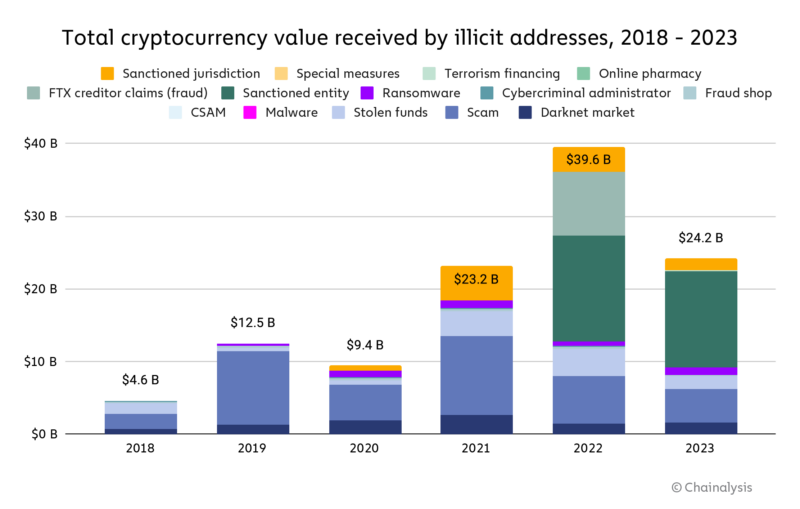
“Bitcoin remains the top choice for money laundering in the digital world, with illicit addresses transferring $23.8 billion in crypto in 2022, marking a 68.0% increase from the previous year.” The source indicated is "Chainanalysis 2024". We will overlook the fact that the company is called Chainalysis.
Source links to “2024 Crypto Crime Trends: Illicit Activity Down as Scamming and Stolen Funds Fall, But Ransomware and Darknet Markets See Growth”, January 18.”
https://t.co/WtM2xDXkAj
I don't even know if I need to continue... The title of the report is literally "Illicit Activity Down."
But let's continue anyway because it's juicy. We are told that activity is increasing even though it is decreasing. The reason is quite simple : the authors of the article take the previous reference year (2022) compared to that of even before (2021).
Why ? Because it serves their message. Between 2021 and 2022, illicit activity had increased (in value, not necessarily in proportion). Between 2022 and 2023, it has decreased. So it doesn't interest them, and they go back to the year before, despite the fact that it would obviously have been more relevant to take this year's figure rather than arbitrarily that of the previous year.
Moreover, in terms of order of magnitude, to tell us that Bitcoin is the "top choice" for laundering when it represents ~$20 billion is to mechanically assert that all other means are inferior, and consequently that there is LESS than 20 billion laundered each year in euros or dollars.
Remember that the Pandora Papers ALONE are $11,000 billion in perfectly fiat currency. The few articles that investigated the subject of illicit activities pointed to a proportion of around 1% of the GDP of the euro zone in 2010, or 110 billion (15 years ago).
https://t.co/vRcOWNThxb
Bad faith is evident to the point of ONLY selecting the years that interest them on graphs which do provide more exhaustive data. At this stage, we are on the edge of pure and simple lies, and, in any case, it is plain and conscious disinformation. I say conscious because they THEMSELVES cite the 2024 Chainalysis article, and so they have seen and read it! They do not ignore this information.
III. Beyond the opinion-based sources, the ambient bad faith, the disinformation, and the fact that the authors are not experts and are in full conflict of interest (one of the authors works specifically on the digital euro in addition... .), we obviously find a pile of false assertions, all debunked, or opinions presented as facts:
1) “Today, Bitcoin transactions are still inconvenient, slow, and costly.”
Compared to what ? A SEPA transfer that takes 5 working days? An international transfer that costs on average between 5 and 10% of the transaction?
Remember that if we compare Bitcoin with payment cards, we are comparing apples and pears. VISA & Mastercard do not do transactions, they do authorizations. And so we have to compare this upper layer to the Lightning Network which perfectly sustains comparison.
2) "Outside the darknet, the hidden part of the internet used for criminal activities, it is hardly used for payments at all."
False, completely false, documented, and admitted by the police or intelligence services. Whether it is the FBI which is delighted that criminals use cryptos, or the gendarmerie or even TracFin in France, it is now admitted, including among detractors, that it is not mainly used for criminal activities.
In the National Money Laudering Risk Assessment 2022 from the US Department of the Treasury, we can read "the use of virtual assets for money laundering remains far below that of fiat currency and more traditional methods" or even "the size and scope of drug proceeds generated on the darknet and laundered via virtual assets remain low in comparison to cash-based retail street sales. Worldwide sales on major darknet markets appear to have remained modest when compared to overall illicit drug sales. For example, during 2017–2020, drug-related darknet market sales amounted to approximately $315 million annually, or about 0.2 percent of the combined estimated illicit annual retail drug sales in the United States and European Union."
https://t.co/7NGQ0Zk9tR
I would add that in 2022, the Bitcoin network processed more transaction value than VISA (+$10,000 billion), which is not bad for something supposed to have failed.
3) “Bitcoin is still not suitable as an investment.”
It's just the best performing asset in 15 years.
4) “the mining of Bitcoin using the proof of work mechanism continues to pollute the environment on the same scale as entire countries”
The authors have not opened the latest academic publications: You et al. (Cornell), Ibanez et al. (University College London), Bruno et al. (University of North Carolina), etc. which ALL points to the opportunity to use Bitcoin to green electricity grids and reduce methane emissions. I guess they also didn't ask those who have already tried, i.e. the Texas grid operator, ERCOT, whose ex-CEO Brad Jones called Bitcoin a blessing for the stability of its network and an incentive to increase the ENR mix.
No, the authors prefer evoking the famous “evidence of its huge negative environmental impact.” Which ones? We won't know, since the assertion, although serious, is simply not sourced.
As we suspect, the authors probably preferred to give credibility to the famous Digiconomist, a person who has no expertise and has been wrong by major orders of magnitude for more than 5 years on everything he says on this subject, who lies (he declares in the Cell Reports paper that he has no conflict of interest, which is obviously false since he works in a central bank), and who moreover is not even researcher, since he has not finished his doctorate. This seems to be a better pedigree than Fengqi You (mentioned), from the renowned Cornell University, whose research specialties include computer science and energy transition, the two areas that interest us here, and which since 2010 has been honored with fifteen awards recognizing the quality of his research work.
To tell the truth, the authors probably don't care at all about the environment, but it gives them a practical angle of attack to attack an object that competes with them.
IV. Finally, I add that the article alone is a mountain of contradictions.
1) The value of Bitcoin would be zero because it does not produce "cash flow (unlike real estate) or dividends (stocks), cannot be used productively (commodities), and offers no social benefit (gold jewelry) or subjective appreciation based on outstanding abilities (works of art)."
Does the euro produce cash flows? No
Does the euro produce dividends? No
Can the euro be “used productively”? No
Does the euro offer “social benefits” like jewelry? No
Is the euro subject to subjective appreciation based on extraordinary qualities? No
So we understand that the euro is worth zero?
2) Bitcoin, as we have seen, is supposed to be the “top choice” for money laundering & terrorism.
Yet further in the article, the authors rebel against regulatory fatalism, and bring out the killer argument to encourage legislators not to sit idly by: “But Bitcoin transactions offer pseudonymity rather than complete anonymity, as each transaction is linked to a unique address on the public blockchain. Therefore, Bitcoin has been a cursed tool for anonymity, facilitating illicit activities and leading to legal action against offenders by the tracing of transactions".
Great, so in the same article, Bitcoin manages to be the best way to carry out illicit activities, but also a “cursed” way which allows “legal actions against offenders” because we can trace the transactions.
In. The. Same. Article.
V. Finally, the authors wonder why Bitcoin is not yet banned (“it seems wrong that Bitcoin should not be subject to strong regulatory intervention, up to practically forbidding it”), and come to suggest actions to legislator (Reminder, this has no place here, since it does not fall under the mandate of price stability).
What are these actions?
"The Bitcoin network has a governance structure in which roles are assigned to identified individuals. Authorities could decide that these should be prosecuted in view of the large scale of illegal payments using Bitcoin."
First, Bitcoin governance does not have roles assigned to individuals. There are roles, yes, but the individuals who participate in them are interchangeable. They are also not necessarily identified, see solo miners.
Among those roles, there are core devs, miners, nodes, exchange platforms etc. Everyone has their little power, but no one controls Bitcoin alone. Let us incidentally recall for example that a few years ago, during the Blocksize Wars, miners & exchange platforms lost their battle against nodes.
So what does the authors’ not-at-all-innocent little phrase mean?
That we're going to take the core devs from their homes and put them in jail? For which motive ? Because they wrote code?
Should Einstein have been put in jail for opening the way to work on nuclear power?
Someone who sells a kitchen knife has to go to jail because a buyer committed a crime with it?
All this on the basis of a “large scale of illegal payments” which is false, and which they themselves debunked in their own article.
I'm sorry, but where is this going ?
I reiterate that Bitcoin is a test for democracies, and that in Europe we are failing every step of the test. What is happening is serious.
Let's stop the liberticidal delusions and authoritarian or even totalitarian excesses now. It's a political fight.
Il n'y a rien qui va dans ce torchon. Car oui c'est un torchon, il n'y a pas d'autre mots. Mais pas n'importe quel torchon, un torchon dangereux.
🧵👇
I. Commençons par dire que le mandat de la BCE, c'est de gérer la stabilité des prix. Ecrire des idioties sur Bitcoin ne me semble pas participer de ce mandat, donc j'aimerais bien que l'argent public ne finance pas ce genre de choses, d'autant plus quand ça fait belle lurette que le mandat principal n'est même pas atteint.
Il est scandaleux que la crédibilité, le temps et l'argent d'une institution publique soit utilisés pour taper sur un actif en particulier. Je rappelle ici que c'est d'ailleurs sur ce point précis que la SEC a perdu son procès aux Etats-Unis, ayant montré qu'ils n'étaient pas "merit neutral", c'est-à-dire indifférents aux mérites et qualités des actifs.
Qui plus est, si Bitcoin n'est pas une monnaie comme ils se plaisent à le répéter, POURQUOI EST CE QU'ILS ECRIVENT DESSUS TOUT COURT ?!
II. Constatons également que l'article manque cruellement de sources. La quasi-totalité des assertions ne sont pas étayées. Quand elles le sont, c'est pour la grande majorité un renvoi vers des articles d'opinion dans la presse.
Il n'y a qu'une seule source académique : Cong et al. (2023) dont l'abstract nous dit "Our sample consists of 29 centralized exchanges, among which the regulated ones feature transaction patterns consistently observed in financial markets and nature.".
Bizarrement, le papier de l'ECB retient une toute autre conclusion: "wash trading accounts for 77.5% of the total trading volume on unregulated exchanges".
Je poursuis sur les sources pour vous montrer l'immense mauvaise foi, et en particulier sur le cas du supposé blanchiment d'argent et financement du terrorisme par les cryptos.
"Bitcoin remains the top choice for money laundering in the digital world, with illicit addresses transferring $23.8 billion in crypto in 2022, marking a 68.0% increase from the previous year." La source indiquée est "Chainanalysis 2024". On passera sur le fait que la boîte s'appelle Chainalysis.
La source renvoie vers "2024 Crypto Crime Trends: Illicit Activity Down as Scamming and Stolen Funds Fall, But Ransomware and Darknet Markets See Growth”, 18 January."
https://t.co/Z1YLRWvoSI
Je ne sais même pas si j'ai besoin de continuer... Le titre du rapport est littéralement "L'activité illicite diminue".
Mais on continue quand même parce que c'est croustillant. On nous dit que l'activité augmente alors qu'elle diminue. La réponse est assez simple, les auteurs de l'article prennent l'année de référence précédente (2022) par rapport à celle d'encore avant (2021).
Pourquoi ? Parce que ça sert leur discours. Entre 2021 et 2022, l'activité illicite a progressé (en valeur, pas nécessairement en proportion). Entre 2022 et 2023, elle baissé. Donc ça ne les intéresse pas et ils remontent à l'année d'avant, malgré le fait qu'il eut été évidemment plus pertinent de prendre le chiffre de cette année plutôt qu'arbitrairement celui de l'année précédente.
J'ajoute qu'en termes d'ordre de grandeur, nous dire que Bitcoin est le "top choice" du blanchiment quand ça représente ~$20 mds, c'est faire l'assertion mécaniquement que tous les autres moyens sont inférieurs, et que donc il y a MOINS de 20 mds blanchis chaque année en euros ou en dollars.
Rappelons que les Pandora Papers SEULS, c'est $11 000 mds en monnaie parfaitement fiat. Les quelques articles ayant investigué le sujet des activités illicites pointaient du doigt une proportion aux alentours de 1% du PIB de la zone euro en 2010, soit 110 mds (il y a 15 ans donc).
Bref, vous le voyez, la mauvaise foi transpire au point de ne sélectionner QUE les années qui les intéressent sur des graphiques qui fournissent pourtant une donnée plus exhaustive. A ce stade, on est à la frontière du mensonge pur et simple, et, en tout cas, on est en plein dans la désinformation consciente. Je dis consciente car ils citent EUX-MÊME l'article Chainalysis de 2024, et ils l'ont donc vu et lu ! Ils n'ignorent pas cette information.
III. Au-delà des sources éclatées, de la mauvaise foi ambiante, de la désinformation, et du fait que les auteurs ne sont pas experts et nagent en plein conflit d'intérêt (un des auteurs travaille spécifiquement sur l'euro numérique en plus...), on retrouve évidemment un pile d'assertions fausses, toutes débunkées, ou d'opinions présentées comme des faits :
1) "Today, Bitcoin transactions are still inconvenient, slow, and costly."
Par rapport à quoi ? Un virement SEPA qui prend 5 jours ouvrés ? Un transfert international qui coûte en moyen entre 5 et 10% de la transaction ?
Parce qu'on rappelle que si c'est avec des cartes de paiement qu'on compare Bitcoin, on compare des pommes et des poires. VISA & Mastercard ne font pas de transactions, ils font des autorisations. Et il faut donc comparer cette couche supérieure au Lightning Network. Je renvoie à l'étude de @kneisseh pour les comparaisons d'efficience, qui sont plutôt favorables à #Bitcoin.
2) "Outside the darknet, the hidden part of the internet used for criminal activities, it is hardly used for payments at all."
Faux, complètement faux, documenté, et avoué par les services de polices ou de renseignement. Que ce soit le FBI qui se réjouit que les criminels utilisent les cryptos, ou la gendarmerie ou encore TracFin en France, il est maintenant admis y compris chez les détracteurs que ce n'est pas utilisé majoritairement pour des activités criminelles.
Dans le National Money Laudering Risk Assessment 2022 du Département du Trésor américain, on peut lire "the use of virtual assets for money laundering remains far below that of fiat currency and more traditional methods" ou encore "the size and scope of drug proceeds generated on the darknet and laundered via virtual assets remain low in comparison to cash-based retail street sales. Worldwide sales on major darknet markets appear to have remained modest when compared to overall illicit drug sales. For example, during 2017–2020, drug-related darknet market sales amounted to approximately $315 million annually, or about 0.2 percent of the combined estimated illicit annual retail drug sales in the United States and European Union."
https://t.co/7NGQ0ZjBEj
J'ajoute que sur 2022, le réseau Bitcoin a traité plus de valeur de transaction que VISA (+ de $10 000 mds), ce qui n'est pas mal pour quelque chose censé avoir échoué.
3) "Bitcoin is still not suitable as an investment."
C'est juste l'actif le plus performant depuis 15 ans.
4) "the mining of Bitcoin using the proof of work mechanism continues to pollute the environment on the same scale as entire countries"
Les auteurs n'ont pas ouvert les dernières publications académiques : You et al. (Cornell), Ibanez et al. (University College London), Bruno et al. (University of North Carolina), etc. qui pointe TOUTES vers l'opportunité d'utiliser Bitcoin pour verdir les réseaux électriques et réduire les émissions de méthane. Je suppose qu'ils n'ont pas non plus demandé à ceux qui ont déjà essayé, c'est à dire le gestionnaire de réseau Texan, ERCOT, dont l'ex-CEO Brad Jones disait de Bitcoin qu'il était une bénédiction pour la stabilité de son réseau et une incitation à augmenter le mix ENR.
Non, les auteurs préfèrent évoquer les fameuses "evidence of its huge negative environmental impact." Lesquelles ? On ne le saura pas, puisque l'assertion, pourtant grave, n'est tout simplement pas sourcée.
On s'en doute, les auteurs ont probablement préféré accorder de la crédibilité au fameux Digiconomist, une personne qui n'a pas d'expertise et se trompe par des ordres de grandeur majeurs depuis plus de 5 ans sur tout ce qu'il dit sur ce sujet, qui ment (il déclare dans le papier de Cell Reports qu'il n'a aucun conflit d'intérêt, ce qui évidemment faux puisqu'il travaille dans une banque centrale), et qui de plus n'est même pas chercheur, puisqu'il n'a pas fini son doctorat. Ca semble être un meilleur pedigree que Fengqi You (susmentionné), de la réputée université Cornell, dont les spécialités de recherche sont entre autres l'informatique et la transition énergétique, les deux domaines qui nous intéressent ici, et qui depuis 2010, a été honoré de quinze récompenses reconnaissant la qualité de son travail de recherche.
A dire vrai, les auteurs n'en ont probablement strictement rien à faire de l'environnement, mais ça leur donne un angle d'attaque pratique pour taper sur un objet qui leur fait concurrence.
IV. J'ajoute enfin que l'article est à lui seul une montagne de contradictions.
1) La valeur de Bitcoin serait de zéro car il ne produit pas "cash flow (unlike real estate) or dividends (stocks), cannot be used productively (commodities), and offers no social benefit (gold jewellery) or subjective appreciation based on outstanding abilities (works of art)."
L'euro produit-il des cash flows ? Non
L'euro produit-il des dividendes ? Non
L'euro peut-il être "utilisé productivement" ? Non
L'euro offre-t-il des "social benefits" comme la bijouterie ? Non
L'euro est-il sujet à appréciation subjective basée sur des qualitiés extraordinaires ? Non
On comprend donc que l'euro vaut zéro ?
2) Bitcoin, comme on l'a vu, est censé être le "top choice" pour le blanchiment & terrorisme.
Pourtant plus loin, les auteurs s'insurgent contre le fatalisme réglementaire, et sortent l'argument qui tue pour inciter les législateurs à ne pas rester les bras croisés : "But Bitcoin transactions offer pseudonymity rather than complete anonymity, as each transaction is linked to a unique address on the public blockchain. Therefore, Bitcoin has been a cursed tool for anonymity, facilitating illicit activities and leading to legal action against offenders by the tracing of transactions"
Super, donc dans le même article, Bitcoin arrive à être le meilleur moyen de conduire des actions illicites mais aussi un moyen "maudit" qui permet des "legal actions against offenders" car on peut tracer les transactions.
Dans. Le. Même. Article.
Pour finir, les auteurs s'interrogent sur le fait que Bitcoin ne soit pas encore interdit ("it seems wrong that Bitcoin should not be subject to strong regulatory intervention, up to practically forbidding it"), et en viennent à suggérer des actions au législateur (on le rappelle, ça n'a rien à faire là, puisque ça ne relève pas du mandat de la stabilité des prix).
Quelles sont ces actions ?
"The Bitcoin network has a governance structure in which roles are assigned to identified individuals. Authorities could decide that these should be prosecuted in view of the large scale of illegal payments using Bitcoin."
D'abord, la gouvernance de Bitcoin n'a pas de rôles assignés à des individus. Il y a des rôles oui, mais les individus qui y participent sont interchangeables. Ils ne sont pas nécessairement identifiés d'ailleurs, cf les solo miners.
Dans ces rôles, il y a les core devs, les mineurs, les noeuds, les plateformes d'échange etc. Chacun a son petit pouvoir, mais personne ne contrôle Bitcoin tout seul. Rappelons incidemment par exemple qu'il y a quelques années, lors des Blocksize Wars, les mineurs & plateformes d'échange ont perdu leur bataille contre les noeuds.
Alors que veut dire la petite phrase pas du tout innocente des auteurs ?
Qu'on va aller chercher les core devs chez eux pour les mettre en taule ? Pour quel motif ? Parce qu'ils ont écrit du code ?
Il aurait fallu mettre Einstein en taule pour avoir ouvert la voie aux travaux sur le nucléaire ?
Quelqu'un qui vend un couteau de cuisine doit aller en taule parce qu'un acheteur a commis un crime avec ?
Tout cela sur la base d'une "large scale of illegal payments" qui est fausse, et qu'ils ont eux-même debunké dans leur propre article.
Pardon, mais on va où là ?
Je réitère que Bitcoin est un test pour les démocraties, et qu'en Europe, nous ratons toutes les étapes du test. Ce qui se passe est grave.
Arrêtons les délires liberticides et dérives autoritaires voire totalitaires maintenant. C'est un combat politique.
🎄 CALENDRIER DE L'AVENT - [23/24] 🎅
SWISSBORG a décidé de faire un magnifique cadeaux de noël à deux d'entre vous en vous offrant 2 x 250$ de $BORG 🎁
👉 Pour participer :
🔹 Follow @swissborg & @CryptoGeneOff
🔹 ♥️ + RT 🔁
📅 Tirage au sort dans 3 jours.
Bonne chance à tous ! 🍀
#Giveaway #CalendrierDelAvent #Concours #nonrémunéré
📢 Concours
Déjà + de 500 bons plans sur l'appli Dealabs ce matin 🔥
Pour fêter ça, on t'offre un pack PS5 + le jeu de ton choix !
1⃣ RT & Follow @Dealabs
2⃣ Commente avec #DealabsBlackFriday et dis-nous quel jeu tu veux 👇
@grimgorgork@Boumboumfr@BFMTV Dans un restaurant à volonté je comprends et je suis pour, mais dans les restaurants traditionnels, non, à partir du moment où tu ne choisis pas la quantité qu’il y a dans ton assiette je vois pas pourquoi on paierai.






![Ta_da_io's tweet photo. Ta-da App is NOW LIVE and available on Apple Store and Google Play Store! 🤯
In this new version:
🪂 Get your share of 150k$ worth of rewards
🛍️ Buy items to become a top earner
🔥 All your actions impact buyback and burn rates!
Start earning now: https://t.co/g0HabyYzQY
[1/9] https://t.co/osZdmXFu2e](https://pbs.twimg.com/media/GTqRlvNWkAAeYtS.png)