Sentinel's dVPN protocol on Cosmos which has facilitated nearly 2 million unique user connections through the only implementation of a decentralized on-chain DHT has been successfully rewritten in Rust and deployed on the Solana devnet with every function successfully validated.
Sentinel x402 lets AI agents and automated systems purchase dVPN access directly, without creating accounts, managing subscriptions, holding P2P for gas payments, or relying on human setup.
Using USDC on Base, with Solana support upcoming, an agent can request access, receive HTTP 402 payment instructions, authorize the payment, and receive the connection details needed to use Sentinel dVPN infrastructure.
Most VPN infrastructure was designed around a human user opening an app, entering payment details, choosing a location, and pressing connect. Autonomous systems need a different model, where connectivity, routing, and privacy-preserving access can be requested, paid for, and used programmatically.
Sentinel’s architecture makes this practical because nodes can be discovered, authenticated, and accessed through on-chain infrastructure, RPC access, and CLI-based workflows. That gives software a direct path to find available dVPN nodes and connect without manual setup.
For developers, the opportunity isn't just to build another VPN app. It is building products, agents, APIs, and services that can use decentralized bandwidth as a programmable resource, with access available from as low as $0.033 per day.
Check out Sentinel x402:
https://t.co/O6DQmxjVMs
Build with Sentinel:
https://t.co/8tgw8Nbr2h
Sentinel is approaching 2 million total unique users across the network, with multiple independently built dVPN applications already using the same decentralized bandwidth layer.
Applications built on Sentinel include @Independentdvpn, @MeileDVPN, @norselabs "DVPN", ChibaTunnel by @TkdAxel , VeilDVPN by @Bitveilofficial , Katacomb VPN by @proofoftrinity , @VALTdata , and the DVPN Telegram Bot by @norselabs
The important part is not only the number of apps, but the usage behind them. With current activity, Sentinel would rank inside the top 20 most-used Solana applications by daily active users after migration, bringing real consumer demand into the Solana ecosystem.
Each application can serve its own users, brand, interface, payments, and distribution while connecting to independent peer-to-peer nodes underneath. Sentinel provides the shared network layer, while independent teams build products on top.
As Sentinel prepares for its migration to @solana, the network is bringing more than protocol infrastructure. It is bringing real users, active applications, independent node infrastructure, and consumer-facing products that can support a wider Sentinel economy inside one of crypto’s strongest builder ecosystems.
Explore the Sentinel ecosystem, use a decentralized VPN, build your own dVPN application, create subscription plans, or host a node:
dVPN applications: https://t.co/yK9zavfM1l
Build with Sentinel docs: https://t.co/8tgw8Nbr2h
Create and manage VPN plans: https://t.co/3PcLbmldtv
Host a dVPN node: https://t.co/UfuQh9k3jL
Node Deployer: https://t.co/RsCvwIr6oL
Open-source ecosystem: https://t.co/ot5PHTxQWQ
Independent dVPN has grown to 500,000+ downloads on Google Play, making it one of the clearest examples of what can be built on the Sentinel Network: a consumer VPN application that gives users a familiar Web2 experience while using decentralized infrastructure underneath.
Most users do not care which protocol, chain, node, or routing system sits behind the app. They care whether the VPN works, whether it connects reliably, and whether it gives them private access to the internet when they need it.
Independent dVPN has turned Sentinel’s decentralized bandwidth into a product mainstream users can understand and use, including people who may have never heard of crypto, DePIN, or decentralized infrastructure.
For users, @Independentdvpn is simply a VPN application. For builders, it shows how Sentinel can support real consumer products using independent node operators, open-source infrastructure, and a shared bandwidth network instead of forcing every team to build a global network from scratch.
Sentinel does not own the application, the brand, the customer relationship, or the user experience. Independent dVPN is built and operated by an independent team, while Sentinel provides the decentralized network layer underneath.
The separation between application and infrastructure matters. Teams can build their own brand, payment flow, distribution, and customer base while using open infrastructure that can be inspected, integrated, and improved by builders across the ecosystem.
Mainstream users do not need to understand decentralized infrastructure to benefit from it. They need products that work, with infrastructure that can be verified.
Try Independent dVPN, powered by the Sentinel Network:
https://t.co/ASpWhyxZgN
Explore more decentralized VPN applications built on Sentinel:
https://t.co/yK9zavfM1l
Most people think VPN privacy starts and ends with encryption. The harder question is who controls the network your connection moves through.
A VPN can reduce what your ISP sees, but it also introduces a new trust layer. The provider, app, server network, analytics stack, payment system, and operating model all shape the privacy outcome.
Many VPN products look similar from the outside. Users open an app, press connect, and expect private internet access, but the infrastructure model underneath can be very different.
Sentinel separates the application layer from the decentralized bandwidth network underneath. Multiple independently built VPN applications can use shared infrastructure powered by independent peer-to-peer node operators, rather than relying on one company’s closed server network.
For users, the product can still feel simple. For builders, Sentinel provides open-source infrastructure, developer integrations, and a network model that can be inspected and built on rather than accepted as a marketing claim.
VPN privacy is not only about whether the tunnel is encrypted. It is also about who operates the network, what data the app collects, and how much control sits with one provider.
Explore decentralized VPN applications built on Sentinel: https://t.co/yK9zavgjQT
Sentinel dVPN nodes support six VPN protocols through the same shared infrastructure.
The multi-protocol node structure in Node v9.0.0 and CLI v5.0.0 gives application builders a more flexible foundation to integrate protocol selection into their apps, while node hosts can run the latest Sentinel node architecture.
Previously, a Sentinel node served one VPN protocol at a time. If that protocol performed poorly on a specific network, operating system, firewall setup, or restricted environment, the usefulness of that node was limited for those users.
A single Sentinel node can serve WireGuard, V2Ray, OpenVPN, Xray, AmneziaWG, and Hysteria2 simultaneously. Applications can discover which protocols a node offers and select the most suitable option for the user, without requiring each protocol to run on separate infrastructure.
Each protocol runs as an isolated service, so one failing protocol does not need to bring down the full node. That gives applications more flexibility across different users, devices, networks, and operating conditions.
The network has never depended on one protocol, one application, or one way of doing things. Sentinel separates the application layer, networking layer, and underlying infrastructure, so protocols can evolve, applications can change, and the chain can change without altering the core network model.
That modular approach is also part of why the move to Solana fits naturally. Independently operated nodes still provide bandwidth to applications built on top, while the infrastructure layer continues to support multiple protocols and application types.
Six VPN protocols. One shared decentralized network.
Learn more about applications built on Sentinel:
https://t.co/yK9zavfM1l
Nolus Protocol the most ardent supporter of the Cosmos ecosystem has announced their plans to transition to Solana.
The discussion and debate is all over.
Sentinel is moving to Solana and dVPN builders will be able to release rev-share tokens for their own applications.
What happens if your VPN company disappears?
BulletVPN ceased operations, leaving its "lifetime" subscriptions without a service.
VPNSecure canceled thousands of lifetime subscriptions after changing ownership.
With a traditional VPN, users depend on one company's infrastructure and decisions.
Sentinel separates the infrastructure from the application. Independent teams can build, maintain, and improve their own decentralized VPNs while sharing the same underlying network.
That's one of the advantages of open, decentralized infrastructure.
Learn more:
https://t.co/yK9zavfM1l
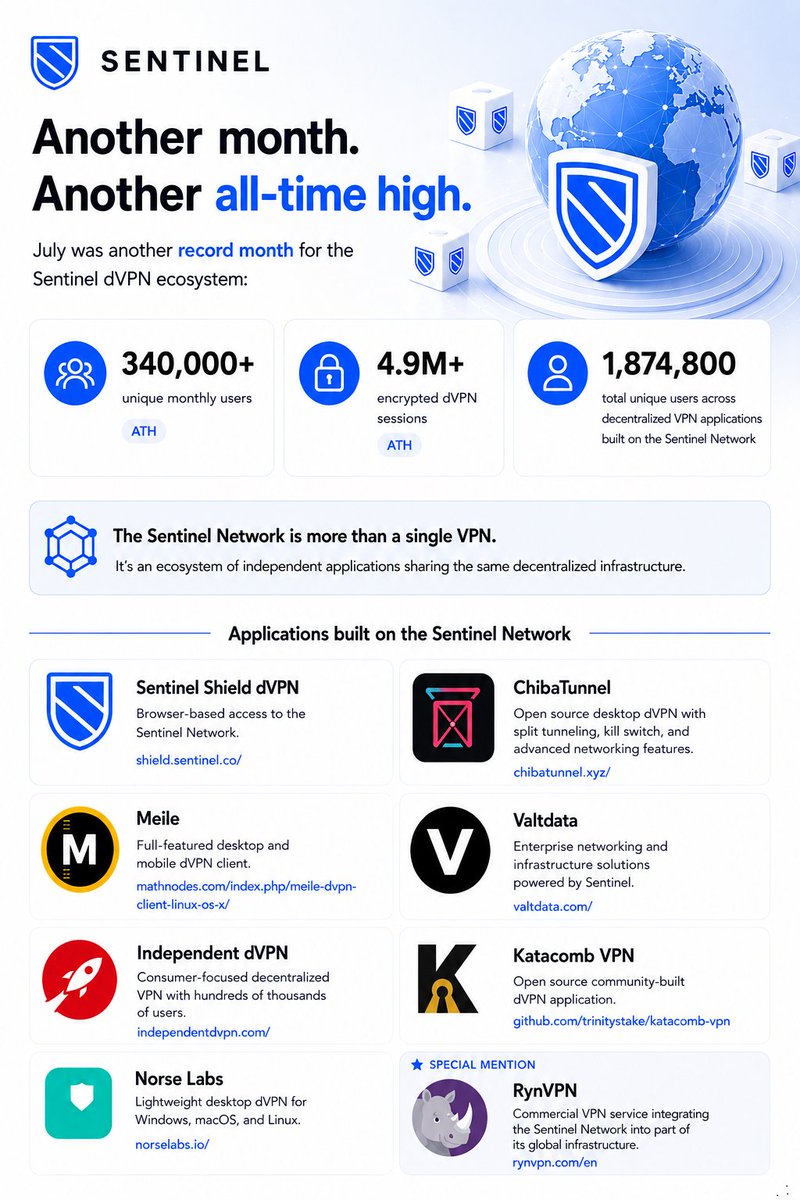
While markets continue to fluctuate, one thing hasn't changed: people continue choosing decentralized VPN applications built on the Sentinel Network.
July was another record month for the Sentinel dVPN ecosystem:
• 340,000+ unique monthly users (ATH)
• 4.9M+ encrypted dVPN sessions (ATH)
• 1,874,800 total unique users across decentralized
VPN applications built on the Sentinel Network
Applications built on Sentinel include:
@Independentdvpn : Consumer-focused decentralized VPN with hundreds of thousands of users. https://t.co/dhqWE5lHV8
@MeileDVPN : Full-featured desktop and mobile dVPN client.
https://t.co/izKz16LszA
@norselabs DVPN : Lightweight desktop dVPN for Windows, macOS, Linux, Mobiles, and Android TVs
https://t.co/VqYqGE7rwe
ChibaTunnel x @TkdAxel : Open source desktop dVPN with advanced networking features.
https://t.co/PlPGbG6SUq
@VALTdata : Enterprise networking and infrastructure solutions powered by Sentinel.
https://t.co/uIVMuTKDqJ
Katacomb VPN x @proofoftrinity : Open source community-built dVPN application.
https://t.co/z0KZDK8q7O
@VpnRyn : Commercial VPN provider integrating the Sentinel Network into part of its global infrastructure.
https://t.co/Vm1pswLx8f
Sentinel Shield dVPN https://t.co/nz9gLztNl4
Want to build your own decentralized VPN application?
Start here:
• Sentinel Docs: https://t.co/JkSePp8Axm
• JavaScript SDK: https://t.co/moEcG29R19
• Python SDK: https://t.co/YJEDpZTqnD
• Node Deployer: https://t.co/RQ4fh3rMpi
• Sentinel GitHub: https://t.co/ot5PHTxQWQ
The Sentinel ecosystem is approaching the 2 million unique user count.
The protocol has proven its ability to handle infrastructure and user demand at scale. Now the focus moving forward is monetization avenues for builders on Sentinel.
Paid subscriptions/Ads/Proxy Pools
Despite market conditions and overall crypto sentiment, the number of users and number of dVPN apps built on the Sentinel ecosystem only continues to grow.
Katacomb VPN v0.1.0 built on Sentinel's dVPN protocol is now available for download on Linux x86_64!
Choose any node on the Sentinel network, pay per GB or per hour, and tunnel through whichever protocol you want; WireGuard, V2Ray, XRAY, AmneziaWG, OpenVPN, or Hysteria2.
- No accounts and no subscription locking you to one provider, you pay individual node operators directly from your wallet
- Six protocols, with full control over DNS and split tunneling
- Kill switch, auto-reconnect, and real-time traffic stats
- Provider console for running nodes or managing plans on-chain
For the 3rd time in Sentinel's history, the number of unique users in 1 week who have connected to at least 1 Sentinel dVPN node has crossed 100k.
Sentinel is proving its capability of being capable of handling web 2 scale traffic with its centralized VPN partners.
Many heavily capitalized projects have come and gone throughout Sentinel's and Akash's journey.
It is easy to have the perseverance to withstand any adverse conditions and push forward when the mission statement is so strong.
Akash and Sentinel are DePin networks that provide a marketplace for distributed services and have a real tangible utility.
Unrestricted internet for all, 1 Mill+ users and counting
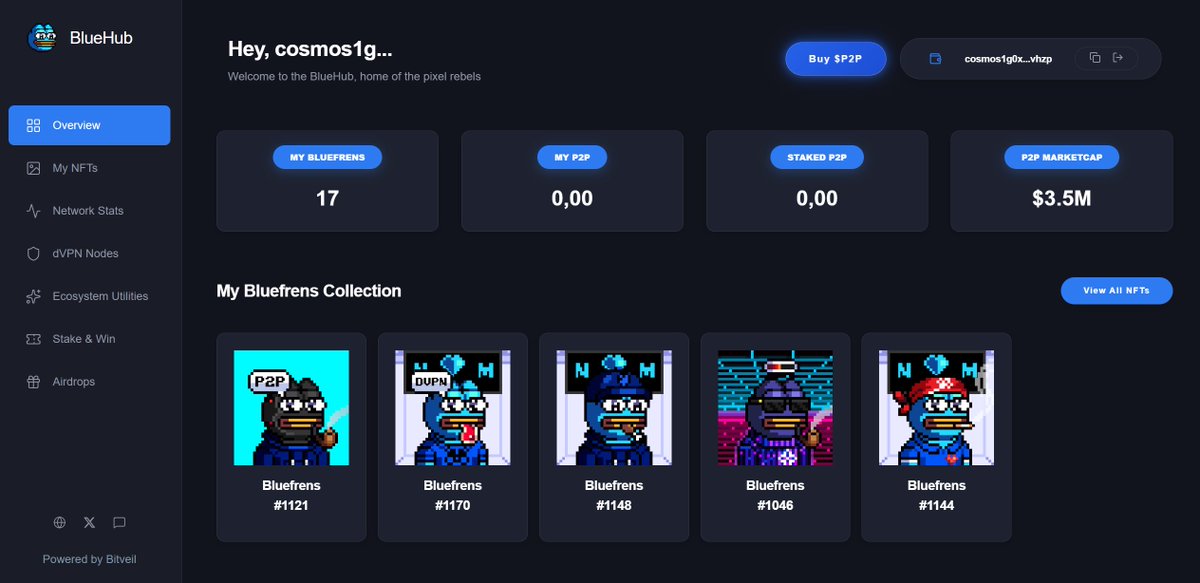
The Bluefrens hub is now live at https://t.co/Oi5ICJhUIt!
Bluefrens is Sentinel's community driven NFT ecosystem created and managed by @Bitveilofficial
Become eligible to enter weekly lottery events at the Bluefrens Hub by holding sentinel:native or Bluefrens NFTs.
Sentinel is an ecosystem focused on utility and real value generation and in order for Sentinel to support a community driven initiative there has to be a strong purpose.
The Bluefrens ecosystem intends for its NFT to have many more usecases than just being a digital JPEG, various dVPN apps and ecosystem utilities built on Sentinel will be offering perks to holders.
Sentinel is one of the first utility focused networks to have a meme culture starting in 2019. The Blue fren was born far before Pepe became famous. Community driven initiatives like Bluefrens drive Sentinel's culture and spirit forward aggressively.
Join the official Bluefrens Discord at:
https://t.co/ou5kzSqbVb
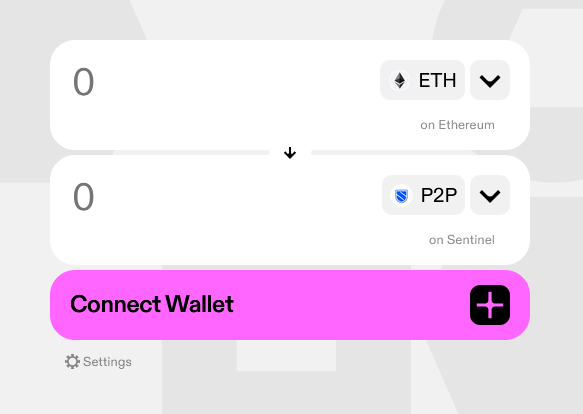
https://t.co/oOPg7m3cLF now redirects to Skip:Go's website which features a trustless bridging solution with amazing UX, powered by the Cosmos IBC.
The Cosmos IBC is the most secure interoperability protocol ever built.
Swap ETH and other tokens directly into sentinel:native
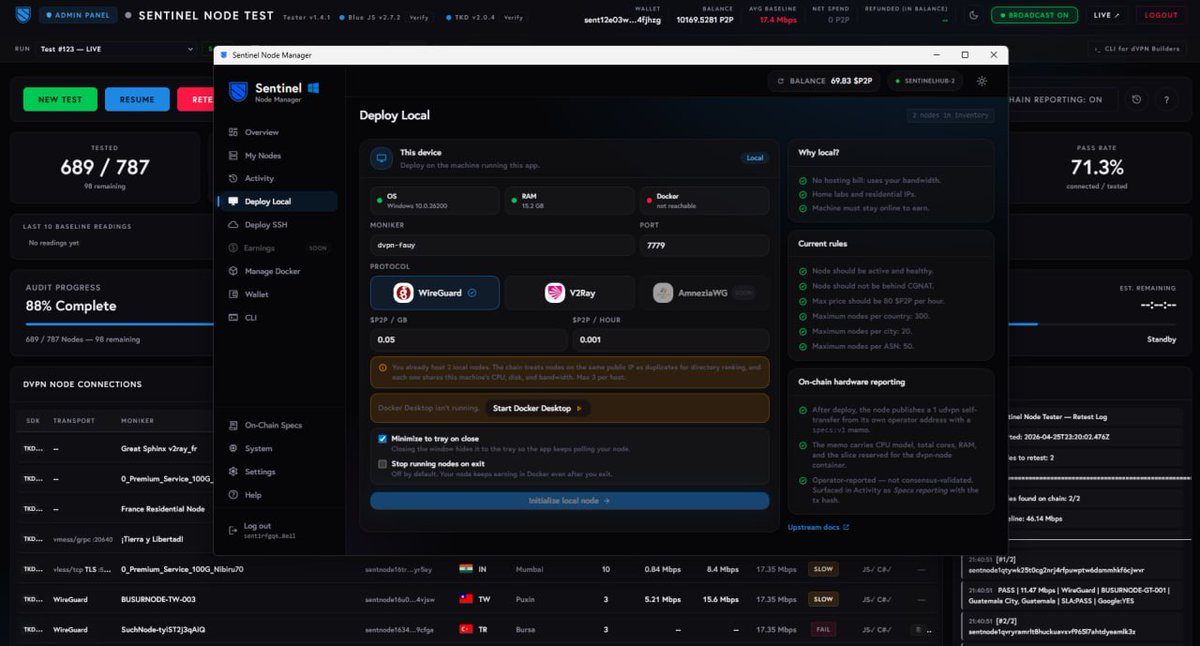
Node Deployer v0.1.1 has been released.
This update includes additional fixes and security-focused improvements for the Sentinel node deployment tooling.
The software simplifies the deployment and management of Sentinel nodes, making it easier for more people to participate in and help grow the decentralized VPN network.
CodeQL analysis and all CI checks passed successfully.
Release:
https://t.co/yXcdvsJgGB
Builds:
Windows
https://t.co/Mq27BwRdAA
Linux
https://t.co/k9VADu8Vx5
macOS
https://t.co/51JV04r3xU
Before Sentinel migrates its protocol architecture to a chain with millions of normies, Sentinel has to become normie friendly. This is the key focus.
Previously you could only host a node on Linux through CLI, soon a node can be hosted within a minute on Windows + Mac + Linux