I’m so proud of my Make More Money students that have been stacking wins in such a short amount of time.
Some of last week’s highlights in our Slack #wins channel:
🚀 One member landed their biggest client since May ($30K in one deal).
💡 Another walked away from a $4K repeat client to protect their energy, and felt better than ever after.
🤝 Someone hired and paid their first team members and realized their business is now creating opportunities for others.
💰 Another secured $10K for a single project… a milestone they once thought was impossible.
Different numbers.
Different stories.
But the same pattern:
When you commit to growth, your wins multiply.
What’s the biggest win you’re chasing right now?
@0xCharlota I’m a fan of the George S. Patton quote:
“Never tell people how to do things. Tell them what to do and they will surprise you with their ingenuity.”
Most agency owners I talk to can’t answer this question:
Where do you want to be in 10 years?
Not just the generic “grow the business” or “hire more people.”
An actual, specific picture of the life.
@bentenwoodring couldn’t either. He runs @nooon_studio, an amazing web and brand studio. Benten’s smart and talented. But he said he normally couldn’t think past a few months at a time.
Watch to see what changed.
Benten’s on a mission now. Go follow him and you’ll see.
If you want help getting your agency out of day-to-day emergencies and instead building toward a larger purpose, DM me “HIGHER” and I’ll tell you more about how I’d work with you.
There’s no right way to fix a broken agency, but there are definitely wrong ways.
Should you cut overhead or hire ahead of revenue? Should you niche down hard or stay a generalist? Should you build for speed or for scale?
Every one of those is a legitimate fix. How do you know which one to pick?
It depends on what kind of boat you’re building.
If you’re building a speedboat, you strip weight, stay lean, and keep the crew tiny. If you’re building a cruise ship, you do the opposite: you add structure, hire roles you don’t need yet, and build for a load that isn’t there. Do speedboat repairs on a cruise ship and you’ll be stuck in a year with a vessel that can’t carry what you wanted it to.
When an agency owner tells me their business is on fire and wants to know where to start, I ask about the destination. You can’t fix the ship until you know which ship it’s supposed to be.
What are you actually building toward? Too many agency owners “just want to do good work.” It’s a great sentiment but it’s not enough.
This Friday, I’m sitting down with @aribajahan for a private conversation with my coaching students.
Ariba has spent her career building things that didn’t exist yet. She co-created an innovation role for herself inside a 75-year-old organization, built a design innovation practice from scratch over 9 years, and has led transformation strategy for some of the most recognized brands in the world. She’s trained global brands on generative AI, deployed AI agents that run synthetic focus groups, and led a $52M public health campaign. She’s an Obama Foundation Leader, has spoken at 200+ events globally, and was named one of the Global Top 100 Women of the Future in Emerging Tech.
We’re going to talk about how to sell transformation work to clients who don’t have a budget line for it, how to use AI as a real business lever (not just a faster way to write copy), and how to build authority while running a demanding business.
This is one of the parts of running this program I’m most grateful for. I get to bring in people like Ariba, put them in front of agency owners who are building something real, and watch the room light up with questions.
If you run an agency and you’re trying to figure out how to move upstream, charge more, and stay ahead of where the industry is going, this is the kind of room you want to be in.
Everyone in the world has an opinion about your work, except for one person: you.
Think about the last thing you designed. What is your opinion about it? What do you believe about it?
Is it good? Is it great? What makes it great? What is it supposed to change for the person viewing or using it? What is it ignoring on purpose?
If you can’t answer those kinds of questions about your work, you don’t have an opinion. You’re just optimizing for good vibes.
The stronger your opinion about your work, the less others’ opinions will matter.
Some days, I skip work to watch movies with my kids.
Other days, I skip watching movies with my kids to work.
I refuse to feel guilty for either.
I do both of these things on purpose, and I know what I’m doing them for.
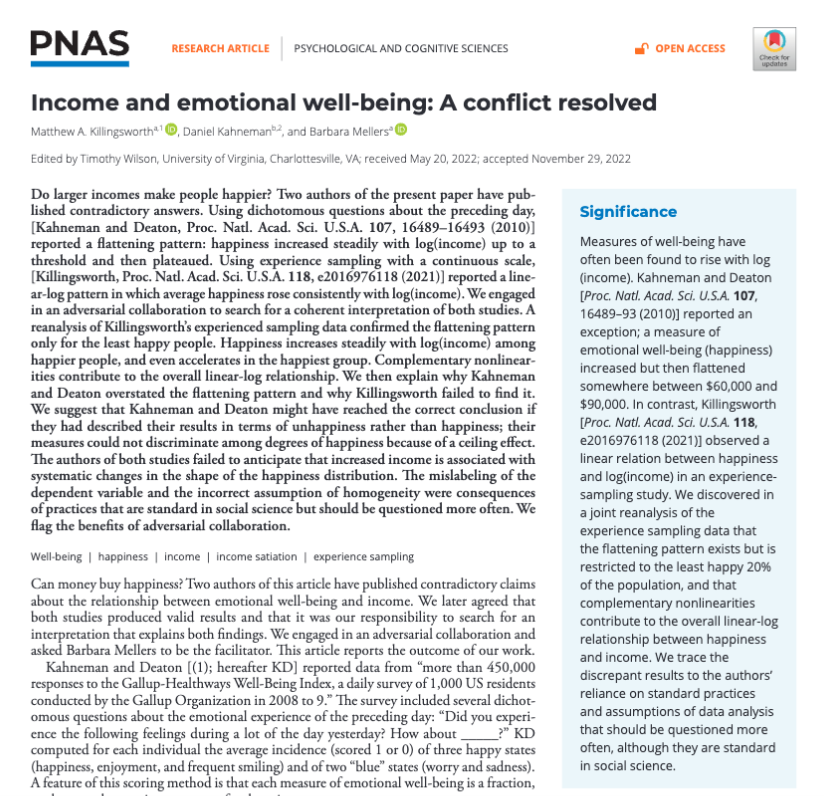
Does money buy happiness? A Princeton Nobel laureate said no above $75,000. A Penn researcher with 1.7 million data points said yes. The day they sat down together to settle the fight, the answer they reached should change how you think about your own life.
The Nobel laureate is Daniel Kahneman. The Penn researcher is Matthew Killingsworth.
The fight between them lasted 13 years, and the way it ended is one of the cleanest examples in modern science of two smart people being wrong in opposite directions about the same question.
In 2010 Kahneman and his Princeton colleague Angus Deaton published a paper that became one of the most quoted findings in the history of social science.
They analyzed 450,000 responses to the Gallup-Healthways Well-Being Index and concluded that emotional well-being rose steadily with income up to about $75,000 a year, and then flattened out completely. Above that line, the extra money was not buying any more daily happiness.
The headline traveled around the world. Every news outlet ran the number.
A CEO in Seattle famously cut his own salary to raise his employees to that exact threshold. The 75,000 dollar figure became cultural shorthand for the idea that the rich are not actually any happier than the rest of us once basic needs are met.
For 11 years almost nobody seriously challenged it. Kahneman had a Nobel Prize in Economics, the sample size was massive, and the conclusion was emotionally satisfying in a way that made everyone feel a little better about not being wealthy.
Then in 2021 a 33 year old researcher at the University of Pennsylvania published a paper that quietly destroyed the entire finding. His name is Matthew Killingsworth.
He had spent the previous decade building a smartphone app called Track Your Happiness that pinged users at random moments during their day and asked them a simple question.
How do you feel right now, on a scale from very bad to very good. The app was designed to catch happiness in the act, not to ask people to recall it later.
By 2021 he had collected over 1.7 million real-time happiness reports from 33,000 adults. When he plotted income against in-the-moment well-being, there was no plateau anywhere.
The line just kept rising. People earning $200,000 were happier on average than people earning $100,000. People earning $400,000 were happier than people earning $200,000. The curve flattened slightly but never stopped climbing.
The famous $75,000 ceiling that the world had been quoting for 11 years simply did not exist in his data.
Now there were two Nobel-quality findings sitting in direct contradiction with each other. One of them had to be wrong, and neither researcher was willing to walk away.
What happened next is the part of the story almost nobody knows.
Kahneman called Killingsworth and proposed something rare in academic science. He called it an adversarial collaboration. The two of them, joined by Penn psychologist Barbara Mellers as a neutral referee, would sit down together and reanalyze the raw data from both studies, line by line, until they figured out which one of them was wrong.
The paper they co-authored was published in March 2023 in the Proceedings of the National Academy of Sciences. And the answer they reached was not what either of them had expected.
Both of them had been right at the same time. They had been measuring two different populations without realizing it.
When the team broke Killingsworth's 1.7 million data points apart by baseline happiness, the picture clarified completely. For the happiest 70 percent of people, more money kept buying more happiness all the way up to $500,000 a year, with no sign of slowing down.
For people in the middle, the same pattern held. But for the bottom 20 percent of the sample, the ones who were already unhappy before the question of money even came up, the curve flattened almost exactly where Kahneman's original paper had said it would. Above roughly $100,000 a year, adjusted for inflation, more money did nothing for them.
This is the finding that changes how the question should be asked.
If you are not already unhappy, money keeps buying happiness for a much longer stretch than Kahneman's original paper suggested. The runway is wider than the world has been telling itself for a decade.
If you are already unhappy, money does almost nothing past a certain point. There is a ceiling, but the ceiling is not about income. It is about the underlying state of the person collecting it.
The deeper insight in Killingsworth's original research, the one almost nobody talks about, is the part that should sit with you longer than the income numbers. The Track Your Happiness app had been telling him for years that the single biggest predictor of in-the-moment well-being is not money at all. It is whether your mind is on the thing you are doing.
His most cited paper, written with Daniel Gilbert at Harvard, is titled A Wandering Mind Is an Unhappy Mind. The data from the app showed that people are mentally absent from what they are doing 47 percent of the time, and that mental absence is one of the strongest predictors of unhappiness in the entire dataset. More predictive than income. More predictive than the activity itself. More predictive than almost any demographic variable you could measure.
Which means the unhappy 20 percent that Kahneman's plateau actually described were probably not unhappy because they did not have enough money. They were unhappy for reasons that more money could not reach.
The reason the curve flattened for them at $100,000 a year is the same reason it would have flattened at $300,000 or $700,000. The thing they were missing was not buyable.
The most uncomfortable line in the entire 2023 paper is the one that nobody on the internet quotes. The authors note that the relationship between income and happiness, while real, is much weaker than the relationship between attention and happiness. A person earning $40,000 who is fully present in their own life will, on average, report higher in-the-moment well-being than a person earning $400,000 whose mind is somewhere else.
The fight about money was the wrong fight the entire time.
The two researchers spent 13 years arguing over whether the dollar ceiling was at $75,000 or $500,000, and the data from Killingsworth's own app was sitting there the whole time saying the ceiling was not about dollars at all. The ceiling is whether you can hold your attention on the life you actually have.
You can run the experiment yourself the next time you catch your mind drifting. Stop. Put your phone down. Look at the room you are in, the person across from you, the food in front of you, the work you are actually doing. That is the part the apps cannot sell you and the salary cannot buy you.
The data has been clear for over a decade. The plateau is not in your bank account. It is in your attention.
@JuanBearsFan One trite example would be to build a CRM trained on your agency’s positioning and offers, industry trends, and client news that automates your outreach and upsells for account growth.
It took me a minute to understand what this was saying, so lemme try to translate.
The CEO of Microsoft is warning that AI is going to turn everyone’s expertise into a basic commodity.
In the past, companies bought or built tools to help their people work better. The tools made people faster and better, and people created more value. But now, AI can absorb what your company knows and sell it to anyone. Once a model learns from your data, the knowledge you thought only you had becomes something any competitor can buy.
Here’s what that means for you: your team’s knowledge, relationships, and judgment need to grow with the AI your agency builds. You can hire someone else to do a task, or even replace a whole role. But you can’t let someone else do your learning for you. The agencies that win will be the ones building a loop where their people make their AI smarter, and their AI makes their people better.
So don’t just use AI. Build AI systems that get smarter every time your team does real work, or one day you’ll look up and realize a model replaced the thing you thought nobody could touch.
@TechRojo Oh, for sure! There’s a ton of projection in here as well. Nadella seems to be directly addressing concerns about the concentration of power, as well as making a strategic case for Microsoft’s entire product strategy.
@MeanwhileInCa Not so fast, buddy. AI is already operating across visual and spatial reasoning, interpersonal pattern recognition, strategic judgment, creative output, and more.
Holding to that line of thinking gets outdated quickly.
@Adedamolajoke Yep! And it doesn’t just have to be their own models. You can even use existing models to build things that accentuate and perpetuate your own opinion and point of view. I’ve both made and purchased many products like this already.
When is a $10 bill worth more than $10?
FDR took office in 1933. The U.S. was abandoning the gold standard, and currency policy was in flux. During the Great Depression, the government printed 216,000 $10 Silver Certificates, but nearly 60,000 were destroyed before even being issued.
There are a few on eBay you can buy for anywhere from $60 to $28,999.
An auctioneer appraised one with the serial number A00000001A—the first ever printed—to be worth over $500,000. It’s owned by a man in suburban Philadelphia. (Go birds.)
The average market rate for a website is around $10,000.
The highest I ever sold a website for was $689,032. The second-highest I ever sold a website for was $225,000. The third-highest I ever sold a website for was $168,500.
When is a website worth more than $10K? The same way a $10 bill is worth more than $10: when it’s rare.
If you wanna charge more than $10K for a website, offer your clients something they can’t get anywhere else.