I'm excited to introduce my FREE AI Pandas Data Analyst Copilot which created a data analysis report with dozens of charts from my questions in under 30 seconds.
Today, I'll share with you how to automate data analysis with my Pandas AI Agent + Copilot, which is available on GitHub.
I'll guide you through setting up the Copilot app, creating dozens of data analysis charts from any CSV or Excel file, and interacting with your data live.
This AI is a BIG help!
Table of Contents:
00:00 Introduction to the App
02:24 Setting Up the App
04:25 Using the App
08:58 Understanding the Python Code
Github to AI Data Science Team (app is in the apps folder): https://t.co/VMGf1yygym
Get the Code and Future Updates by Joining my Python AI/ML Tips Newsletter: https://t.co/RKy2mAyfbA
===
Want to learn how to build AI projects companies actually want? (live Python Code)
On Wednesday, April 9th, I'm sharing one of my best AI Projects: Time Series Forecasting with AI
Register here (500 Seats): https://t.co/onpLpRwSpf
#Red_Team_Tactics
1. Dumping lsass without mimikatz with the exfiltration of the data using FAKE ntp packets
https://t.co/OnApMJtqlL
2. Bypassing Windows Defender Application Control with Loki C2
https://t.co/lOsIZ4Ga8f
3. Exploiting CVE-2024-0402 in GitLab
https://t.co/oq1aR9nCkh
7 must-know runtime complexities for coding interviews:
1. 𝐎(1) - 𝐂𝐨𝐧𝐬𝐭𝐚𝐧𝐭 𝐭𝐢𝐦𝐞
- The runtime doesn't change regardless of the input size.
- Example: Accessing an element in an array by its index.
2. 𝐎(𝐥𝐨𝐠 𝐧) - 𝐋𝐨𝐠𝐚𝐫𝐢𝐭𝐡𝐦𝐢𝐜 𝐭𝐢𝐦𝐞
- The runtime grows slowly as the input size increases. Typically seen in algorithms that divide the problem in half with each step.
- Example: Binary search in a sorted array.
3. 𝐎(𝐧) - 𝐋𝐢𝐧𝐞𝐚𝐫 𝐭𝐢𝐦𝐞
- The runtime grows linearly with the input size.
- Example: Finding an element in an array by iterating through each element.
4. 𝐎(𝐧 𝐥𝐨𝐠 𝐧) - 𝐋𝐢𝐧𝐞𝐚𝐫𝐢𝐭𝐡𝐦𝐢𝐜 𝐭𝐢𝐦𝐞
- The runtime grows slightly faster than linear time. It involves a logarithmic number of operations for each element in the input.
- Example: Sorting an array using quick sort or merge sort.
5. 𝐎(𝐧^2) - 𝐐𝐮𝐚𝐝𝐫𝐚𝐭𝐢𝐜 𝐭𝐢𝐦𝐞
- The runtime grows proportionally to the square of the input size.
- Example: Bubble sort algorithm which compares and potentially swaps every pair of elements.
6. 𝐎(2^𝐧) - 𝐄𝐱𝐩𝐨𝐧𝐞𝐧𝐭𝐢𝐚𝐥 𝐭𝐢𝐦𝐞
- The runtime doubles with each addition to the input. These algorithms become impractical for larger input sizes.
- Example: Generating all subsets of a set.
7. 𝐎(𝐧!) - 𝐅𝐚𝐜𝐭𝐨𝐫𝐢𝐚𝐥 𝐭𝐢𝐦𝐞
- Runtime is proportional to the factorial of the input size.
- Example: Generating all permutations of a set.
♻️ Repost to help others in your network.
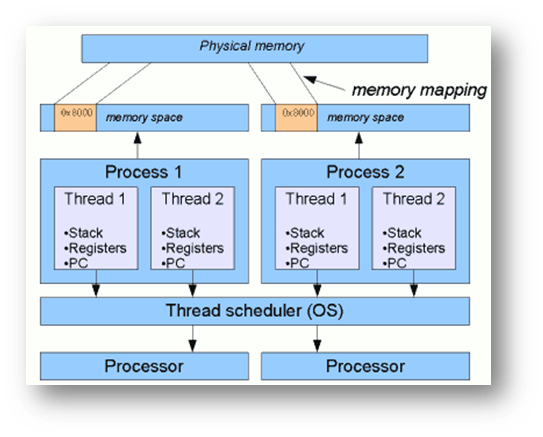
🧵 Pointers - CPU/Memory View
Used the wonderful CPU state-machine animation and recorded a lecture on what pointers are and how one should imagine them to be...
Here is a snap from the lecture.
Here are some points to remember about pointers -
✅ A Pointer is a Number.
✅The number is interpreted as an address.
Dereferencing a Pointer:
✅ If that number is put on the Data Bus - It is a data pointer.
✅ If that number is put in the PC - It is a function pointer.
✅ If there is no information about the datatype of the content at the address, it is a void pointer! Just plain address...
The lecture goes into more details. I never understood why pointer became a dreaded concept/topic. To me it just looks very logical.
Full lecture is part of the course (link below).
Malware developers are actively developing anti-VM techniques 🖥️
Here an example for Windows of a PowerShell script found in the wild, checking for specific OS versions, CPU and GPU characteristics to stop execution.
If none of the checks fail, a next stage payload is executed
Microsoft open-sourced a no-code data analysis tool!
Introducing Data Formulator, an LLM-powered, no-code tool that transforms data in a snap and creates stunning visualizations using AI.
100% open source
Course material for an MIT class "Introduction to Flow Matching and Diffusion Models", looks great if you want a principled and hands on understanding of diffusion models/flow matching