My Expat Due Diligence Rules
After years of living internationally, here are a few operating rules I wish someone had given me earlier:
1. Never rely on one provider opinion
Get a second and sometimes third perspective.
2. Always ask who gets paid
Not judgmentally. Just clearly.
3. Do not outsource critical thinking
“No worries, we’ll handle everything” is not a substitute for understanding.
4. Get your own lawyer
Especially in property transactions.
5. Talk to long-term locals and expats
People with scars are often more useful than people selling.
6. Be careful with urgency
Pressure is often a signal.
Separate confidence from competence
The loudest voice is not always the best advisor.
International life has hidden incentive structures.
Understanding them is part of becoming antifragile.
What rule would you add?
#ExpatLife #GlobalMobility #InternationalLiving #Resilience
Real Estate Rule
My strongest rule for buying property abroad:
Never use only the lawyer recommended by the real estate firm.
The people trying to close the deal are not the people incentivized to slow things down and point out risks.
Get independent counsel.
Always.
Hidden Incentives
One thing I wish I understood earlier as an expat:
Many “trusted recommendations” are actually paid sales channels.
Immigration lawyer.
Tax advisor.
Real estate agent.
Residency consultant.
Sometimes excellent.
Sometimes simply the provider willing to share economics.
Not cynicism.
Incentives.
Before accepting a recommendation, quietly ask:
Who pays whom?
Lately I’ve been wondering whether reality has two layers:
one material
one spiritual.
For most of my life, I focused almost entirely on the material layer.
Now I’m starting to suspect that the material world may be downstream of something deeper.
A shadow cast by spiritual reality.
If that’s true, then corruption, disorder, and injustice in the visible world may be reflections of corruption at a deeper level.
It raises a difficult question:
Is this world partly a training ground for the soul?
Not a place to escape reality, but a place to see it more clearly.
Taxes + social contributions matter
Most young people ignore taxes and social contributions because it feels abstract.
It isn’t abstract.
It’s the biggest invisible drag on your ability to build options.
Life Launch rule:
know what the system takes before you choose the location and the job.
“Rent is the boss fight”
If you’re in your 20s, here’s a rule I wish everyone understood:
Rent is the boss fight.
If housing eats your runway, you can’t build options.
You can’t invest in skills.
You can’t take intelligent risks.
Keep rent sane and you buy freedom.
My meditation teacher told me we were looking for "openness." I didn't know what he meant.
5 years later I have a theory. Openness = consciousness - thinking. Consciousness outside of thinking domination which leaves space for the lived experience and awareness.
Wondering if this aligns with your experience.
A single 5-min meditation at 8:30AM this morning..
(All I had time for before my daughter wanted her morning walk)
Led to a full day afterglow >>> shrooms
It feels like there's a wellspring of nectar like bliss that's been pouring forth from the chest
This is incredibly nourishing & soothing
And there's really nothing other than meditation that can bring you here...
And on the way to making your mind concentrated
You'll exhaust a tremendous amount of baggage you've been carrying around
The baggage that runs & ruins your life if left to fester in the unconscious mind
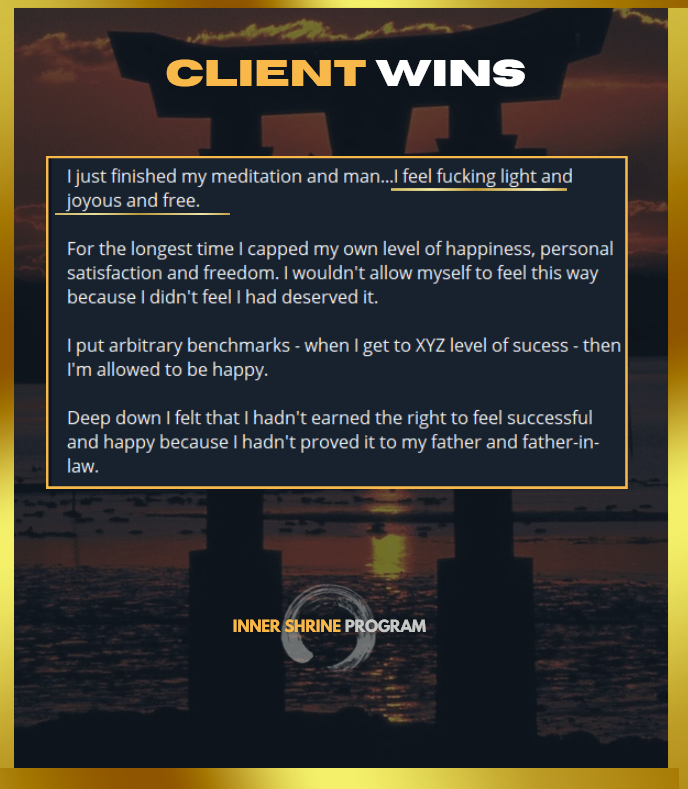
Here's a good example from a client who experienced a BIG letting to while meditating
Real world benefit:
(other than feeling light, joyous & free...which is the point of it all)
This shift helped him make $100,000s of dollars
Seen other clients find love, attract dream opportunities, heal relationships, make life changing decisions, finally start enjoying life etc
All while feeling amazed at how easy it felt
This is the natural result of upgrading your inner OS
Bhutan just launched a digital nomad visa.
It costs $2,800/year to live and travel anywhere in the kingdom for 12 months.
It also requires depositing $10k into its sovereign financial infrastructure by buying its new gold-backed cryptocurrency, TER.
If it’s a headache machine, it’s not optimization
Here’s a rule I stole from investing and apply to life-stack decisions:
Does the payoff justify the effort?
Example: owning and renting little Airbnbs all over the world.
- The % return might be fine.
- The dollar return is small.
And each one guarantees a couple headaches per year.
That’s not optimization. That’s buying recurring friction.
I’m not hunting for small wins that add complexity.
I’m hunting for bigger opportunities that simplify the stack and increase time ownership.
If the “upgrade” comes with a built-in support ticket system… pass.
Tax maps are useful — and 0% matters — but it’s only part of the picture.
What I’ve learned is that an acceptable digital asset environment is about whether everything works together:
banking, compliance, KYC, day-to-day operability.
I’ve been in “friendly” jurisdictions where the tax box was checked, but KYC friction and unclear edges killed traction — even in completely boring cases. That’s much harder now than it was a few years ago.
Tax is a lever.
Operability is the outcome.
Anything that helps distinguish theoretical friendliness from what actually works in practice would be incredibly useful.
A lot of people optimize for theoretical wins.
Lower taxes.
Higher returns.
More options.
But the lived metric that changes everything is traction:
Can you actually get things done?
Can you move fast when you need to?
Do the systems around you help… or jam you?
For me, changing residency to Georgia increased my ability to take action (governance + banking).
That traction reformatted my life more than any spreadsheet ever could.
If your stack reduces traction, it’s not “safe.” It’s a slow bleed.
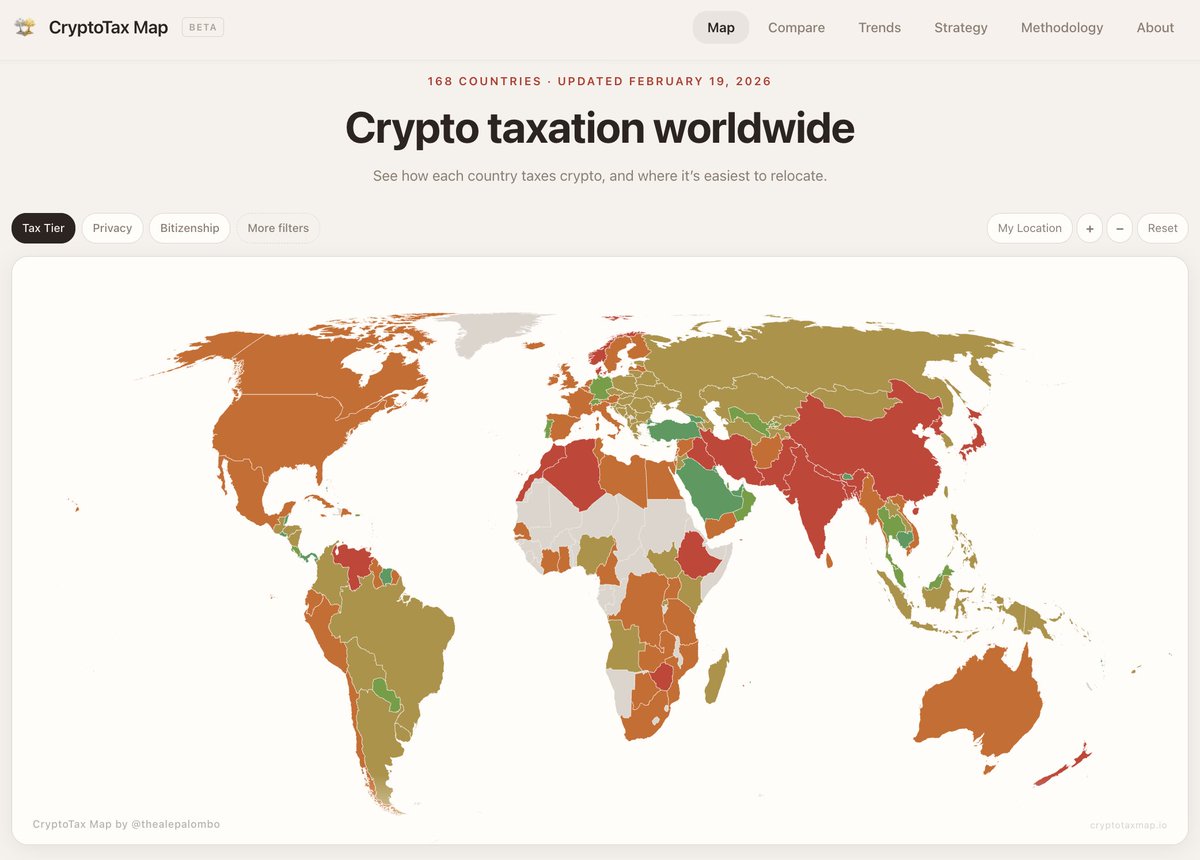
There are 32+ countries with 0% crypto tax. Most people can't name three.
So I built CryptoTax Map.
168 countries. All tax rates. Regulatory trends. Planning tools. One place.
→ See every country's crypto tax rate at a glance
→ Compare up to 3 countries side by side
→ Plan your second residency with the Strategy tool
→ Track which countries are getting friendlier (or worse) since 2020
→ Filter by what matters: 0% tax, privacy, Bitizenship, FATCA, CARF
I built it because I needed it myself.
What feature would you find most useful?
👇
The IMI® Program Pages are simply the best place on the web to search, filter, and compare migration programs. Built on nearly a decade of research:
Interact with our database of 266 citizenship by investment, residence by investment, independent means visa, and active investor visa programs.
Narrow down your program search using our 15+ filters, such as
📅 Time to citizenship
🌍 Visa-free destinations
⌛ Annual stay requirements
💰 Minimum contribution amounts
🧩 Supranational settlement blocs
🌴 Country attributes (tax, climate, languages, etc.)
🏠 Contribution types (real estate, bonds, business)
+++
Get instant visual comparison, whether on the map or the list, and identify programs that suit you.
Click to open the detailed Program Page, where you'll find experts who can help with that particular program.
This tool gets you from "I'm interested" to "here are my three best options" in under two minutes.
This is a decision engine.
Most people talk about “optimizing their life” like it’s a single metric.
It’s not.
You optimize each rail differently:
Banking: reliability + custodial integrity
Residency: governance + ability to take action
Citizenship: safety + optionality (sometimes tax)
Expenses: stability + low friction
Information: signal-to-noise + mental sovereignty
Then you zoom out and ask the only question that matters:
Does the whole stack deliver the life you want?
That’s life-stack optimization: rail-by-rail tuning + system-level outcomes.
What really clicks for me is how AI pulls previously “out-of-reach” skills into range.
You don’t need to master everything — you need to experiment fast enough to discover where judgment + leverage now compound.
The edge moves to people who probe the frontier instead of defending old terrain.
When we say “best,” what problem are we optimizing for?
U.S. cards are clearly unbeatable on rewards extraction if you can play the points game well. No argument there.
But as part of a broader life-stack, they can also add fragility: compliance exposure, account shutdown risk, and dependence on one jurisdiction’s rails. Those costs don’t show up in the points math—but they’re real if you’re operating internationally.
For some people, the upside dominates. For others, especially multi-jurisdictional lives, “best” depends on how much optionality and resilience you’re willing to trade for rewards.
Interesting map—and I agree the Southern Cone stands out for its relative calm.
One thought experiment I always find revealing: instead of mapping where conflicts occurred, map where they originated—or whose interests were ultimately being served.
The geography of violence and the geography of decision-making are often very different. That gap explains a lot about why some regions stay “chill” while others absorb repeated shocks.
Uruguay clearly checks a lot of boxes—governance, stability, and a tax regime that doesn’t punish foreign capital. That combination is rarer than people think, especially in the Western Hemisphere.
One thing I’ve learned living in multiple places: every location that looks “almost perfect” usually hides a few tradeoffs that only show up after time on the ground. Pace, energy, weather, cost drift, social friction—something always gives.
Curious from your experience: where does Uruguay fall short in practice? What’s the friction you only notice after the honeymoon phase?