Call me a stickler, but if you regularly paint public school as “government school” and “taxpayer funded indoctrination”, where those who “don’t know what time it is” send their kids, your opinion on what is or isn’t included in the curriculum is not particularly relevant. 🤓
@jenniferwilkin Your influence is so far reaching. I just don’t think poking this bear is wise. It never ends well. “Make it your goal to live a quiet life, minding your own business and working with your hands, just as we instructed you before.”
1 Thessalonians 4:11
🚨Another Piece of America Slips Away - Sugar Land, Texas!
While most Texans were going about their business, the streets of Sugar Land recently filled with an Annual Muharram Jaloos - a large religious procession organized by the Ali Center Houston (Masjid-e-Ali). Black-clad participants, banners, and mourning rituals marched through an American suburb in the name of ancient sectarian history.
Walking among them were the children - the Buturab Scouts.
This community didn’t just join the Boy Scouts of America as previous generations of immigrants did. They built their own.
They have their own school (Buturab School).
They have their own scouting program.
They have their own mosque, their own majalis, their own entire parallel ecosystem.
Why?
Because, in their own words, they are building “a strong, unified community grounded in the teachings of Islam… empowering our members to live by Islamic principles in all aspects of their lives.”
Translation: keep the kids walled off from American society.
The Boy Scouts - with its co-ed policies, gender ideology, and secular drift, no longer served their purpose. So they created their own version to ensure the next generation remains loyal to the Ahlul-Bayt and Islamic identity first, American culture second (or not at all).
This is replacement by parallel society.
Texas is watching the same pattern that destroyed many parts of Europe play out in real time:
Growing Muslim populations (hundreds of thousands in the Houston metro alone).
Massive public religious processions that turn American streets into temporary extensions of Karachi or Tehran.
Institutions deliberately designed to insulate children from the host society.
No interest in joining the existing American fabric - only in expanding their own.
The Ali Center isn’t hiding it.
Their mission statement is clear: preserve traditions, strengthen bonds among believers, and live by Islamic principles [. They are openly building a self-contained Islamic community inside Sugar Land.
And they’re doing it with American freedoms, American roads, and American tolerance.
This is what “diversity” looks like when one side refuses to assimilate.
🔺Processions in the streets.
🔺Separate scouts.
🔺Separate schools.
🔺Separate everything.
While native Texans are told they must celebrate every foreign tradition or be labeled bigots.
Texas didn’t vote for this. But mass Islamic immigration + high birth rates + deliberate non-assimilation are delivering it anyway.
The mosques aren’t “storming” the streets with weapons.
They’re doing something far more effective: they’re marching with children in uniform, claiming public space, and raising a generation that sees itself as separate from and superior to the country that took them in.
This is conquest by demographics and parallel institutions.
Texas, take notice of which politicians are refusing to acknowledge the Islamization of your state!
@neilschori This amendment is a return to biblical principles for the church. Women are given by God significant roles within the church-preaching to the congregation is just not one of them.
🚨PRIDE MONTH🚨
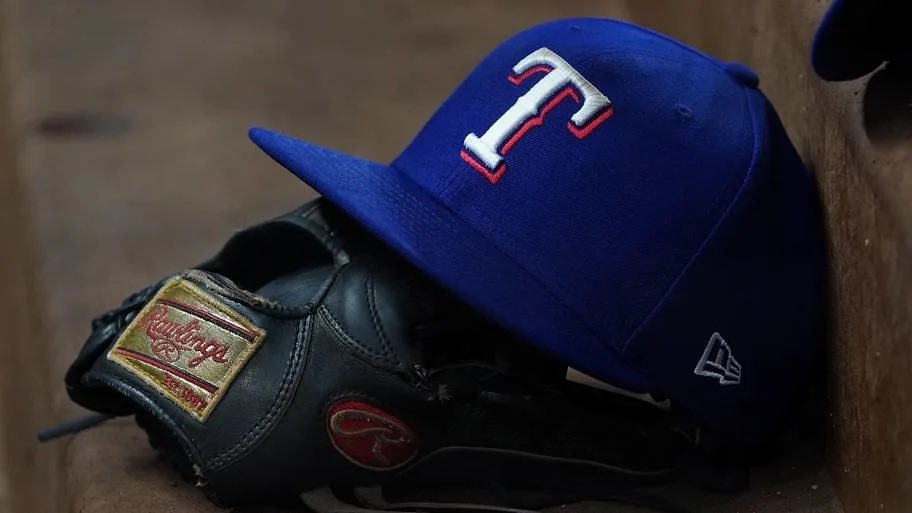
The Texas Rangers are the ONLY MLB team not acknowledging “Pride Month.”
The Rangers are again not hosting an LGBT night event.
Instead, on June 18, they will be hosting a Faith and Family Night.
According to their website, the event will feature “personal testimonies from Rangers players Wyatt Langford, Josh Jung, Cody Bradford, Jacob Latz, Jalen Beeks, and others, sharing how faith impacts their lives both on and off the field.”
@nickitruesdell@DavidSpillerTX Great news! We need this in big bold letters for all DPS workers to see. We follow the rules. Do all the things & still struggle to accomplish the simple things like getting a drivers permit. Should not be this hard.
@nickitruesdell Can I ask where you are going? I know things are getting worse but I’ve never had a VOE questioned but if anything was going to be questioned it happened at Sherman for us.
@nickitruesdell My daughter enjoyed this course. My son used Generations new book ,”How to Think Biblically” and it was really good as well. Both highly recommended.
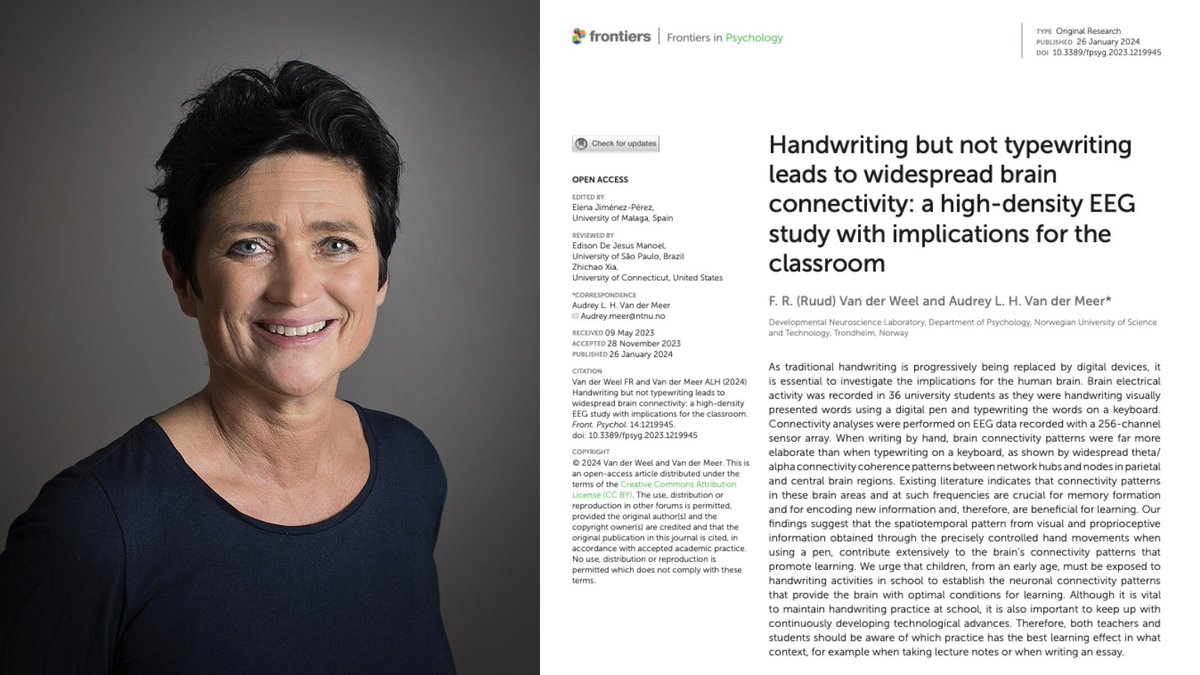
A Norwegian neuroscientist spent 20 years proving that the act of writing by hand changes the human brain in ways typing physically cannot, and almost nobody outside her field has read the paper.
Her name is Audrey van der Meer.
She runs a brain research lab in Trondheim, and the paper that closed the argument was published in 2024 in a journal called Frontiers in Psychology. The finding is brutal enough that it should have changed every classroom on Earth.
The experiment was simple. She recruited 36 university students and put each one in a cap with 256 sensors pressed against their scalp to record brain activity. Words flashed on a screen one at a time.
Sometimes the students wrote the word by hand on a touchscreen using a digital pen, and sometimes they typed the same word on a keyboard. Every neural response was recorded for the full five seconds the word stayed on screen.
Then her team looked at the part of the data most researchers had ignored for years, which is how different parts of the brain were communicating with each other during the task.
When the students wrote by hand, the brain lit up everywhere at once.
The regions responsible for memory, sensory integration, and the encoding of new information were all firing together in a coordinated pattern that spread across the entire cortex. The whole network was awake and connected.
When the same students typed the same word, that pattern collapsed almost completely.
Most of the brain went quiet, and the connections between regions that had been alive seconds earlier were nowhere to be found on the EEG.
Same word, same brain, same person, and two completely different neurological events.
The reason turned out to be something nobody had really paid attention to before her work. Writing by hand is not one motion but a sequence of thousands of tiny micro-movements coordinated with your eyes in real time, where each letter is a different shape that requires the brain to solve a slightly different spatial problem.
Your fingers, wrist, vision, and the parts of your brain that track position in space are all working together to produce one letter, then the next, then the next.
Typing throws all of that away. Every key on a keyboard requires the exact same finger motion regardless of which letter you are pressing, which means the brain has almost nothing to integrate and almost no problem to solve.
Van der Meer said it plainly in her interviews.
Pressing the same key with the same finger over and over does not stimulate the brain in any meaningful way, and she pointed out something that should scare every parent who handed their kid an iPad.
Children who learn to read and write on tablets often cannot tell letters like b and d apart, because they have never physically felt with their bodies what it takes to actually produce those letters on a page.
A decade before her, two researchers at Princeton ran the same fight using a completely different method and ended up at the same answer. Pam Mueller and Daniel Oppenheimer tested 327 students across three experiments, where half took notes on laptops with the internet disabled and half took notes by hand, before testing everyone on what they actually understood from the lectures they had watched.
The handwriting group won by a wide margin on every question that required real understanding rather than surface recall.
The reason was hiding in the transcripts of what the two groups had actually written down.
The laptop students typed almost word for word, capturing more total content but processing almost none of it as they went, while the handwriting students physically could not write fast enough to transcribe a lecture in real time, which forced them to listen carefully, decide what actually mattered, and put it in their own words on the page.
That single act of choosing what to keep was the learning itself, and the keyboard had quietly skipped the choosing and skipped the learning along with it.
Two studies. Two countries. Same answer.
Handwriting makes the brain work. Typing lets it coast.
Every note you have ever typed instead of written went into your brain through a thinner pipe. Every meeting, every book highlight, every idea you captured on your phone instead of on paper was processed at half depth.
You did not forget those things because your memory is bad. You forgot them because typing never woke the part of the brain that would have made them stick.
The fix is the thing your grandmother already knew.
Pick up a pen. Write the thing down. The slower road is the faster one.
Yesterday, my son finished his 8th grade school year. It was my 29th year to homeschool. There was no big celebration. He just handed me his final assignment then he went fishing. There. Done. ✅