𝗕𝘂𝗶𝗹𝗱 𝗧𝗵𝗶𝘀 𝗘𝗻𝗱-𝘁𝗼-𝗘𝗻𝗱 𝗔𝗪𝗦 𝗗𝗲𝘃𝗢𝗽𝘀 𝗣𝗿𝗼𝗷𝗲𝗰𝘁 (𝗥𝗲𝗮𝗹 𝗣𝗿𝗼𝗱𝘂𝗰𝘁𝗶𝗼𝗻 𝗘𝘅𝗽𝗼𝘀𝘂𝗿𝗲)
You will learn more by building one hands-on project from scratch than by watching 10 YouTube tutorials.
Project Description: An OpenTelemetry-based E-commerce microservices app deployed on AWS with full CI/CD + GitOps.
🟢 Project Architecture (Industry Style)
User
→ Domain (GoDaddy)
→ Route53
→ Load Balancer
→ EKS
→ Kubernetes Services
→ 20+ Microservices
If you build this once interviews become easy.
🟢 Step 1: Infrastructure as Code (Terraform)
Use Terraform to provision everything.
What you will implement:
✅ VPC (public + private subnets)
✅ Internet Gateway
✅ Route Tables
✅ NAT Gateway
✅ Security Groups
✅ EKS Cluster using Amazon EKS
✅ S3 backend for remote state
✅ DynamoDB for state locking
👉 What you will learn:
- Real VPC networking design
- How production EKS clusters are created
- Remote state management best practices
- Terraform backend configuration
- State locking (why it matters in teams)
- This alone gives you real DevOps exposure.
🟢 Step 2: CI/CD with GitHub Actions
Use GitHub Actions
Pipeline Stages You Should Create:
🔹 Build
- Checkout code
- Setup Go
- Install dependencies
- Run unit tests
🔹 Code Quality
- Integrate golangci-lint
- Perform static analysis
🔹 Docker
- Build images
- Push to Docker Hub
🔹 Update Kubernetes Manifests
- Auto-update image tag
- Commit back to repo
👉 What you will learn:
- Automated CI pipelines
- Docker image tagging strategy
- Version control in pipelines
- Secure secret handling
- Production-grade workflow design
This is exactly what companies expect.
🟢 Step 3: Containerization
Use Docker
What you will implement:
- Containerize 20+ microservices
- Multi-stage Docker builds
- Lightweight production images
- docker-compose for local testing
👉 What you will learn:
- Microservice packaging
- Build optimization
- Local vs production environment differences
- Dependency management
🟢 Step 4: Kubernetes on AWS
Deploy everything on Kubernetes using Amazon EKS
What you will implement:
✅ Deployments
✅ Services (ClusterIP, LoadBalancer)
✅ Ingress
✅ Service Accounts (IAM roles for service accounts – IRSA)
✅ Resource limits & requests
👉 What you will learn:
- Pod scheduling
- Service-to-service communication
- Ingress + ALB integration
- Secure workload identity
- Real cluster debugging
- This is real production experience.
🟢 Step 5: GitOps with ArgoCD
Use Argo CD
What you will implement:
- Connect GitHub repo to EKS
- Enable auto-sync
- Maintain desired state = actual state
👉 What you will learn:
- GitOps workflow
- Declarative deployments
- Drift detection
- Production-grade release strategy
- Modern companies are moving toward GitOps.
🟢Step 6: Domain + Traffic Routing
Use:
- Amazon Route 53
- GoDaddy domain
Flow:
User
→ Route53
→ AWS Load Balancer
→ Ingress
→ Service
→ Pod
👉 What you will learn:
- DNS configuration
- Hosted zones
- A records / CNAME
- Real internet traffic routing
Now your project becomes public and production-like.
🎯Final Outcome
If you build this project fully: You will understand:
✔ Networking
✔ CI/CD
✔ GitOps
✔ Kubernetes
✔ IAM & Security
✔ Terraform Backend
✔ Production troubleshooting
✔ Real DevOps workflow
I have documented everything in my GitHub repository.
You can follow it step by step, and if you get stuck, feel free to take help from ChatGPT but make sure you truly understand the concepts.
𝗠𝗮𝗶𝗻 𝗣𝗿𝗼𝗷𝗲𝗰𝘁 𝗥𝗲𝗽𝗼: https://t.co/HoGVLDDXlN
𝗧𝗲𝗿𝗿𝗮𝗳𝗼𝗿𝗺 𝗥𝗲𝗽𝗼: https://t.co/VffpUPOyUn
If you found this helpful, feel free to like, retweet, and share it with aspiring DevOps engineers.
Signing off
@devops_nk 🫡
Stop collecting AWS certifications thinking that’s how you learn cloud.
If you are just starting to learn AWS, here are 7 beginner-friendly AWS projects that will teach you more than any shiny certification will.
And you can do it on your own:
Project 1: Static Website on S3
Host a simple site for $0/month plus learn bucket policies, CloudFront integration, and why public buckets are dangerous.
Project 2: EC2 Web Server
Launch an instance and deploy a small app while discovering security groups, SSH keys, and why you need load balancers.
Project 3: File Backup System
Upload and retrieve files in S3 while understanding storage classes, lifecycle policies, and versioning.
Project 4: Simple Database App
Use RDS with a Python/Flask app to learn connection pooling, backup strategies, and why you don’t run databases on EC2.
Project 5: CloudFront Distribution
Speed up your static site with a CDN while learning edge locations, cache invalidation, and origin behaviors.
Project 6: Serverless Function (Lambda)
Trigger a Python function when files are uploaded and discover cold starts, memory limits, and event-driven architecture.
Project 7: Route 53 Domain Setup
Buy a domain and connect it to S3/EC2 while learning DNS records, health checks, and traffic routing.
Each project teaches you one core AWS concept through real implementation, not theory.
You don’t need to learn all 100+ AWS services, you just need 10:
VPC, EC2, RDS, ECS, Lambda, IAM, S3, EKS, Route53, Secrets Manager/KMS
Master these through building, and the rest will make sense when you need them.
.
.
These all are basic projects but if you want to learn to build hardcore real world Devops projects like one use in production then consider my 20 week Devops bootcamps.
https://t.co/xwMrGd0Ktq
As a senior DevOps engineer, you’re not paid to memorize commands.
You’re paid to solve complex problems under pressure when the business is hemorrhaging money.
Here are 5 scenarios that reveal who’s actually been in the war room
👉 Your observability costs are 40% of your infrastructure budget. How do you optimize without losing critical visibility?
→ Implement log sampling and retention policies based on criticality
→ Use metric aggregation and downsampling for historical data
→ Replace expensive APM tools with open-source alternatives where possible
→ Set up intelligent alerting to reduce noise and false positives
→ Archive old logs to cheaper storage tiers automatically
→ Negotiate volume discounts with monitoring vendors
→ Focus on business-critical metrics and eliminate vanity dashboards
👉 Create a disaster recovery test that validates your 4-hour RTO without impacting live traffic or customer data.
→ Build parallel infrastructure in isolated network segments
→ Use anonymized production data snapshots for realistic testing
→ Simulate different failure scenarios with chaos engineering tools
→ Test backup restoration processes with actual recovery procedures
→ Validate DNS failover and load balancer configurations
→ Document step-by-step recovery playbooks with timing expectations
→ Run monthly DR drills with different team members leading
👉 Design a multi-tenant Kubernetes architecture where one tenant’s resource spike can’t impact others.
→ Implement strict resource quotas and limits per namespace
→ Use node affinity and anti-affinity rules for workload isolation
→ Deploy network policies to prevent cross-tenant communication
→ Set up separate ingress controllers for each tenant
→ Monitor resource usage with tenant-specific dashboards
→ Implement priority classes for critical vs non-critical workloads
→ Use pod disruption budgets to maintain availability during updates
👉 Your database replica lag hits 10 minutes during peak hours. How do you solve this without affecting write performance?
→ Analyze slow queries and optimize indexes on replica databases
→ Implement read query caching to reduce replica load
→ Scale replica infrastructure horizontally during peak times
→ Use connection pooling to prevent replica connection exhaustion
→ Route non-critical reads to eventual consistency endpoints
→ Implement query load balancing across multiple replicas
→ Monitor replication metrics and set up lag-based alerts
👉 Implement automated compliance scanning that prevents policy violations while maintaining developer velocity.
→ Integrate security scanning into CI/CD pipelines with fast feedback
→ Use policy-as-code tools for consistent rule enforcement
→ Implement progressive security gates based on risk levels
→ Provide self-service tools for developers to check compliance locally
→ Create security policy templates and approved configurations
→ Set up automated remediation for common violations
→ Establish clear escalation paths for security exceptions
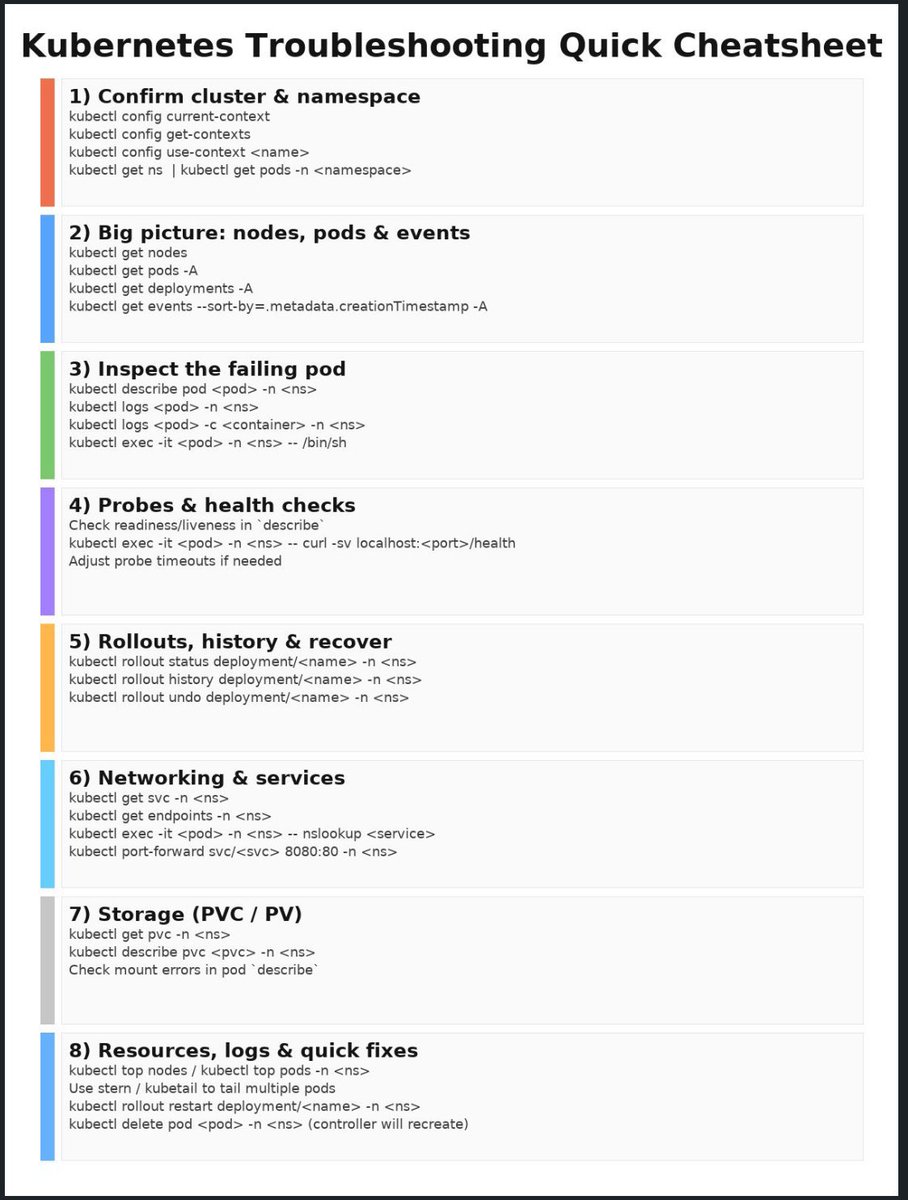
Production Kubernetes cluster is down. Your manager is asking for updates every 5 minutes.
Here’s your step-by-step troubleshooting playbook:
Step 1: Get your bearings
Check where you are: kubectl config current-context
See all contexts: kubectl config get-contexts
Switch if needed: kubectl config use-context name
List namespaces: kubectl get ns
Step 2: See the big picture
Node health: kubectl get nodes
All pods: kubectl get pods -A
Recent events: kubectl get events –sort-by=.metadata.creationTimestamp -A
This tells you if it’s a cluster-wide issue or isolated problem.
Step 3: Focus on the failing pod
Get details: kubectl describe pod podname -n namespace
Check logs: kubectl logs podname -n namespace
Get inside: kubectl exec -it podname -n namespace – /bin/sh
Step 4: Check health probes
Look for probe failures in the describe output
Test probe endpoint: kubectl exec -it podname -n namespace – curl localhost:port/health
Step 5: Check deployments and rollouts
Rollout status: kubectl rollout status deployment/name -n namespace
View history: kubectl rollout history deployment/name -n namespace
Rollback: kubectl rollout undo deployment/name -n namespace
Step 6: Verify networking
List services: kubectl get svc -n namespace
Check endpoints: kubectl get endpoints -n namespace
Test DNS: kubectl exec -it podname – nslookup servicename
Step 7: Quick fixes that work
Restart deployment: kubectl rollout restart deployment/name -n namespace
Delete problematic pod: kubectl delete pod podname -n namespace
The key is following the steps in order, not jumping around randomly.
As a DevOps engineer, we all use Nginx.
But most don’t understand how powerful Nginx really is.
Here’s what happens when a request hits your Nginx server:
Nginx sits as your system’s entry point, listening on ports 80 and 443. When a request comes in, it instantly decides the best action based on your configuration.
- For static files like images or CSS, Nginx serves them directly from disk. Blazing fast with no backend needed.
- For dynamic requests, it acts as a reverse proxy. It forwards requests to your backend applications and waits for responses.
👉But here’s where it gets powerful:
- Load balancing across multiple backend servers with different strategies.
- TLS termination handling all SSL certificates and encryption.
- Response caching to serve repeated requests instantly.
- Rate limiting and IP blocking for security.
- Response compression to reduce bandwidth.
- Custom headers for CORS and security policies.
All of this is controlled by a single nginx.conf file. It reloads without downtime.
👉In Kubernetes environments, Nginx serves as an Ingress Controller. It manages and routes traffic to internal services based on paths and rules.
✅That’s why Nginx powers over 400 million websites. It’s not just a web server - it’s a complete traffic management solution.
The A - Z of @cysic_xyz
A - AI Integrity
B - Blockchain Compatibility
C - Compute Guarantee (CG)
D - DePIN Integration
E - Edge Computing
F - Full-Stack ZK Infrastructure
G - GPU & ASIC Acceleration
H - Hardware Prover Incentives
I - IPFS Compatible Storage
J - Just-in-Time Proving
K - zkVMs (zk Virtual Machines)
L - Latency Optimization
M - Modular Architecture
N - Native Staking
O - Off-Chain Computation
P - Proof-of-Compute (PoC)
Q - Quantum Resistant Possibilities
R - Recursive ZK Proofs
S - SNARKs & STARKs
T - Trustless Computation
U - Universal Verifiers
V - Verifiable Offchain Computation
W - Web2 + Web3 Bridge
X - eXecutable Proofs
Y - Yield from Compute
Z - zkML (Zero Knowledge Machine Learning)
Bullish on ComputeFi.
gmsor loveesssss. 🫶🏼🩷
Just dropped a quick guide on managing team members on APItoolkit dashboard.
Adding, removing and updating permissions, super easy stuff. Catch the walkthrough 👇
RT for the women on the TL.
You get 200k+ for free towards your learning, and data allowance every month for 12 months.
It’s women only tho.
Courtesy of @kikimordi and friends.
Fill the form.
https://t.co/EHttDHlALP
Mistakes are inevitable, but what’s your plan for fixing them and avoiding similar ones in the future?
Proactive monitoring and observability helps you avoid such expensive mistakes 👇