Volkswagen is cutting 100,000 jobs.
Britain should be terrified.
Not because VW is British.
Because this is what happens when industry can no longer compete.
Cheap Chinese rivals.
High costs.
Factories with nowhere near enough work.
And what is Britain doing?
Making energy brutally expensive.
Taxing employers harder.
Piling on more rules.
Highest industrial power prices in the rich world.
Then Reeves wonders why investment goes elsewhere.
You cannot tax and regulate your way to an industrial revival.
Industry goes where it is wanted.
Cheap energy.
Low taxes.
Freedom to build.
Get that wrong and the factories leave.
The jobs follow.
And once they’re gone, getting them back is almost impossible.
Wind providing a mere 3% of UK electricity this morning. So we’re having to import 10 times that amount at massive cost. Plus generate almost the same from gas-fired stations expensively kept for this sort of back up. As a result we’re paying an average £136/MWh. Our energy policy is a costly shambles.
The SNP runs into the Laffer Curve: its 48% top rate of income tax (NICs on top) results in £22m LESS in tax revenues.
Don’t they teach economics in the land of Adam Smith any more?
Or does left-wing virtue signalling — I’m ‘taxing the rich’ more than you — trump everything?
@JamesMelville Hi James, you’re not entirely right here. I agree with most of your net zero stuff (it’s crazy most of it) but not this. Drax’s wood is from Woodchip/sawdust and pre-commercial thinings from sustainable forests. £ is hard to justify but it helps balance grid for other NZ madness
Excellent thread, this. Something I’ve spent a lot of time thinking about…
The British state is run by people who have never been fired, never missed a number, never had a client scream at them, never stayed up until 3am working on a deal, or repricing a book because Tokyo opened badly.
They have never experienced CONSEQUENCE. Ever.
THAT is the single most important fact in British public life.
The pipeline is so uniform and mediocre it scarcely needs describing:
- School
- PPE or adjacent
- Civil Service fast stream or a Think Tank research role
- Spell as local councillor to appear “grounded,”
- Then a safe seat and a red box before 40
At no point has the market ever called them a moron.
At no point has a P&L told them their idea was shit.
The feedback loop that every private sector professional takes for granted simply does not exist in their world.
This matters because policy is NOT an essay. It IS a trade. Every regulation has a cost, every tax has a behavioural response, every intervention has second and third order consequences.
In markets, if you misread convexity you get carried out. In government, you get reshuffled to a different department.
The incentive structure could not be more perfectly designed to retain the incompetent and repel the capable.
Anyone with genuine commercial talent is earning multiples of a ministerial salary by their early thirties. So the applicant pool self selects for people for whom the title is the reward because they could never command that status where performance is measured.
The think tank ecosystem makes it worse.
IPPR, the Resolution Foundation, JRF and the rest function as ideological finishing schools and revolving doors. They produce people fluent in the language of policy who have never implemented anything. They can model a distributional impact assessment in their sleep but could not run a corner shop at profit.
This is NOT intelligence. It is pattern matching within a closed system that never tests its own assumptions because everyone in it shares the same priors.
The civil service compounds it further. The fast stream rewards generalism, rotating you through departments every 18 to 24 months to develop “breadth,” which in practice means you never develop depth.
A Treasury official who helped design a tax policy in 2019 is working on transport by the time it starts distorting behaviour in 2022. Nobody owns the outcome.
The private sector has one thing the state fundamentally lacks: a kill switch.
Bad companies go bust.
Bad traders get sacked.
The state just absorbs failure, reclassifies it as “lessons learned,” and promotes the people responsible.
The compound effect of thirty years of this is a permanent class institutionally incapable of delivering growth or even understanding why the private sector they depend on for revenue keeps shrinking under their stewardship. This is what we have, right now.
You cannot fix this with better people inside the same system. The system selects against competence, insulates against feedback, and rewards survival over performance.
Every parliament is just a fresh rotation of the same profile through the same machine expressing the same surprise when nothing improves.
We need parallel institutions to be built by the guy or gal staying up til 3am repricing the book. The risk taker. The entrepreneur.
Then we gradually phase the existing sclerotic failed structures out.
That’s how we win.
Make Britain Great Again 🇬🇧 💪
Every measure you list involves spending wealth.
You don’t list one measure that creates wealth.
And if you don’t create wealth you will soon run out of it to spend, which is already happening (hence all your extra taxes and borrowing).
Last year Britain lost a THIRD of its refineries.
Why? A Carbon Tax on industry that Ed Miliband doubled.
We won’t need any less petrol, diesel, jet fuel, ceramics or chemicals - we'll just rely more on foreign imports.
We must axe the Carbon Tax and save British industry.
ChatGPT made this graphic for me to illustrate the pump price of petrol...
The fuel duty is higher than the crude oil component
And then we pay VAT including on the fuel duty!!
When @RachelReevesMP talks about fuel profiteering she needs to look in the mirror
@griffitha@ClaireCoutinho
@afneil@KemiBadenoch Bonkers indeed. UK misses out on billions in tax receipts, billions in investment and hundreds of thousands of jobs. All for the governments misplaced desire to underpin our economy with crazily expensive energy from unreliable renewables. Makes me want to cry.
Ed Miliband is a dangerous fantasist who is gambling with our energy security.
As the world gets more dangerous, Britain should be asking itself a hard question: is our energy system resilient enough?
Miliband argues that his race to power the country on the wind and the sun makes us more secure. In reality, he is doubling down on a reckless experiment which is making us weaker and poorer.
What Britain really needs is an Energy Resilience Strategy.
Miliband’s first fatal mistake is shutting down the North Sea, which still provides half of our gas supply.
Rather than use our own, Labour would prefer Britain became more reliant on dirtier gas from abroad, while losing thousands of jobs here and sending billions of pounds overseas in the process.
We have to end Miliband’s mad ban on new oil and gas licences, scrap the Net Zero restrictions and job-destroying taxes and maximise recovery from the North Sea.
Second, we need to make electricity cheap.
Miliband is so consumed by making our electricity supply completely clean that he doesn’t care that he’s also making it unbearably expensive.
He has the problem completely back to front. He is making it harder for people to opt for electricity to protect themselves from shocks.
Our Cheap Power Plan would cut everyone’s electricity bill by 20% and make it far cheaper for households and businesses to electrify if they choose to do so.
Third, we must double down on nuclear. Nuclear provides reliable, 24/7 power which has the most secure supply chain of any energy source.
Yet Labour scrapped my plans to build the third modern large nuclear plant in Britain. This is absurd and must be reversed.
Fourth, in times of war, our industrial power is our hard power. British industry is being crippled by soaring Carbon Taxes which have as much as doubled under Labour.
We will still need chemicals, plastics and steel, we will just end up getting them from more polluting countries who do not impose these taxes. We must stop escalating Carbon Taxes and back British industry.
None of this is inevitable. We are an energy-rich nation choosing to make ourselves energy-poor.
Making ourselves weak to appease Net Zero ideologues will make us a warning, not an example, to the rest of the world.
It’s not too late to change course. Keir Starmer must ditch his dangerous Energy Secretary and prioritise Britain’s energy resilience now.
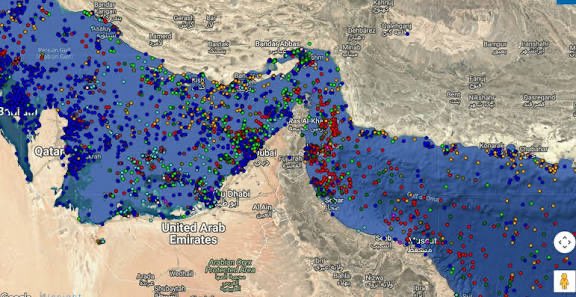
Twenty million barrels of oil passed through the Strait of Hormuz yesterday.
Today the number may be zero.
Not because Iran mined the water. Not because a tanker was hit. Because Lloyd’s of London picked up the phone.
War risk underwriters began canceling policies for strait transits hours after Operation Epic Fury launched. The Financial Times confirmed premiums surging 50 percent. Baseline war risk sits at 0.25 percent of hull value. For a hundred million dollar tanker that is 250,000 dollars per voyage. At peak escalation rates, one million per transit. Vessels linked to American or Israeli interests are becoming uninsurable entirely. No price. No policy. No passage.
The KHK Empress was loaded with Omani crude heading for Basra when it executed a U-turn mid-strait and redirected to India. The Eagle Veracruz halted at the western approach carrying two million barrels of Saudi crude bound for China. The Front Shanghai stopped off Sharjah with Iraqi crude destined for Rotterdam. Nippon Yusen ordered its entire fleet to avoid Hormuz. Greece told its merchant armada to reassess passage. Hapag-Lloyd suspended all transits.
None of them were fired upon. Every one of them got the same call.
More than fifty million years ago the Arabian plate collided with the Eurasian plate and compressed the Persian Gulf into a basin that drains through a single geological bottleneck twenty one miles wide. Twenty one percent of global petroleum. Twenty percent of all seaborne LNG. One fifth of industrial civilization’s energy supply forced through a tectonic accident narrower than the English Channel, bordered on one side by the country whose supreme leader was killed yesterday morning.
The USS Abraham Lincoln carries enough Tomahawks to sink every IRGC patrol boat in 48 hours. Operation Praying Mantis crippled Iran’s operational naval forces in eight hours in 1988. The Fifth Fleet has rehearsed this scenario for decades.
None of that matters. Aircraft carriers cannot force an underwriter to rewrite a policy. Tomahawks cannot lower a premium. The most powerful navy in human history cannot make a Lloyd’s syndicate decide that a VLCC transiting Iranian coastal waters represents an acceptable risk on a Saturday afternoon when missiles are landing in Dubai.
Goldman Sachs estimates Brent could peak at 110 dollars per barrel. JP Morgan projects 120 to 130. At those levels every airline bleeds cash. Every central bank watches three years of inflation fighting reignite overnight. Bypass pipelines from Saudi Arabia and the UAE handle roughly three million barrels. Hormuz handles twenty million. The math does not close.
Iran figured out something the Pentagon still has not.
You do not need to close a strait. You just need to make it uninsurable.
https://t.co/BrzGRrU3VW
@Ed_Miliband So that's why you've thrown everything including the kitchen sink at renewables at a massive premium to secure, reliable gas fired power generation
You're out of your mind
If you missed it. This is Kemi Badenoch's response to Rachel Reeves' disaster budget *in full*.
I've never seen anything like it. Kemi tears her to shreds.
This is absolutely brutal.
Well worth a watch 🔥
We had a dream. It came true in the most dramatic way possible, via three of the greatest goals you'll ever see. Though I think McTominay's is top, perhaps of all Scotland goals. Sorry, Archie.
https://t.co/MTDHy55iot