Senior Lecturer in British Politics, @QMPoliticsIR. Researching UK politics and parliament: legislation, opposition days, private members' bills, procedure.
This episode of @LordSpeaker's Corner with @MileEndInst’s Peter Hennessy is delightful.
As the King said of the Queen Mother, one of Peter's great heroes, Peter and Enid are "life enhancers". Their stoicism and good cheer in the face of Parkinson's should be a model to us all.
Next month, I'm going to be launching my new @BloomsburyAcad book, "Now or Never!", at my beloved @MileEndInst.
Speakers include the voice of Radio 4 @carolynquinncq, @po_qu's Ben Jackson and a MYSTERY Scottish politician. Do join us if you can!
https://t.co/9KEPWQgFcV
We are recruiting!
We care about what you can do, not where you went to university.
We’re hiring a Head of Operations. First-stage selection is based on six skills-based answers, reviewed blind.
Bring your organisational skills and interest in democracy.
Apply by 23 October:
https://t.co/p38ns9d2L0
A blast from the constitutional past, but a new piece from me on Westminster's experiment with EVEL.
'The operation and abolition of ‘English Votes for English Laws’ in the UK parliament: differentiated voting rights and English ‘legislative consent’'
https://t.co/7f1Ka9xwem
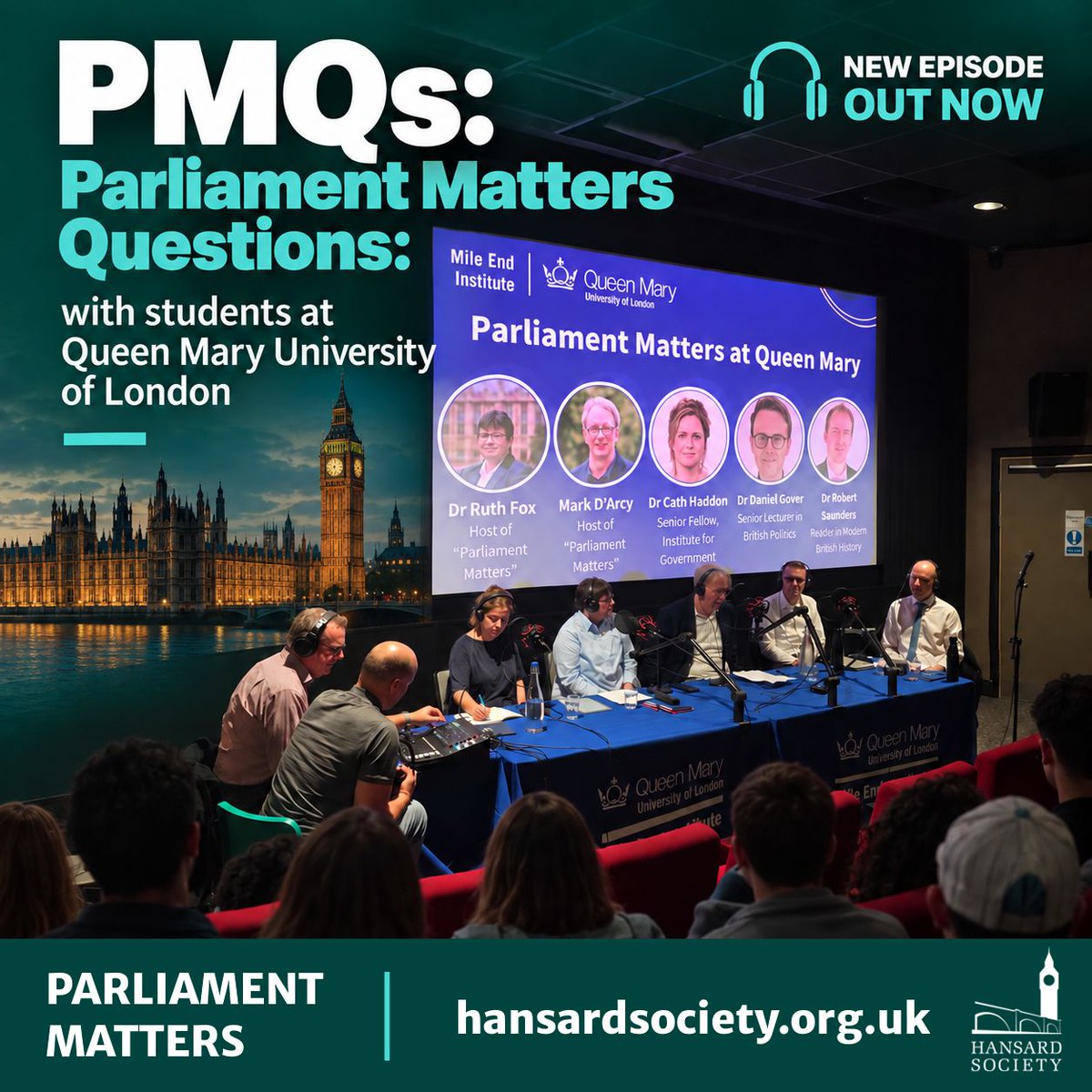
🎙️ NEW: PMQs – Parliament Matters Questions
We took the podcast to Queen Mary University of London @QMUL for a live Student Week special episode.
Students put their questions about Parliament, politics and government to:
- Dr Robert Saunders - @redhistorian
- Dr Daniel Gover - @DanielGover &
- Dr Catherine Haddon - @cath_haddon
Listen now:
https://t.co/9emPlbDD16
The Procedure Committee have just published their report on Written Parliamentary Questions.
Finding that “the WPQs system is currently under huge stress both within government and within the House”, it makes a number of recommendations for reform. 🧵
https://t.co/Gtxg3QRTk3
Excellent summary of vote on assisted dying by excellent QMUL colleague @DanielGover
Why did MPs vote to reject the assisted dying bill – and what happens now? https://t.co/uyDmquE3EO via @ConversationUK
After MPs voted against assisted dying legislation today, a new piece from me on the outcome:
'Why did MPs vote to reject the assisted dying bill – and what happens now?' @ConversationUK
https://t.co/OlwFcZ2Hjo
Comparing today's assisted dying bill vote to the last time MPs voted (June 2025), turnout was key.
Only 5 MPs look to have actively switched their vote (all from yes to no).
But among MPs voting no in June 2025, 15 didn't vote this time. Among those who voted yes it was 43.
Just to explain what's happening here... MPs basically had a vote on whether or not to have a vote.
293 said yes let's please have a vote on the assisted dying bill
218 said no let's not (and it would potentially fail)
It's all a bit confusing but that's the nub of it.
Closure won by 293 to 218. Now move to second reading of the assisted dying bill itself.
The fact that closure was won by a large margin is promising for bill supporters. But there are good reasons opponents might not vote against closure.
We are coming towards the end of the second reading debate on the assisted dying bill.
What comes next:
🟢 Closure: Likely someone will move to 'close' the debate. May be agreed without a vote.
🟢 Second reading: If closure agreed, then vote on bill itself.
@Geordiegraham2 For what it's worth, I don't think that is right. I think their ideal scenario is that the bill completes its scrutiny in the Lords, which may mean making further concessions. I don't think anyone thinks the current version of the bill is the one they would ideally pass.
Karen Bradley states that if MPs pass the assisted dying bill in this form the Parliament Acts apply automatically.
This is essentially correct. Parliament Acts do apply automatically - though MPs can vote to disapply the process (possible, but would need Commons time).
@Geordiegraham2 He proposed 77 himself last time so I think is likely to propose many of those again. Some of these responded to others - e.g. recommendations by Lords committees.
Assisted dying bill debate has featured lots on process. Some truth on both sides.
🟢 Opponents correct that passing bill could by default result in it becoming law without amendment.
🟢 Supporters correct that nothing stops Lords amending bill - and strong incentives to do so.