📊Share investment knowledge and experience to help traders—both new and experienced—enhance their skills and achieve profit targets exceeding one million.
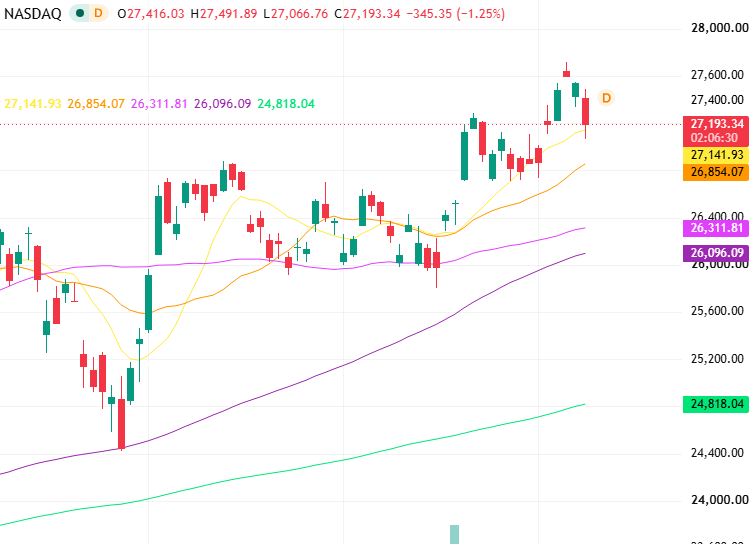
🔴 All three major U.S. stock indices closed lower on Tuesday as traders digested earnings reports from several major banks and weighed the pressure placed on memory chip stocks by a sharp overnight drop in the South Korean market.
⬇️ The S&P 500 edged down 0.02%, and the Nasdaq Composite fell 0.15%. The Dow Jones Industrial Average declined 0.35%, erasing earlier gains after having risen more than 460 points during the session.
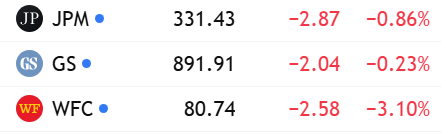
⬇️ JPMorgan Chase (-0.86%) reported third-quarter earnings and revenue that missed analysts' expectations, though the bank raised its net interest income guidance for 2026; its stock price ended virtually flat. Wells Fargo (-3.10%) fell 2% following mixed third-quarter results, while Goldman Sachs (-0.23%) saw a slight gain after its third-quarter revenue beat expectations.
$JPM $WFC $GS
$CRWV
🟢I share the same view: CRWV is a stock worth watching and buying. Whether for short-term or long-term trading, the stock is bound to surge rapidly and multiply in value down the line.
$CRWV is one of my biggest bets right now.
The stock is currently sitting in my long-term accumulation zone.
I don't think we will see price consolidating this low for long.
The business is improving so rapidly, that the stock price has to follow at some point.
As soon as we break above the upper trendline of the wedge, this will be flying towards $300.
Most people have no idea how fast this company is growing.
This name has 20x potential over the next 5 years.
➡️The three largest U.S. banks posted record net interest income for the third quarter, as customers continued to borrow despite rising interest rates.
$JPM Chase, Citigroup, and Wells Fargo reported combined net interest income of $56.5 billion for the third quarter on Tuesday, marking a record high for the fifth consecutive quarter. JPMorgan projects that its net interest income will rise further by 2027.
Today’s U.S. stock market opening reflects a classic divergence: the Dow is outperforming the Nasdaq. Earnings season for major banks has kicked off, with pre-market gains for institutions like Goldman Sachs and JPMorgan—bolstered by a pullback in Treasury yields—driving the Dow steadily higher; conversely, the Nasdaq has retreated, weighed down by a sell-off in semiconductor and memory chip stocks. Ahead of Wednesday's critical CPI inflation data, the market is generally characterized by internal capital rotation and range-bound trading.
$CPI
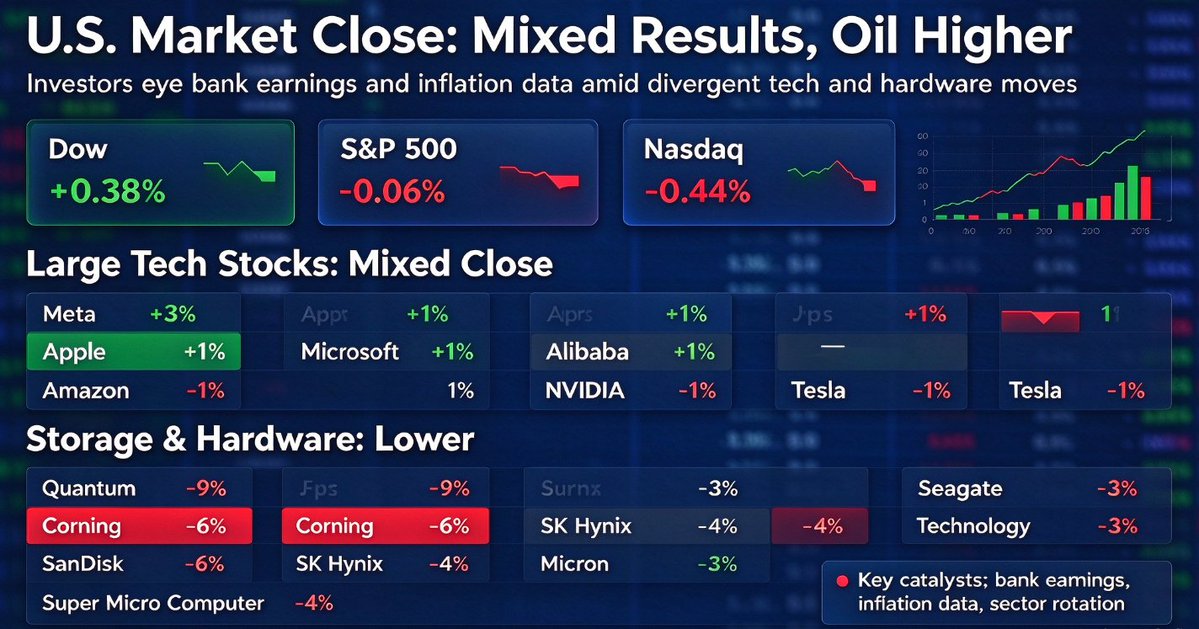
📊U.S. stocks closed mixed on Monday; oil prices rose as the market focused on bank earnings and inflation data.
➡️The Dow rose 0.38%, while the S&P 500 fell 0.06% and the Nasdaq dropped 0.44%.
➡️Performance among major tech stocks was mixed: Meta rose over 3%, Apple and Microsoft gained more than 1%, and Google posted a slight gain, while Amazon, Nvidia, and Tesla fell more than 1%. The memory, optical communications, and computer hardware sectors declined; Quantum fell over 9%, Corning dropped 6%, SanDisk fell nearly 6%, SK Hynix and Super Micro Computer dropped over 4%, and Micron Technology and Seagate Technology fell more than 3%.
$META $AAPL $MSFT $GOOGL $AMZN $NVDA $TSLA $QMCO $GLW $SNDK $SKHY $SMCI $MU $STX
🔔 Following a strong rally over the past few weeks, there are signs of capital rotating from high-valuation tech stocks into traditional value sectors.
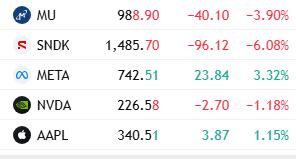
1️⃣ Memory chip stocks led the decline: Major memory manufacturers faced profit-taking, driven by competitors' technological breakthroughs and Samsung's recent earnings missing expectations. SanDisk ($SNDK ) plunged nearly 7%, Micron Technology ($MU ) fell over 4%, and Western Digital also traded lower under pressure.
2️⃣ Divergence among tech giants: $META bucked the trend with a surge of over 3%, boosted by strong early retention and download figures for its newly launched AI assistant, Muse; Nvidia ($NVDA ) dipped slightly (over 1%); meanwhile, Apple ($AAPL ) rose approximately 1.5%, overcoming rumors regarding supply chain order adjustments.
📊Today’s U.S. stock market performance fully validated my pre-market forecast: the broader market fluctuated within a narrow range at elevated levels, weighed down by the dual pressures of high Treasury yields and rising oil prices. Technology and semiconductor stocks faced notable downward pressure, dragged down by the memory chip sector. As anticipated, capital flowed into low-valuation defensive sectors—such as utilities and consumer staples—providing market support. With a "wait-and-see" sentiment prevailing ahead of key inflation data and earnings reports, equal-weighted strategies outperformed, perfectly aligning with my earlier analysis.
$DJJ $SPX $IXIC
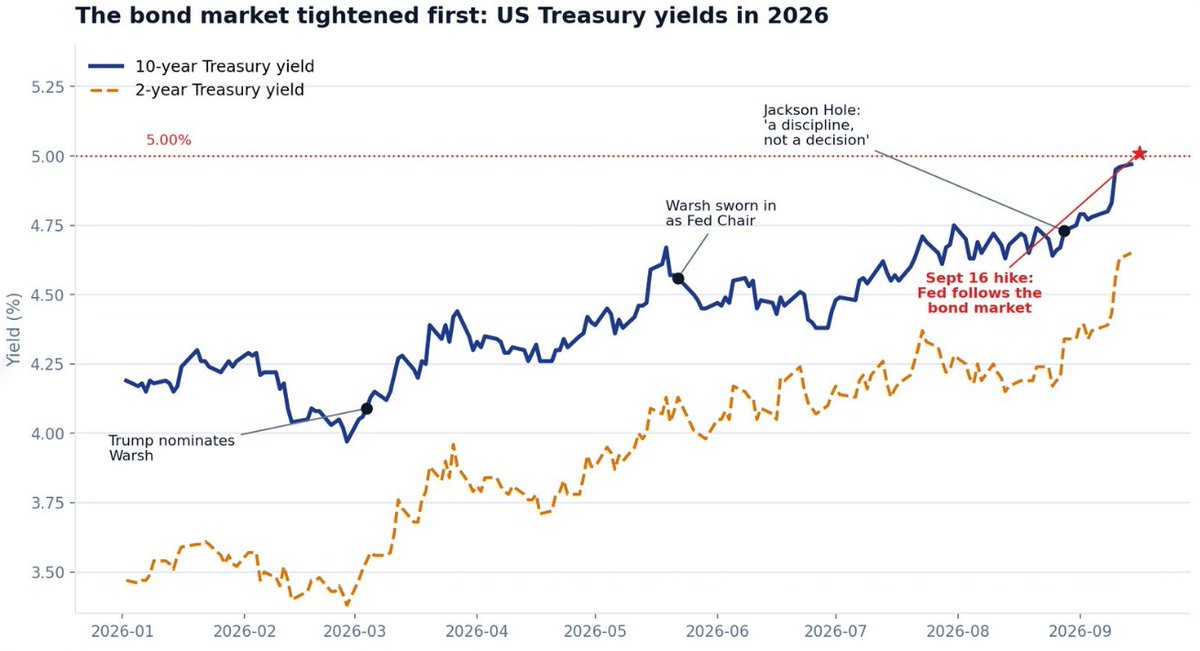
🔥 US markets are expected to open with indices fluctuating within a narrow range at elevated levels, characterized by structural divergence. Upside potential for the broader market is constrained by elevated US Treasury yields (exceeding 5.2%) and oil prices surpassing the $100 mark. Sector performance is notably mixed; semiconductor and technology stocks are under pressure due to pre-market weakness in memory chip stocks. Capital is increasingly flowing into defensive value sectors—such as utilities, consumer staples, and energy—providing market support. With the release of September inflation data (CPI/PPI) and third-quarter bank earnings approaching, a wait-and-see sentiment prevails; investors are advised to focus on undervalued defensive sectors and equal-weight allocation strategies.
$CRWV
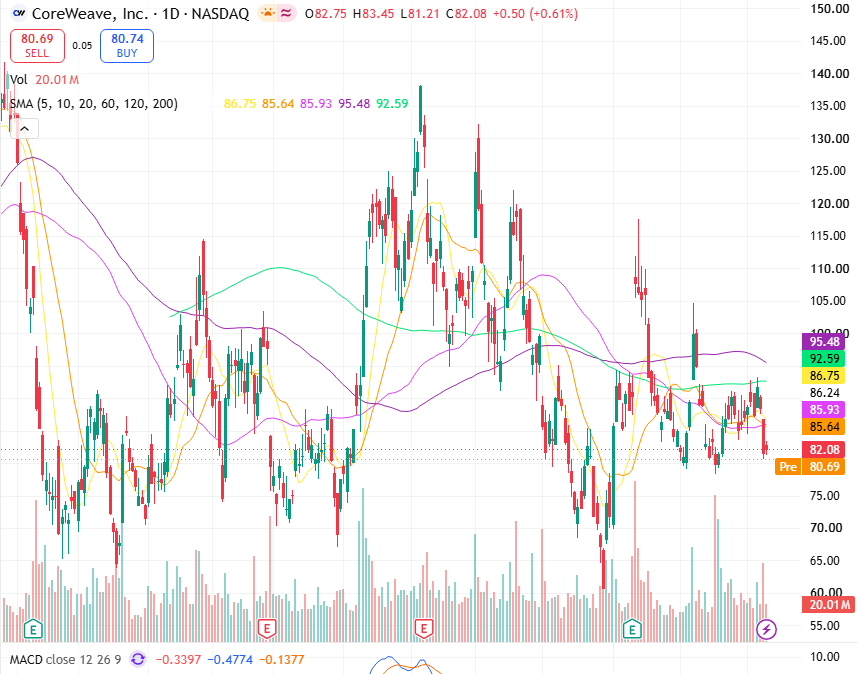
We recommend monitoring the US-listed stock CRWV today, with a suggested entry range of $78.50–$80.00.
$CRWV has recently pulled back to the support zone at the bottom of its trading range; both daily and weekly charts show clear signs of bottoming out, stabilization, and accumulation. The $78.50 level offers strong support and an attractive risk-to-reward (R/R) ratio. Coupled with an RSI recovery from oversold territory and stabilization on lower trading volume, the stock possesses significant rebound momentum. We suggest establishing a position in the $78.50–$80.00 range, with an initial short-term target of $90.00; if strong resistance is broken, the price could target $96.00.
🔥 US markets are expected to open with indices fluctuating within a narrow range at elevated levels, characterized by structural divergence. Upside potential for the broader market is constrained by elevated US Treasury yields (exceeding 5.2%) and oil prices surpassing the $100 mark. Sector performance is notably mixed; semiconductor and technology stocks are under pressure due to pre-market weakness in memory chip stocks. Capital is increasingly flowing into defensive value sectors—such as utilities, consumer staples, and energy—providing market support. With the release of September inflation data (CPI/PPI) and third-quarter bank earnings approaching, a wait-and-see sentiment prevails; investors are advised to focus on undervalued defensive sectors and equal-weight allocation strategies.
🔔 As the U.S. midterm elections approach, Bank of America has issued a report warning that if the Democratic Party secures control of both the Senate and the House of Representatives, the broader U.S. stock market (S&P 500) could face a sharp short-term pullback exceeding 10%. The market has expressed significant concern regarding the potential shift in the balance of power in Congress and the uncertainty surrounding future tax and regulatory policies.
🔥 Several key events next week could impact the trends of stocks, cryptocurrencies, and global markets.
1️⃣ Monday:
Markets reopen following announcements regarding a Russia-Ukraine energy ceasefire agreement and news on Russian diesel trading.
2️⃣ Tuesday:
The International Monetary Fund (IMF) releases updated global growth forecasts.
3️⃣ Wednesday:
🇨🇳 CPI (Consumer Price Index) inflation data
🇺🇸 CPI (Consumer Price Index) inflation data
4️⃣ Thursday:
🇺🇸 PPI (Producer Price Index) inflation data
🇺🇸 Retail sales data
5️⃣ Friday:
🇺🇸 Speech by Federal Reserve Chair Kevin Warsh
🇪🇺 Eurozone final inflation data
👉 If you invest in stocks or other markets, you may want to keep an eye on these events.
US stocks rose, supported by the technology sector. Throughout the week, US Treasury yields and oil prices remained elevated, while artificial intelligence (AI) stocks experienced declines.
Dow Jones Industrial Average: +0.83%
S&P 500: +0.59%
Nasdaq: +0.64%
$DJJ $SPX $IXIC $AI
💥Market focus has shifted to the Q3 earnings season starting next week on October 13. Major banks, including JPMorgan, will lead off reporting, providing key insights into US corporate earnings and broader economic resilience.
US major indexes edged higher today as falling crude eased inflation and OpenAI updates boosted tech. However, Apple order-cut rumors and elevated yields limited upside, keeping the broader market in a weak, divergent rebound.
Have your stocks gone up?
$Apple #AI
@jbfinancebull Yields need cooling inflation or slowing growth to pull back and drive rate-cut pricing.
Pre-earnings and under inflation clouds, buy-siders remain cautious, mostly scalping or unwinding hedges. Without a solid catalyst, dip-buyers lack staying power
Here are a few stocks worth watching—they are bound to double in price.⬆️
$NOW
Current price: $137
$HIMS
Current price: $28
$ASST
Current price: $28.2
$RKLB
Current price: $68.7
$ASTS
Current price: $56.7
$CRDO
Current price: $213
$NBIS
Current price: $223
US August wholesale inventories grew 0.5% MoM to $964.2 billion (+0.6% ex-petroleum), coming in below the forecast range of 0.7%–1.0%. Strong wholesale sales growth of 1.8% during the same period lowered the inventory-to-sales ratio from 1.19 to 1.18.
#oil