🇷🇺 Russia: and then things got worse.
Russian nationalist leader Dmitry Demushkin paints a deliciously grim picture of the current situation in his country.
So, since the full-scale invasion of Ukraine, out of the 10 biblical plagues, Russia has already checked off:
✅ Water in the Don River turning red
✅ Livestock dying in Siberia and Altai due to foot-and-mouth disease
✅ Hail and fire all over Russia
✅ Locusts in Kalmykia and Dagestan
✅ Flies in the Moscow region this summer
✅ Mass deaths of first-born males at the front
✅ and now boils, courtesy of a lab in Irkutsk.
So we’re down to three: lice, frogs, and darkness.
I’m not sure when the lice and frogs will show up, but something tells me darkness might be coming to Russia soon. 🌚
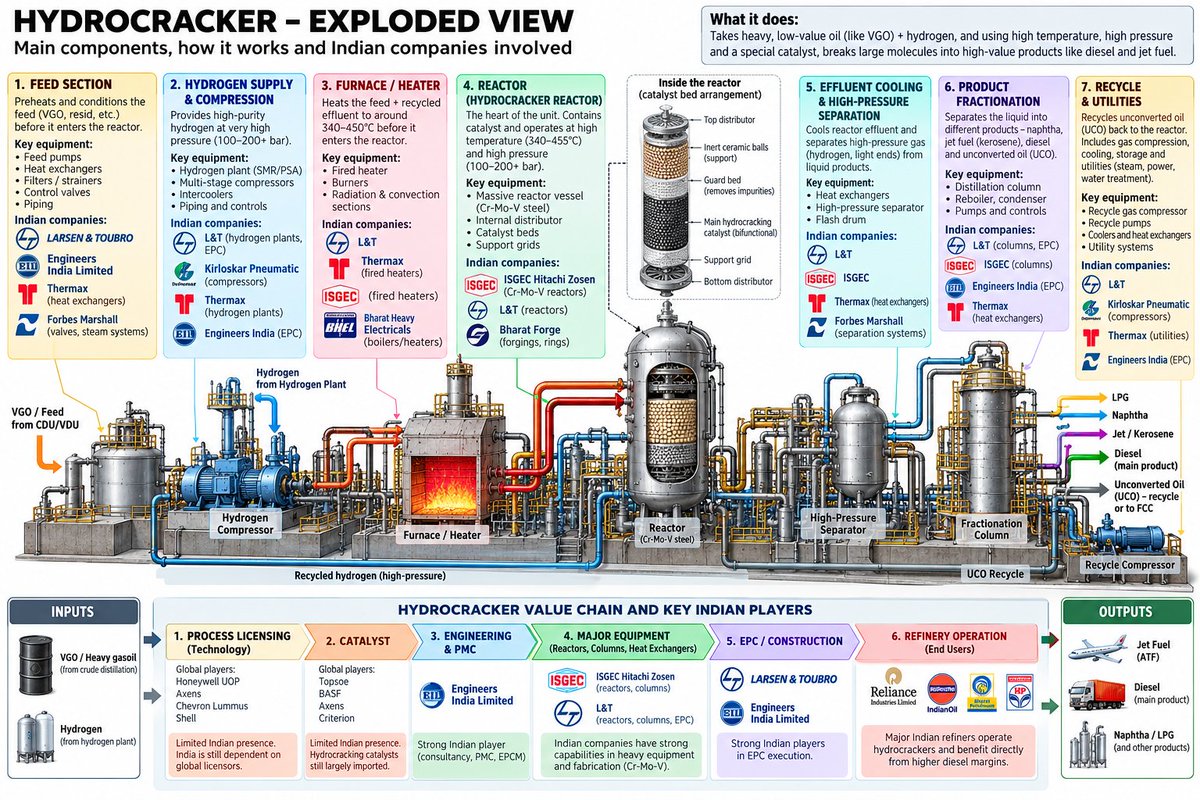
THE NEXT REFINING BOTTLENECK ISN’T CRUDE. IT’S THE #HYDROCRACKER.
The world is facing a diesel supply squeeze, not simply an oil shortage. Middle East and Russian diesel exports have fallen sharply, while refineries outside the affected regions are already running close to their practical limits. Diesel cracks have therefore surged because the world needs more refined diesel, but cannot quickly add the capacity required to produce it.
This is where the hydrocracker becomes important. A hydrocracker takes heavy, low-value oil such as VGO and, using hydrogen, catalysts, high temperature and very high pressure, converts it into higher-value products such as diesel and jet fuel. In simple words, it is the refinery machine that helps turn the “thick and cheap” part of crude into the “clean and valuable” part.
The important structural change is that existing hydrocracking capacity is becoming more valuable. Refiners cannot simply build new hydrocrackers to capture today's diesel margins because these are complex projects involving process licensing, detailed engineering, giant high-pressure reactors, compressors, construction and commissioning. The guide estimates a 2–5+ year timeline for new hydrocracker and residue-upgrader projects.
That creates a fascinating value chain: raw materials → process licensor → catalyst → engineering/PMC → heavy equipment and reactors → EPC → refinery operator → aftermarket → diesel/jet markets. The shortage therefore does not benefit just the refiner. It can gradually move upstream into engineering, heavy fabrication, catalysts and project execution as refiners respond with debottlenecking, catalyst changes and new conversion projects.
For investors, the most important distinction is cyclical value vs structural value. Refiners such as #Reliance, #IOC, #BPCL, #HPCL, #MRPL and #CPCL can make very large profits when diesel cracks are high, but their earnings remain exposed to refining cycles, government policy and product pricing. The guide therefore classifies refiners as largely cyclical.
The more interesting “quality” part of the chain sits with technology #licensors and #catalystsuppliers. Their products are mission-critical but represent a relatively small portion of the refinery's economics. A refiner may hesitate to experiment with an unproven catalyst or process design because a poor result can destroy far more value than the catalyst itself costs. That creates high switching costs and repeat business.
India's position is particularly interesting. We are strong in the middle of the value chain. #EngineersIndia has experience across refinery engineering, PMC/EPCM and related technologies. #LT is a major player in heavy hydrocracker reactors, EPC and heavy forgings. #ISGEC Hitachi Zosen has the capability to manufacture specialised Cr-Mo-V reactors, while #KirloskarPneumatic has relevant high-pressure gas-compression capabilities, although the specific hydrocracker link is less directly verified.
The biggest strategic gap is at the top of the value chain. India has world-class engineering, fabrication and refinery operating capabilities, but hydrocracking process licensing and catalyst technology are still dominated largely by global players such as #Chevron Lummus Global, #Axens, #Honeywell UOP, #Shell and #Topsoe. Indigenous efforts exist, but hydrocracking itself remains an area where India is still developing deeper capability.
The investment takeaway: a diesel shortage first creates an earnings windfall for refiners. If the shortage persists, it can trigger higher refinery utilisation → catalyst optimisation → debottlenecking → hydrogen expansion → new hydrocracker/residue-upgrader projects → demand for heavy reactors, engineering and EPC. The first-order beneficiary may be the refiner, but the more durable value can migrate toward the bottlenecks behind the refinery. That is the structural change I would watch most closely.
Russia had a chance after 1991 to look forward. Instead it chose imperial maps and millions dead in the mud.
It burned 21st-century wealth on a 19th-century map & threw away its 22nd century.
The world is laughing at the “great power” drag itself back to the Stone Age.
Nur damit die selbsternannten "Verteidiger der Demokratie" wissen wie es sich in anderen Ländern entwickelt hat und was auf sie zukommen.
Ich persönlich kann darauf sehr gut verzichten.
UN Secretary-General Antonio Guterres:
"We are faced with a dramatic geopolitical divide and this dramatic geopolitical divide paralyzes the Security Council, the body that is supposed to maintain or help to maintain peace and security around the world.
On the other hand, the superpowers themselves engage into wars in some circumstances against international law and that creates an environment of impunity in which mid-sized powers believe that they can do whatever they want because nothing will happen to them. And wars are becoming multiplied and more and more complex."
Comment from me: the existing security system is effectively broken. A new one must arise, and the outcome of Russia's war against Ukraine will largely decide how it will look like.
❗️The broadcast of Trump’s White House event is happening without sound. American media are boycotting the press pool: ABC, CBS, NBC, CNN, and Fox News have stopped participating in the joint coverage of the president’s events after the Trump administration barred White House access for journalists from CNN, Politico, and MS NOW.
Three media outlets have also said they intend to sue the administration, calling the restrictions a violation of press freedom.
@NatalkaKyiv You need another kiddo. You're still young enough and very attractive. I think you know how to score a decent man. I'm sure you can, and will. If it's a boy, please call him Danny. I'll ask the Angels for help. Greetings fro The Hague.
21-річну доньку В. Зеленського все частіше називають однією із найзагадковіших дівчат України. Олександра практично не з'являється на публіці та уникає уваги преси.
З міркувань безпеки Олександра живе окремо від батьків, але їхати з України не збирається. ⬇️
🇷🇺 “The economy cannot survive under the current system of spending and the way things are.”
— Russian nationalist leader Dmitry Demushkin discusses the Russian economy with political blogger Alexander Bobylev.
Армия путинской РФ впервые за долгие месяцы потерпела крупное военное поражение на Донбассе – ВС РФ были вынуждены оставить более 200 километров в Донецкой области, потеряв ключевой плацдарм севернее Лимана.
А теперь самое интересное.
Незадолго до этого Витёк и тот второй (Зятёк) прилетали в Киев, чтобы спешно уговорить Украину «сдаться по линии разграничения».
Выглядит так, словно они это сделали по прямому приказу из Кремля – так как там видели, к чему всё идёт на Донбассе.