PhD Candidate @Harvard Gov. Political Economist researching on the politics of opportunity. Credit access, Education, and Labor Market Policy. On the market.
New Working Paper! Why do policies that reinforce unequal opportunities persist? Some blame elites. I argue less secure families defend these "boundaries" against reform, and call this "boundary defense". I test this on a 2010 referendum against school reform in Hamburg, Germany.
@alz_zyd_ This feels like a Chicago undergrad micro True/False/Uncertain question. Depends on time horizons, elasticity of supply/demand on them. Plausible that marginal suppliers with economies of scale shut off, few remaining with sticky gas car preferences may be price insensitive etc
can be found linked on the home, research, and CV pages of my website which also offer a comprehensive summary of what I'd contribute to your institution both research-wise and on the teaching front, drawing from my xp teaching all Poli sci subfields.
https://t.co/qdYjqjzBse
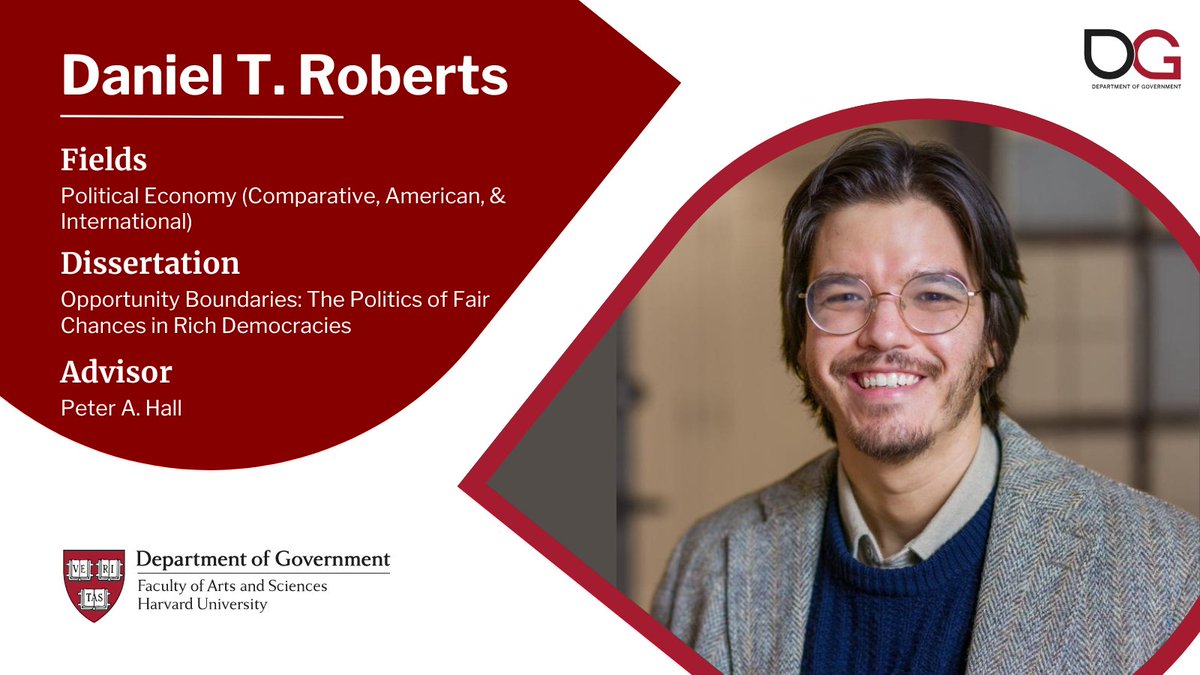
Hey everyone, I'm on the job market! Thanks @Harvard_GovDept for summarizing my profile! I'm a broad-based political economist who studies the politics of opportunity access in rich democracies, including the American political economy. Happy to answer questions by email/dm!
@DanielT_Roberts is a Political Economist who studies the politics of opportunity access. Spanning subfields, he focuses on education, credit, and labor policy in the US, Germany, and Japan. His 1st JMP draws from his dissertation and argues insecure families not elites defend...
on the American Politics market with a job market paper that studies why a bipartisan coalition in Congress rolled back the Dodd Frank Act in 2018, leading to 3 of the 5 largest bank failures in US history in 2023 (saliently, incl Silicon Valley Bank). The latest version...
@DanielT_Roberts is a Political Economist who studies the politics of opportunity access. Spanning subfields, he focuses on education, credit, and labor policy in the US, Germany, and Japan. His 1st JMP draws from his dissertation and argues insecure families not elites defend...
Some implications for politics research on labor and AI implicit: suggests cleavage in AI labor shock exposure by e.g. age, skills/education, firm/industry, etc. Poli-sci studies have explored how such cleavages affect political preferences, behavior, which can be extended to AI.
Excellent new essay from @econ_b on what we know about AI and its impacts on labor markets. Among other work, it summarizes his recent paper with co-authors which suggests young workers may be feeling the brunt of the labor market shock, and it sets agenda for future research...
- AI is likely not leading to widespread employment disruption so far, but young workers may be feeling the brunt
- We need to be studying impacts on education way more
- We need to do more economic modeling of alternative policy choices
Full essay: https://t.co/63Bd8fyoxC
The paper is available publicly on SocArXiv: (https://t.co/4LdOjM34b4). Or as a direct pdf: (https://t.co/Lq6C7BTomY) A pdf version of the poster can also be found directly at this link (https://t.co/eEa4lVwBhb) Feel free to reach out if you have any questions about the paper!
I'll be presenting a poster on one of my job market papers at APSA in Vancouver today from 12:30-1 PM, as part of the Comparative Politics Section! Location is East Exhibit Level, East Exhibit Hall A. Come find me and say hello, I'd love to discuss! Image of the poster below:
The figures are less aesthetically pleasing than in the latest version, and I wasn't able to include my formal model of what I call "Boundary Defense" given space constraints, so check out the more comprehensive explainer thread below if interested!
https://t.co/cp8sXEP1vI
New Working Paper! Why do policies that reinforce unequal opportunities persist? Some blame elites. I argue less secure families defend these "boundaries" against reform, and call this "boundary defense". I test this on a 2010 referendum against school reform in Hamburg, Germany.
@Google decided the first day of APSA of all possible days that my website hosted *by them* is a phishing scam 😅 you can still bypass the @googlechrome warning and reach my site. Resolving but in meantime please email me at Danielroberts @ https://t.co/HofCK21FFT if you have qs!
Link to nytimes article on the end of the "Bull Market for Economists", (https://t.co/GNmEmkGrf2), which I found through a substack post by @oliverwkim on "The Twilight of the Econs"
(https://t.co/qtEdevh8Yp)
🚨 New blog post: Twilight of the Econs? 🚨
Why is the Econ job market faltering—and what does it mean for the place of Economists in society?
https://t.co/ZX8uyI3b4g
Thoughtful post on the state of the economics job market and the state of the field more broadly -- including with some meta-framing that draws from Fourcade's sociological work on "Economists and Societies" 🤔
🚨 New blog post: Twilight of the Econs? 🚨
Why is the Econ job market faltering—and what does it mean for the place of Economists in society?
https://t.co/ZX8uyI3b4g
@lotemhalevy Haha I put political scientist first so that I didn't lead with political economist, the slash was meant to be historical political economist (maybe a boot that fits?) but I botched the ordering. My repressed inner field expansionist political economist is chastened either way 😅
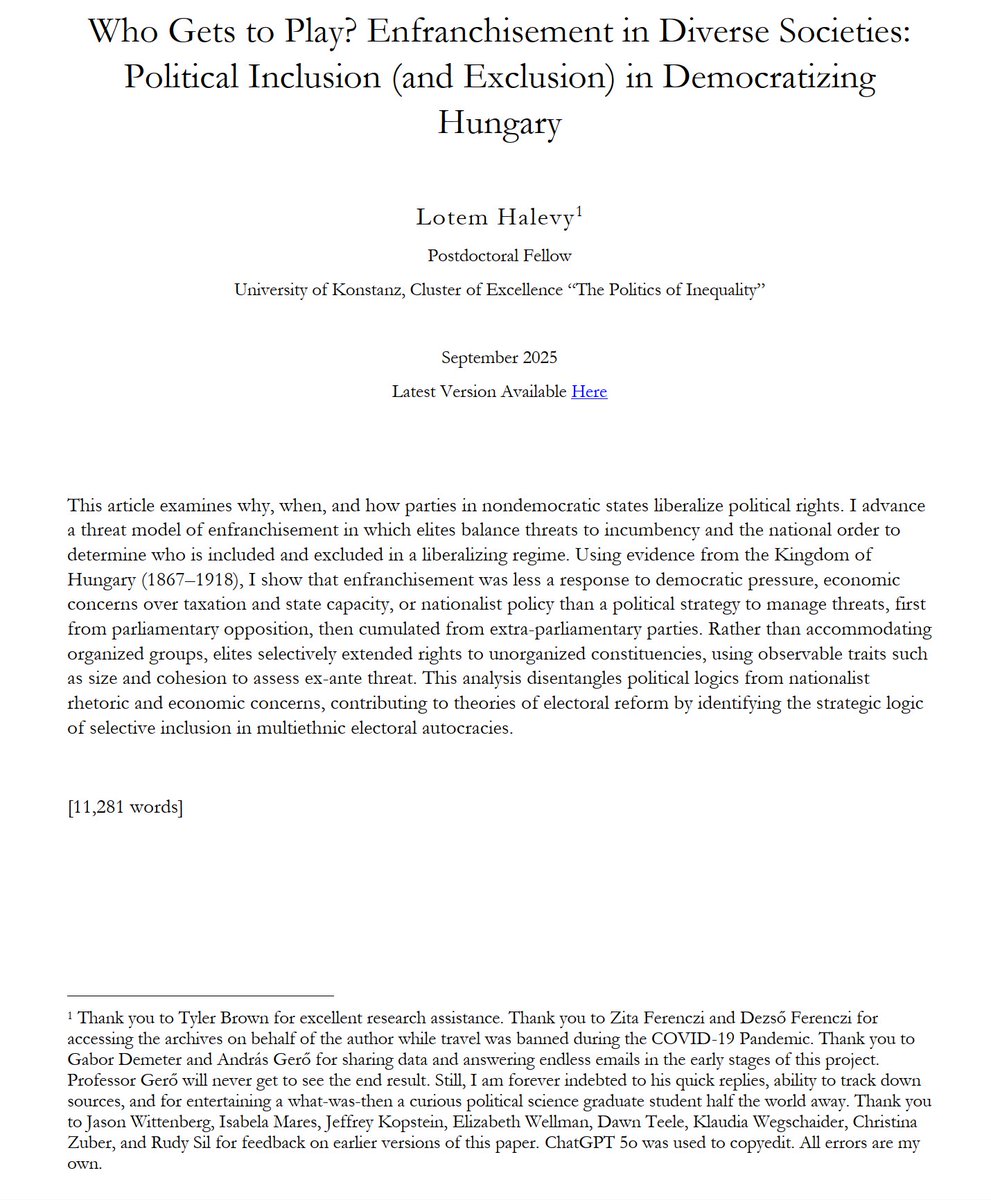
Lotem's ability to weave together rigorous theory building with an unrivaled understanding of cases gleaned from countless hours of careful archival research is truly superlative in the field today. Definitely read her work, great historical political scientist/economist!
Just getting ready for the Job Market, so I uploaded a new working paper to my website (https://t.co/7Yc2hgMNMc), along with some other goodies.
The paper should be available on SSRN shortly!