Just deployed a major evolution of the Biologist's Toolkit: The Botanical Taxonomy Workbench. 🌿🔬
I’ve unified my experimental prototypes into a single, integrated interface.
Try it here: 🔗 https://t.co/mdYzfKLQed
@Noahpinion Island ecosystems hit by invasives are nature's China Shock: endemic species sheltered behind geographic barriers get wiped out by continental competitors overnight. No adjustment period, no factor mobility. Autor, Dorn & Hanson, but for birds.
AI has now solved a major open problem -- one of the best known Erdos problems called the unit distance problem, one of Erdos's favourite questions and one that many mathematicians had tried.
https://t.co/SD1vVPkrHR
Added a geographical filter to Taxon Profiles! Get localised species counts and regional diagnostic context to refine your profiles.
Try it here: 🔗 https://t.co/LW5MsslvO1
⚠️ Experimental tool: verify for critical IDs.
New workflow for plant identifications and learning:
Instead of scrolling through PDFs, upload your taxonomic treatments and flora docs to NotebookLM. Connect it as a source in Gemini to "chat" with the data.
It grounds Gemini in your specific sources, reducing hallucinations.
I’ve added a "Localities" module to my Workbench!
Enter coordinates or a place name to instantly pull botanical data—including ecological, climatic, and geological context—plus notable taxa and local threats. You can also click any taxon to jump straight to its profile!
Pancreatic cancer mRNA vaccine shows lasting results in an early trial. Scientists caution that more research is needed, but nearly all of the patients who responded to the personalized vaccine are still alive six years later.
https://t.co/13GBL8ujOV
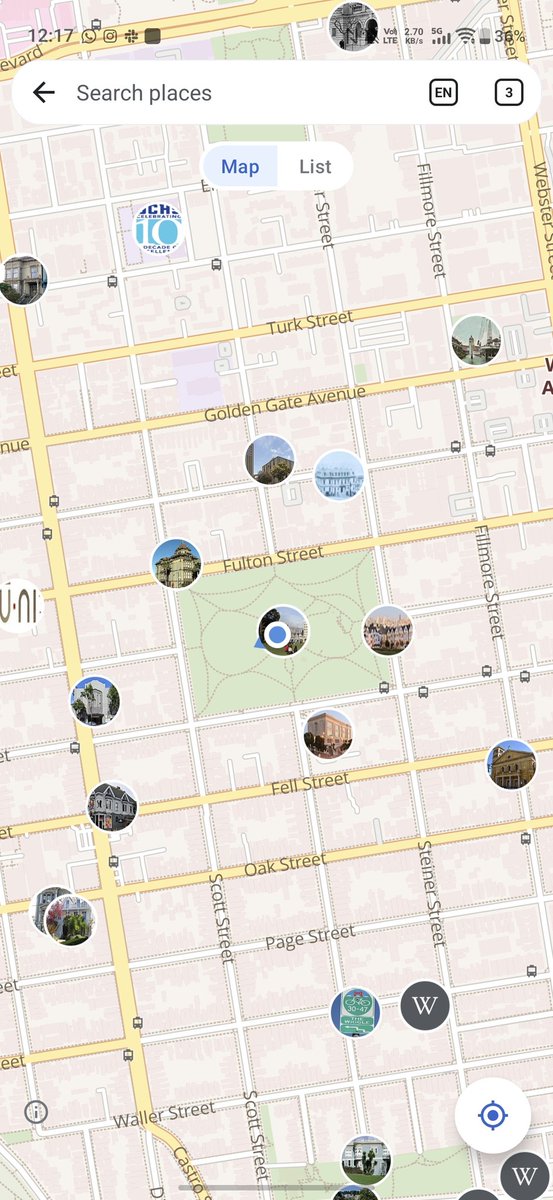
i accidentally discovered one of the coolest features on the internet
the Wikipedia app has a "nearby" feature that shows wikipedia articles around your location!
i opened it and instantly fell into a rabbit hole of random places, local history and weird things around me
try it and tell me what shows up near you
Gemini’s Notebooks are likely the simplest solution for interactive floras. Use NotebookLM as a repository for authoritative texts and Gemini to interact with them—perfect for comparing species or generating keys for specific taxa. It turns static reference into a dynamic tool.
Project organization is here: Introducing notebooks in Gemini.
You can now keep multiple projects organized and even add past chats and relevant files as sources, so you have a dedicated space to focus on the task at hand.
Select “New notebook” in the side panel to get started.
Digitising old botanical texts? Upload the page image or paste your OCR output (e.g., from BHL), then prompt: "Messy OCR scan of a botanical description in [Language]. Fix errors, especially botanical terms and abbreviations. Return cleaned text with an English translation."
Your eyes can only see the moon in gray. It's actually covered in color, blues and oranges and pinks, all from different metals sitting in the rock. You just need a camera and some patience to pull them out.
These photos are called "mineral moons." A photographer points a telescope at the moon, takes hundreds or thousands of pictures, stacks them on top of each other to clean up the image, then slowly turns up the color intensity in editing software. The colors that show up were always there. Too faint for your eyes to catch on their own.
Each color is a different metal. The blue areas have a lot of titanium in them. The orange and brown zones have more iron. The pinkish-red patches around the edges are the oldest parts of the moon's crust, full of aluminum and calcium.
That deep blue region on the left side is called the Sea of Tranquility. Apollo 11 landed right there in July 1969. When Armstrong and Aldrin brought back 47 pounds of rock from that blue titanium zone, scientists cracked the samples open and found three minerals that had never been seen on Earth before. They named one "armalcolite" after the three astronauts (Arm-Al-Col: Armstrong, Aldrin, Collins). They named another "tranquillityite" after the landing site itself. For 40 years, tranquillityite was known as "the moon's own mineral" because nobody could find it here. Then in 2011, a geologist in Western Australia spotted a speck of it inside a billion-year-old rock.
Andrew McCarthy, a photographer in Sacramento, once stacked 150,000 separate pictures of the moon to build one color map. Each splash of blue or orange in these images is a real metal deposit on a surface that's been getting hit by space rocks for 3.5 billion years. The moon was never gray. We just couldn't see it.
When you're out in the field, try this prompt: 'I’m in [locality] looking at a [genus] species. What specific features do I need to photograph for a definitive ID?'
Where, on this chart, is the evidence that Ehrlich's predictions of inevitable, imminent, worsening global famine, starting in the 1960s, were "premature" rather than wrong?
Quick update on the Workbench: I’ve heard the feedback regarding latency. I’ve specifically tuned the thinking parameters for Taxon Profiles and ID Guides to find a better balance between speed and accuracy. Things should feel much snappier now; thanks for the patience!
Under the hood, it runs on Gemini 3 Flash.
As always, the entire project is open-source. You can explore the unified codebase and the botanical logic on GitHub: https://t.co/1DUnaYWv3B
Just deployed a major evolution of the Biologist's Toolkit: The Botanical Taxonomy Workbench. 🌿🔬
I’ve unified my experimental prototypes into a single, integrated interface.
Try it here: 🔗 https://t.co/mdYzfKLQed
The new Guide Module is a significant addition for identification workflows. 📖
It allows you to generate detailed taxonomic guides and dichotomous keys from scratch. Provide raw descriptions or ask for a group, and the AI synthesises a structured ID tool.