La llegada de las IA con "automejora recursiva": qué significa que Astra haya ayudado a modificar otro modelo de IA y qué riesgos y beneficios conlleva https://t.co/a2FFGOkgDr
From 9% to 60% — my story, in plain words
I won’t dress this up. My trouble with fluoroquinolones started long ago. The first big hit was in 2003, when I took 170 tablets of ciprofloxacin in a single treatment. Later came multiple therapies with levofloxacin. The last time I took levofloxacin was in 2010 — just 5 tablets — and that was enough to break me. After that exposure, I was bedridden for almost two years, from 2010 to 2012. My life fell apart. Acumen testing showed my mitochondria working at only about 9%. I had more than 150 side effects, I was completely bedridden, and honestly, I thought I might not survive.
Don’t forget the delayed reaction — symptoms can appear months after exposure. That’s why at first I had no idea what was happening to me. I was poisoned by fluoroquinolone toxicity.
I visited dozens of doctors. Most didn’t understand. Some suspected multiple sclerosis, others simply gave up. Out of many physicians, only a few finally gave me the right diagnosis: mitochondrial dysfunction. That diagnosis changed everything. Doctors stopped doing things that were making me worse and began focusing on protecting what little energy production I had left.
At that time, I couldn’t tolerate normal doses of supplements. When mitochondria are at 9%, every vitamin or amino acid is not just nutrition — it’s work. The cell needs ATP and enzymes to process it. Giving big doses then was like asking a broken engine to run flat out. So I used micro-doses, transdermal and sublingual forms. If a sublingual product contained sugar, I rinsed my mouth after one minute to avoid swallowing carbs and breaking ketosis.
Oxygen therapy became a necessity. After FQ toxicity, my oxygen saturation at night would drop below 90%, sometimes down to 84–85%. I developed severe sleep apnea and had to use both CPAP and supplemental oxygen. Oxygen wasn’t a cure, but it kept me alive — helping my cells survive low-oxygen states long enough to start repairing.
For the first years I couldn’t fast because my blood sugar was unstable. I had to be careful — eating very little, very often, while constantly monitoring glucose. Only years later, when my when my mito results was more then 60% and glucose stabilized, I could safely introduce fasting. That became a turning point. Ketones give cleaner fuel, lower oxidative stress, and fasting activates autophagy and mitophagy — clearing out the most damaged mitochondria so the healthier ones can survive. With time, fasting also activates PGC-1α, which drives the creation of new mitochondria. Slowly, the system began to turn.
In the second phase of diet, I could only tolerate selected foods — I had to carefully choose and test what I ate, step by step. It was part of stabilizing and rebuilding.
I also developed a special therapy for myself, aimed at speeding up cell renewal. It supported cell division and accelerated the formation of new mitochondria — a process naturally linked to tissue regeneration. I won’t describe it here in detail, but it was another piece of the puzzle that helped my body restart its regenerative capacity. My protocol also helped several other people I trusted — and they, too, began to improve.
There’s one more thing I want to mention — the work we did in Poland. In our studies, I was the only person who went through every stage of the stem-cell renewal protocols we tested. My body began to produce stem cells, which later contributed to forming cell lines across different tissues. We documented these stages in the study. For me, this was a breakthrough: proof that regenerative processes can be reactivated, even after heavy damage.
As my mitochondrial function improved, the chronic low-grade inflammation that had followed me for years started to fade. Damaged mitochondria release alarm signals — fragments of mtDNA, ROS, abnormal metabolites — and the immune system stays in constant alert mode. When mitochondria stopped leaking those signals, inflammatory markers dropped, pain and brain fog eased, and life became quieter. This isn’t poetry — it’s biology: less ROS, fewer alarm signals, better cellular balance.
It took me two long years just to get out of bed, and many more to rebuild a life that could be called living. After several years and three Acumen tests, mitochondrial function rose from about 9% to over 60%. I haven’t returned to the man I was before, but I’m here. I walk, I work, I meet people. If you are lying in bed now, in pain and without hope, listen to me: I was there too. If I could climb out of that hole, you can too. It’s a slow process. Often boring. But possible.
Now my goal is to publish — based on my mitochondrial tests and in comparison with several other cases, including that of a close friend — to show the huge progress that is possible with proper treatment. I want to do this together with doctors and scientists who are willing to collaborate, not for profit, but for truth and for patients.
To everyone reading this who is suffering: don’t give up. Take one small step today — measure, rest, keep your meals steady, and try to reduce the noise around you. Recovery doesn’t happen in a single day, but it can happen in days that add up. You are not a lost cause.
My protocol has three phases:
Phase 1: I was bedridden. I couldn’t even turn by myself. My weight dropped to almost nothing — just skin and bones. Because of glucose swings, fasting was impossible then. Instead, I ate very little, very often, constantly checking blood sugar.
Phase 2: When I began to tolerate food again and slowly gain weight, I stabilized supplementation. In this phase, I could only manage certain foods, and I very cautiously raised supplement doses where it was safe.
Phase 3: When glucose instability calmed and my body was stronger, digestion improved and I could use supplements more easily. This is when I introduced intermittent fasting as part of my routine.
Please — don’t write to me asking for medical advice. I am not a doctor, and I cannot give advice. Because of my work with the foundation, I cannot risk its reputation. This message is meant to give support and hope — to show that it’s possible to survive hell and get back to something like a normal life, and in people with milder damage, even to full recovery.
What made me worse was not only being “refloxed.” The decline came from many directions — other medications, anesthesia, exposure to heat and cold, chemicals, alcohol, stress, trauma, and even over-exercising. Too many supplements at the wrong time added to the problem. Ionizing radiation, MRI contrast, CT and PET scans, as well as other medical exposures, all aggravated my condition.
I later realized that infections, lack of sleep, poor nutrition, and certain immune challenges could also trigger setbacks. Environmental toxins such as mold, heavy metals, pesticides, polluted air, and even everyday foods played a role. Meat containing antibiotic residues, processed products, and chlorinated water — including swimming pools treated with chlorine or other chemicals — all contributed to my worsening symptoms. Flying, changes in pressure in the mountains, and even prolonged exposure to ultraviolet or infrared radiation also became serious triggers.
Fasting can be good for some people, but in severe mitochondrial dysfunction it is not recommended. My body simply didn’t have the energy reserves, and fasting only pushed me into greater weakness, unstable blood sugar, and deeper exhaustion. Only later, once I was more stable and stronger, could I even think about intermittent fasting in a cautious way.
I share this not as advice, but as my experience. Recovery meant understanding what made me worse, learning to avoid my triggers, and holding on to hope. Even the smallest stressor could break me down, but faith, patience, and support from others helped me keep going.
Written by one of our foundation Founders - Jerzy Tyszkowski
Disclaimer: This is my personal story and what worked for me. It is not medical advice. Everyone is different — consult a medical professional before changing treatment, starting fasting, or using supplements or oxygen therapy.
Please visit our research Foundation, run by a few long-term "floxies", at: https://t.co/G9NJIEKEij
💊Medications in the fluoroquinolone class (incl: Cipro/ciprofloxacin, Levaquin (off market)/levofloxacin, Avelox/moxifloxacin etc) in all forms for humans and pets: https://t.co/OKH2DOWix0
♦️♦️♦️♦️♦️♦️♦️♦️♦️
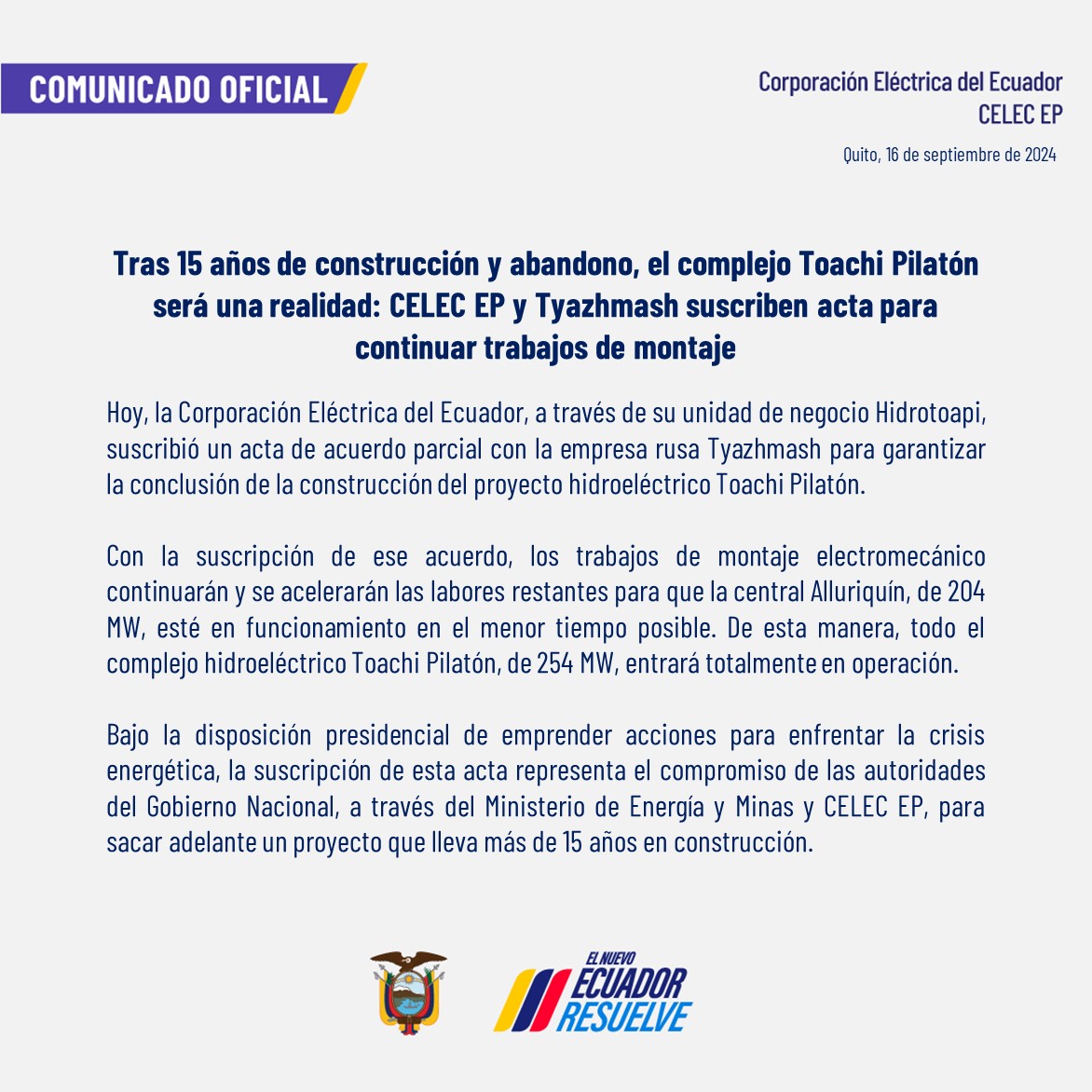
Concluimos el mantenimiento de la Unidad TV1 de la central Trinitaria, incorporando 85 MW al servicio de los ecuatorianos. Estos trabajos, realizados entre junio y septiembre de 2024, ayudan a mitigar la falta de energía hidroeléctrica causada por la escasez de lluvias.
El presidente Daniel Noboa ordenó mediante decreto ejecutivo que la sede de la Corporación Eléctrica del Ecuador (Celec) se traslade desde Cuenca a Quito.💻 https://t.co/pOAJYLyHri
#Urgente ¡EL GOBIERNO HARÁ BOMBARDEO DE NUBES PARA PROVOCAR LLUVIAS!
El ministro de Energía, Antonio Goncalves, anunció hoy en su visita a la Central Hidroeléctrica Mazar, en Azuay, que habrá bombardeo de nubes para provocar lluvias.