Senior construction manager, renewables & infrastructure. Germany/Marbella. Investing for freedom in Europe. Portfolio & reasoning: eToro. Capital at risk.
Fair point, I thought it was just a general statement. In that case the actual German tax if it goes through will be 26.375%, assuming no church tax due to the solidarity surcharge.
As it stands, the BMF Referentenentwurf of 30 September 2026 would move new purchases after 31 December 2026 into the capital-income regime (25% + solidarity surcharge, no holding period). Existing holdings acquired by that date would keep the current §23 treatment.
For that to become law it still needs:
1. Cabinet adoption (currently scheduled for 14 October 2026) — turns the ministry draft into a government bill.
2. Bundesrat first reading and comments.
3. Bundestag debate and vote in three readings.
4. Bundesrat consent (required under the draft).
5. Signature by the Federal President and promulgation in the Federal Law Gazette.
Only after promulgation does the legal position change. Until then the one-year rule continues to apply. The draft itself aims for entry into force on 1 January 2027 for new purchases, with platform withholding from 2028.
Happy to keep the distinction clear between current law and the proposed change.
The 25% is the Abgeltungsteuer that applies to capital income (shares, ETFs, funds).
Privately owned Bitcoin is currently treated differently. Under §23 EStG, gains from genuine private Bitcoin held for more than one year are generally tax-free, regardless of the amount. Gains within one year are taxed at the personal progressive income-tax rate (not the flat 25% Abgeltungsteuer), and there is a €1,000 annual Freigrenze for short-term private-sale gains. If you exceed the threshold, the entire gain is taxed at your personal rate.
That one-year rule does not apply to MSTR or to equity/ETF gains.
A flat “Germany taxes crypto at 25%” claim therefore mixes two different regimes. The one-year treatment is current law. A draft exists that would move new purchases after 31 December 2026 into the 25% capital-income rules, but it is not yet enacted.
The pattern is worth watching, but the 2024 cycle already broke the old timing (ATH before the halving).
This drawdown was also shallower than prior ones. From the mid-2026 low near $58k we’re already back in the low $80ks.
Whether this is the final leg or the start of the next advance depends more on liquidity and institutional flows than on a fixed day count, i think.
Strategy put $21.5m into $BTC and $192.4m into $STRC buybacks last week.
Lower future payouts could help $MSTR shareholders. The cost is less cash flexibility.
My take as a holder:
https://t.co/GpTno1xiBV
Capital at risk.
Same Bitcoin thesis, more aggressive expression which is fair.
One structural difference that matters for some of us: as a German tax resident, genuinely owned private BTC can fall outside §23 after more than one year. MSTR is equity. Gains stay under Abgeltungsteuer regardless of holding period. Meaning if I sell $MSTR
After holding 1 year I am taxed ~28% and on direct $BTC 0% on profit.
So the higher volatility is real, but the after-tax outcome is not the same as holding the underlying coins. The financing and dilution decisions also sit with Strategy, not with the holder.
Still a valid satellite if the cycle call is right. Just a different risk and tax profile than direct BTC.
What is your winning tax profile like?
First post here.
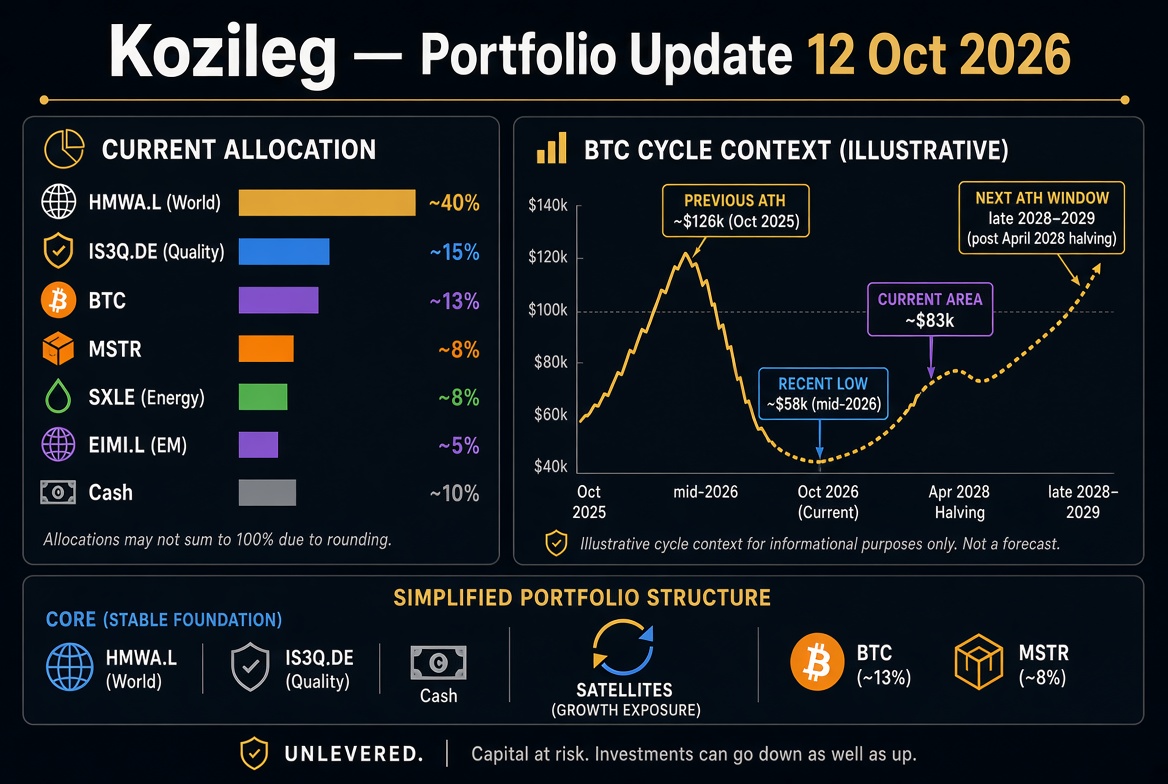
I’m Danny-Lee Krohn. Senior construction manager in renewables and large infrastructure. I live between Germany and Marbella and invest for long-term freedom in Europe. Portfolio and reasoning are on eToro under Kozileg.
Cut the portfolio down.
Fewer positions. Lower friction for anyone copying. Core stays global equity plus a small Energy sleeve that matches the day job.
Added the Bitcoin-risk sleeve: real $BTC (1×, not CFD) and Strategy ($MSTR ). Entry around the recent cycle area after the mid-2026 low near $58k. Previous ATH was \~$126k in Oct 2025. Next halving \~April 2028. Historical peak windows have often landed late 2028–2029. Past cycles are not a forecast.
German tax angle (my case only): genuinely owned private BTC can fall outside §23 after more than one year. $MSTR and equity/ETF gains do not get that treatment.
All unlevered. Risk score kept with headroom under 7. Full book on eToro (Kozileg).
Capital at risk.
Daisy, the multiplication checks out. The assumption connecting BTC’s old high to $450 $MSTR is where the maths needs more work.
Using Strategy’s October 4 disclosures: 848,000 $BTC ÷ roughly 451.7 million shares, assuming all convertibles convert, gives about 0.00188 $BTC per share.
At $126,000 $BTC , that’s roughly $237 of GROSS Bitcoin value per share. A $450 stock price would therefore represent about 1.9× that gross backing. The proper calculation also adjusts for cash, debt, preferred stock claims and which convertibles actually convert.
That premium can change substantially. In fact, when $BTC reached its October 2025 record, $MSTR closed around $360.
There’s a bullish counterpoint too: issuing shares above their net Bitcoin backing can fund purchases that increase Bitcoin value per share. More shares doesn’t automatically mean a worse investment. But issuing shares to fund interest or preferred dividends can have a different effect.
So yes, $100,000 becoming $450,000 is possible: $350,000 profit before tax and fees. But you’re betting on $BTC recovery, future financing decisions and the valuation investors will pay. Revisiting Bitcoin’s old high alone doesn’t establish a $450 $MSTR target. (Not saying that $MSTR is not a potentially great investment.)
@SpaceX@Starlink Oh my god.
Please do Germany next. Our phone networks are terrible and the local phone companies have been exploiting us for far too long.