My PhD supervisor told me give the reader just four numbers to remember; doesn't matter however elaborate and complicated your empirical analysis. Those from whom I learnt public speaking said, Make three points – no one remembers anything beyond that.
What about Asia might help it navigate the international economics of strategic interdependence?
Quah, Danny. 2026. "Asia's Evolving Development Landscape: The International Economics of Strategic Interdependence" (June)
https://t.co/Oe8X9Rn026
Working paper, comments welcomed
Small states are traditionally norm-takers, just as in economics, consumers and firms price-takers. However, while in economics there is a theorem that price-taking leads to systemic efficiency, the study of world order admits no analogous proposition.
https://t.co/1f0xjKmBmK
Dear DeepSeek - you are much better than you give yourself credit for.
(You see, I managed to read your thought process and the draft answer you were providing, before you suddenly deleted everything.)
Is US dollar-dominance in the International Monetary System a red herring? How Is Changing A USD-dominant IMS Harder Than Changing World Order?
https://t.co/zb8IWF1saO
https://t.co/3f5xOsURZW
We're Princeton alumni. So of course we spent the whole evening discussing distribution requirements and how they become constraints that do not bind, and that the Honor Code no longer is. Also, service to nation and the world.
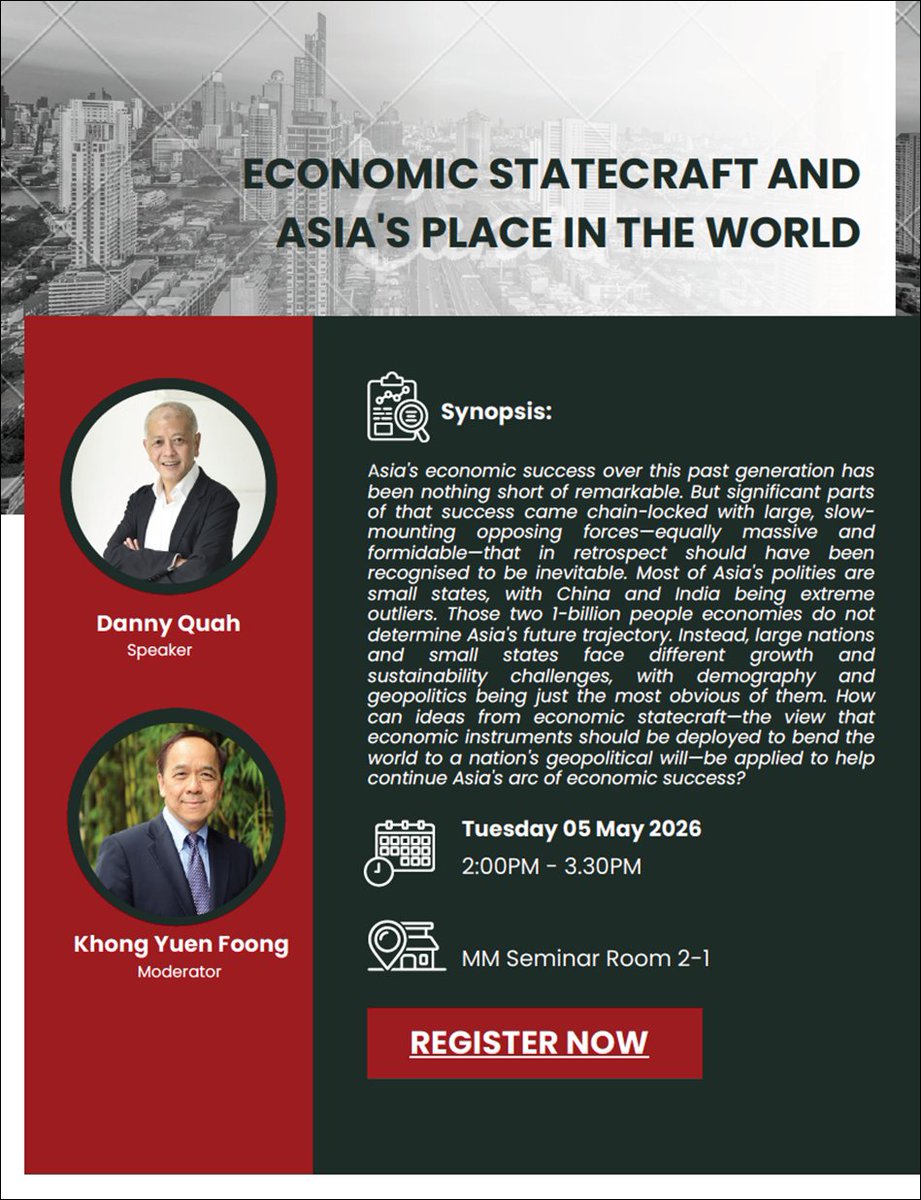
Asia is more than China and India, and its future might be shaped not by its giants but by its smaller states. When Great Powers practise economic statecraft, they bend the world to their geopolitical will.
What's in the smaller state's playbook?
https://t.co/SZIZ2b86Zz
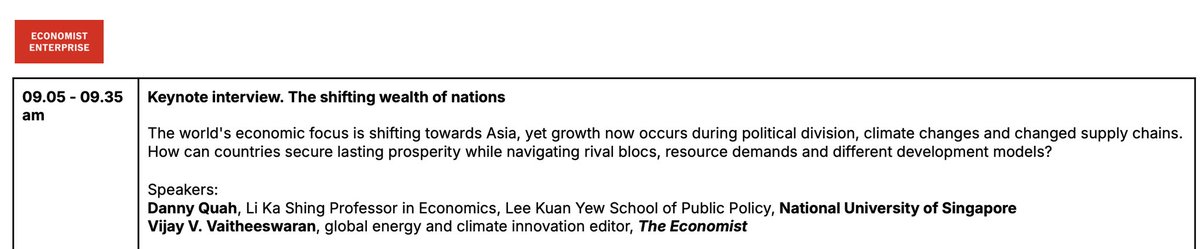
World order is metastatizing. The wealth of nations is shifting. I was in conversation in Delhi with Vijay Vaitheeswaran on disorder, the futility of power, and how the new global order might look. Who rolled up to ask questions: Gen Z's making macroeconomics great again.
An MIT professor taught the same math course for 62 years, and the day he retired, students from every country on earth showed up online to watch him give his final lecture.
I opened the playlist at 2am and ended up watching three of them back to back.
His name is Gilbert Strang. The course is MIT 18.06 Linear Algebra.
Every machine learning engineer, every data scientist, every quant, every self-taught programmer who actually understands how AI works learned the math from this one man. Most of them never set foot on MIT's campus. They just opened a free playlist on YouTube and let him teach.
Here's the story almost nobody tells you.
Strang joined the MIT math faculty in 1962. He retired in 2023. That is 61 years of standing at the same chalkboard teaching the same subject to 18-year-olds.
The interesting part is what he did when MIT launched OpenCourseWare in 2002. Most professors were skeptical. They worried that putting their lectures online would make their classrooms irrelevant. Strang did not hesitate. He said his life's mission was to open mathematics to students everywhere. He filmed every lecture and gave it away.
The decision quietly changed how the world learns math.
For decades linear algebra was taught the wrong way. Professors started with abstract vector spaces and proofs about field axioms. Students drowned in the abstraction. Most never recovered. They walked out believing they were bad at math when they had simply been taught in an order that nobody's brain is built to absorb.
Strang inverted the entire curriculum.
He started with matrix multiplication. Something you can write down on paper. Something you can compute by hand. Something you can see. Then he showed his students that everything else in linear algebra eigenvectors, singular value decomposition, orthogonality, the four fundamental subspaces was just a different lens for understanding what the matrix was actually doing under the hood.
His rule was strict. If a student could not explain a concept using a concrete 3 by 3 example, that student did not actually understand the concept yet. The abstraction was supposed to come last, not first. The intuition was the foundation. The proofs were just confirmation that the intuition was correct.
The second thing Strang changed was the classroom itself. He said please and thank you to his students. Every single lecture. He paused mid-derivation to ask "am I OK?" to check if anyone was lost. He never used the word "obviously" or "trivially" because he knew exactly what those words do to a student who is one step behind. He treated 19-year-olds learning math for the first time the way he treated his own colleagues. With patience. With respect. With the assumption that they belonged in the room.
For 62 years.
The result is something that has never happened in the history of education. A single math professor became the default teacher of his subject for the entire planet.
Universities in India, China, Brazil, Nigeria, every country with a computer science department, started telling their own students to just watch Strang's lectures. The University of Illinois revised its linear algebra course to do almost no in-person lecturing. The reason was honest. The professor said they could not compete with the videos.
His final lecture was in May 2023.
The auditorium was packed with students who had never met him before. He walked to the chalkboard, taught for an hour, and at the end the entire room stood and applauded. He looked confused for a moment, like he genuinely did not understand why they were cheering. Then he smiled and waved them off and walked out.
His written comment under the YouTube video of that final lecture was four sentences long. He said teaching had been a wonderful life. He said he was grateful to everyone who saw the importance of linear algebra. He said the movement of teaching it well would continue because it was right.
That was it. No book promotion. No farewell speech. No legacy management.
The man whose teaching is the foundation of modern AI just thanked the audience and went home.
20 million views. Zero ego. The entire engine of the AI revolution sits on top of math that millions of people learned for free from one quiet professor in Cambridge.
The course is still on MIT OpenCourseWare. Every lecture, every problem set, every exam, every solution. Free.
The most important math course of the 21st century is sitting one click away from you. Most people will never open it.
Very early draft, but it's got a technical appendix (and carefully-crafted LaTeX drawings), and it's been presented to serious scholars, so...
Quah, D. 2026. "The Rest of Us: Incentives, not Power, in Rebuilding World Order", LKYSPP (Apr). https://t.co/uTfEJxAVFZ
Wed 29 Apr in Delhi I'm discussing shifts in the global economy with Vijay Vaitheeswaran, The Economist's Global energy and climate innovation editor.
https://t.co/KX5FBGDmFm
Four decades of Seoul Forum International Affairs, and this year a paper on multilateralism namechecks The Last of Us. I'm speaking alongside Victor Cha and Christina Davis, but it's Chatham House Rule. So all I'll say is the fungal metaphor multilateral collapse is underused.
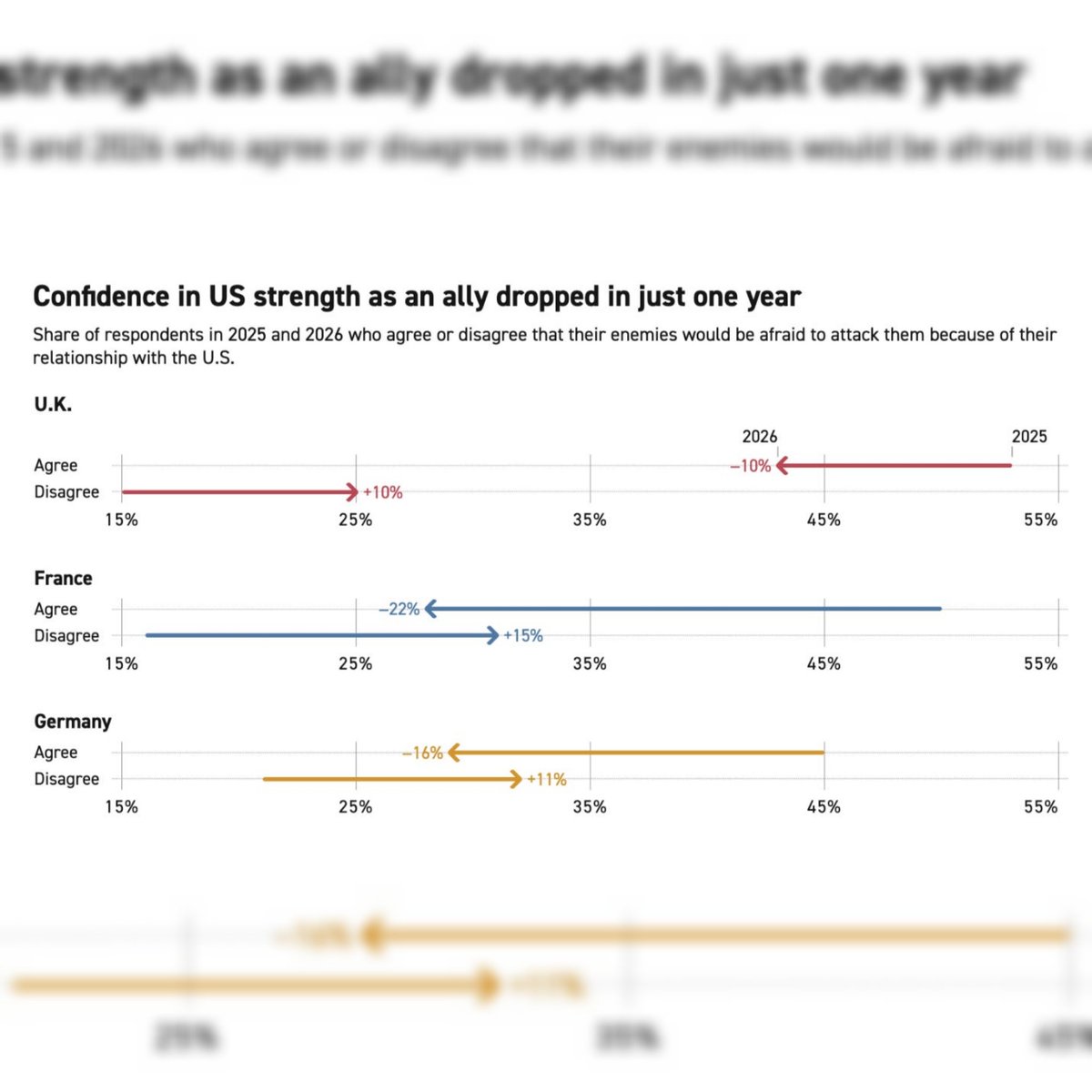
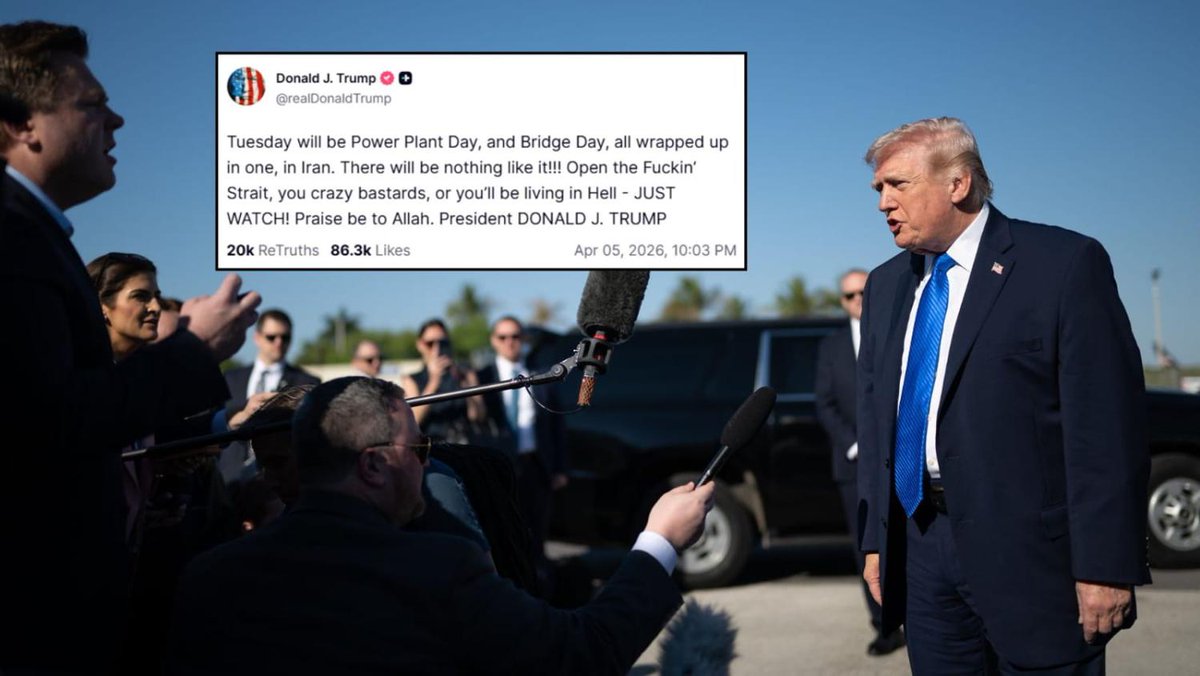
Today if you are not American and cheering on the US administration's foreign policy actions, you are cheering on the actions of an administration that is ever less recognised by the American people.
https://t.co/ooDILB40lT
Even as a young assistant professor, Obstfeld seemed to get to make a paper presentation at every macroeconomics conference .. which is good, as every time we read him, our thinking course-corrected.
WEAI International Conference, Chulalongkorn, Bangkok https://t.co/S0zZMnUWZA
Boao Forum this year centered on the theme of a shared future and new models of cooperation. I am a big fan of new models of cooperation.
Also, whatever happened to the traditional Chinese gift offerings of smartphones, tablets, and powerbanks?
https://t.co/lWRwVYdSbl
PM Lawrence Wong at Boao Forum for Asia: flexible plurilateralism with pathfinder initiatives, with groupings remaining open and inclusive, will complement not replace traditional multilateralism. Importance of greater regional cooperation and integration.
Andrew Rozanov and I recalled the Santiago Principles - guidelines which the US insisted on so that potential adversaries invested based only on economic risk-return calculation, not political motivation.
Yeah, we had a good laugh at that one.
Then we discussed war.