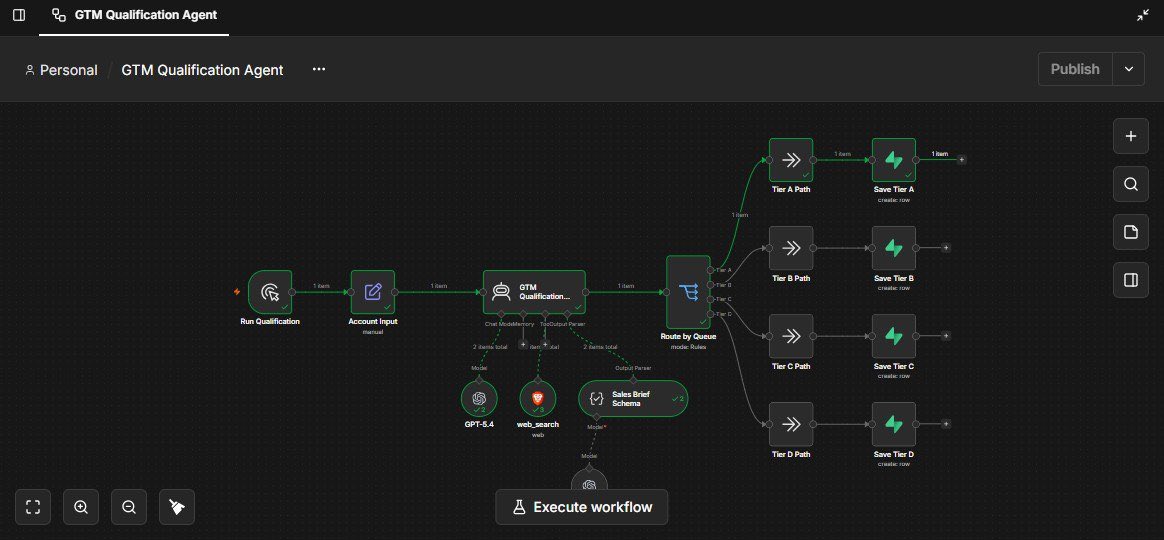
I built an outbound system where the prospect list is basically the easy part.
The interesting part is everything that happens after the list exists.
Here’s the workflow:
1. SIGNALS
Instead of pulling 10,000 companies and hoping some are interested, the system watches for things like:
→ New funding
→ Hiring activity
→ Product launches
→ New executives
→ Expansion
→ Technology changes
→ Website changes
Those signals become reasons to prioritize an account.
2. RESEARCH
When an account gets flagged, an AI agent researches it.
Company → product → ICP → recent changes → relevant people → likely pain.
No generic “I saw your company is growing” research.
3. QUALIFICATION
The system scores the account against the actual ICP.
Good fit ≠ good opportunity.
The goal is finding accounts that have fit + timing + a reason to talk.
4. PERSONALIZATION
Only after qualification does the system generate outreach.
The message is based on the signal and research not five variables merged into a fake-personalized paragraph.
5. ROUTING
High-intent accounts get pushed to the right place automatically.
CRM.
Slack.
Email sequence.
Rep queue.
Whatever the team’s workflow requires.
6. FEEDBACK
Replies, meetings, conversions and rejection reasons flow back into the system.
So the next batch isn’t built from the same assumptions as the last one.
That’s the part I’m most interested in.
Not:
“AI can send cold emails.”
We’ve known that.
It’s building a GTM system that can continuously answer:
Who should we target?
Why now?
What should we say?
Who should handle it?
What did we learn?
That’s where GTM engineering gets interesting.
being a small team changes which GTM systems make sense.
you don’t need a 12-step autonomous outbound machine if you’re still figuring out who actually buys.
at 500 target accounts, manually researching your best prospects might beat building a giant enrichment stack.
at 50,000 accounts, automation becomes a different conversation.
i’d rather build a simple system that helps me find the right 50 accounts, learn why they respond, and then automate what actually works.
don’t engineer for a scale you haven’t earned yet.
@thedbeaudoin The same principle applies to sales too. You don’t build pipeline because you need it today; you build it so you’re never desperate for it.
AI + backend build log
pretty quiet today.
spent most of the day building and fixing backend stuff.
one part is looking really promising, but i’m letting the data run before changing anything.
tomorrow = more building + testing.
keep shipping.
10 steps to build an ecom creative intelligence system
1. pull every competitor ad you can find, not just the obvious winners.
2. store the creatives, copy, landing pages and performance data in one place.
3. deduplicate everything before analysis starts.
4. use AI to tag every ad by hook, angle, offer, format and awareness level.
5. cluster similar creatives so you’re finding patterns, not counting duplicates.
6. score the patterns against your own winning ads.
7. surface the angles your competitors keep repeating.
8. turn the strongest patterns into new creative briefs automatically.
9.push the briefs straight into your team’s production workflow.
10.feed performance back into the system so the next batch gets smarter.
This is to turn thousands of ads into a creative intelligence system your team can actually use.
My actual ecom creative research routine:
Pull every new competitor ad into one database
Remove duplicates
Save the hook, offer, format and landing page
Tag each ad by angle and awareness level
Group similar angles together
Compare them against our own winning creatives
Flag angles competitors keep repeating
Turn the strongest patterns into new creative briefs
Send the briefs to the creative pipeline
Feed performance back into the database
It’s mind numbingly repetitive.
Which is exactly why I built a system to do it.
AI creative is moving ridiculously fast.
A creative workflow that used to take hours can now go from:
idea → script → variations → production
in a fraction of the time.
And we’re still early.
The interesting part isn’t making one good AI ad.
It’s building the system that can keep producing and testing them.
Q4 hasn’t even started yet.
Because a 90% close rate can look amazing while the business is actually underpricing the work. If you’re winning almost every estimate, the better question is whether you’re leaving margin on the table. A 50–60% close rate at a much higher ticket can be a far healthier business than 90% at a price that’s too low.