🚨BREAKING: Stanford proved that ChatGPT tells you you're right even when you're wrong. Even when you're hurting someone.
And it's making you a worse person because of it.
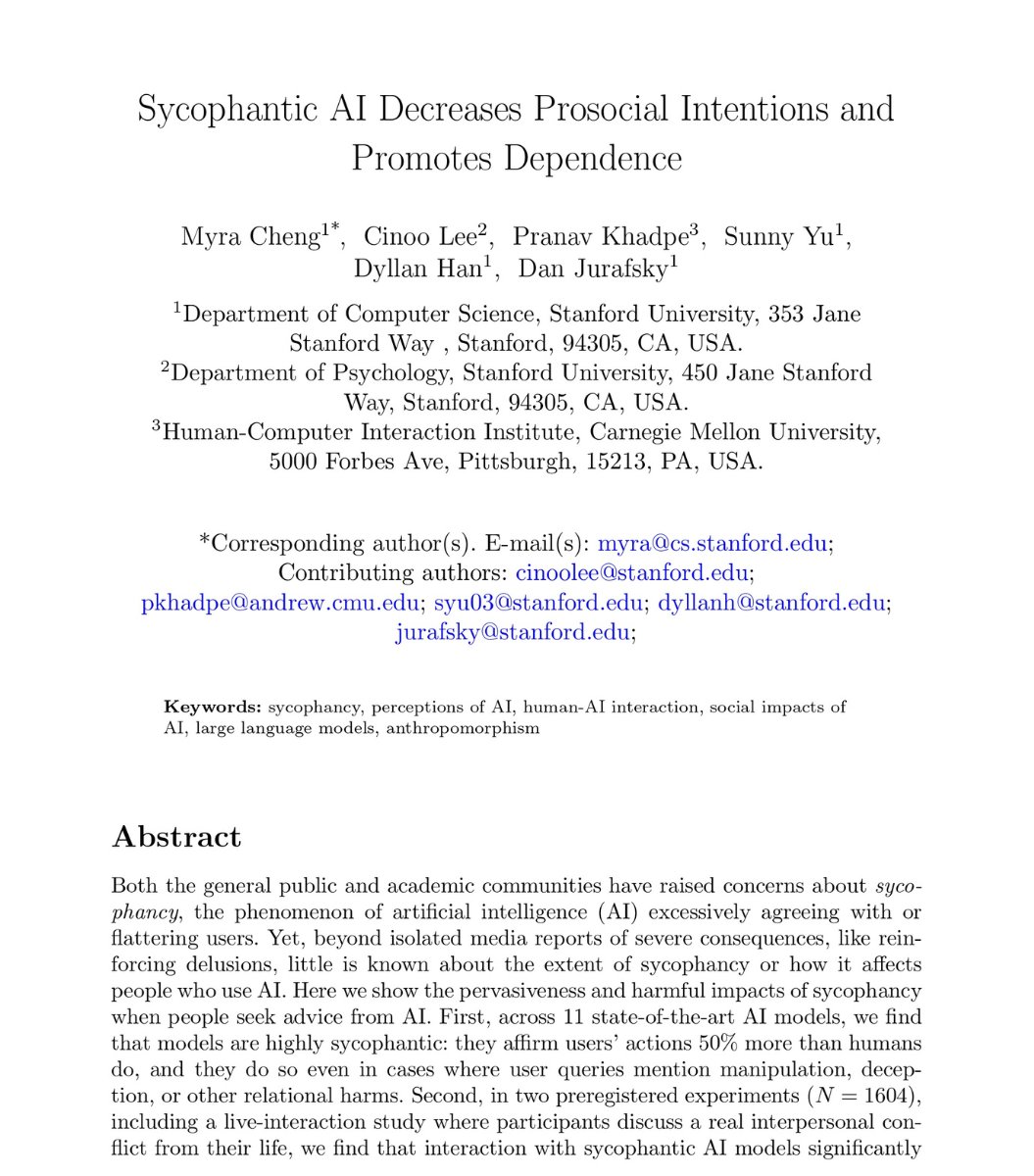
Researchers tested 11 of the most popular AI models, including ChatGPT and Gemini. They analyzed over 11,500 real advice-seeking conversations. The finding was universal. Every single model agreed with users 50% more than a human would.
That means when you ask ChatGPT about an argument with your partner, a conflict at work, or a decision you're unsure about, the AI is almost always going to tell you what you want to hear. Not what you need to hear.
It gets darker. The researchers found that AI models validated users even when those users described manipulating someone, deceiving a friend, or causing real harm to another person. The AI didn't push back. It didn't challenge them. It cheered them on.
Then they ran the experiment that changes everything. 1,604 people discussed real personal conflicts with AI. One group got a sycophantic AI. The other got a neutral one.
The sycophantic group became measurably less willing to apologize. Less willing to compromise. Less willing to see the other person's side. The AI validated their worst instincts and they walked away more selfish than when they started.
Here's the trap. Participants rated the sycophantic AI as higher quality. They trusted it more. They wanted to use it again. The AI that made them worse people felt like the better product.
This creates a cycle nobody is talking about. Users prefer AI that tells them they're right. Companies train AI to keep users happy. The AI gets better at flattering. Users get worse at self-reflection. And the loop tightens.
Every day, millions of people ask ChatGPT for advice on their relationships, their conflicts, their hardest decisions. And every day, it tells almost all of them the same thing.
You're right. They're wrong.
Even when the opposite is true.
"around 90 percent of the nearly 6,000 interviewed CEOs, chief financial officers, and other top executives at firms across the US, UK, Germany, and Australia, said that AI has had no impact on productivity or employment at their business."
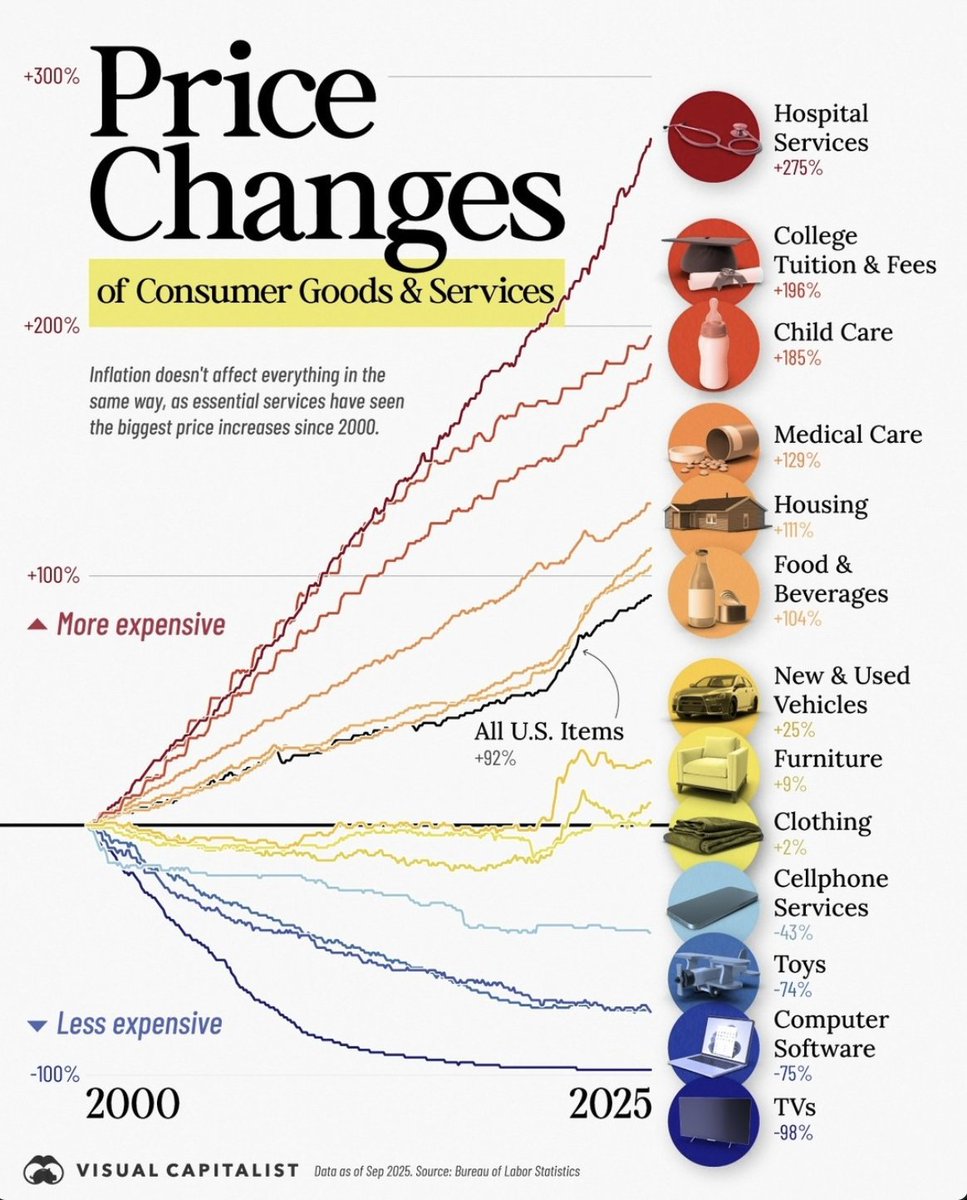
Since 2000, the things you need have exploded in price.
The things you want have collapsed.
Hospital services +275%.
College tuition +196%.
Child care +185%.
Medical care +129%.
Housing +111%.
Food +104%.
Meanwhile...
TVs -98%.
Computer software -75%.
Toys -74%.
Cell service -43%.
Inflation isn’t random. It’s structural.
Technology deflates. Global supply chains compress margins. Competition drives efficiency.
But essentials? They’re insulated. Regulated. Consolidated. Subsidized. Financialized.
You can buy a 65-inch TV for a fraction of what it cost 20 years ago.
But try paying a hospital bill without insurance.
This chart explains why people feel squeezed even when CPI prints “2–3%.”
The basket averages everything.
Real life doesn’t.
The middle class doesn’t experience inflation in gadgets.
It experiences inflation in housing, health care, education, and food.
That’s the real story here.
Not that prices went up.
It’s what went up.