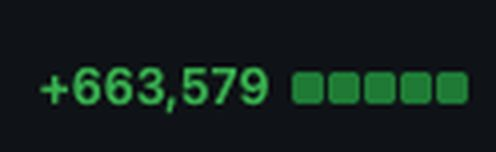
I labeled 100 transactions by hand. My agent labeled the rest.
Since then, every confirmed answer becomes a rule. A rule costs nothing and gives the same answer every time. A model call costs tokens and can change its mind.
194 rules so far. https://t.co/al1hBIdG64
I started my career as a full stack engineer a while ago. A very, very curious junior.
On my team there was a star. Ten years in, and he knew how to make an app work for millions of people. I still remember standing next to him and feeling it: the weight of everything he'd already seen break. Today TikTok would draw an aura around people like him.
I have a habit with people like that. I ask how they learn, and I ask for their top three.
I've asked it enough times to see a pattern. And it's not only the best engineers. Most of the smart people I've met put books at number one or two.
I asked him too. He took five minutes before answering. Five minutes of silence, with a junior waiting.
Then he said: if you want to understand a topic deeply, the best thing you can do is read a book.
That answer still holds, even now.
You can ask a model for the summary in ten seconds. Summaries are good for surfacing ideas, and they'll push you forward. They won't take you deep. The summary is the part you'll forget. On the topic that matters most to you, you'll end up reading the book.
Since that conversation I've added one move to it. Read the book, and wrestle with its ideas.
Wrestling is when you play out a situation from your own life where the idea will matter. You don't stop at "interesting point." You ask where it would have saved you, and what you'd have done.
Reading a book on how to write posts? Take one of your old posts and rewrite it in your head. Which line goes first, and where you lost the reader.
Here's a real one. I read Donella Meadows' *Thinking in Systems*. She ranks leverage points: the places where you can push on a system to change it, from weakest to strongest. At work I was building an AI governance process, so I wrestled every point against it. Where am I pushing?
It clicked fast. Number three: changing the goal of the system. The system was the company. That was exactly the scale I meant to work on.
No notebook, no app, no flashcards. A walk is enough. It's the cheapest way I know to keep an idea in your head for years, because by the time you need it, you've already used it once.
Agents get their skills from a SKILL.md file. A good book plus wrestling is how I write mine.
He needed five minutes to answer. I'm still using the answer.
My Obsidian on iPhone stopped opening. Stuck on "Loading Obsidian..." forever.
Asked Claude Code why. It read Obsidian's startup code and found 170 MB of .git syncing through iCloud.
Moved .git out. Phone opens.
20mins to fix. Before agents that's a weekend of forum threads.
I can generate 600k lines of code in one PR just to see how something works.
So on a huge project, the hours go into deciding what's in V1.
I skipped Excel and built the planning tool our process needed. It's one HTML file. https://t.co/4jVPvBcGnT
How do you find out whether AI can help you with a task?
Start with the smallest task you can hand over, and see if it works.
Example: Devin released bots. These are scheduled jobs that own an outcome.
I decided to use one instead of a scheduled AI run over the new bugs in our channel, and created BlameBot. It does a root cause analysis and pings the person who last touched the code, so they review the bug and fix it if action is needed.
After it started to work, I asked the bot to introduce itself in the channel where we share AI use cases. I also asked it to make a joke.
I did not expect it to call me father :D
Fable 5.2 experiment: minimal prompt, zero supervision, 4 references of success.
I’m on the LapaLLM team. We’re building the #1 Ukrainian LLM.
My current part is a pipeline that builds UA datasets, so the next Lapa gets better at high business value tasks like: customer support in banking, retail, e-commerce.
Then I decided to add a telecom domain. Asked Fable to extend the pipeline. Left it alone for 5 days, on purpose: I wanted to see if it can take the 4 reference domains in the repo and add a sixth with nobody stopping it.
It came back with a 600k-line PR.
The Python changes alone are 120k lines. That’s 20x my whole pipeline, for one more domain.
I have a static grader that sits outside the repo. It says Fable did the right thing. The thing I asked for is done.
AND I AM SCARED TO OPEN IT :D
Part 2 after I open it: what's actually inside those 600k lines.
P.S. PR will be reworked with normal iterative workflow, because Fable received too much freedom and blew up.
Arc browser will be sunsetted soon so I moved to Dia (it is Arc’s offspring from the same company)
@diabrowser added ai assistant but removed folder in folder for bookmarks
why no subfolder? I am upset
For a couple of months during my PhD, I came up with three research ideas a day. Almost every one turned out to be someone else's paper.
A dissertation has to state its scientific novelty: what you found that nobody had found before. Until you can write that paragraph, you don't have a thesis. So I went looking for mine.
I started with context. I mapped my field into a knowledge graph by hand: software architecture, the methods for improving and measuring it, and how coding agents work with it. Every day I read the AI overviews of new papers on alphaXiv (very nice, by the way), and when one hooked me, I saved it and read the full paper. I wasn't hunting for ideas yet. I wanted to know who was working on what.
Then I wrote concepts. Each one was a one-pager: the purpose of the work, its object and its subject. I'd search for it with AI and re-read the papers, looking for the one that had already done it.
There almost always was one.
Finding an idea that looked new was a real pleasure. Finding its paper a few hours later was not. That was the rough part, three times a day.
Now I read those months differently. Every "someone already did it" cost me a few hours and saved me months. Someone else had already burned those calories for me.
The dead ideas weren't wasted, either. Do this long enough and it starts to feel like everything has been done. It hasn't. Each dead idea marks a spot where someone is already standing, and after enough of them the empty spot shows.
Every architecture check I found ran on code the agent had already written. My concept predicts what the agent's plan will do to the architecture, before any code exists. It survived the search. It's my thesis now.
The habit stayed. Step one of anything I build is a search. On a complex AI system, like the multi-tenant platform with tons of agentic features we built for a US startup, that means reading what's already out there and building only the part nobody has. For our family budget, it meant a century of finance books first. Every system I found automated three of the four steps, so I built only the fourth.
I ran this lesson through the same search. Someone had it decades ago: "A couple of months in the laboratory can frequently save a couple of hours in the library." It's usually credited to the chemist Frank Westheimer.
A paper is somebody's year of work, left where you can find it.
When I pay my psychologist, my bank records a transfer to a sole proprietor.
In our budget, it's Therapy.
A bank statement is a list of who got paid. It's a terrible budget. I handed the translation to an agent and automated my personal finance: https://t.co/toO8zhienV
I labeled 100 transactions by hand. My agent labeled the rest.
Since then, every confirmed answer becomes a rule. A rule costs nothing and gives the same answer every time. A model call costs tokens and can change its mind.
194 rules so far. https://t.co/al1hBIdG64
Our family budget messages me only when something needs attention: we're over plan, or a payment needs my call.
Otherwise it says nothing. Silence means we're on plan.
Frederick Taylor called this the exception principle. In 1903.
Check personal finance automation guide: https://t.co/GOIZUINF8M
I labeled 100 transactions by hand. My agent labeled the rest.
Since then, every confirmed answer becomes a rule. A rule costs nothing and gives the same answer every time. A model call costs tokens and can change its mind.
194 rules so far. https://t.co/al1hBIdG64
@IanYanusko@diabrowser it was just broken shortcut, thank you for the response!
Do you have any plans to let users create subfolders in bookmarks? it was really useful to keep sidebar clean
Automation for personal finance with AI:
My agent didn't know a local grocery shop on our bank statement.
So it found the shop on a map, saw a grocery store, and filed the payment under Groceries.
That answer is a rule now. It never has to look again.
https://t.co/QsAsAQPaxE
I labeled 100 transactions by hand. My agent labeled the rest.
Since then, every confirmed answer becomes a rule. A rule costs nothing and gives the same answer every time. A model call costs tokens and can change its mind.
194 rules so far. https://t.co/al1hBIdG64
I wanted to remember what it feels like to be a total beginner in software engineering.
So I picked up electronic music production from scratch.
Here’s what putting myself back at step zero taught me about tech: https://t.co/tvhxzZ2W6Y
I labeled 100 transactions by hand. My agent labeled the rest.
Since then, every confirmed answer becomes a rule. A rule costs nothing and gives the same answer every time. A model call costs tokens and can change its mind.
194 rules so far. https://t.co/al1hBIdG64