Iran is reportedly claiming it is ending its latest round of ballistic missile attacks on Israel.
The real issue here, however, is what Iran’s Lebanese proxy, Hezbollah, does.
Hezbollah is not an independent actor. It is Tehran’s most heavily armed proxy force, funded, armed, trained, and directed by the Islamic Republic.
And if Hezbollah refrains from firing rockets and drones at Israeli civilians, Israel has previously agreed not to strike Hezbollah targets in Beirut.
But if Hezbollah resumes attacking northern Israel, Israel will respond. And if Israel responds, Iran has already threatened further attacks.
In other words, whether this latest “ceasefire” survives m
depends entirely on the behavior of Iran’s own creation - Hezbollah.
If this collapses, it will not be because Israel refused to absorb attacks on its civilians. It will be because Tehran once again chose escalation through its proxies.
@POTUS@SecRubio@GovMikeHuckabee
Iran fires 11 ballistic missiles at Israel - missiles capable of leveling apartment buildings and killing hundreds - and President Trump apparently expects Israel to simply absorb it.
No serious country would.
More remarkably, Iran continues to demand that any U.S.-Iran ceasefire must be linked to restrictions on Israel’s ability to strike Hezbollah.
But Hezbollah is not some independent actor. It is Iran’s most powerful foreign legion.
It was Hezbollah, acting at Tehran’s direction, that opened a second front against Israel after February 28. It was Hezbollah that repeatedly violated the U.S.-brokered ceasefire. And over the past several days, it has again fired at civilian communities in northern Israel.
The formula was simple: if Hezbollah does not attack Israel, then Israel does not strike Hezbollah targets in Beirut. If Hezbollah fires on Israeli civilians, Israel responds.
The escalation did not begin with Israeli strikes in Lebanon. It began with Iranian missiles and Iranian proxies attacking Israelis.
For forty years, Iran has armed, funded, trained, and directed proxy forces while pretending their actions are somehow separate from Tehran. Nobody should still be fooled by that fiction.
@POTUS asking Israel to stand down after Iran launches ballistic missiles and Hezbollah continues to attack Israeli civilians does not reduce the likelihood of a wider war. It teaches Tehran that its aggression and proxy games carry no meaningful cost.
That lesson has never produced peace in the Middle East. It has only produced more aggression.
After nearly 2,000 years without sovereignty, the Jewish people regained it.
What did they build?
Amazing Hospitals. Universities. Life-saving innovation.
My latest with the @Algemeiner - “From Exile to Innovation: What Israel Built.”
https://t.co/P8rJVaFODz
The “chutzpah” is remarkable.
Iran is reportedly trying to condition further negotiations on Israel not striking Hezbollah, Hamas, or other Iranian proxy forces, and on Israel withdrawing from positions established in response to those same proxies’ attacks.
But Hezbollah and Hamas are not neutral actors. They are Iranian-backed organizations that launched wars against Israel, fired thousands of rockets, missiles, and drones at Israeli civilians, and openly proclaim their intention to destroy the Jewish state.
Even during the supposed recent ceasefire, Hezbollah repeatedly violated its terms by launching hundreds of rockets, missiles, and drones and maintaining military infrastructure in violation of the agreement.
Iran’s position is essentially this: our proxies may attack Israel, but Israel may not strike back.
That is like a mafia boss demanding immunity for the enforcers he sent into the neighborhood to terrorize local residents - and then insisting that his victims have no right to defend themselves or pursue the attackers afterward.
No serious country would accept such an arrangement. And no serious ally should expect Israel to accept it either.
If Iran really wants Gaza and Lebanon left to their own devices - the answer is simple: disarm Hamas and Hezbollah and stop using them as proxies to attack Israel.
Iran demanding that negotiations require Israel not strike Hezbollah or Hamas is like a mafia boss demanding protection for the enforcers he sent to attack the neighborhood.
Hezbollah and Hamas are Iranian proxies. Israel’s actions against them were triggered by their attacks on Israel in the first place.
Even during the supposed recent Lebanon ceasefire, Hezbollah has repeatedly launched rockets, missiles, and drones at Israeli territory and forces, with hundreds of documented attack waves since the “ceasefire” began.
Iran’s position is essentially: our proxies may attack Israel, but Israel may not strike back.
No serious country would accept that. And no serious ally would expect that from
Israel.
The claim this deal was “95% done” is absurd.
Trump repeatedly said any deal had to include Iran giving up its enriched uranium and ending enrichment. Iran repeatedly insisted it would neither surrender its enriched uranium nor accept a permanent end to enrichment - and at various points even claimed the nuclear issue itself would not be part of any agreement.
That’s not a deal that was 95% complete. That’s two sides publicly rejecting each other’s core demands.
Calling that “95% done” is like claiming you almost got a “100” on the test, when you missed 9 out of 10 questions.
The obsession with whether Trump or Netanyahu “calls the shots” is just a recycled version of the old “Israel controls America” conspiracy theory. Sometimes Washington and Jerusalem disagree. Sometimes they agree. Neither proves control. What matters is whether Hezbollah is violating the ceasefire Israel agreed to with Lebanon.
And over the past several weeks Hezbollah has continued firing rockets, attack drones, and other cross-border attacks while openly refusing to disarm and continuing military activity prohibited under the agreement. Even Reuters, AP, and other outlets have reported repeated Hezbollah rocket and drone attacks during the supposed ceasefire period.
The real question isn’t who “controls” whom. It’s why so many commentators pretend ceasefires only impose obligations on Israel.
Sharing my latest piece in @Algemeiner
Politicians like Sen. @ChrisVanHollen and @SenPeterWelch keep insisting Israel is the primary obstacle to a “two-state solution.”
A few inconvenient facts:
Jewish leadership accepted partition in 1937.
They accepted partition again in 1947. They sought UNSC, US, or USSR enforcement of the UN endorsed plan.
Arab leaders rejected both opportunities to create an Arab state west of the Jordan River.
They then launched a catastrophic war to prevent the first two-state solution from ever coming into existence.
So why are some politicians uniquely blaming Israel for the absence of one today?
History matters.
https://t.co/9gvJ6AOM5q
Latest in The @Algemeiner on the reaction to @RepThomasMassie’s defeat - and why rhetoric from figures like @cenkuygur should alarm anyone who knows even a little history.
Criticizing AIPAC or Israeli policy is legitimate.
Claiming America is “occupied,” that “Israel controls our government,” and that American politicians are “servants” of a foreign power is something else entirely.
That is not normal political discourse. It is one of the oldest and most dangerous political reflexes in history - repackaged for the social media age.
History has seen this movie before. It has a terrible ending.
https://t.co/iO6NqOTBJE
Reminder for @realDonaldTrump and @SecRubio —
You were both right when you criticized Biden for prematurely weakening the original maximum-pressure campaign before a real, verifiable deal existed.
And @POTUS was right to call out how badly wrong Joe Kent is on Iran.
The IRGC regime has spent decades using negotiations to relieve pressure, regain revenue, recalibrate, and continue pursuing its long-term ideological and strategic objectives once the immediate threat passes.
Sanctions relief and major oil revenue should not come first.
Not unless Iran has already verifiably:
•surrendered its 60% enriched uranium,
•ended further enrichment capability,
•accepted intrusive inspections,
•and agreed to missile limits that prevent the construction of a missile umbrella shielding a future sprint toward nuclear weapons capability.
A deal that economically revives the regime while leaving its core infrastructure and ambitions intact will not create lasting stability.
It will only buy the regime time after leverage has already been surrendered.
The announcement by President Trump about the potential peace deal is very good news.
To make the deal effective we have to be realistic about Israel.
We must recognize that a peace deal of any kind with the Iranian regime will be viewed by Israelis as an existential threat to their objectives, therefore they will seek to thwart the deal.
To stop the Israelis from thwarting a potential peace deal, we will have to take away the military support that we provide that allows them to go on the offensive against Iran, and make it clear more will be taken from them if they attack Lebanon.
Joe, what you are proposing here is extraordinary.
You are arguing that the USA should threaten military support for Israel not because Israel harmed America, but because it distrusts a temporary arrangement with a regime that has spent decades chanting “Death to America,” backing terror proxies, and exploiting diplomacy to relieve pressure while preserving its openly jihadist and messianic ambitions.
Based on the reported terms, Israel’s skepticism here is entirely rational.
Historically, regimes under severe pressure rarely make lasting concessions once sanctions relief and oil revenue begin flowing again.
Reassembling international pressure later is vastly harder than maintaining it now.
And this is not merely an Israeli concern.
A nuclear-threshold Iran that treats hostility toward America and the West as an organizing principle - while funding Hezbollah, the Houthis, Iraqi militias, and other proxies — plainly threatens broader American interests as well.
History also warns against the fantasy that revolutionary regimes can be stabilized through premature accommodation and weak agreements detached from actual strategic change.
A deal that economically revives and legitimizes the Iranian regime while leaving its long-term ambitions fundamentally intact is not a peace deal. It is a pause.
And threatening allies to pressure them into accepting that outcome is not realism or restraint.
It is short-term thinking driven by the desire for immediate de-escalation and temporary stability without fully reckoning with the long-term strategic costs.
Glenn, @emilykschrader was plainly not saying that “the American President exists to serve Israel.”
That’s your framing. And it reflects a broader habit in much of the anti-Israel world: if something is viewed as strategically important for Israel, they immediately assume it must therefore be bad for America.
But allies generally share interests - especially when dealing with aggressive totalitarian & openly messianic regimes like Iran.
Something can matter more immediately to Israel while still carrying major consequences for the United States.
Emily’s point was about leverage and credibility.
The Iranian regime has spent decades mastering the art of using negotiations to ease pressure, buy time, regain economic oxygen, and recalibrate once the immediate danger passes.
If the United States spends time & capital building pressure, demonstrating resolve, and then significantly eases sanctions before major concessions are actually locked in and verified, other adversaries notice. They learn from it.
That concern is hardly unique to Israel.
For example, during World War II, a premature negotiation by the USA that economically strengthened Nazi Germany again would obviously have endangered Britain and occupied Europe first and most directly. It still would have been terrible for the United States and the broader democratic world.
Not every issue has to be framed through the simplistic & mendacious lens of “good for Israel = bad for America.”
Captain Itamar Sapir was killed yesterday in Lebanon.
You didn't hear about it because a Hezbollah terrorist fired from inside a church in the village of Koza.
If Itamar hadn't been killed, you would have heard about it — as a story about the IDF firing on a church.
In Lebanon, just like in Gaza, terrorists fire from inside churches, hospitals, schools, and mosques.
Remember his name. Share the truth.
One of the oldest antisemitic patterns is the recycling of grotesque lies about Jews - not because they are believable, but because they are emotionally useful.
From medieval “poisoned wells” and blood libels, to claims Israel trained sharks, organ-harvesting conspiracies, and now the surreal “rape dogs” allegation amplified by @NickKristof through the @nytimes ecosystem.
My latest in @JewishJournal examines not only the lies themselves, but the collapse of many institutional guardrails that once filtered out this kind of hysteria.
https://t.co/T9QVgjPehS
“The Jews rigged Eurovision” may be one of the dumbest modern conspiracy theories.
There are only about 7 million Jews outside Israel on earth. Roughly 6 million live in the United States - mostly asleep during Eurovision voting and largely indifferent to Eurovision itself.
Meanwhile Eurovision audiences total hundreds of millions of viewers across Europe and beyond.
Nobody was “caught rigging” anything. Israel encouraged supporters outside of Israel to use their allowed votes - exactly what other countries and fan bases also do. The rule was simply changed from 20 votes per phone to 10.
That is not evidence of a global Jewish conspiracy.
It is evidence that some people cannot emotionally process the fact that millions of ordinary viewers voted for an Israeli singer.
Is the real Eurovision scandal that people keep voting for Israel?
Despite boos, protests, activist pressure campaigns, and media insinuations, millions of ordinary viewers once again voted Israel near the top anyway.
My latest in @algemeiner:
https://t.co/JGQUeZbekE
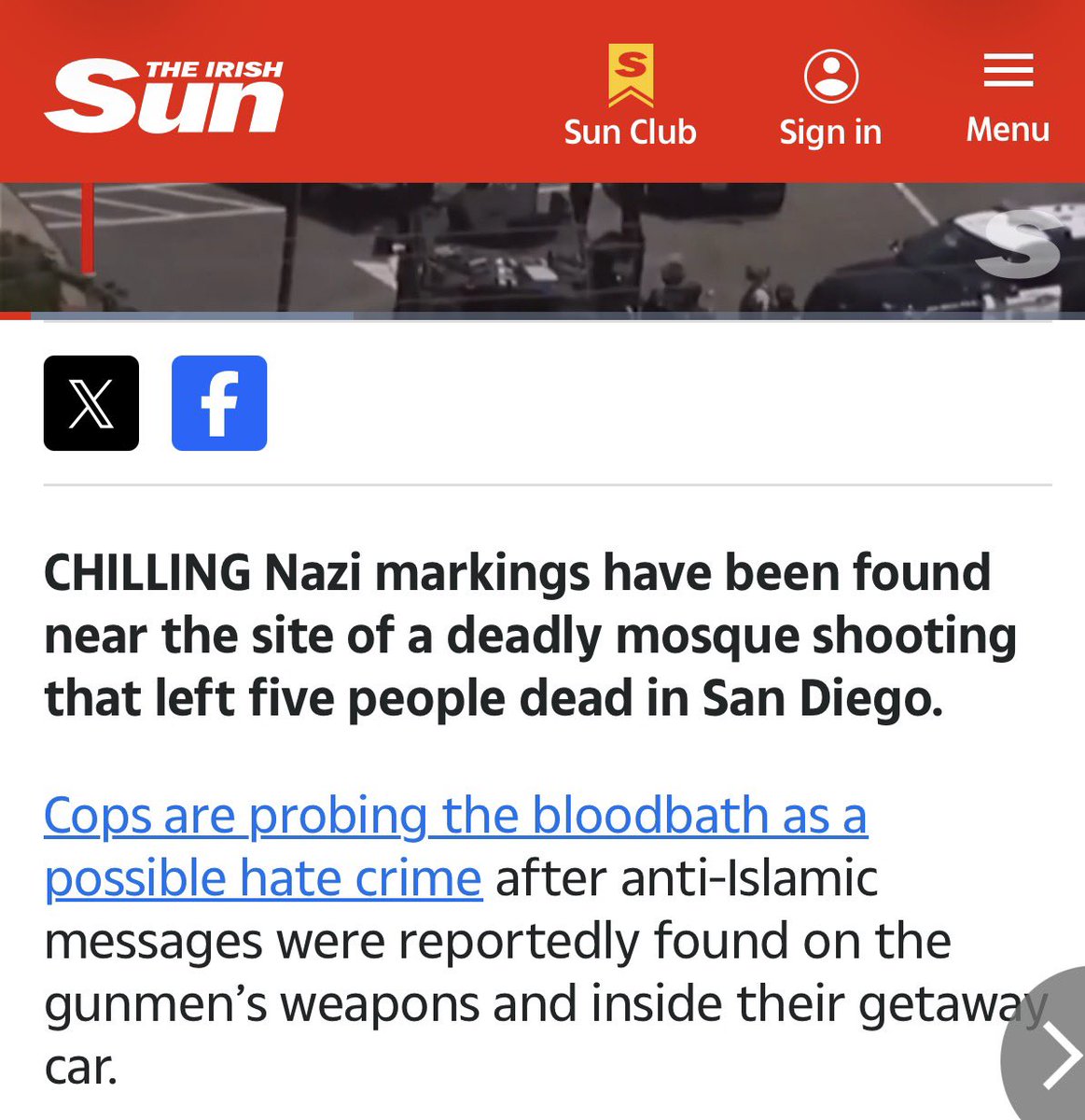
When neo-Nazis and white supremacists walk into a mosque and murder worshippers, the immediate takeaway should not be “let’s litigate the imam.”
Because the ideology that murders Muslims in mosques is the same ideology that has murdered Jews in synagogues, Black Americans in churches, Sikhs in temples, and others for decades.
The ideology behind this attack is evil and a threat to every minority community in America, including Jews.
Yes, this imam reportedly said deeply hateful things about Jews. That matters. And it should be addressed.
But right now, the priority should be protecting houses of worship.
Enough already. Synagogues, churches, and mosques should be treated as civic no-go zones for intimidation and violence.
Not shootings. Not vandalism. Not mobs screaming outside to terrify worshippers - something we now see in places like New York with disturbing regularity. Not “protests” designed to make ordinary people afraid to pray or gather with their community.
Disagree with clergy. Criticize ideologies. Debate politics passionately if you want.
But once a society starts normalizing intimidation campaigns around houses of worship, everybody loses.
People should be able to walk into a synagogue, church, or mosque without fear. Period.
Jeremy, I don’t know how many American Jews J Street actually represents. But I do know this:
An organization that spends years publicly lobbying against Israeli governments during wartime, amplifying international pressure campaigns, pushing for concessions that Israelis overwhelmingly reject, and routinely portraying Israel as the primary obstacle to peace is not meaningfully “pro-Israel” in any normal sense of the term.
Please identify even one truly pro-Israel position or statement in J Street’s history that did not immediately pivot into criticism, pressure campaigns, sanctions threats, or attempts to constrain Israel’s ability to defend itself.
Because “we support Israel’s right to exist” is not some profound act of Zionist commitment.
That is the absolute floor of basic legitimacy - roughly equivalent to saying Japan has a right to exist.
A genuinely pro-Israel organization occasionally sounds like it actually likes, admires, defends, or even trusts the Jewish state - not merely tolerates its continued existence while spending most of its energy publicly indicting it, lobbying against its elected governments, and validating many of the narratives used to try and isolate it internationally.
Disagreement with Israeli policy is normal. Israelis do it nonstop.
But there is a reason so many Israelis across the political spectrum view J Street not as “pro-Israel opposition,” but as an organization far more comfortable pressuring Israel than confronting the movements and regimes openly dedicated to destroying it.
Chris, this argument erases the single biggest reason these negotiations repeatedly failed: Palestinian Arab leadership repeatedly rejected statehood offers while refusing to accept the legitimacy of Jewish sovereignty in any borders.
In 1937 and 1947, the Jews accepted partition and a state on a tiny portion of the arable land in the original British Mandate for Palestine.
The Arab leadership under Haj Amin al-Husseini - a literal Nazi collaborator and Hitler ally - rejected both offers and chose war instead.
And when Arab armies conquered territory in 1948, they ethnically cleansed every Jew they could find, destroyed synagogues, desecrated holy sites, and barred Jews from Jerusalem’s Old City for 19 years.
Almost 1 million Jews were then expelled or forced out from Arab countries.
Israel absorbed them without a UN refugee empire, hereditary refugee status, or demands for billions in reparations.
Meanwhile, Palestinian Arab leaders rejected Camp David and the Clinton Parameters - despite offers including a state in Gaza and most of the West Bank, East Jerusalem as a capital, massive international aid packages, and compensation in the tens of billions.
So when you claim previous offers included no meaningful compensation or reparations, you are simply wrong.
Arafat walked away without even making a serious counteroffer. Then came the Second Intifada.
And the truly astonishing part is this: people still argue Israel should now hand an authoritarian Palestinian Arab leadership a sovereign state and hundreds of billions more while demanding almost nothing from the Palestinian Arab leadership in return culturally or politically.
Nothing about “pay-for-slay.”
Nothing about decades of antisemitic incitement in schools, sermons, TV, textbooks, and official media that often resembles the dehumanizing propaganda of 1930s Europe.
Nothing about teaching generations that Jews are somehow foreign colonial invaders in Judea with no legitimate connection to the land despite 3,000 years of Jewish history there.
Israel already withdrew fully from Gaza and left behind extensive agricultural infrastructure and billions in economic opportunities.
The result was not peace. It was Hamas, tunnels, rockets, October 7, and an Iranian-backed terror fortress.
And your Iran point is similarly detached from reality.
The war is not already “lost.” Iran’s economy is under enormous strain, its proxy network has taken major blows across the region, and the current pressure campaign is vastly more economically sustainable for the United States and its allies than for Tehran and that’s before any kinetic war has restarted – which Iran can definitely not win.
Bottom line - the core issue between Israel and the Arabs who generally began to identify - after 1950 - as Palestinian - has never been borders.
It has been whether major Palestinian Arab factions and their very authoritarian leaders are willing to permanently accept any Jewish state within the historic land of Israel in any borders at all.
Jews may be the only people on earth regularly told their indigenous history somehow “expired” - not because the connection vanished - but because centuries passed after conquest, exile, and dispersion.
Yet Jews never stopped praying toward Jerusalem, maintaining a presence in the land, preserving Hebrew, or repeatedly seeking, including through uprisings against empires, restored sovereignty in the historic Land of Israel.
No one applies this indigeneity “statute of limitations” to any other people.
My latest in @JewishJournal:
https://t.co/6EvsOMfwyY