If Toyin Abraham says, She is the GOAT…She is definitely the GOAT….before you start crying…show me that Movie Director that grossed over One Billion Naira at the Cinema the First Time She Directed a Movie, “a newbie Director”….I dey wait @seyfunmi@Alpha_Yom
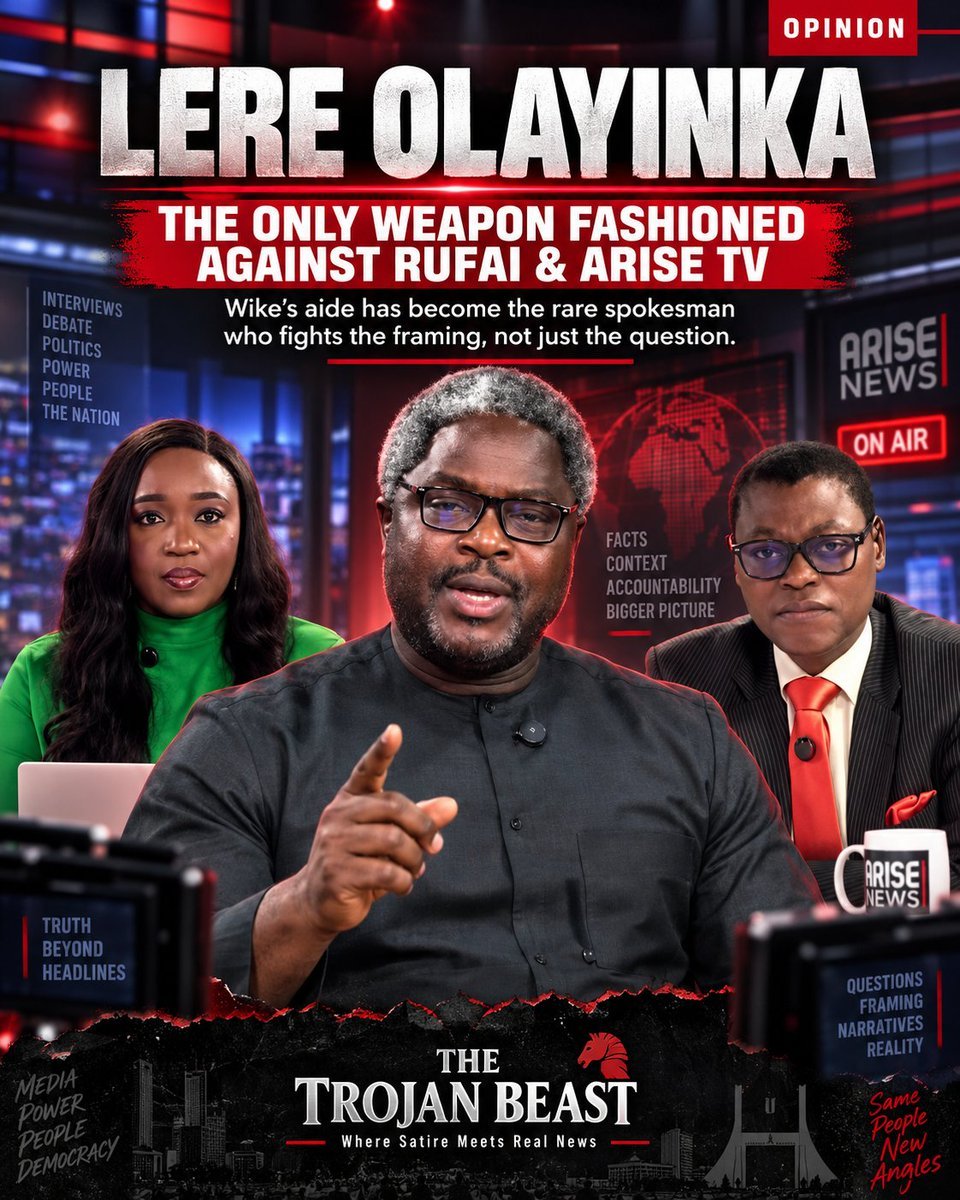
LERE OLAYINKA: THE WEAPON FASHIONED AGAINST RUFAI OSENI AND ARISE TV
By Ishola Adebiyi | The Trojan Beast
Opinion
For years, Nigerian politicians and government spokesmen have walked into television studios already afraid of the presenters.
They arrive over-prepared, over-polite and terrified of becoming the next viral clip.
Then came Lere Olayinka.
The Senior Special Assistant on Public Communications and Social Media to FCT Minister Nyesom Wike has developed something increasingly rare in Nigerian political communication: the willingness to fight the framing of an interview, not merely answer the questions placed before him.
And that is precisely why his encounters with Rufai Oseni and Arise TV have become compelling television.
On September 4, 2026, Olayinka appeared on Arise News’ The Morning Show. The conversation eventually deteriorated when he refused to engage Rufai Oseni, and the interview was brought to an end.
Some will call that arrogance.
Others will call it unnecessary confrontation.
I call it evidence that Nigerian political communication has finally produced someone who understands a simple rule:
A microphone does not confer infallibility.
A journalist has every right to interrogate a politician.
But the politician—or his spokesman—also has every right to interrogate the assumptions, language and framing behind the interrogation.
That is where Lere Olayinka is different.
He does not enter an interview behaving like a schoolboy summoned before the disciplinary committee.
He challenges.
He interrupts when necessary.
He remembers previous statements.
He fights his principal’s corner.
And, perhaps most importantly, he refuses to accept the idea that only the person holding the microphone is entitled to be aggressive.
THE ANTIDOTE TO THE TELEVISION AMBUSH
Rufai Oseni has built a considerable public following partly through a confrontational interviewing style. His supporters call it fearless journalism. His critics see grandstanding, selective outrage and commentary sometimes presented with the force of unquestionable fact.
Whatever side one takes, one thing is undeniable: Oseni is difficult television terrain for an unprepared political spokesman.
Most politicians respond by becoming defensive.
Lere responds by attacking the premise.
That is why he may be the closest thing yet to the weapon fashioned against the Rufai-Arise style of political interrogation.
Not because he silences journalists.
He cannot—and should not.
But because he refuses to surrender the battlefield before the conversation even begins.
Wike FOUND THE RIGHT MOUTHPIECE
Nyesom Wike himself is hardly known for diplomatic whispers.
So perhaps it was inevitable that his communications operation would eventually produce a spokesman prepared to communicate in the same political language: direct, combative and unapologetic.
Olayinka understands his assignment.
He is not employed to become Arise TV's favourite guest.
He is not there to collect applause from opposition social-media influencers.
He is there to articulate and defend his principal's position.
And whether you love Wike or despise him, you cannot accuse Lere of forgetting who sent him to the studio.
That distinction matters.
Nigeria has too many government spokesmen who enter hostile interviews trying desperately to impress the interviewer rather than communicate with the millions watching at home.
Lere understands that the real audience is outside the studio.
ARISE ALSO HAS A RIGHT TO PUSH BACK
There is another side that should not be ignored.
Arise TV was equally entitled to insist that a guest appearing before its panel engage its presenters. When Olayinka refused to answer Oseni, the programme was entitled to terminate the interview.
That is editorial freedom.
But Olayinka was equally entitled to make his objection—and accept the consequences.
That tension is healthy.
Journalists should challenge politicians.
Politicians should challenge journalists.
Neither profession should be treated as a priesthood whose members are above scrutiny.
The public can then watch both sides and decide who made the stronger case.
NO MORE TREMBLING SPOKESMEN
The lesson from the Lere-Rufai confrontation is bigger than either man.
Government communicators need preparation, memory, facts and backbone.
When a question is legitimate, answer it.
When an allegation is factual, confront it with evidence.
But when an interviewer introduces questionable assumptions, double standards or loaded framing, challenge it immediately.
That is where Lere Olayinka has distinguished himself.
You may dislike his language.
You may dislike Wike.
You may even believe Rufai won the confrontation.
But nobody watching that interview could describe Lere Olayinka as intimidated.
And in Nigeria's increasingly theatrical television politics, that alone makes him unusual.
Rufai Oseni has finally encountered a political communicator who does not arrive at Arise TV looking for approval.
He arrives ready for combat.
Perhaps scripture needs a political amendment:
No weapon fashioned against Wike shall prosper—because Lere Olayinka will probably be on television that morning firing back.
And somewhere inside the Arise TV control room, somebody may already be asking:
“Who invited this man again?”
THE TROJAN BEAST
Where Satire Meets Real News
@lere
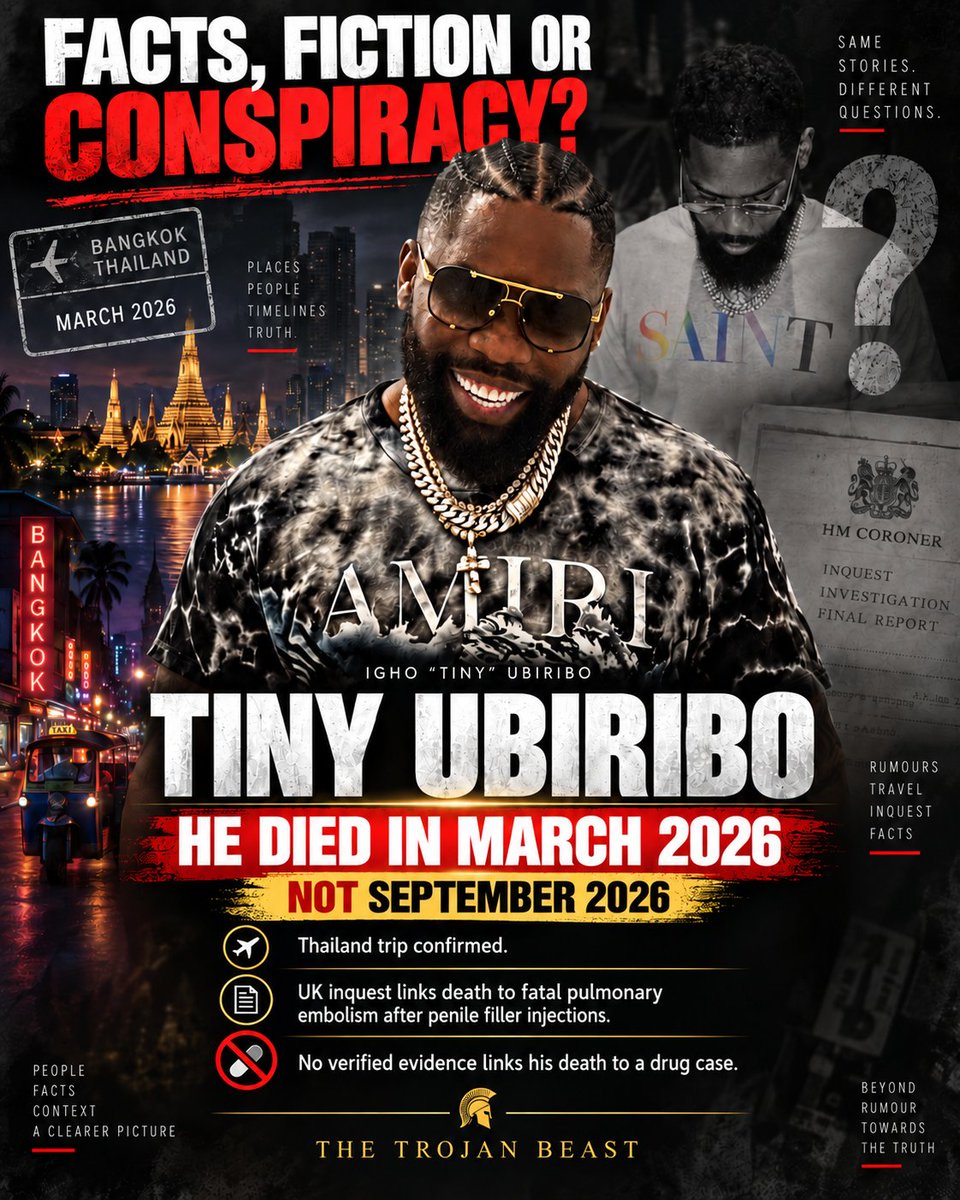
FACTS, FICTION OR CONSPIRACY?
What Really Happened to Igho “Tiny” Ubiribo — and Why Is His March Death Trending Again?
By Ishola Adebiyi | The Trojan Beast
For anyone encountering the story of Igho “Tiny” Ubiribo for the first time this weekend, one fact needs to be established immediately:
Tiny did not just die.
The British-Nigerian businessman and social-media personality died in Bangkok, Thailand, on March 6, 2026. What has emerged months later is more detailed reporting about the circumstances surrounding his death and evidence reportedly presented during a London coroner’s inquest.
That difference matters.
A six-month-old death suddenly circulating as breaking news naturally creates questions. But questions are not evidence, and speculation should not be presented as fact.
WHAT HAPPENED IN THAILAND?
Reports of evidence presented at the Inner West London Coroner’s Court state that Ubiribo underwent a cosmetic penile-filler procedure in Bangkok on March 5.
Approximately 40 millilitres of hyaluronic acid mixed with lidocaine were reportedly injected.
Shortly afterward, while receiving a massage, Ubiribo complained of chest pain and lost consciousness. He was transported to Sukhumvit Hospital, where his condition deteriorated. Medical personnel reportedly attempted resuscitation for more than 100 minutes. He died in the early hours of March 6.
A subsequent UK post-mortem reportedly found material in his lungs consistent with the filler used during the procedure.
The reported conclusion from the inquest was that Ubiribo suffered a fatal pulmonary embolism associated with the cosmetic procedure.
DID HE GO TO THAILAND FOR PENIS ENLARGEMENT?
Based on the available reporting of the inquest evidence, yes — there is substantial support for that claim.
But terminology matters.
Reports describe penile filler injections, not necessarily the kind of major surgical operation many people imagine when they hear the words “penis enlargement surgery.”
That distinction should be maintained when reporting the story.
WHAT ABOUT CLAIMS THAT HE WENT TO CHANGE HIS FACE?
This is where the evidence becomes much weaker.
The Trojan Beast has not found credible medical, coroner or law-enforcement documentation establishing that Ubiribo travelled to Thailand for facial reconstruction, facial alteration or an attempt to change his identity.
There may be rumours circulating online, but rumours are not records.
Unless documentary or medical evidence emerges, the facial-change story should be described as unverified speculation, not fact.
WAS HIS DEATH CONNECTED TO A DRUG CASE?
This is the most serious claim — and currently the least supported.
There is presently no verified evidence establishing that Ubiribo's death was caused by, arranged because of, or connected to a drug investigation or criminal case.
The reported medical evidence instead provides a specific physiological explanation: a pulmonary embolism following the cosmetic filler procedure.
That does not mean journalists should stop asking questions about other aspects of his life.
It means that anyone alleging murder, a fake death, a drug-related assassination or an identity-change operation must produce evidence capable of overcoming the existing medical explanation.
SO WHY ARE WE HEARING ABOUT IT NOW?
That is the more legitimate question.
Ubiribo died in March 2026, yet detailed international coverage of the circumstances surrounding his death only exploded in September 2026.
The likely explanation is not that his death was hidden until September, but that details from the British inquest brought renewed attention to a death that had already occurred months earlier.
That is substantially different from claiming somebody secretly died and authorities concealed the death.
THE TROJAN BEAST VERDICT
FACT: Igho “Tiny” Ubiribo died in Bangkok in March 2026.
FACT: Reports of the UK inquest say he underwent penile filler injections shortly before becoming critically ill.
FACT: The reported medical conclusion links his death to a pulmonary embolism following that procedure.
UNVERIFIED: Claims that he travelled to Thailand primarily to change his face.
UNVERIFIED: Claims that his death was connected to a drug case.
CONSPIRACY — UNTIL EVIDENCE EMERGES: Claims that he was murdered, his death was staged, or the cosmetic procedure was merely a cover story.
There is nothing wrong with asking questions.
But investigation begins where rumours end.
The real story is not “Did Tiny just die?”
He didn't.
The real question is:
Why did the full circumstances of a March death become international news six months later — and what exactly does the complete coroner’s record show?
THE TROJAN BEAST — Where Satire Meets Real News
Calling everybody you disagree with “APC media propagandists” is not an argument. Yes, hashtags cannot erase hunger, unemployment or insecurity but neither can opposition hashtags magically prove that nothing is improving.
Government should be judged by verifiable results, not vibes: jobs created, roads completed, power supplied, security outcomes, investment, revenues and whether reforms eventually improve living standards.
Your personal experience matters, but it is not the entire national dataset. So bring the receipts and we’ll bring ours. Criticism is welcome; propaganda disguised as criticism will still be fact-checked.
You say we can reshape the narrative but not your experience? Fine. Then let the facts reshape the argument. 😏
It is my Padi’s Birthday 🎂
Dearest Luca, you will always be celebrated, my padi ni gba Ogun Obidient, the one who stood gidigba wey not allow those pikin silence most of Us. My Padi will always ginger me to not show fear but to stay strong and push back against the bullies…
I know you are reading this, you know you are very special to me and the rest that knew you…Your impact is still as strong as yesterday, Enjoy your day Friendship🎉🎉🎉🎂🎂🎂🥳🥳🥳💃💃💃🥂🥂🥂🍾🍾
@oMoTonsore
The comparison is a sobering reminder. One factual correction: Chadwick Boseman was diagnosed with stage III colon cancer in 2016, kept the diagnosis private, continued working during treatment, and died in August 2020 at age 43 after the cancer progressed to stage IV. During his illness, some people online did make insensitive comments about his increasingly thin appearance.
The larger point about Ogogo can be made without speculating about his health:
Chadwick Boseman: A Reminder About Mocking What You Don’t Understand
In 2016, Chadwick Boseman was diagnosed with colon cancer.
The world didn’t know.
For four years, he privately underwent surgeries and chemotherapy while continuing to work. When photographs and videos later showed him looking noticeably thinner, some people on social media mocked his appearance.
They did not know the battle he was fighting.
Then, on August 28, 2020, Chadwick Boseman died.
That history should make us think carefully before turning someone’s appearance, weight loss, illness or even rumours about their health into political entertainment.
Whatever your politics, Ogogo is a human being before he is a political figure or someone you disagree with. Nobody on social media knows everything another person may be dealing with privately.
Criticize his politics. Challenge his statements. Debate his record.
But mocking someone because they look sick, old, frail or have lost weight crosses a different line.
Today it is Ogogo. Tomorrow it could be someone we love. Eventually, mortality comes for every one of us.
Chadwick Boseman taught the world an unforgettable lesson without intending to: sometimes the person you are laughing at is quietly fighting a battle you know absolutely nothing about.
Politics will pass.
Tweets will disappear.
But our humanity or lack of it will be remembered.