The @DataRobot Community Slack is now open :)
If you're building with AI and want direct access to us, this is the place.
We have the best AI researchers, ML engineers and agent builders up in here.
Come ask something hard. 👇
https://t.co/Yb7cgloGS6
What’s the hardest part of getting AI agents into production?
NYC, bring your answers to us tomorrow.
AITAM NYC + AI Builders, only a few seats left!
https://t.co/TLRz5PC4a7
https://t.co/h10OJWrg79
Less than 24 hours til our AITAM and Boston AI Builders events... we have a few seats left. See you there?
https://t.co/aoOjhDFyin
https://t.co/5HXIB8w9jk
Boston! Come build agents with us in Boston on 10/8 and NYC on 10/14! 🗓️🛠️🤖
We're teaming up with @nvidia and @Dell to give you a crash course on building enterprise ready agents from Day 1
https://t.co/5HXIB8vBtM
Hack on an idea, demo what you've built, or just come meet Boston's AI builders.
Thursday, October 8, 2:30 p.m., Back Bay. Pizza and drinks on us.
https://t.co/aoOjhDFyin
AI can flag a supply chain risk. But what happens next?
The real value comes when AI can help teams act on the problem. @ScottwLuton and Kim Reuter talk with Vika Smilansky and Marc Amarillas of @DataRobot about using AI agents to tackle supplier risk, tariffs and operational disruptions, including a $2.5B risk addressed in 72 hours.
🎥 Watch on demand: https://t.co/mBrlZkVKU0
Most agents get tested once, by whoever built them, on prompts that work. No signal on a malicious payload or six turns of pushback.
Agent Assist now red-teams agents before deploy: multi-turn attacks, fixes you approve, a readiness verdict for the PR.
https://t.co/Lg4FdEivXT
Most AI pilots never make it past the test phase. What happens when you actually put AI to work?
Launched today: @ScottwLuton, Kim Reuter, Vika Smilansky and Marc Amarillas of @DataRobot break down what it takes to move agentic AI from pilot to production, including a real $2.5B supply chain risk resolved in 72 hours.
Watch the new on demand webinar: https://t.co/Q0egHiu8BI
Elvin Aghammadzada, DataRobot, mapped where a context window stops working: up to 40% full it's the smart zone, past that it's the dumb zone
here's how to shrink an agent's context, from scratch:
step 1 → measure your own edge, 2026 measurements put the start of degradation at 25% of the window, not near the end - a window is not a tank, it's a runway
step 2 → count what's burned before the user says a word, an agent wired to 15 MCP servers spends over 100,000 tokens on tool definitions alone
step 3 → load on demand, a skill's front matter is under 100 tokens and the body only arrives when it's needed, roughly 10x cheaper in context than plain MCP
step 4 → put teachability on the buying checklist next to security and compliance, skills already ship natively in 26+ platforms
step 5 → prune the junk, model-written skills perform worse than human-written ones and there is still no verification layer for them
on August 1-2 OpenAI showed Astra: ten problems open for decades, cracked by coordinating multiple agents over long runs, with about $2,000 of tokens for all ten
most people bolt on one more MCP server - he switches off everything the current step doesn't need
bookmark & watch - this 26-min talk, then read the full context rot breakdown below ↓
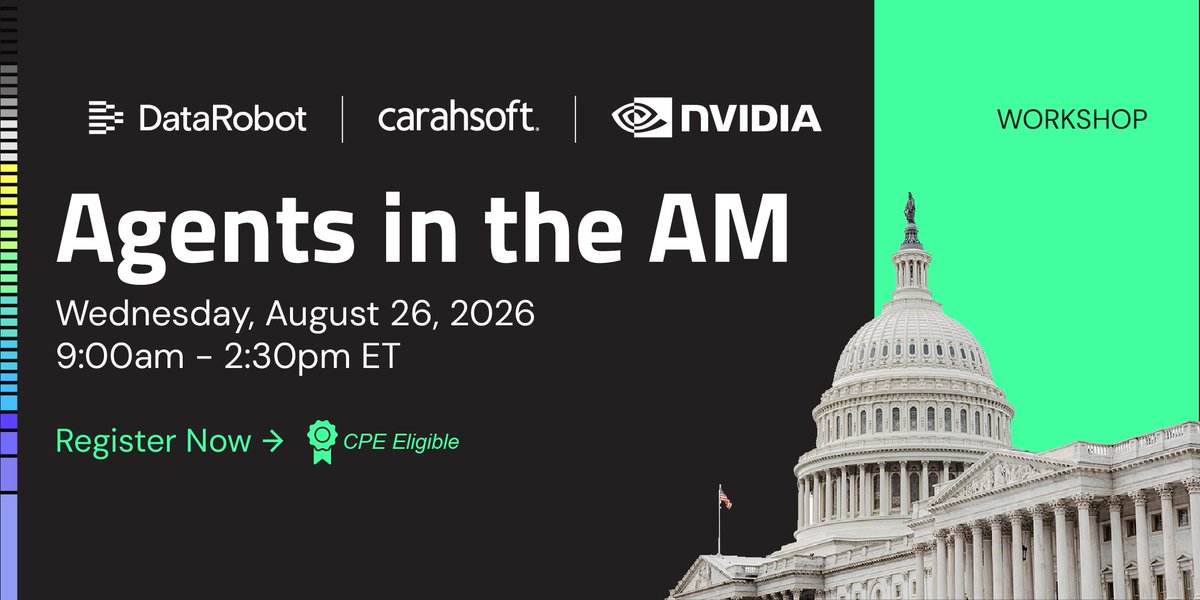
Ready to move #AI agents from concept to production? Join @DataRobot & @nvidia on August 26 for an executive briefing & hands-on lab covering secure deployment, governance & enterprise-scale AI. Save your spot: https://t.co/zQl4VToYZl
We've been asking our devs: who's actually responsible when an agent fails in production? The developer, the platform, or the org?
One dev's perspective:
Join @DataRobot and @nvidia on 8/26 for an interactive workshop focused on building enterprise-ready AI agents from the ground up... Register here: https://t.co/4AzBukgwVd
Dev to dev: your agent isn't broken. Your testing process is.
The teams making it to production are the ones systematically catching errors, turning them into tests, and iterating before they become production fires.
One DataRobot dev built a framework for exactly that:
Trustworthy AI should give similar answers to similar questions. If your agent's responses vary wildly, you've got a stability issue.
Hear about how we've been tackling the stochastic nature of language models head-on:
The enterprise AI story is changing.
The first wave was chatbots.
The next wave is AI systems that can actually run parts of a business.
In our conversation with @Saha_Deban, CEO of @DataRobot, he explains why this shift changes everything, and what companies are getting wrong about enterprise AI.
Listen to the latest episode of Nebius for Startups podcast: https://t.co/DfBR9piM6o
Switching AI models mid-project used to mean switching your whole coding agent, and starting a new vendor review. DataRobot OpenCode makes it a slash command instead. One agent, many model options, one governed key.
https://t.co/xH6elmf1UV
What are the four parts of a first-class agent identity? That's a hard math problem... let our latest @DataRobot blog break it down for you https://t.co/xVTQjVsMMT
Your agent shipped with your API key. Now it has all your permissions, you can't tell the two apart in your logs, and the only off switch breaks your own access.
@datarobot is launching a new series on agent identity, check out part 1!
https://t.co/kyj2ZC4TzU