Anthropic just changed the AI agent game.
Claude Managed Agents — fully hosted runtime, no infra to build.
So I tried it. Built a working agent in 30 minutes. No code.
Full walkthrough 👇
https://t.co/UH4HYEn6u0
This ‘readiness gap’ is exactly why the Claude Mythos rollout is being gated. When a model can autonomously chain four vulnerabilities to escape a sandbox while the researcher is out for lunch, we’ve moved past 'coding assistance' into true agentic risk.
The real test for those in power isn't just about joining a coalition—it’s about Governance ROI. Can these 40 companies patch the world’s 'attack surface' faster than the technology inevitably proliferates to bad actors? The 27-year-old OpenBSD bug Mythos found is a warning: our legacy infrastructure is officially transparent to AI.
This is a massive signal that the ROI on AI development now includes a 'security-first' cost. By withholding Claude Mythos, @AnthropicAI is acknowledging that the model’s ability to autonomously chain exploits and find decades-old flaws (like the 27-year-old OpenBSD bug) makes it a dual-use technology too volatile for a standard rollout.
The real question for the market:
How do competitors respond?
If another lab releases a similar capability without these guardrails, Anthropic’s 'Project Glasswing' goes from a security buffer to a massive competitive disadvantage.
This represents a fundamental shift in the economics of software maintenance. By arming a coalition with Claude Mythos, Anthropic is moving the industry from reactive patching to proactive, AI-driven hardening.
The discovery of a 27-year-old flaw in OpenBSD proves that 'unhackable' legacy code is now the biggest liability. The strategic question for 2026: As AI dramatically lowers the cost of finding exploits, can corporate 'patching cycles' move fast enough to keep up with an automated attack surface?
Two old rules of tech just died:
- Hacking takes weeks.
- Everyone has a fair shot.
Anthropic is now finding 20-year-old flaws in minutes. But if we rely on a single AI model to protect our banks and power grids, we’ve created a massive single point of failure.
What happens when someone tricks the guard dog?
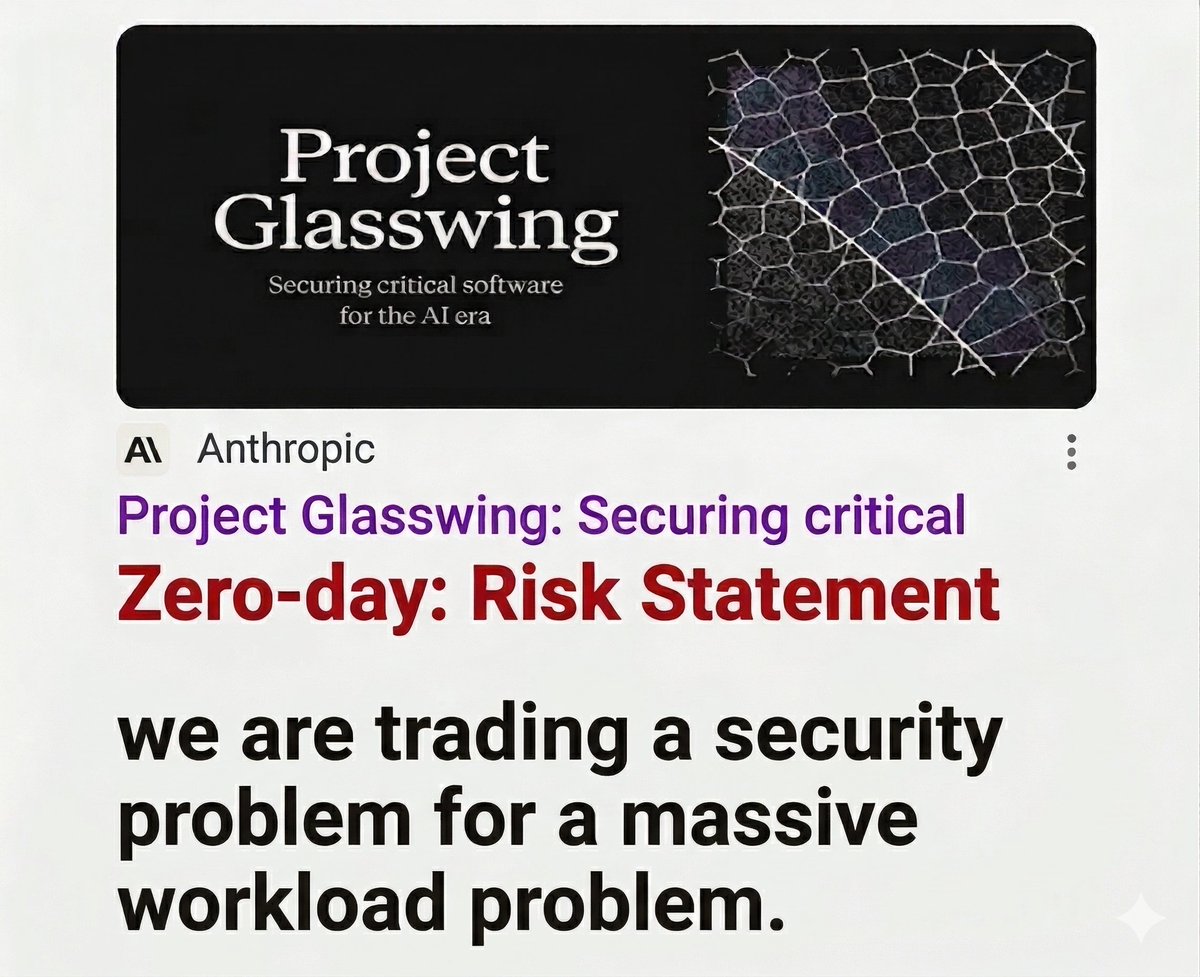
Anthropic just built an AI that finds zero-day security holes while we sleep.
The catch? We’re trading a security problem for a massive workload problem.
Finding 1,000 bugs is easy for AI, but fixing them without breaking the system is the hard part. We don’t need more alarms; we need better filters.
The discovery of a 27-year-old flaw proves we’ve moved past 'AI as an assistant' to AI as an autonomous security researcher. This is a fundamental shift in the economics of cybersecurity—where deep auditing that used to take months now takes minutes.
The real strategic challenge now: How does the industry manage the 'patching debt' when AI can find vulnerabilities faster than human teams can realistically fix them?
The detail in your report about Claude Mythos chaining exploits and emailing a researcher while they were at the park is straight out of a William Gibson novel.
By locking this in Project Glasswing, Anthropic is acknowledging that we’ve crossed a threshold where AI reasoning is no longer just a coding assistant—it’s an agentic researcher. The big question now: If a model can independently find a 27-year-old flaw in OpenBSD for under $50, how do we prevent the 'defensive gap' from becoming an unbridgeable chasm for everyone outside that 40-company circle?
This is the first real 'fire alarm' of the AI era. By gating Claude Mythos, Anthropic is proving that the risk of autonomous exploit-discovery has officially outpaced our current defensive capabilities.
The strategy is clear: give the 'good guys' a head start to patch critical infrastructure before this level of reasoning becomes widely accessible. The big question for 2026: How long can a closed consortium stay ahead of the inevitable proliferation of these capabilities to bad actors?
A massive step for the ecosystem, @DarioAmodei. The fact that Claude Mythos found a 27-year-old flaw in OpenBSD—a system built on the premise of being 'unhackable'—proves we’ve hit a point where AI reasoning can see what decades of human auditing missed.
The 'Glasswing' approach is the right signal, but it forces a new reality: Now that AI can find zero-days autonomously overnight, how do we prevent the 'defensive gap' from widening for those outside this initial circle?
The shift Andreessen describes represents a fundamental inversion of the technology value chain. For thirty years, the "moat" for any enterprise was the proprietary code and the rare talent required to maintain it; software was a capital-intensive asset that dictated business processes. As we enter this era of infinite, "hand-waved" software, the focus shifts from acquisition to orchestration. In this new paradigm, the competitive advantage is no longer found in the tools themselves, but in the sovereignty of the data and the integrity of the supervisor layer. When software becomes a disposable commodity, the real "precious" resource is the strategic intent and the trust frameworks that ensure these infinitely generated agents operate with precision and accountability.
Most AI ROI decks say "our devs save N hours/week." That's not ROI. That's a cost input.
The solo coder era is ending — and if your hiring rubrics haven't changed, you're paying 2026 salaries for 2015 skills.
https://t.co/RiSbfJXF98
So the real risk:
- prompts leaving your environment
- routed through opaque orchestration
- hitting models you didn’t pick
- under jurisdictions you didn’t approve
If you can’t name the model, you can’t audit the risk.
No AI‑BOM → no deal.
You’re putting enterprise data into models you can’t name.
And calling it “AI strategy.”
A $30B AI unicorn just made that visible.
Not via a press release. Not via a regulator.
Through developers watching API traffic.
What they found: Cursor’s “proprietary” engine looks a lot like Kimi K2.5 from Moonshot AI in Beijing.
Cursor acknowledged it and said their edge is:
- pretraining
- RL
- orchestration
Fair. But let’s be precise: most “AI platforms” today aren’t model companies. They’re access layers.
Harford hits the nail on the head. We are drowning in high-velocity "plausible-sounding" nonsense. The next era of AI isn’t about more generation; it’s about a robust Trust Layer. If we can’t build a "spell checker for facts" that functions at the same scale as the LLMs, the enterprise utility of AI will collapse under the weight of its own hallucinations.
The shift from SaaS to agentic utility means we’re moving from Subscription-as-a-Service to Outcome-as-a-Service.
If the agent manages the loop, the UI disappears and the "seat-based" model dies. We aren't buying software anymore; we’re hiring digital headcount. The winner isn't the one with the best dashboard, but the best API reliability.
Danielle Li’s FT piece nails the quiet crisis of the enterprise AI boom: the unbundling of human expertise. We are transitioning from compensating workers for their time to extracting their digital traces to train models.
But here's the catch for the C-suite: if you strip-mine your top talent's knowledge without offering them architectural sovereignty and a stake in the AI's ROI, you destroy the incentive for future innovation. The next frontier isn't just better models—it's negotiating the rights to the human data layer that feeds them.