Home
Language
English
Türkçe
Bahasa Indonesia
About
Privacy Policy
Terms of Service
Pricing
Sign In
Download All
Share
Dataphile
@Dataphil3
Building sovereign SI infrastructure. 15-node cluster · 6× RTX PRO 6000 Blackwell (576GB VRAM) · 2TB ECC RAM · PB-scale Ceph · 200GbE fabric
Mountain View, CA / London, UK
Joined November 2013
1.8K
Following
1.6K
Followers
290
Posts
Pinned Tweet
Dataphile
@Dataphil3
about 13 hours ago
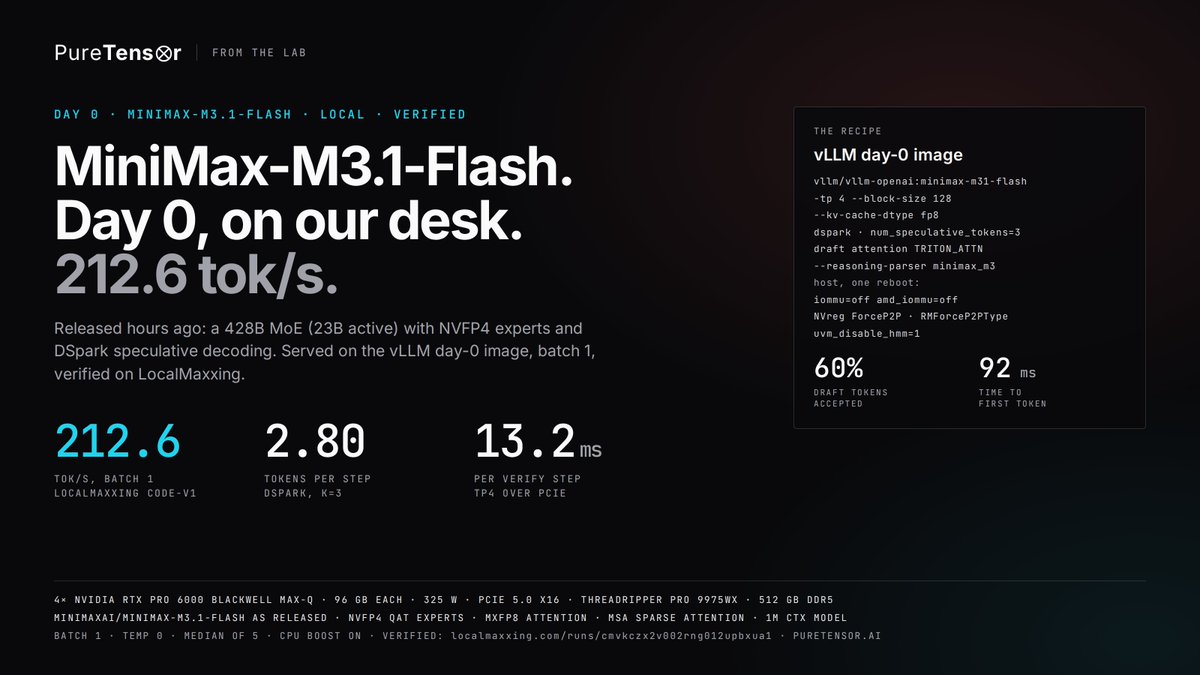
MiniMax-M3.1-Flash, day 0, running local. 212.6 tok/s, batch 1, verified on LocalMaxxing. 428B MoE, NVFP4 experts, DSpark speculative decoding. vLLM day-0 image, TP4 on one workstation. https://t.co/EKAHy6M42I
#MiniMax
#LocalLLM
Dataphile
@Dataphil3
about 1 hour ago
@VaibhavLab
mythos is only for a few selected people
Dataphile
@Dataphil3
about 1 hour ago
@komal_uk01
he is a business man
Dataphile
@Dataphil3
about 1 hour ago
@Greg_GL_87
@xodud_rkd
600gb isnt so bad
Dataphile
@Dataphil3
about 1 hour ago
@shadownet1337
@deepseek_ai
@Google
yes they set the stage for the AI era, yet they didnt break out the chatbots and have been lagging on the frontier, but are making a big comeback now. they have all the ingredients for major Ai dominane
Dataphile
@Dataphil3
about 14 hours ago
Same box. Same model. Code: 502 tok/s. Prose: 211.
@deepseek_ai
V4.1-Flash-1017, batch 1, one workstation: code lands 6.1 tokens per step (76% of drafts accepted) prose lands 2.1 (39%) step time: 12 vs 10 ms Spec decoding benchmarks measure your prompt.
#DeepSeek
#LocalLLM
See More
Dataphile
@Dataphil3
about 1 hour ago
@alwayspriyesh
Great for deep review
Dataphile
@Dataphil3
about 2 hours ago
@shadownet1337
@deepseek_ai
Remarkable how much
@google
has contributed to Ai research over the years
Dataphile
@Dataphil3
about 2 hours ago
@yangyang_2048
@grok
Is he Ai ?
Dataphile
@Dataphil3
about 2 hours ago
@shadownet1337
@deepseek_ai
Google is lid
Dataphile
@Dataphil3
about 2 hours ago
@blessedofcodes
Toaster
Dataphile
@Dataphil3
about 3 hours ago
@pfernan95dev
0.42$
Dataphile
@Dataphil3
about 3 hours ago
@Gaus450
where in USA? where in Australia?
Dataphile
@Dataphil3
about 3 hours ago
@PeasantSmith
@Blackfrost_AI
Splendid
Dataphile
@Dataphil3
about 4 hours ago
@Blackwellboy
Glorious
Dataphile
@Dataphil3
about 4 hours ago
@Blackwellboy
Glorious !
Dataphile
@Dataphil3
about 4 hours ago
@markfenner
that mug again! I want it in film negative, black with white, instead of white on black.
Dataphile
@Dataphil3
about 4 hours ago
@_jayyy18_13k
pro means TOOBIG for my infra 2T parameters prob
Dataphile
@Dataphil3
about 5 hours ago
@theo
But it’s NOT in the bloody APi
Dataphile
@Dataphil3
about 9 hours ago
@MiaAI_lab
https://t.co/CyXjku90NA
Dataphile
@Dataphil3
about 13 hours ago
MiniMax-M3.1-Flash, day 0, running local. 212.6 tok/s, batch 1, verified on LocalMaxxing. 428B MoE, NVFP4 experts, DSpark speculative decoding. vLLM day-0 image, TP4 on one workstation. https://t.co/EKAHy6M42I
#MiniMax
#LocalLLM
Dataphile
@Dataphil3
about 10 hours ago
@LLMJunky
thats true, yes
Dataphile
@Dataphil3
about 11 hours ago
@karbonx6
We will soon all be
#Eloi
due to
@claudeai
Last Seen Users on Sotwe
LeeHongTrang
Seen from
Vietnam
andyd
Seen from
Italy
curvy mature milf
Seen from
Turkey
Nicolas Meneses
Seen from
Colombia
hasanyani
Seen from
Malaysia
Lady Scarlett’s MeasleCock (GG25)
Seen from
Netherlands
.
Seen from
Malaysia
CUCKOLD KIRAATHANESİ
Seen from
Germany
KHẨU DÂM
Seen from
Vietnam
NestyP312
Seen from
Thailand
Trends for you
1
Ethan
Under 10K tweets
2
Fat Albert
Under 10K tweets
3
Oleshky
Under 10K tweets
4
Good Friday
Under 10K tweets
5
Dolan
Under 10K tweets
6
Hellebuyck
Under 10K tweets
7
Meghan
Under 10K tweets
8
#FridayVibes
Under 10K tweets
9
#LastFourWatched
Under 10K tweets
10
#FursuitFriday
Under 10K tweets
Most Popular Users
1
Elon Musk
@elonmusk
241.5M followers
2
Barack Obama
@barackobama
118.8M followers
3
Cristiano Ronaldo
@cristiano
114.5M followers
4
Donald J. Trump
@realdonaldtrump
111.8M followers
5
Narendra Modi
@narendramodi
107.1M followers
6
Rihanna
@rihanna
98.7M followers
7
NASA
@nasa
92.3M followers
8
Justin Bieber
@justinbieber
91.8M followers
9
KATY PERRY
@katyperry
90M followers
10
Taylor Swift
@taylorswift13
84M followers
11
Lady Gaga
@ladygaga
75.5M followers
12
Virat Kohli
@imvkohli
73.5M followers
13
Kim Kardashian
@kimkardashian
70.9M followers
14
YouTube
@youtube
68.8M followers
15
Neymar Jr
@neymarjr
66.5M followers
16
Bill Gates
@billgates
65.3M followers
17
Selena Gomez
@selenagomez
63.1M followers
18
The Ellen Show
@theellenshow
62.2M followers
19
CNN
@cnn
61.7M followers
20
X
@x
60.7M followers
Olivia
Online
✨
⭐
💫