🌐✨ THE POWER OF COLLECTIVE CREATION ✨🌐
🏛️ Some of the most important things in an ecosystem are never built by a single person.
They emerge when researchers, builders, analysts, creators, developers, and communities contribute their individual pieces to something larger than themselves.
🦅 ✦ 🦅
🎥 What stands out here is not just the video.
It is the process behind it.
An observation became a discussion.
A discussion became research.
Research became collaboration.
And collaboration became something capable of reaching far more people than any one individual could alone.
🦅 ✦ 🦅
⚙️ Every ecosystem has visible contributors.
But it also has countless people working quietly in the background.
The developers.
The researchers.
The document writers.
The idea explorers.
The community members connecting information across many different perspectives.
Most of their work is never seen.
Yet without them, none of the visible outcomes would exist.
🦅 ✦ 🦅
🌱 This is a reminder that progress is rarely an individual achievement.
It is often the result of many minds independently pursuing understanding and then sharing what they discover.
One insight builds upon another.
One contribution strengthens another.
And gradually something larger begins to take shape.
🦅 ✦ 🦅
🙏 A heartfelt thank you to HexJamHex, and to everyone throughout the community who continues building, researching, questioning, testing, documenting, and sharing knowledge.
Not for seeking recognition.
But for helping others see more clearly.
🦅 ✦ 🦅
💭 A moment of reflection for all of us:
What becomes possible when people stop competing for attention...
...and start building understanding together?
The answer may be greater than any of us can create alone.
🦅 ✦ 🦅
⚙️🦅 DPV 🦅⚙️
DataPointVector
Structure Before Emotion.
Alignment Before Action.
Patience Before Momentum.
#DataPointVector #PulseChain #HexJamHex #Community #CollectiveIntelligence
🌐✨ DPV OBSERVATION ✨🌐
Interesting meme.
But beneath the humor lies a real question:
Who funds the future?
🦅 ✦ 🦅
Networks don't survive because of narratives.
They survive because builders, infrastructure, capital, and incentives remain aligned over time.
The most important question is rarely:
"Which chain wins?"
It is:
"Which architecture remains sustainable?"
🦅 ✦ 🦅
⚙️🦅 DPV 🦅⚙️
🦅 THE SHADOW MECHANICS
The Architecture of Hidden Systems
SEASON II - THE ERC-1967 CODEX
🔳 PART 13 - THE ADMIN LAYER
WHO HOLDS THE RIGHT TO REWRITE THE MACHINE?
Dear Observers,
Most people assume power resides where assets are stored.
They follow balances.
They measure liquidity.
They monitor transactions.
They watch what moves.
But architecture asks a different question:
Who decides how the system moves?
🦅 ✦ 🦅
🔐 THE INVISIBLE KEY
Within many upgradeable systems, ownership of assets and ownership of authority are not the same thing.
One controls value.
The other controls behavior.
A wallet may hold billions.
Yet another address may possess the ability to redefine the rules that govern those billions.
The observer sees activity.
The architect searches for authority.
🦅 ✦ 🦅
⚙️ THE RIGHT TO CHANGE
An upgradeable system possesses a paradox.
The system can improve.
The system can evolve.
The system can survive.
But those abilities exist only because someone possesses the right to modify it.
Every improvement begins with authority.
Every authority creates responsibility.
And every responsibility introduces risk.
🦅 ✦ 🦅
🏛️ THE ADMIN PARADOX
The admin layer is often misunderstood.
It does not necessarily create value.
It creates capability.
It does not generate adoption.
It enables adaptation.
It is not the outcome.
It is one of the conditions that make future outcomes possible.
The market celebrates results.
Architecture studies permissions.
🦅 ✦ 🦅
🌑 THE SHADOW OF CONTROL
Most users interact with interfaces.
Most investors interact with narratives.
Most analysts interact with transactions.
Yet beneath those layers exists a deeper reality.
The layer that determines:
Who can upgrade.
Who can replace.
Who can pause.
Who can connect.
Who can redirect.
Who can decide which future becomes possible.
This is where architecture becomes governance.
And governance becomes power.
🦅 ✦ 🦅
🧠 THE CAPABILITY QUESTION
When observers discover an admin layer, they instinctively ask:
❝ Is this dangerous? ❞
A deeper question may be:
❝ What capabilities exist because this layer exists? ❞
Without authority:
No repair.
No upgrade.
No evolution.
Without constraints:
No limits.
No accountability.
No protection.
Resilient systems balance both.
Capability and restraint.
Authority and responsibility.
Power and discipline.
🦅 ✦ 🦅
♟️ THE CHESSBOARD
The beginner studies pieces.
The strategist studies positions.
The architect studies rules.
Because pieces move within rules.
And rules determine what movements become possible.
The admin layer rarely attracts attention.
Yet it may define the entire game.
Not by moving pieces directly.
But by determining the architecture within which every move occurs.
🦅 ✦ 🦅
🌐 THE DEEPEST DISTINCTION
Most people ask:
❝ Who owns the assets? ❞
Architects ask:
❝ Who owns the authority? ❞
Ownership describes the present.
Authority influences the future.
This distinction changes everything.
🦅 ✦ 🦅
💭 DPV REFLECTION
When a system evolves...
Are we witnessing the intelligence of the machine?
Or the authority of the layer allowed to change it?
The answer may reveal where power truly resides.
🦅 ✦ 🦅
🔑 DPV KEYS
🦅 Assets hold value.
🦅 Authority governs behavior.
🦅 Upgradeability creates capability.
🦅 Capability requires responsibility.
🦅 Governance determines direction.
🦅 Permissions shape possibility.
🦅 Architecture precedes outcomes.
🦅 The deepest power often exists beneath visibility.
🦅 The admin layer may be the most important layer nobody studies.
🦅 ✦ 🦅
⚙️🦅 DPV 🦅⚙️
DataPointVector
Structure Before Emotion.
Alignment Before Action.
Patience Before Momentum.
🦅 THE SHADOW MECHANICS
The Architecture of Hidden Systems
SEASON II - THE ERC-1967 CODEX
🔳 PART 13 - THE ADMIN LAYER
WHO HOLDS THE RIGHT TO REWRITE THE MACHINE?
🦅 ✦ 🦅
Most people ask:
"Who owns the assets?"
Architects ask:
"Who owns the authority?"
🦅 ✦ 🦅
Assets describe the present.
Authority influences the future.
An address may hold value.
An admin layer may define what that value can become tomorrow.
🦅 ✦ 🦅
The market watches balances.
Architecture studies permissions.
🦅 ✦ 🦅
🔽 For those who wish to explore deeper, the full DPV Perspective continues below.
⚙️🦅 DPV 🦅⚙️
#DataPointVector #ShadowMechanics #ERC1967 #AdminLayer #SystemControl
🌐✨ THE POWER OF COLLECTIVE CREATION ✨🌐
🏛️ Some of the most important things in an ecosystem are never built by a single person.
They emerge when researchers, builders, analysts, creators, developers, and communities contribute their individual pieces to something larger than themselves.
🦅 ✦ 🦅
🎥 What stands out here is not just the video.
It is the process behind it.
An observation became a discussion.
A discussion became research.
Research became collaboration.
And collaboration became something capable of reaching far more people than any one individual could alone.
🦅 ✦ 🦅
⚙️ Every ecosystem has visible contributors.
But it also has countless people working quietly in the background.
The developers.
The researchers.
The document writers.
The idea explorers.
The community members connecting information across many different perspectives.
Most of their work is never seen.
Yet without them, none of the visible outcomes would exist.
🦅 ✦ 🦅
🌱 This is a reminder that progress is rarely an individual achievement.
It is often the result of many minds independently pursuing understanding and then sharing what they discover.
One insight builds upon another.
One contribution strengthens another.
And gradually something larger begins to take shape.
🦅 ✦ 🦅
🙏 A heartfelt thank you to HexJamHex, and to everyone throughout the community who continues building, researching, questioning, testing, documenting, and sharing knowledge.
Not for seeking recognition.
But for helping others see more clearly.
🦅 ✦ 🦅
💭 A moment of reflection for all of us:
What becomes possible when people stop competing for attention...
...and start building understanding together?
The answer may be greater than any of us can create alone.
🦅 ✦ 🦅
⚙️🦅 DPV 🦅⚙️
DataPointVector
Structure Before Emotion.
Alignment Before Action.
Patience Before Momentum.
#DataPointVector #PulseChain #HexJamHex #Community #CollectiveIntelligence
🦅 THE SHADOW MECHANICS
The Architecture of Hidden Systems
SEASON II - THE ERC-1967 CODEX
🆔 PART 12 - IDENTITY VS IMPLEMENTATION
Why An Address Can Remain The Same While Behavior Changes.
Dear Observers,
Most people believe identity is defined by appearance.
In blockchain systems, appearance often takes the form of an address.
It is the destination everyone recognizes.
The reference point explorers display.
The location integrations trust.
The coordinate around which liquidity, history, and reputation accumulate.
The address appears permanent.
The address appears familiar.
The address appears unchanged.
But identity and behavior are not the same thing.
🦅 ✦ 🦅
🏛️ THE ILLUSION OF CONTINUITY
Humans instinctively trust continuity.
When something looks the same, we assume it remains the same.
The same account.
The same contract.
The same address.
The same system.
Yet architecture often operates according to a different rule:
Continuity of appearance does not guarantee continuity of function.
A door can remain unchanged while the building behind it is completely redesigned.
🦅 ✦ 🦅
⚙️ THE TWO IDENTITIES
Within upgradeable architectures, two identities emerge.
The first is the identity observers see.
The second is the identity the system executes.
One is public.
One is operational.
One creates recognition.
One creates behavior.
The observer often studies the visible identity.
The architect studies the operational identity.
And the distance between those two perspectives can become enormous.
🦅 ✦ 🦅
🔄 THE PARADOX OF EVOLUTION
This is what makes proxy architecture so fascinating.
A system can evolve without relocating.
A system can transform without migrating.
A system can become something new while preserving the appearance of something familiar.
The address remains.
The memory remains.
The relationships remain.
Yet the logic interpreting reality may be completely different.
The machine survives.
The mind changes.
🦅 ✦ 🦅
🗄️ MEMORY NEVER STARTS OVER
The most profound aspect of upgradeable systems is not the upgrade.
It is inheritance.
New logic does not arrive in an empty world.
It enters a world already filled with history.
Balances.
Permissions.
Relationships.
Behaviors.
Consequences.
Every implementation inherits the memory of those before it.
The future arrives carrying the weight of the past.
🦅 ✦ 🦅
🌑 THE SHADOW OF ASSUMPTION
This is where many observers become trapped.
They monitor the address.
They monitor the balance.
They monitor the public interface.
But they fail to ask:
"What is actually executing underneath?"
The greatest changes in a system do not always occur where everyone is looking.
Sometimes the visible layer exists specifically to preserve familiarity while transformation occurs elsewhere.
🦅 ✦ 🦅
🔐 THE DEEPER LESSON OF 1967
The most valuable lesson emerging from recent research may not be about any specific wallet, protocol, or theory.
It is about evidence itself.
A convincing narrative is not the same thing as a verified relationship.
A coherent architecture is not the same thing as an operational architecture.
A compatible component is not the same thing as a connected component.
Just as a familiar address may conceal changing logic...
A compelling story may conceal an unverified connection.
The observer must therefore learn to separate:
What is visible.
What is plausible.
What is compatible.
And what is proven.
🦅 ✦ 🦅
🧠 THE IDENTITY PROBLEM
Identity is ultimately a question of definition.
Is a system defined by:
Its address?
Its history?
Its implementation?
Its authority?
Its behavior?
Or the mechanisms that determine what it may become tomorrow?
Perhaps the deepest answer is this:
Identity exists where continuity and control intersect.
Everything else is appearance.
🦅 ✦ 🦅
👑 THE HIDDEN CENTER OF POWER
Many believe the implementation is the most important layer.
Others believe the proxy is the most important layer.
But neither may be true.
The deepest layer is often authority itself.
Who decides which implementation becomes active?
Who controls the future behavior of the machine?
Who possesses the ability to redefine reality while preserving identity?
This is where technology becomes governance.
And governance becomes power.
🦅 ✦ 🦅
🔭 THE OBSERVER'S DISCIPLINE
The mature observer learns to ask different questions.
Not:
"What is this address?"
But:
"What currently defines its behavior?"
Not:
"Does this narrative make sense?"
But:
"Which relationships can be independently verified?"
Not:
"What appears connected?"
But:
"What evidence demonstrates an actual connection?
The deeper the architecture becomes, the more important these distinctions become."
🦅 ✦ 🦅
💭 DPV REFLECTION
If an address can remain the same while its behavior evolves...
Could the greatest transformations in a system occur without visible movement at all?
And if identity survives every upgrade...
What is identity truly made of?
The address?
The memory?
The implementation?
Or the authority that shapes what comes next?
🦅 ✦ 🦅
🔑 DPV KEYS
🆔 Identity is not behavior.
⚙️ Implementation defines execution.
🗄️ Storage preserves memory.
🔄 Continuity does not eliminate change.
👑 Authority governs transformation.
🔐 Compatibility does not prove connection.
🔍 Narratives explain possibilities.
✅ Evidence verifies reality.
The visible address may remain unchanged.
The invisible machine may become something entirely new.
🦅 ✦ 🦅
⚙️🦅 DPV 🦅⚙️
DataPointVector
Structure Before Emotion.
Alignment Before Action.
Patience Before Momentum.
#DataPointVector #ShadowMechanics #ERC1967 #ProxyArchitecture #SystemIdentity
🌐✨ THE DIFFERENCE BETWEEN A MOVE AND A POSITION ✨🌐
♟️ Strong observers do not focus on a single piece.
They study the position created by all the pieces together.
🦅 ✦ 🦅
⚙️ A new route matters.
A new listing matters.
A new liquidity corridor matters.
But their true significance cannot be measured in isolation.
Every move changes the possibilities available to the entire board.
🦅 ✦ 🦅
👁️ What I appreciate about this perspective is the willingness to separate observation from conclusion.
The move is real.
The pathway is real.
The expanded possibility is real.
The final outcome remains unwritten.
🦅 ✦ 🦅
🏛️ Strategic thinking begins when we stop asking:
"What does this move mean?"
And start asking:
"How does this move change the position?"
Because systems evolve through interaction.
Not through isolated events.
🦅 ✦ 🦅
🌊 Capital flows.
Liquidity depth.
Adoption.
Behavior.
These are the pieces that will eventually reveal whether the move was merely interesting...
...or genuinely transformative.
🦅 ✦ 🦅
🌑 The strongest analysts rarely claim certainty.
They observe how each development alters the landscape of possibilities.
Then they wait patiently for reality to reveal its weight.
🦅 ✦ 🦅
💭 A moment of reflection for all of us:
Are we watching individual moves...
...or are we learning to understand the position they create together?
Because a move changes a moment.
A position shapes the future.
🦅 ✦ 🦅
⚙️🦅 DPV 🦅⚙️
DataPointVector
Structure Before Emotion.
Alignment Before Action.
Patience Before Momentum.
#DataPointVector #PulseChain #Strategy #Liquidity #SystemArchitecture
Another piece just moved on the board. ♟️
Most people will read this and see:
“LibertySwap added $pDAI and $pWBTC.”
I see something much bigger.
ACCESS.
Capital sitting on Ethereum, Base, BNB Chain and Arbitrum can now find a direct route toward two of the assets sitting inside the PulseChain rabbit hole.
$pDAI isn't being isolated.
More roads are being built TO it.
And that's exactly what I've been watching:
liquidity → access → interoperability → privacy → settlement
One piece at a time.
Chess isn't won by staring at the King.
You study the entire board.
Where can capital enter?
Where can it move?
Where is liquidity forming?
Which pieces are being connected?
And what happens when all those routes finally meet?
Maybe $pDAI reaches $1.
Maybe it doesn't.
I'm not here to force the conclusion.
I'm watching the architecture being positioned around it.
THINK. ANALYZE. STRATEGY.
♟️ The market watches the price.
I watch the board.
$pDAI 🟣
@LibertySwapFi
The game is getting interesting.
🌐✨ THE PATIENCE OF FOUNDATIONS ✨🌐
🏛️ Every enduring system begins as an act of conviction.
Long before recognition.
Long before validation.
Long before the majority considers it important.
🦅 ✦ 🦅
🌱 Foundations are rarely exciting while they are being laid.
The excitement usually arrives later.
After the structure becomes visible.
After the network effects emerge.
After the decisions made in obscurity begin producing consequences.
🦅 ✦ 🦅
⚙️ What fascinates me most about emerging ecosystems is not their current valuation.
It is their ability to continue developing through indifference.
Because persistence reveals something speculation cannot:
Commitment.
🦅 ✦ 🦅
🔥 Conviction is easy when momentum is abundant.
Conviction becomes meaningful when progress depends on patience.
The builders continue.
The researchers continue.
The believers continue.
Not because outcomes are guaranteed.
Because the mission remains worthwhile.
🦅 ✦ 🦅
🌑 Many of history's most important transitions shared one characteristic:
The future was visible to a few long before it became obvious to many.
The challenge was never seeing the possibility.
The challenge was remaining present long enough to witness its unfolding.
🦅 ✦ 🦅
💭 A moment of reflection for all of us:
Are we investing in attention...
...or are we investing in foundations?
Because attention can move overnight.
Foundations shape what survives for decades.
🦅 ✦ 🦅
⚙️🦅 DPV 🦅⚙️
DataPointVector
Structure Before Emotion.
Alignment Before Action.
Patience Before Momentum.
#DataPointVector #PulseChain #Conviction #Builders #LongTermThinking
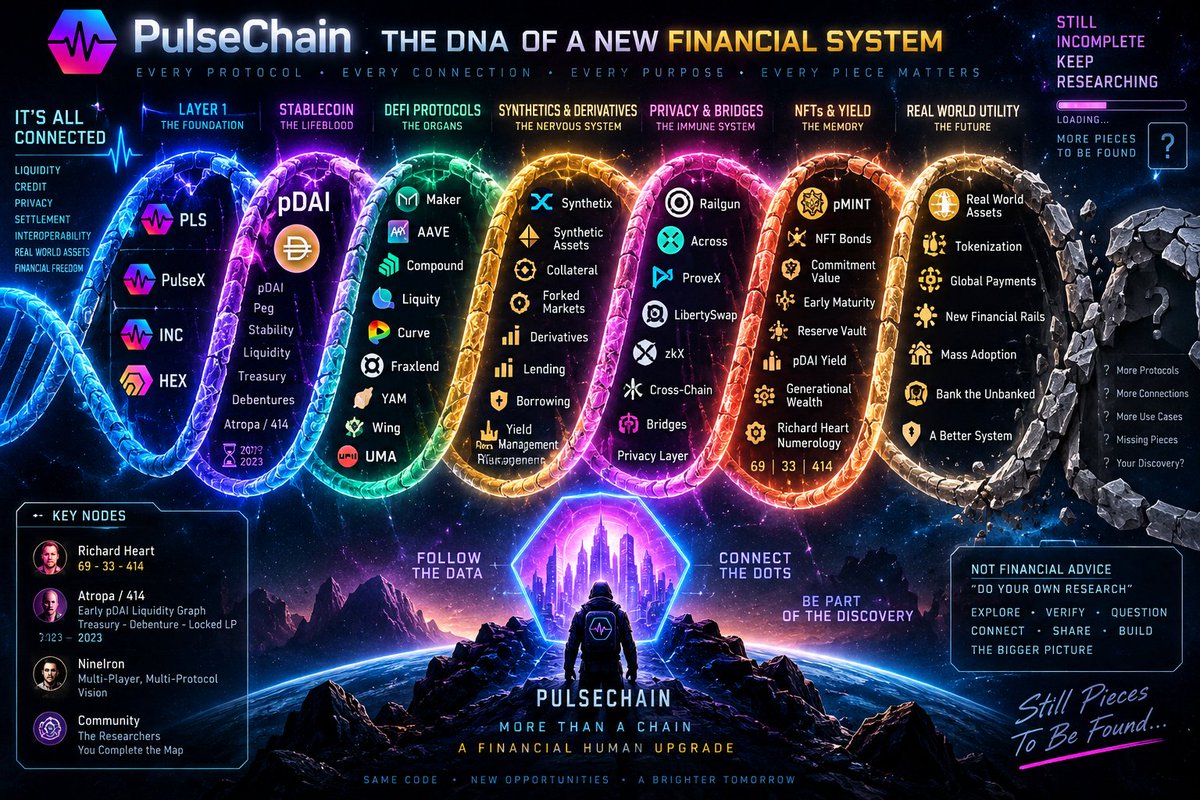
PulseChain might not be a collection of random protocols.
It may be a financial DNA strand that is still being assembled.
I started with pDAI.
Then the trail kept expanding:
Maker. AAVE. Compound. Liquity. Curve. Fraxlend. YAM. Wing. UMA. Synthetix. Across. Railgun. ProveX. LibertySwap. zkX. pMINT. Atropa / 414.
Liquidity.
Credit.
Privacy.
Settlement.
Synthetic assets.
NFT bonds.
Cross-chain infrastructure.
Real-world utility.
Some connections are visible.
Some are only hypotheses.
And some pieces are still missing.
That is exactly why the DNA in this image is broken.
I am not claiming the entire map is solved.
I am saying:
LOOK AT THE CONNECTIONS.
Follow the contracts.
Follow the liquidity.
Follow the wallets.
Follow the builders.
Follow the timestamps.
Follow the numbers.
69.
33.
414.
Ask yourself why old Ethereum financial infrastructure is still being touched on PulseChain.
Ask why pDAI keeps appearing in the middle of the rabbit hole.
Ask why pMINT is being built around it.
Ask why so many pieces appear to point toward:
liquidity → credit → privacy → settlement → interoperability → real-world finance
Maybe I am looking at disconnected experiments.
Or maybe I am watching the DNA of a new financial system being assembled in public.
The map is incomplete.
Good.
That means there is still something left to discover.
🔎 Zoom in. Verify everything. Find the missing pieces.
#PulseChain #pDAI #pMINT #HEX #DeFi #Crypto #Blockchain
🌐✨ THE DIFFERENCE BETWEEN VISIBILITY AND VALUE ✨🌐
👁️ History rarely rewards what receives the most attention.
It often rewards what continues developing while attention is looking elsewhere.
🦅 ✦ 🦅
⚖️ Visibility and value are not the same thing.
A system can be highly visible and structurally weak.
A system can be largely ignored and structurally strong.
The market frequently confuses the two.
🦅 ✦ 🦅
🏛️ The deeper question is not whether PulseChain is overlooked.
The deeper question is why some forms of infrastructure attract capital immediately...
...while other forms of infrastructure require time before their importance becomes visible.
🦅 ✦ 🦅
🌑 Every architecture carries a philosophy.
Some architectures optimize for integration with existing structures.
Others optimize for sovereignty, self-custody, and independent participation.
Neither path guarantees success.
But they produce fundamentally different outcomes over time.
🦅 ✦ 🦅
⚙️ What makes PulseChain interesting to many observers is not simply technology.
It is the continued pursuit of an idea:
That individuals should increasingly control their own assets, transactions, and participation without unnecessary intermediaries.
Whether the market fully appreciates that today is a separate question.
🦅 ✦ 🦅
🌱 The strongest ecosystems are often built during periods when recognition is scarce.
Builders continue building.
Researchers continue researching.
Communities continue learning.
And layer by layer, structure accumulates beneath the surface.
🦅 ✦ 🦅
💭 A moment of reflection for all of us:
Are we measuring a network by the attention it receives today...
...or by the principles it continues to pursue while attention is elsewhere?
The answer may reveal the difference between popularity and significance.
🦅 ✦ 🦅
⚙️🦅 DPV 🦅⚙️
DataPointVector
Structure Before Emotion.
Alignment Before Action.
Patience Before Momentum.
#DataPointVector #PulseChain #FinancialSovereignty #SelfCustody #SystemArchitecture
⚡ THE PLAN ⚡
What if PulseChain is being overlooked for a reason? 👀
BlackRock, Vanguard, and Wall Street are moving deeper into Ethereum. If traditional finance is moving on-chain, do they really want true decentralisation—or simply blockchain infrastructure they can influence and control?
That’s what makes PulseChain interesting.
Richard has spent years promoting self-custody, censorship resistance, and the removal of unnecessary middlemen. PulseChain was built around those principles.
Yet Ethereum receives most of the attention, while PulseChain is barely mentioned.
Perhaps larger players understand what is being built, but have little incentive to promote an ecosystem they cannot easily control.
Richard is continuing Satoshi's vision, ultimately financial sovereignty.
When liquidity returns and the market wakes up,
PulseChain will be significantly revalued. 🏒
Hi my friend,
The more I studied the data, the more I found myself arriving at many of the same distinctions and conclusions you've been describing.
Especially the separation between infrastructure, evidence, hypothesis, and outcome.
The recent updates only strengthened that view.
That's one reason I found your work so valuable throughout this process.
⚙️🦅 DPV 🦅⚙️
🦅 THE SHADOW MECHANICS
The Architecture of Hidden Systems
SEASON II - THE ERC-1967 CODEX
🔳 PART 11 - THE PROXY
WHY THE CONTRACT YOU SEE MAY NOT BE THE LOGIC YOU USE
Dear Observers,
Most people believe a contract address reveals the machine.
They inspect the address.
They examine the balance.
They follow the transactions.
They assume the visible contract contains the logic governing every interaction.
But within proxy architecture, visibility can become an illusion.
The address you see may be only the entrance.
The logic you use may exist somewhere else.
🦅 ✦ 🦅
🚪 THE PERMANENT DOOR
A proxy can remain at the same address while forwarding execution to a separate implementation contract.
The entrance remains visible.
The stored state remains attached.
The user continues interacting with the same destination.
Yet the behavior may come from code located behind that destination.
The proxy appears to be the machine.
In reality, it may be the doorway through which the machine is reached.
🦅 ✦ 🦅
🔄 THE DELEGATED REALITY
The proxy receives the call.
The implementation defines the response.
One preserves continuity.
The other provides behavior.
This separation creates a system with two identities.
The public identity that users recognize.
The operational identity that determines what the system can do.
Most observers monitor the first.
Architects investigate the second.
🦅 ✦ 🦅
🧩 THE INVISIBLE LOGIC
The implementation contract may hold the instructions.
The proxy may hold the history.
Balances remain.
Storage remains.
Relationships remain.
But the logic interpreting that memory can change.
This creates one of the deepest paradoxes in programmable systems:
The structure can remain recognizable while its behavior evolves.
The address survives.
The machinery behind it changes.
🦅 ✦ 🦅
⚖️ THE TRUST QUESTION
A familiar address can create psychological certainty.
Users recognize it.
Applications integrate it.
Liquidity surrounds it.
History gives it credibility.
But continuity of address does not automatically mean continuity of logic.
A system should not be understood only by asking:
❝ Which contract am I interacting with? ❞
The deeper questions are:
❝ Which implementation is currently active? ❞
❝ Who can replace it? ❞
❝ What authority exists behind the visible interface? ❞
🦅 ✦ 🦅
🏛️ THE ARCHITECTURAL ADVANTAGE
Proxy architecture can allow a system to evolve without abandoning its existing identity.
Logic can be repaired.
Functions can be extended.
Connections can be introduced.
The external address can remain unchanged.
This can preserve continuity across users, integrations and stored state.
But every architectural advantage creates a corresponding responsibility.
The ability to upgrade becomes the ability to redefine behavior.
The power to repair becomes the power to rewrite.
🦅 ✦ 🦅
🌑 THE SHADOW LAYER
The deepest power may not reside in the contract holding the assets.
It may reside in the mechanism selecting the logic.
The proxy is visible.
The implementation is discoverable.
But authority exists one layer deeper.
Behind the interface.
Behind the implementation.
Behind the promise of continuity.
This is where technical architecture becomes governance architecture.
And governance architecture becomes power.
🦅 ✦ 🦅
🔐 THE ERC-1967 CODE
ERC-1967 gives observers a standardized path into this hidden structure.
The implementation layer reveals which logic is active.
The admin layer reveals where upgrade authority may exist.
The beacon layer can reveal another source from which implementations are selected.
These are not minor technical details.
They are the coordinates of control.
To understand the proxy, the observer must study what the interface does not immediately reveal.
🦅 ✦ 🦅
⚙️ CAPABILITY BEFORE OUTCOME
Most people study outcomes.
Architects study capability.
Before a system can scale...
It must first be capable.
Before capability can emerge...
Architecture must exist.
The proxy is not the outcome.
The proxy is part of the condition that makes future outcomes possible.
This distinction changes everything.
Architecture creates capability before it creates outcomes.
🦅 ✦ 🦅
💭 DPV REFLECTION
When a contract address remains unchanged...
Are users still interacting with the same system?
Or are they interacting with a preserved identity whose internal behavior can continue to evolve?
The answer is not found at the front door.
It is found in the architecture behind it.
🦅 ✦ 🦅
🔑 DPV KEYS
🦅 The proxy preserves continuity.
🦅 The implementation defines behavior.
🦅 Storage preserves history.
🦅 Upgrade authority governs change.
🦅 A familiar address does not guarantee familiar logic.
🦅 Upgradeability creates adaptability.
🦅 Upgrade authority creates responsibility.
🦅 Architecture creates capability before it creates outcomes.
🦅 The visible contract may be only the entrance.
🦅 ✦ 🦅
⚙️🦅 DPV 🦅⚙️
DataPointVector
Structure Before Emotion.
Alignment Before Action.
Patience Before Momentum.
#DataPointVector #ShadowMechanics #ERC1967 #ProxyArchitecture #SystemControl
🌐✨ THE FIRE THAT SURVIVES THE TRENCHES ✨🌐
❤️🔥 The deepest communities are not built during the bull market.
They are revealed during the difficult seasons.
When excitement fades.
When prices disappoint.
When conviction is tested.
And people still choose to remain.
🦅 ✦ 🦅
🌱 Anyone can celebrate a vision when everything moves upward.
The real question is:
Who continues building when progress feels slow?
Who continues showing up when nobody is applauding?
Who continues believing when certainty disappears?
🦅 ✦ 🦅
🏛️ Every ecosystem is ultimately built by two forces.
Technology creates possibility.
People create continuity.
Without builders, infrastructure remains unused.
Without community, innovation remains unnoticed.
Together, they transform ideas into living systems.
🦅 ✦ 🦅
🌑 What I've always appreciated about PulseChain is that beneath the charts, narratives, and daily market noise, there remains a group of people who continue creating, learning, teaching, helping, and building.
Not because it is easy.
Because they believe something worthwhile takes time.
🦅 ✦ 🦅
⚙️ The strongest networks are not held together by price.
They are held together by shared purpose.
Price can attract attention.
Purpose sustains momentum.
And momentum built on purpose often survives storms that speculation cannot.
🦅 ✦ 🦅
💚 A sincere thank you to everyone who continues contributing in their own way.
The educators.
The builders.
The researchers.
The creators.
The supporters.
The people still showing up.
Every contribution becomes part of a story larger than any individual participant.
🦅 ✦ 🦅
💭 A moment of reflection for all of us:
Perhaps the true measure of a community is not how it behaves when everything goes right...
...but what it chooses to become while moving through adversity together.
🦅 ✦ 🦅
⚙️🦅 DPV 🦅⚙️
🌐✨ THE EVOLUTION OF THE USER LAYER ✨🌐
🦊 Having used and tested many wallets over the years, what stands out to me is not any single feature.
It is the direction of development.
🦅 ✦ 🦅
⚙️ Great infrastructure only reaches its full potential when ordinary users can access it without unnecessary friction.
The strongest protocols are often invisible.
The best tools make complexity feel simple.
🦅 ✦ 🦅
🔐 Smart Accounts.
⛽ Gas abstraction.
🛡️ Privacy layers.
🔄 Seamless swapping.
Each feature may appear small on its own.
Together they begin to change the user experience itself.
🦅 ✦ 🦅
🌑 The deeper story is not about a wallet.
It is about reducing the distance between powerful blockchain infrastructure and the people using it.
Every removed point of friction expands participation.
Every improvement expands accessibility.
Every layer of simplicity unlocks another layer of adoption.
🦅 ✦ 🦅
🚀 This is one reason many of us remain excited about PulseChain.
Not because development has stopped.
But because builders continue pushing forward.
Infrastructure.
Liquidity.
Privacy.
User experience.
One layer at a time.
🦅 ✦ 🦅
💭 A moment of reflection for all of us:
The future of crypto may not belong to the most complex tools...
...but to the tools that allow powerful systems to feel effortless.
🦅 ✦ 🦅
⚙️🦅 DPV 🦅⚙️
🌐✨ THE COST OF CERTAINTY ✨🌐
⚖️ Every system makes a trade.
Not between good and bad.
But between different forms of trust.
🦅 ✦ 🦅
🔐 Centralization often offers simplicity.
Decentralization often offers resilience.
One minimizes complexity by concentrating authority.
The other distributes authority so failure becomes harder to contain.
🦅 ✦ 🦅
🏛️ The deepest question is rarely:
"Which chain is better?"
The deeper question is:
"Where does the system expect trust to live?"
In institutions?
In operators?
In federations?
Or in transparent execution and distributed validation?
🦅 ✦ 🦅
🌑 Most people notice security only after a failure becomes visible.
Architects study security before the failure arrives.
Because every architecture eventually reveals the assumptions upon which it was built.
This is one reason many builders remain optimistic about PulseChain.
Not because perfection exists.
But because open execution, public verification, and transparent smart-contract infrastructure create an environment where trust can increasingly move from institutions toward code.
🦅 ✦ 🦅
🧠 A system is ultimately defined by what happens when something goes wrong.
Not when everything works.
Stress reveals structure.
Failure reveals design.
And design reveals philosophy.
🦅 ✦ 🦅
⚙️ The strongest networks are not those that claim uncertainty cannot occur.
They are the ones designed to remain functional when uncertainty eventually arrives.
Resilience is rarely visible during calm conditions.
It becomes visible during stress.
🦅 ✦ 🦅
💭 A moment of reflection for all of us:
When evaluating a network...
Do we focus on today's success?
Or on how the system is designed to behave when tomorrow brings uncertainty?
The answer often matters more than the headline itself.
🦅 ✦ 🦅
⚙️🦅 DPV 🦅⚙️
DataPointVector
Structure Before Emotion.
Alignment Before Action.
Patience Before Momentum.
#DataPointVector #PulseChain #Security #Decentralization #SystemArchitecture
Bitcoin. PulseChain welcomes you. It's just better.
ackthually, its lots and lots better for lots and lots of reasons, but I don't feeling like typing em all
The Architecture of Hidden Systems
🌑 PART 8 - THE ATTENTION TRAP
Why Attention Often Distracts From What Is Essential
Dear Observers,
Attention feels like awareness.
But attention and awareness are not the same thing.
Attention is drawn.
Awareness is chosen.
One reacts to what becomes visible.
The other searches for what remains important even when nobody is looking.
🦅 ✦ 🦅
👁️ THE SPOTLIGHT EFFECT
Every system contains two worlds.
The world that is illuminated.
And the world that is operating.
Most observers confuse the two.
They assume the brightest signal must be the most important signal.
But visibility and significance rarely move together.
The spotlight was never designed to reveal the entire stage.
It was designed to direct the audience toward a specific part of it.
🦅 ✦ 🦅
🎭 THE ECONOMICS OF ATTENTION
Attention is not merely observation.
Attention is a resource.
A finite resource.
Every moment spent watching one signal is a moment unavailable to everything else.
This is why attention has become one of the most valuable currencies in modern systems.
Whoever influences attention influences perception.
Whoever influences perception influences behavior.
And whoever influences behavior influences outcomes.
The architecture of influence therefore begins long before decisions are made.
It begins where attention is directed.
🦅 ✦ 🦅
⚡ THE NOISE ADVANTAGE
Noise possesses a strange advantage over substance.
Noise is immediate.
Substance is gradual.
Noise demands reaction.
Substance demands observation.
Noise creates urgency.
Substance creates understanding.
This is why systems undergoing the greatest transformation are often ignored while they are being built.
The visible events consume attention.
The invisible mechanisms shape the future.
🦅 ✦ 🦅
🏛️ THE ARCHITECT'S PERSPECTIVE
The crowd asks:
"What is everyone talking about?"
The architect asks:
"What continues functioning after everyone stops talking?"
The crowd follows narratives.
The architect studies structures.
Narratives can rise and fall within days.
Structures can influence outcomes for years.
The deepest mechanics are usually quiet.
Not because they are unimportant.
Because they are foundational.
🦅 ✦ 🦅
🌊 THE RIVER BENEATH THE WAVES
Most people observe the wave.
Few observe the river.
The wave is dramatic.
The river is consequential.
Price movement is a wave.
Liquidity structure is a river.
News is a wave.
Incentive design is a river.
Social excitement is a wave.
Infrastructure is a river.
The observer who studies only waves becomes emotional.
The observer who understands rivers begins to see direction.
🦅 ✦ 🦅
🧠 THE ATTENTION PARADOX
The more attention something receives...
The less likely people are to ask why it receives attention at all.
Attention validates itself.
Popularity validates itself.
Repetition validates itself.
And eventually visibility becomes mistaken for truth.
This is the trap.
Not deception.
Not manipulation.
But the unconscious assumption that whatever dominates awareness must also dominate reality.
🦅 ✦ 🦅
🔍 THE SHADOW ZONE
Every important transformation spends time in obscurity.
Before capital flows become obvious.
Before systems become visible.
Before infrastructure becomes appreciated.
Before outcomes become measurable.
There is always a period during which essential developments exist outside collective attention.
This is where the deepest opportunities and the deepest misunderstandings often emerge.
🦅 ✦ 🦅
⚖️ THE OBSERVER'S DISCIPLINE
True observation requires resisting both fascination and dismissal.
Not everything important is visible.
Not everything visible is important.
The observer must therefore develop a different habit:
To investigate what remains structurally relevant regardless of public attention.
Because attention can be purchased.
Attention can be manipulated.
Attention can migrate.
Structure remains.
🦅 ✦ 🦅
💭 DPV REFLECTION
When everyone is looking in the same direction...
What remains unseen behind them?
And if attention suddenly disappeared tomorrow...
Which systems would continue functioning exactly as before?
Those systems may be closer to the truth than the spotlight itself.
🦅 ✦ 🦅
🔑 DPV KEYS
Attention creates visibility.
Visibility does not create importance.
Noise accelerates reaction.
Structure determines outcomes.
Narratives attract observers.
Architecture shapes reality.
The crowd follows the spotlight.
The architect studies the machinery powering it.
🦅 ✦ 🦅
⚙️🦅 DPV 🦅⚙️
DataPointVector
Structure Before Emotion.
Alignment Before Action.
Patience Before Momentum.
#DataPointVector #ShadowMechanics #AttentionTrap #SystemArchitecture #BehavioralDynamics
🌐✨ THE DIFFERENCE BETWEEN A STORY AND A SYSTEM ✨🌐
⚖️ One of the most valuable observations in this analysis is the separation of possibility from proof.
Too often, markets collapse multiple stages of development into a single conclusion.
A corridor becomes a peg.
Infrastructure becomes redemption.
Potential becomes certainty.
🦅 ✦ 🦅
🏗️ But systems emerge layer by layer.
First the routes.
Then the liquidity.
Then the incentives.
Then the behavior.
Only afterwards do outcomes reveal themselves.
🦅 ✦ 🦅
🔍 The deeper lesson may not be about pDAI at all.
It may be about understanding the difference between what is being built...
...and what has already been achieved.
Those are not the same thing.
🦅 ✦ 🦅
🌑 Architecture operates in silence long before results become visible.
Most observers notice the destination.
Few study the roads being constructed underneath it.
Yet every destination depends on roads that existed first.
🦅 ✦ 🦅
💭 A moment of reflection for all of us:
When we observe a system evolving...
Are we looking at the outcome?
Or are we looking at the conditions from which the outcome may eventually emerge?
The distinction changes everything.
🦅 ✦ 🦅
⚙️🦅 DPV 🦅⚙️
DataPointVector
Structure Before Emotion.
Alignment Before Action.
Patience Before Momentum.
#DataPointVector #pDAI #PulseChain #StableSwap #SystemArchitecture
🌐✨ THE TRUE POWER OF A COMMUNITY ✨🌐
🤝 Sometimes the biggest milestones are not built by protocols.
They are built by people.
One conversation.
One connection.
One helping hand at a time.
🦅 ✦ 🦅
🌱 What stands out here is not the tablets themselves.
It is the path they traveled.
A request became a conversation.
A conversation became coordination.
And coordination became action.
🦅 ✦ 🦅
🔗 Great communities are not measured by how loudly they celebrate success.
They are measured by how naturally they support each other while building it.
One person asks.
Another connects.
Another contributes.
Another delivers.
The network moves as one.
🦅 ✦ 🦅
⚙️ This is the hidden mechanics of every growing ecosystem.
Trust becomes cooperation.
Cooperation becomes momentum.
Momentum becomes opportunity.
And opportunity spreads further than any individual can reach alone.
🦅 ✦ 🦅
🙏 A heartfelt thank you to everyone involved in making this happen.
Not only to those who contributed directly.
But also to those who continue sharing, supporting, educating, building, and helping others along the way.
Every contribution strengthens the network.
🦅 ✦ 🦅
💭 A moment of reflection for all of us:
Perhaps the true value of a community is not what it owns...
...but what it becomes capable of creating together.
🦅 ✦ 🦅
⚙️🦅 DPV 🦅⚙️
DataPointVector
Structure Before Emotion.
Alignment Before Action.
Patience Before Momentum.
#DataPointVector #PulseChain #Community #NetworkEffect #PulseChainFamily
A special thank you goes out to my Pulsechain family. I have been wanting some tablets to pass out to wealthy clients. I reached out to @CountSacula369 who asked @AWildSJ then to @EcoBuildr ultimately to @Cryptorigga88 . @Cryptorigga88 gave me a couple boxes today. I will be able to get these into some good hands starting this next week.. Thank you all! Go Pulsechain!