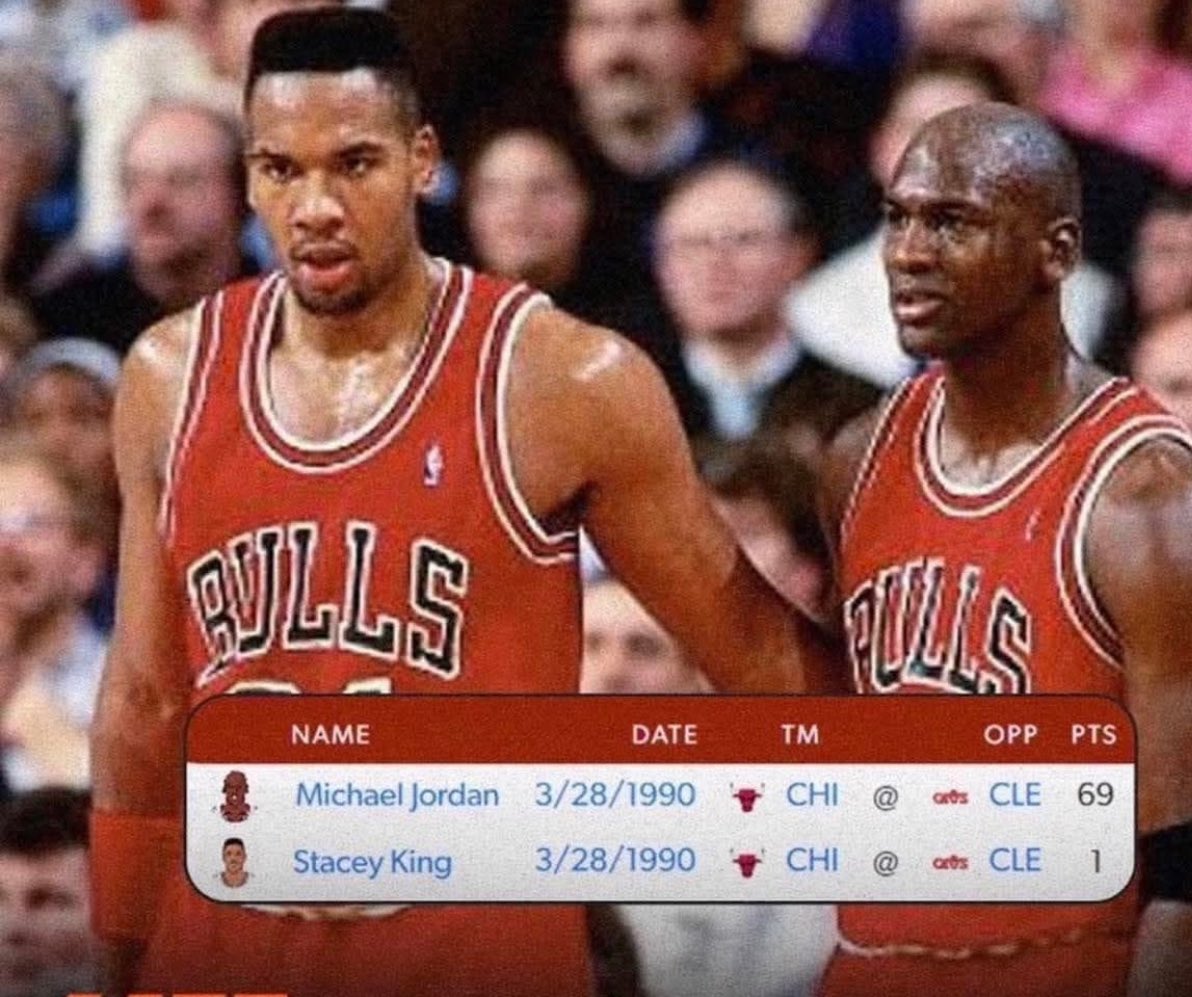
After Michael Jordan scored a career-high 69 points in one game, Stacey King said:
“I'll always remember this as the night that Michael Jordan and I combined to score 70 points"
Amazing sense of humor. Stacey, you will be missed so much.
Data center power consumption is forecast to double by 2030, rising from 448 TWh to 945 TWh, per the UN, with AI accounting for 40% of that total.
$MSFT $META $GOOG $AMZN $NVDA
After shrugging off $AVGO -12.6% on Thursday, the strong jobs report drove the 2yr yld +10bps to the highest levels since early 2025 & S&P -2.6% on Fri. For the wk, S&P/Nas/SOXX/Mag7 were -2.6%/-4.7%/-4.7%/-5.8% despite oil -3% to $91.
This is what I posted on X on last Sunday night “Over the near-term, the overall market at some point will need to take a breather from increasingly overbought technical conditions. After nine straight weekly gains, the S&P is now up 19% from its recent closing low on March 30th. But I feel like any losses will be contained to the typical ~5% pullback which is typically seen three to four times per year.”
After being up for nine straight weeks, the S&P went from an all-time closing high on Tuesday June 2nd and 14-day RSI of 75 to an RSI of 49 on Friday June 5th and down 3.0% from that Tuesday level.
During the internet infrastructure buildout between December 31, 1994 and the peak on March 10, 2000, the S&P tripled, the Nasdaq went up 6.7x and the SOXX Index advanced 9.5x. The S&P during this time had its 14-day RSI cross below 70 (overbought level) fifty times. 36% of the time, that day was the low point before it crossed back above 70 again. 42% of the time the low was reached within 2 trading days and 62% within three days. The average was 10 trading days to hit a short-term low and down 2.5% on average from the overbought level before the advance started to the next overbought reading.
Next week, there will be several potential market moving events. The $AAPL WWDC is on Monday. With the stock price surge into this event, a sell the news reaction would not be surprising much like with recent tech results. But I am bullish longer-term given after a 2 year wait we should finally get an AI infused iPhone. I am also very bullish on the larger form factor of a foldable phone that has driven major upgrade cycles in the past. Samsung introduced a foldable in 2019.
CPI on Wednesday will be closely watched along with how bond yields react. $ORCL results are also that day which should be solid given recent commentary from major customer OpenAI as well as related hyper-scaler cloud results. Having said that, a new CFO may want to set very achievable initial FY27 guidance that could disappoint.
The ECB is likely to raise rates on Thursday since being on hold after cutting rates in June of 2025 to 2.0%. Commentary will likely set the bar for the Fed in the following week.
Over the long-term I remain bullish given: 1) S&P earnings are expected to increase 25% this year driven by the advent of Agentic AI, 2) I believe oil prices will come down to the $80ish level given the political toll it is extracting on the US administration every day that the Strait of Hormuz is closed, and 3) new Fed Chairman Warsh is likely to push back against calls to raise rates. I view this recent pullback as well needed to work off the recent froth versus marking "the top."
All the best in the week ahead.
SK Hynix Chairman Chey Tae-won believes the memory shortage could continue until 2030, with SK Hynix planning to double its memory wafer capacity over the next five years to help meet demand.
$MU $NVDA $AMD
A $NVDA Rubin Ultra AI Factory rack contains $123,092 worth of power semiconductors. A Hopper rack from 2023 contained $3,888.
That is a 31x increase in four years. Not from higher prices. From a complete architectural overhaul of how electricity moves inside an AI factory.
The old standard was 54 volt DC. Power supply units in each rack converted AC from the grid, stepped it down to 54V, and distributed it through copper busbars to each GPU. That system worked fine at 40 kilowatts per rack.
Rubin Ultra pulls 600 kilowatts. Feynman hits 1 megawatt. At that scale, 54V distribution requires up to 200 kilograms of copper busbar per rack. A single 1-gigawatt AI factory would need 200,000 kilograms of copper just for busbars.
$NVDA's answer is 800 volt DC. AC from the grid is converted once at the facility perimeter and distributed at 800V through the AI factory. This cuts copper requirements by 45% and enables 85% more power through the same conductor size.
I'm putting together a deep report on my favorite names in this space dropping Monday. So keep an eye out.
This is Peter Lynch’s favorite metric and I like it too because it ties valuation to growth. I prefer using a 2026 to 2028 window so the multiple adjusts for how fast the business is actually compounding.
For example $AMD may trade at ~54x forward earnings but earnings are expected to grow from $5.43 in 2026 to $16.24 in 2028 implying a ~73% earnings CAGR and a PEG of ~0.7x.
It is wild to see $META trading at 22x forward P/E with 42% operating margins.
$TSLA 185.2x
$AMZN 33.5x
$AAPL 30.2x
$GOOGL 29.9x
$MSFT 24.5x
$NVDA 24.2x
Elon stating - what I reiterated in my post a few weeks back. US MUST develop domestic expertise in memory manufacturing.
$MU Terrafab
https://t.co/PGcoXDeVsz
CPUs have gone from an afterthought to becoming the AI trade’s next great bottleneck - and with $AMD, $NVDA, $ARM and $INTC circling a market that is doubling nearly overnight, the only question left is which company walks away the leader. ⬇️
https://t.co/iMwKWuJMk3
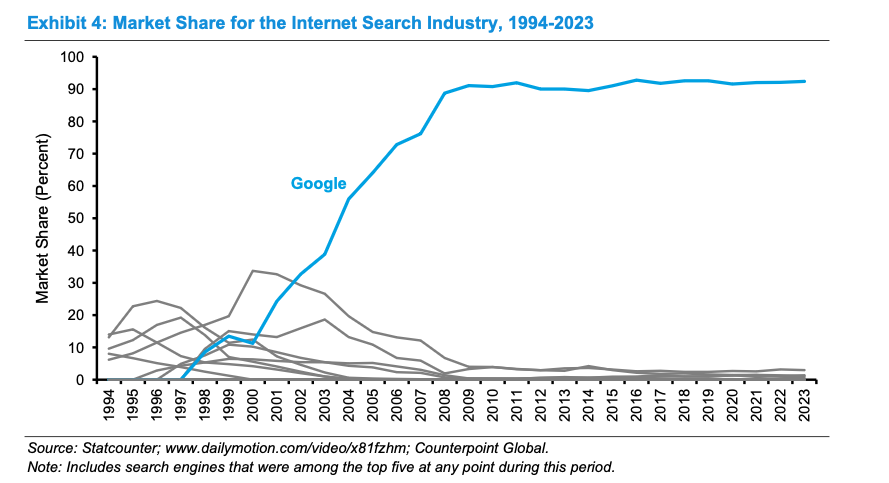
First to market ≠ winner of the market.
We instinctively pay a premium for pioneers, the ones who got there first and planted the flag. History often says the opposite.
$GOOGL runs 90%+ of search today. In the late 1990s it wasn't even in the top five.
Don't buy "the first" just because it's first. An early lead is a weak signal, and the pioneer premium usually evaporates.
Pay for proven economics over the narrative. The marks of a real winner are a steadily high or rising ROIC and a market share that is already consolidating. That shows up in the numbers, not in press releases.
h/t @mjmauboussin
This is how the largest US listed stocks have performed so far in 2026
Nvidia $NVDA +10%🟢
Apple $AAPL +13.1%🟢
Google $GOOGL +17.7%🟢
Microsoft $MSFT -13.8%🔴
Amazon $AMZN +6.6%🟢
Tawian Semi $TSM +36.6%🟢
Broadcom $AVGO +11.5%🟢
Meta Platforms $META -10.2%🔴
Tesla $TSLA -13.1%🔴
Eli Lilly $LLY +5.3%🟢
Berkshire Hathaway $BRK.B -2.9%🔴
Micron $MU +202.7%🟢
Walmart $WMT +6.7%🟢
JPMorgan $JPM -3.1%🔴
$AMD +117.8%🟢