He taught himself how to code with ChatGPT...
Then built 3 iphone apps. Made $10M in revenue.
We called him up and asked him to break it all down. Talked for hours, but cut out all the fluff to give you all the alpha:
– why mobile apps are lucrative right now (2:08)
– $1M business ideas RIGHT NOW (6:43)
– playbook for validating app ideas (8:56)
– must-have tools for building mobile apps (9:42)
– the sweet spot pricing strategy (12:33)
– building $1M apps for $50 bucks (15:35)
– Light a fire under your ass (17:03)
How can Cache Systems go wrong?
The diagram below shows 4 typical cases where caches can go wrong and their solutions.
1. Thunder herd problem
This happens when a large number of keys in the cache expire at the same time. Then the query requests directly hit the database, which overloads the database.
There are two ways to mitigate this issue: one is to avoid setting the same expiry time for the keys, adding a random number in the configuration; the other is to allow only the core business data to hit the database and prevent non-core data to access the database until the cache is back up.
2. Cache penetration
This happens when the key doesn’t exist in the cache or the database. The application cannot retrieve relevant data from the database to update the cache. This problem creates a lot of pressure on both the cache and the database.
To solve this, there are two suggestions. One is to cache a null value for non-existent keys, avoiding hitting the database. The other is to use a bloom filter to check the key existence first, and if the key doesn’t exist, we can avoid hitting the database.
3. Cache breakdown
This is similar to the thunder herd problem. It happens when a hot key expires. A large number of requests hit the database.
Since the hot keys take up 80% of the queries, we do not set an expiration time for them.
4. Cache crash
This happens when the cache is down and all the requests go to the database.
There are two ways to solve this problem. One is to set up a circuit breaker, and when the cache is down, the application services cannot visit the cache or the database. The other is to set up a cluster for the cache to improve cache availability.
Over to you: Have you met any of these issues in production?
–
Subscribe to our weekly newsletter to get a Free System Design PDF (158 pages): https://t.co/eVEdOFSYPY
@imousart Thanks! Yes there is a lot of little thecnical steps to do in the site like sitemaps and site ownership verification and so on. What was your site problem?
@itsalexzajac I dont think that it is a blocker but for me a lot of times i like to know how things work under the hood, and i love math and so on but it can be a rabbit hole hhh.
And there is also a lot of algo and model architectures that adds up fast hhh
פיתוח שרותים שמשתמשים במודלי שפה זה כיף גדול.
אבל רגע, מה עם אבטחה שלהם? יש כל כך הרבה אפשרויות תקיפה. מתי יקרה רגע הצ׳רוקי שלהם? כל זאת ועוד עם גיא, מנהל הפיתוח של החברה
https://t.co/051Swkht2T
@rantav@orilahav @guygrinap @guyg_99
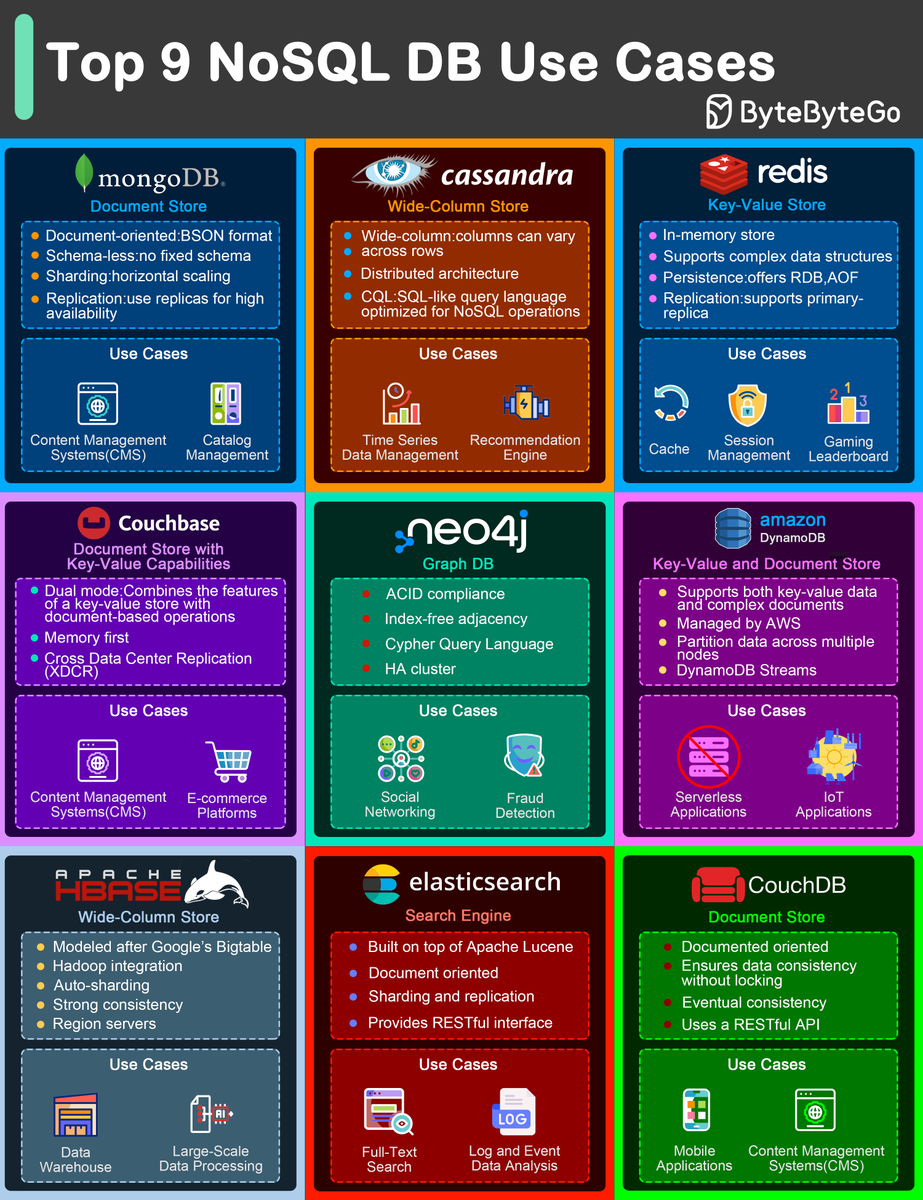
Top 9 NoSQL Database Use Cases
Different databases excel in different areas and it’s important to choose the right database for the requirement.
1 - MongoDB (Document Store)
Used for content management systems and catalog management. Features BSON format, schema-less design, supports horizontal scaling with sharding, and high availability with replication
2 - Cassandra (Wide-column Store)
Ideal for time-series data management and recommendation engines. Offers wide-column format, distributed architecture, and CQL for SQL-like querying.
3 - Redis (Key-Value Store)
Suited for Cache, Session Management, and Gaming Leaderboards. Provides in-memory storage, support for complex data structures, and persistence options with RDB and AOF.
4 - Couchbase (Document Store with Key-Value)
Used for content management systems and e-commerce platforms. Combines key-value and document-based operations with memory-first architecture and cross-data center replication.
5 - Neo4j (Graph DB)
Excellent for social networking and fraud detection. Features ACID compliance, index-free adjacency, Cypher Query Language, and HA cluster capabilities.
6 - Amazon DynamoDB (Key-Value and Document)
Perfect for serverless and IoT applications. Supports both key-value and complex document data, managed by AWS, with features like partition data across nodes and DynamoDB streams.
7 - Apache Hbase (Wide-Column Store)
Used for data warehouse and large-scale data processing. Modeled after Google’s Bigtable, offers Hadoop integration, auto-sharding, strong consistency, and region servers.
8 - Elasticsearch (Search Engine)
Ideal for full-text search and log and event data analysis. Built on Apache Lucene, document-oriented, with sharding and replication capabilities, and a RESTful interface.
9 - CouchDB (Document Store)
Suitable for mobile applications and CMS. Document-oriented, ensures data consistency without locking, supports eventual consistency, and uses a RESTful API.
Over to you: Which other NoSQL database would you add to the list?
--
Subscribe to our weekly newsletter to get a Free System Design PDF (158 pages): https://t.co/eVEdOFSYPY
Your SaaS product didn't fail because you ran out of money.
It failed because you:
→ Didn't validate your idea
→ Didn't prioritize marketing
→ Built without distribution
→ Built for your investors instead of your users.
Stop blaming the lack of funding.
Founders are bootstrapping businesses from nothing all the time.
Cost isn't a barrier anymore.
It's an excuse.