To celebrate 1 month since this @MicroCapClub Club Conversation came out, I'm publishing it here.
In this conversation, @HowardMarksBook shares his insights on investment strategies, the nature of risk, and the impact of market cycles. He discusses the origin of his company, Oak Tree, and elaborates on the concept of risk, emphasizing that it is subjective and tied to the possibility of undesirable outcomes. Marks also explores the upside of bubbles in technology, the implications of Brexit on the UK economy, and the current state of private credit. He provides advice on portfolio structuring, the importance of incentives in organizations, and personal reflections on success and happiness.
Join MicroCapClub and unlock the ability to listen and participate live in these discussions - https://t.co/gD65pI9Ha5
Chapters
00:00 The Origin of Oak Tree Capital
03:19 Understanding Risk
07:23 The Upside of Bubbles
11:29 Market Dynamics and the S&P 500
14:25 Microcap Stocks and Market Cycles
19:23 The Impact of Brexit on the UK Economy
22:50 Risks in Private Credit
25:41 Catching Falling Knives in Investing
31:35 Navigating Financial Crises
34:44 Investment Philosophy and Risk Management
39:03 Asset Allocation Strategies
41:49 Personal Insights and Success Factors
46:01 Quality of Life and Enjoyment
49:50 Building Effective Organizations
54:41 Reflections on Happiness and Legacy
@MicroCapClub just dropped our Club Conversation with @HowardMarksBook, Co-Founder of @Oaktree!
I listened to it 2x already since we recorded this...
📺 https://t.co/3xpaypbvFb
🎧 https://t.co/KzojVRKz8B (or your favourite podcast player)
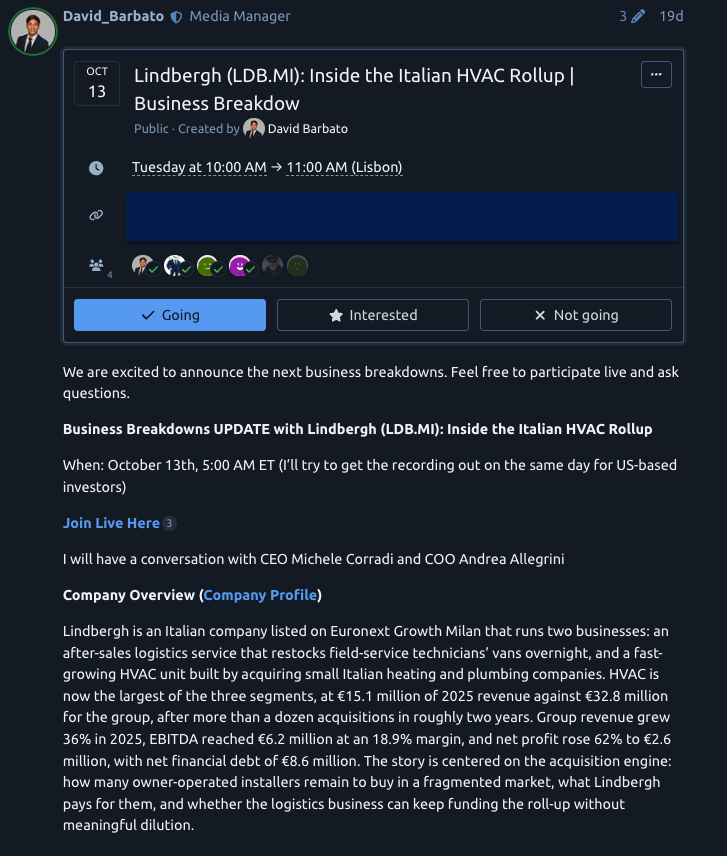
Excited to share my conversation with $LDB.MI
In this @MicroCapClub Business Breakdowns, I sit down with Lindbergh’s ($LDB.MI) CEO Michele Corradi and COO Andrea Allegrini. The company was originally profiled by MicroCapClub member @mavix_leon on October 2nd, 2023, at $2.09 EUR per share.
Michele and Andrea explain how they pay about 4 to 4.5 times EBITDA, mostly through vendor loans that the acquired company’s own cash pays off. They also talk about why they now prefer adding companies in regions where they already operate, and how they find each local manager inside the company they buy. Later they cover the end of Italy’s gas boiler incentives, getting acquired companies to collect cash on time, and the shift toward cooling work in the summer months.
Chapters
00:00 Intro
02:33 From waste pickups to an HVAC roll-up
08:52 First-half results
14:00 Spare parts delivered by 7 a.m.
24:19 How they buy HVAC companies
26:28 Paying with vendor loans
29:53 Q&A begins
32:15 Why deals have slowed down
36:33 Competing with private equity
41:55 What makes a good target
44:30 The case for B2B maintenance contracts
48:15 Raising Alpiclima’s margins
53:44 The job ends when the cash is in the bank
58:13 Italy ends gas boiler incentives
1:01:17 Hotter summers, less seasonality
1:04:37 The next 20 years
@MicroCapClub has decided to open Lindbergh's ($LDB.MI) Business Breakdown to non-MCC members as well.
When: Tuesday, Oct 13th at 11:00 AM CET
Register here: https://t.co/kwdtHgzREd
Max Capacity: 100 people
See you on Tuesday
@TSOH_Investing, is the author of Buffett and Munger Unscripted, a topic-by-topic organization of three decades of Berkshire Hathaway shareholder meetings, and he writes TSOH Investment Research, where he publishes his portfolio and discloses every change before he makes it. He spent roughly twenty years investing, most recently at a firm managing over a billion dollars, before going independent in 2021.
Alex explains how the Ted Williams "fat pitch" idea shapes a portfolio of ten to fifteen names where the largest positions run north of 10%, and why he makes only a handful of changes a year. He walks through Microsoft and Dollar Tree as investments that worked, and Comcast and Disney as theses he held too long, including what he missed on fixed wireless taking share from cable broadband. He also describes writing to Warren Buffett for permission before starting the book, what three decades of meetings revealed about how Buffett and Munger weighted capital allocation, and why he thinks their 2000 warning about the internet making American business less profitable has aged well.
Chapters
00:00 Introduction to the episode and guest
02:48 The science of hitting and its analogy to investing
04:28 Origin of the TSOH name and its significance
05:44 Investment philosophy and portfolio construction
08:40 Shift towards smaller companies and micro caps
11:19 Case study: Microsoft as a formative investment
13:32 Case study: Dollar Tree and strategic evolution
16:57 Dealing with large gains and position management
21:17 Lessons from bad investments: Comcast and Disney
24:56 Understanding long-term investment horizons and patience
28:31 The importance of macro perspective and market timing
29:46 Writing the Warren Buffett and Charlie Munger book
34:01 Charlie Munger's 2009 market insight
35:21 Market outlook and macroeconomic views
48:36 Misunderstood aspects of Warren Buffett's approach
54:55 Lessons from Warren Buffett's early valuation methods
01:00:00 Buffett's quick decision-making and industry knowledge
01:01:49 Evolution of Buffett's valuation approach
01:04:12 Learning from Buffett's experience with brands and acquisitions
01:05:14 The value of decades of experience in investing
@MicroCapClub has decided to open Lindbergh's ($LDB.MI) Business Breakdown to non-MCC members as well.
When: Tuesday, Oct 13th at 11:00 AM CET
Register here: https://t.co/kwdtHgzREd
Max Capacity: 100 people
See you on Tuesday
Next week I'm going to do a deep dive on exchanges with James Davolos, portfolio manager and head of research at @HorizonKinetics for the @MicroCapClub podcast.
This is going to be a great time to have this discussion!
$MIAX $ICE $CBOE $CME
I've been using @Journalytic on and off for the last few years, but in an age of AI, the value of recording all your investment decisions is incredibly high and is compounding at higher rates. My prediction is that in 10 years, if you don't have good data on your past decisions, you'll become obsolete.
Why? Because other people who have will be able to gett much better outputs from an AI workflow.
Thanks to @atomicalcapital for opening my eyes to this. My interview with him will be out in a month or so, and I believe it will be extremely helpful for most serious investors.
@walter_schloss Ahahah i was trying to understand how prediction markets work exactly 🤣🤣
But ended up clicking on some guy who did a song about prediction markets, it's actually not bad.