Starbucks employees expose that Starbucks is using “blending powder” in many of their newer drinks
This new powder was just introduced this month. If you drink Starbucks you should be concerned about this
This “blending powder” consists of Gum arabic, maltodextrin, xanthan gum, natural flavor, silica and stevia extract (rebaudioside-A)
The reason they use it is because it acts as an emulsifier and stabilizer
The gums and other components create a smoother, more consistent frozen blended texture and slows separation that would otherwise happen soon after the drink leaves the blender
Starbucks employees have been making videos saying it makes their throats hurt, makes them cough and makes their head hurt
The silica is silicon dioxide and acts as an anti-caking agent. This is a very controversial ingredient for health concerns
But it’s also a concern for these Starbucks employees because inhaling it is dangerous
Fine silica dust can become airborne when the powder is scooped. Prolonged or repeated inhalation of certain forms of silica is linked to serious lung conditions like silicosis
This should not be put in drinks we consume
Our food is a science experiment
‘Starbucks Workers United and individual baristas have publicly raised concerns since the powder’s introduction around mid-July 2026. Reports include the powder becoming airborne easily, along with some partners mentioning symptoms like sore throats, coughing, or chest irritation’
I am not, and never have been a country music fan, despite living in one of the few far northern states that embraces it.
This is generational talent on display, Taylor Swift couldn’t be this in her wildest dreams.
141 years ago today, on July 23, 1885, Ulysses S. Grant died at 63.
Most people know him as the general who won the Civil War and the two term president on the fifty dollar bill. Almost nobody knows how his story actually ended, and it's one of the most quietly heroic things in American history.
Start with the fact that "Ulysses S. Grant" was never even his name. He was born Hiram Ulysses Grant. When he got to West Point, a congressman filled out the paperwork wrong and wrote him down as Ulysses S. Grant. The S stood for nothing at all. Grant just shrugged and kept it for the rest of his life. Later, when he forced a Confederate fort to give up with no conditions, soldiers said the U.S. stood for "Unconditional Surrender."
Here's the strange thing though. Before the war, Grant was a failure at nearly everything he tried. He flopped at farming. He flopped at real estate. By his late thirties he was working as a clerk in his father's leather goods store, hauling hides for his younger brothers. Then the war came, and the quiet clerk turned out to be one of the greatest military minds the country ever produced. He took Vicksburg. He ground down Lee. He accepted the surrender at Appomattox and, instead of gloating, let the Confederate soldiers keep their horses so they could plant crops. Then he won the White House twice.
So how does a man like that end up dying broke?
In 1884 Grant trusted his savings to a Wall Street firm run by a young hotshot named Ferdinand Ward, basically the Bernie Madoff of his day. Ward was running a con. When it collapsed, Grant lost everything. He was so wiped out that he had to borrow money just to cover his household, and he handed over his war trophies and swords to pay a debt. The most famous soldier in America was suddenly poor.
Then it got worse. Doctors found throat cancer. Grant had smoked as many as twenty cigars a day, a habit the public actually fed. After his victories, admirers mailed him cigars by the thousands, and it very likely killed him.
Now here is the part that gives me chills.
Grant knew he was dying, and he knew he was leaving his wife Julia with nothing. So a man in constant pain, throat closing up, some days unable to speak above a whisper, sat down to write his memoirs and out earn death itself. Mark Twain, who admired him, offered him a stunning book deal, far better than anything normal authors got. Grant took it and went to work.
He wrote something like three hundred thousand words in about a year while cancer ate his throat. On the days he couldn't talk, he wrote on slips of paper. Witnesses said the pain was constant. He kept going anyway. He finished the manuscript just days before he died.
And it worked. The memoirs became one of the best selling books of the century and are still considered maybe the finest memoir ever written by an American president. The royalties sent to Julia came to roughly four hundred fifty thousand dollars, an enormous fortune then, enough that she never had to worry about money again. He couldn't win the money back on Wall Street, so he wrote his way out and crossed the finish line with almost nothing to spare.
When he died, the country stopped. Around a million and a half people lined the streets of New York for his funeral, the largest the city had ever seen. And look at who carried him. His pallbearers included Union generals and Confederate generals, side by side. One of them, Simon Bolivar Buckner, was the very man who had surrendered to Grant at Fort Donelson decades earlier. He came to Grant's sickbed near the end, two old enemies making peace, and then helped carry him to his grave.
That grave became Grant's Tomb in New York, the largest mausoleum in North America.
A failed store clerk who saved the Union, lost everything to a con man, and then, dying and in agony, wrote a masterpiece to protect his wife.
141 years ago today. They really don't make them like that anymore.
Almost all the reinforced concrete foundations of wind turbines ever built — weighing up to a thousand tonnes each — could be left to rot in the ground.
The number of turbines reaching the end of their working lives will soon surpass tens of thousands. As they degrade, they risk shedding their oily gearbox fluids, hydraulic liquids, and synthetic lubricants into the soil.
No one wants to deal with these massive concrete and steel monoliths later. Concrete may be mostly inert, but over the decades, these blocks can disrupt deep-soil hydrology and remain as permanent industrial junk below the surface of rural landscapes.
The concrete base of a typical early 2-3 MW wind turbine weighs 400 to 800 tonnes. But the foundations of later, even bigger turbines (5 MW+) can exceed 1,000 tonnes.
In many jurisdictions, decommissioning regulations only require the operator to clear the foundation to a depth of 1 meter below the surface. While contracts state operators are responsible, the financial reality is complex.
Bank guarantees or bonds set aside for removal (around $100,000 per turbine) are woefully inadequate. Real-world estimates for total removal and site restoration can exceed $200,000 to $400,000 per unit.
If the cost of total removal vastly exceeds the bond, there is a strong incentive for shell companies to declare bankruptcy — leaving landowners to foot the bill.
We are already seeing this play out at Victoria's Codrington wind farm. Operators announced plans to remove only the top 1.5-meter pedestal, leaving the bulk of the project's 20,000 tonnes of subterranean foundations permanently buried.
This triggered an intense backlash from local communities and MPs who argue it violates the original promise to restore the land.
It leaves a disturbing legacy.
BREAKING 🚨: U.S. Housing Market
227,500 properties filed for foreclosure so far this year, a 21% increase from last year and a 30% increase from two years ago 🤯 👀
The engineering behind Real Madrid’s Santiago Bernabéu pitch system is insane.
The natural grass retracts into a 30-meter underground greenhouse to stay fresh while the stadium hosts concerts.
This aerial footage was captured by Scott Hatton, who said that it shows smoke rising from fires in Thunder Bay, Ontario.
At least 183 wildfires were burning in Ontario as of Wednesday, July 15.
Credit: Scott Hatton via Storyful
A pilot flying over Thunder Bay, Ontario, captured striking aerial footage that shows massive pyrocumulus clouds, a towering fire cloud formed by extreme convective updrafts. Over 130 active wildfires are currently burning, with more than 60 uncontained in Canada and Minnesota.
In my office I keep a clock that tracks our national debt in real time. This morning it read nearly $40T.
Washington taxes you, borrows against your grandchildren, then sends billions out the door without knowing who receives it or if any service was ever performed. No private business survives that way. The government shouldn't either.
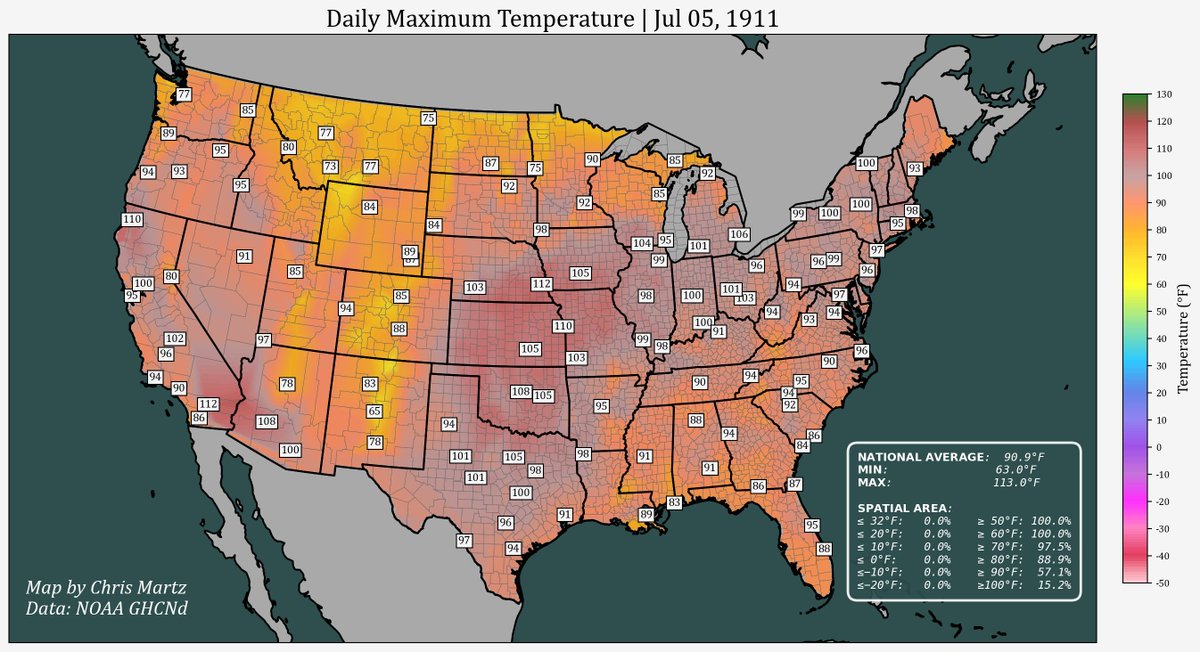
On this date in 1911, nearly 60% of the U.S. was ≥90°F and 15% was ≥100°F. This weekend's heatwave is only unprecedented if you think history began 30 years ago.
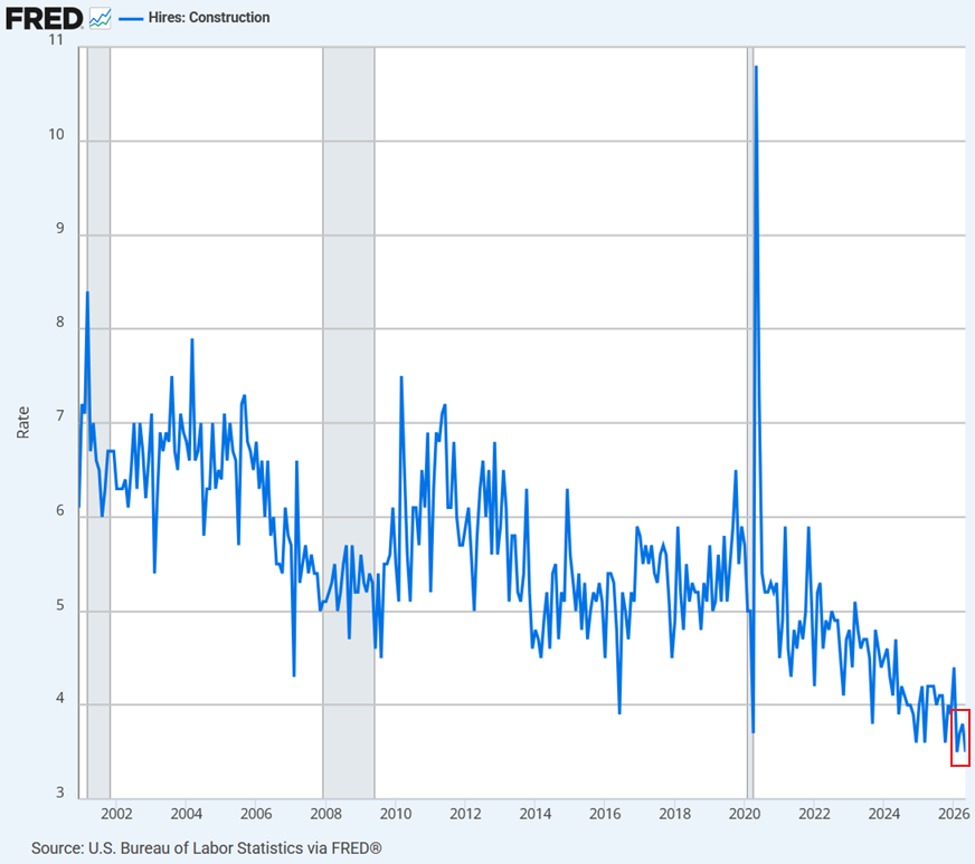
What is happening with the US construction sector?
The hiring rate in US construction fell -0.3 percentage points in May, to 3.5%, the lowest since data began in 2000.
Since January, this figure has declined -1.1 percentage points, extending its 4-year downtrend.
By comparison, the 2008 Financial Crisis and 2020 pandemic lows were 4.5% and 3.7%, respectively.
This comes as 295,000 new workers were hired in the construction sector in May, the 3rd-lowest monthly total since the 2020 pandemic.
Excluding 2020, this is the 3rd-lowest reading in 10 years.
US construction hiring is historically weak.
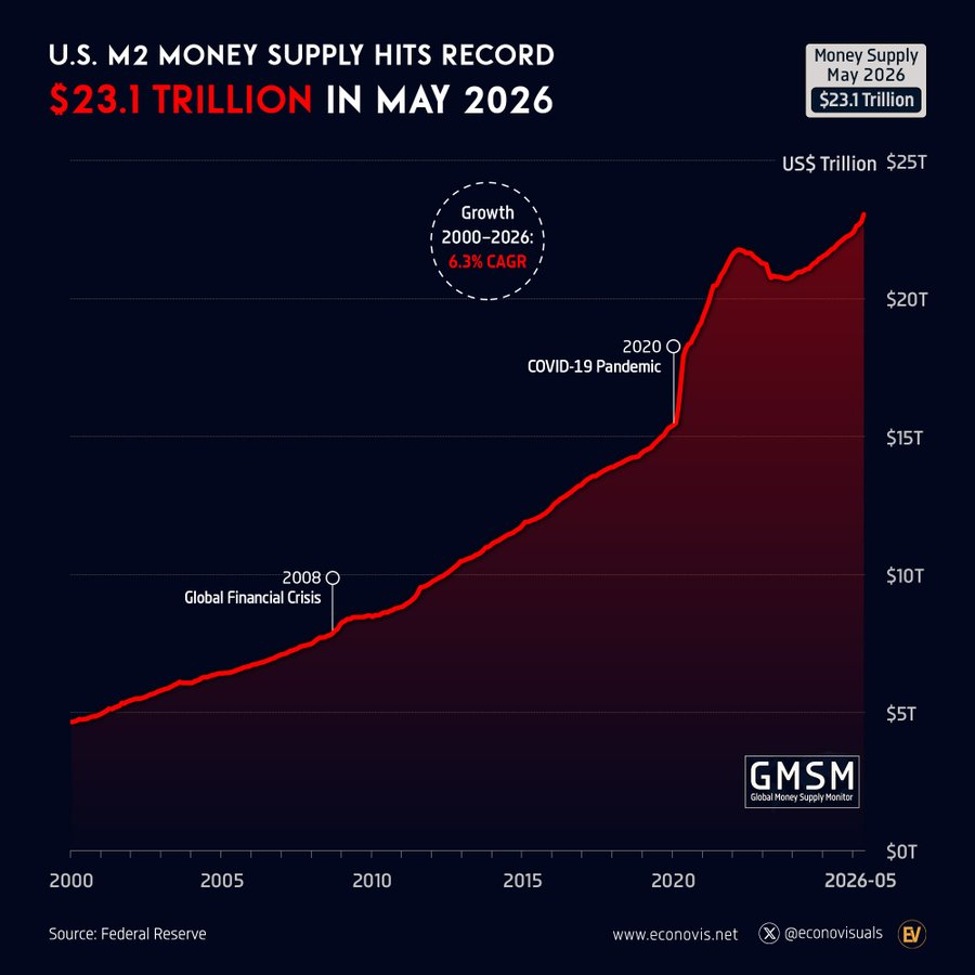
BREAKING: US M2 money supply surged +$247.8 billion in May, to a record $23.1 trillion.
This marks the largest monthly increase since May 2021.
Year-to-date, M2 has soared +$698.6 billion, the largest January to May increase in 5 years.
Money supply now stands $1.3 trillion above the March 2022 peak.
Since 2000, money in circulation has grown at an average annual rate of +6.3%.
US money creation is accelerating.
@Handre This is known as the Ricardo Effect, proposed by the economist David Ricardo. When wages rise, employers replace labor with capital intensive technology.
A minimum wage treats the symptom, not the cause. Print money, prices and wages rise.
Secular bull markets always end with a valuation reversal, either because they reach bubble levels unsupported by fundamentals (1929 and 2000) or because they get derated by inflation (1968). Whenever the current trend comes to an end (hopefully not anytime soon), it will likely be for one of those two reasons. Perhaps it will even be both, if the two tail risks manifest at the same time. But for now, valuations are supported by the fundamentals of margins and credit spreads, so let’s enjoy the ride while we can.